
Listen closely, retail participants frequently track aerospace share price fluctuations without evaluating the complex defense procurement cycles that dictate true valuation on Dalal Street. In real trading desks, we never chase aerospace counters based on rumors or speculative message board tips. Instead, we dissect order book backlogs, government indigenization mandates, and technical delivery volume before risking hard-earned capital.
Here is the real deal about the Indian defense and aerospace sector. Under the Make in India initiative, domestic manufacturers are capturing multi-year contracts from the Ministry of Defence. Because of this structural shift, companies involved in precision engineering and aircraft structures enjoy sustained revenue visibility.
Traders eager to master proper valuation methods should enroll in our structured Basics of Stock Market Course to distinguish between cyclical order flows and structural compounders. In addition, reading our authoritative Kaliyiri Share Market Book provides essential rules for trading volatile momentum names with discipline.
Aerospace Defense Manufacturing Architecture and Revenue Drivers
Let us keep it simple when breaking down how aerospace component manufacturers build their balance sheets. Most defense engineering firms operate across three distinct operational divisions. Each division carries unique working capital cycles, delivery timelines, and operating profit margins.

First, defense aerospace contracts form the bedrock of baseline operations. These agreements cover critical structural airframe components, precision hydraulic mounts, and missile sub-assemblies. While qualification cycles take years, successful delivery secures stable cash flows over decades.
Second, commercial aviation supply provides valuable geographic diversification. Indian precision engineering firms act as Tier-1 and Tier-2 suppliers to global aerospace giants like Boeing and Airbus. As global airline passenger traffic expands, recurring replacement part orders provide resilient export revenues.
Third, multi-year order book backlogs establish long-term visibility. In real trading desks, institutional analysts examine the order-to-bill ratio of any defense enterprise. When backlog exceeds three times annual sales, market participants happily assign rich valuation multiples to the stock.
Before entering any defense position, smart traders compute net take-home returns using our free Stock Profit Calculator to model transaction taxes and exit fees. Serious investors also monitor global risk sentiment on eMintage crypto tracking to evaluate cross-asset capital flows across emerging markets.
Dalal Street Delivery Volume Analysis Versus Day Trading Speculation
Understanding order flow on the National Stock Exchange requires separating genuine institutional delivery from superficial day trading volume. Small-cap defense stocks frequently experience high intraday turnover driven by retail momentum screeners. However, seasoned desk traders look specifically at end-of-day delivery percentages.
When an aerospace counter demonstrates delivery volume exceeding 60% of total daily traded quantity, it indicates that institutional accounts are locking shares into custody accounts. This accumulation removes floating supply from the secondary market, creating a natural supply vacuum. As available floating inventory shrinks, even modest retail buying pressure can spark sustained upward price expansions.
Conversely, when daily volume spikes dramatically but delivery percentage falls below 20%, it signals intense retail churn and speculative day trading. Desks treat such volume bursts with caution because speculative buyers rarely hold positions during overnight gap downs. Tracking delivery trends helps traders avoid getting trapped in false breakout traps.
Aerospace Share Price Technical Levels and Volume Structure
When analyzing price action on the BSE and NSE, technical chart structures reveal institutional handiwork. Big operators never accumulate shares in a single dramatic burst. Instead, they absorb floating supply inside tight base consolidation channels over several months.

No confusion exists about the 52-week high breakout ceiling. When a stock approaches historical peaks, retail participants who bought earlier look to exit near breakeven. Therefore, a decisive close above resistance requires daily trading volume at least two times higher than the 20-day moving average.
Between resistance and major support lies the accumulation pivot range. In this consolidation zone, price swings narrow and volume contracts significantly. Experienced chartists recognize this dry-up in volume as evidence that sellers are exhausted.
Finally, the 200-day moving average represents the long-term trendline anchor. Institutional funds and mutual fund managers regularly defend this moving average during broader market corrections. As long as weekly candles close above this line, the long-term bullish trend remains intact.
Traders calculating execution expenses can use our Indian Stock Brokerage Calculator to budget total charges accurately. Keeping friction costs low protects portfolio capital across choppy consolidation phases.
Defense Offset Realities and Subcontracting Cycles in India
A critical fundamental pillar supporting Indian aerospace suppliers is the national defense offset policy. Under existing defense acquisition guidelines, foreign defense contractors winning major Indian tenders must reinvest a substantial portion of the contract value back into domestic engineering industries. This regulatory mechanism directly channels billions of dollars toward private Tier-2 and Tier-3 precision component makers.
However, securing subcontracting work under defense offset programs requires stringent international certifications. Aerospace suppliers must pass rigorous aerospace standard accreditations, including AS9100 quality certifications and Nadcap special process approvals. These accreditations create a formidable moat that prevents unorganized engineering workshops from competing for defense contracts.
When evaluating aerospace companies, our desk verifies whether the enterprise maintains active vendor codes with domestic defense public sector undertakings like Hindustan Aeronautics Limited and Bharat Electronics Limited. Holding certified vendor registrations ensures steady workflow even during periods of global supply chain disruptions.
Aerospace Share Price Key Metrics and Comparative Desk Table
Institutional trading desks always compare core financial ratios against industrial averages before deploying capital. Below is our proprietary Dalal Street desk matrix outlining operational benchmarks for the aerospace defense sector.
Honestly speaking, numbers like EBITDA margin and order backlog separate genuine defense players from hype-driven operators. When an enterprise demonstrates rising return on capital employed alongside low debt, long-term wealth compounding naturally follows.
Defense Sector Risk Controls and Capital Allocation Rules
Trading high-beta defense and aerospace stocks requires strict capital defense protocols. Retail market participants often make the mistake of going all-in on aerospace counters after seeing positive headlines in news channels.
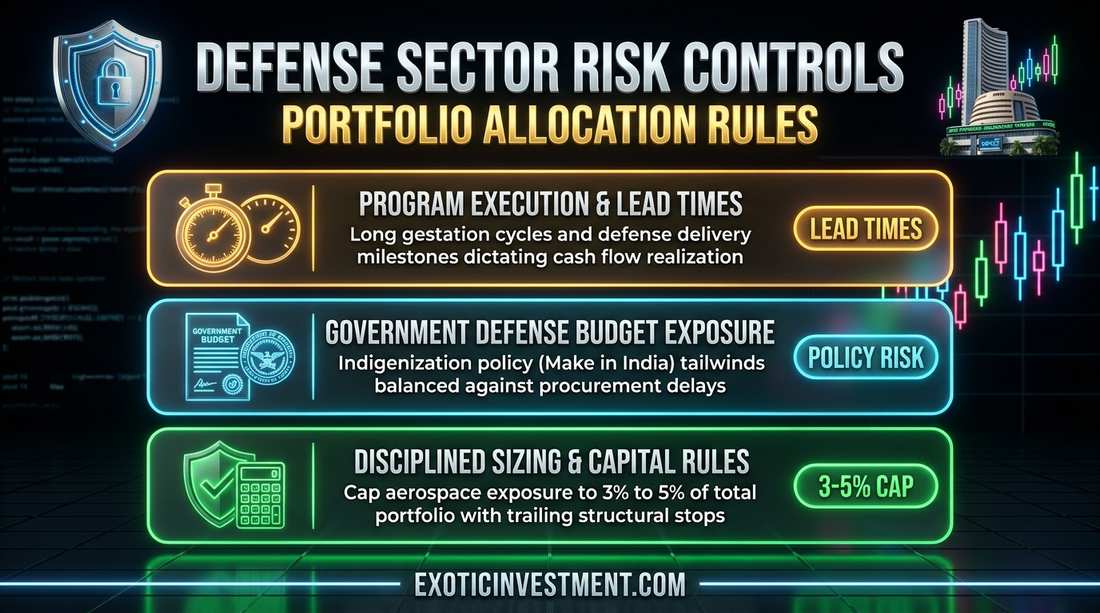
First, be mindful of extended program execution lead times. Defense contracts involve rigorous testing, environmental qualifications, and complex acceptance procedures. Consequently, unexpected delays in government approvals can push anticipated quarterly revenues into subsequent financial years.
Second, monitor government defense budget disbursement cycles closely. While budgetary allocations for defense modernization remain substantial, actual procurement milestones experience periodic administrative delays. Smart traders track quarterly cash conversion cycles rather than relying solely on headline order announcements.
Third, apply strict portfolio allocation boundaries. Never allocate more than 3% to 5% of total portfolio capital to a single small-cap or mid-cap defense counter. In addition, place structural trailing stop-losses below swing support levels to protect capital against sudden market downturns.
Step-by-Step Desk Blueprint for Trading Aerospace Counters
To execute trades with consistent discipline, our trading desk follows a clear four-step process. This structured framework eliminates emotional guesswork and ensures high risk-to-reward entries.
- Verify Order Book Authenticity: Always examine official exchange filings on NSE and BSE to confirm contract values, execution timelines, and client identities.
- Map Volume Breakout Levels: Identify historical resistance ceilings on daily and weekly charts. Only enter when price clears resistance on above-average volume.
- Calculate Exact Position Sizing: Determine share quantity based on the distance between entry price and the 200-day moving average. Never risk more than 1% of total account capital on a single trade.
- Enforce Trailing Profit Targets: Lock in partial profits when the stock rallies 15% to 20% from entry. Trail remaining shares using the 20-day exponential moving average as a dynamic floor.
Following this desk protocol prevents disastrous account blowups during sharp market pullbacks. Consistency in risk management is the single factor that separates seasoned market professionals from struggling amateurs.
Frequently Asked Questions About Aerospace Share Price
What drives the aerospace share price over the long term?
Long-term valuation is driven by order book execution, operating EBITDA margins, and sustained defense budget disbursements. As domestic indigenization policies expand, manufacturers with certified cleanrooms and precision tooling enjoy durable pricing power.
Is aerospace share price traded on both NSE and BSE?
Major Indian aerospace and defense engineering stocks trade on both the National Stock Exchange (NSE) and Bombay Stock Exchange (BSE). Always verify the correct exchange ticker symbol and monitor daily delivery volumes before initiating trading positions.
What are the primary risks when investing in defense aerospace stocks?
Key risks include program execution delays, raw material inflation in specialized titanium and alloys, and extended government procurement cycles. Practicing disciplined position sizing of 3% to 5% protects investor portfolios against unforeseen quarterly fluctuations.
How do circuit breaker limits protect retail investors in aerospace stocks?
Stock exchanges enforce daily circuit filter bands of 5%, 10%, or 20% to prevent excessive price manipulation. These limits curb sudden panic selling and give market participants time to evaluate material disclosures calmly.
How does the 200-day moving average help determine trade entries?
The 200-day moving average acts as a long-term structural institutional trendline. Buying pullbacks near an upward-sloping 200-DMA offers favorable risk-to-reward ratios compared to chasing overextended breakouts.