
Understanding what is stt in share market transactions is essential for every Indian equity and derivatives participant seeking to protect their net trading profits. Securities Transaction Tax (STT) is a direct federal tax collected at source on every purchase and sale of securities listed on recognized Indian stock exchanges. Following significant revisions in the Union Budget, understanding the exact rate hikes across equity futures and options contracts has become a non-negotiable requirement for capital preservation.
Every single trading day on the National Stock Exchange (NSE) and Bombay Stock Exchange (BSE), clearing corporations deduct this statutory levy automatically from your trade ledger. Because STT is charged directly on gross transaction turnover rather than net profit, uncalculated trading can quickly turn a winning trading session into a painful net loss. Therefore, disciplined Dalal Street participants calculate their tax obligations before entering live market orders.
What is STT in Share Market? Purpose and Legal Foundation
Securities Transaction Tax was introduced by the Government of India in the Union Budget of 2004 under Chapter VII of the Finance (No. 2) Act. Originally formulated to counter widespread capital gains tax evasion and curb unaccounted cash transactions in financial markets, STT established a clean electronic collection mechanism. As a result, the tax is gathered at source by the stock exchange matching engine and remitted straight to the central exchequer.
Before STT existed, many market participants evaded declaring short-term capital gains by failing to report cash market transactions accurately on their annual income tax filings. In response, the Finance Ministry replaced physical compliance scrutiny with an automated, unavoidable levy deducted at the exact instant a trade executes. Consequently, whether you trade through Zerodha, Upstox, Angel One, or Groww, STT appears prominently on your digital contract note.
However, many retail traders mistakenly confuse STT with broker commissions or Goods and Services Tax (GST). In reality, brokerage is a private service fee paid to your broker, while GST represents an 18% statutory consumption tax applied solely to that brokerage fee. In contrast, STT is a direct sovereign tax applied against the total traded turnover of your transaction.
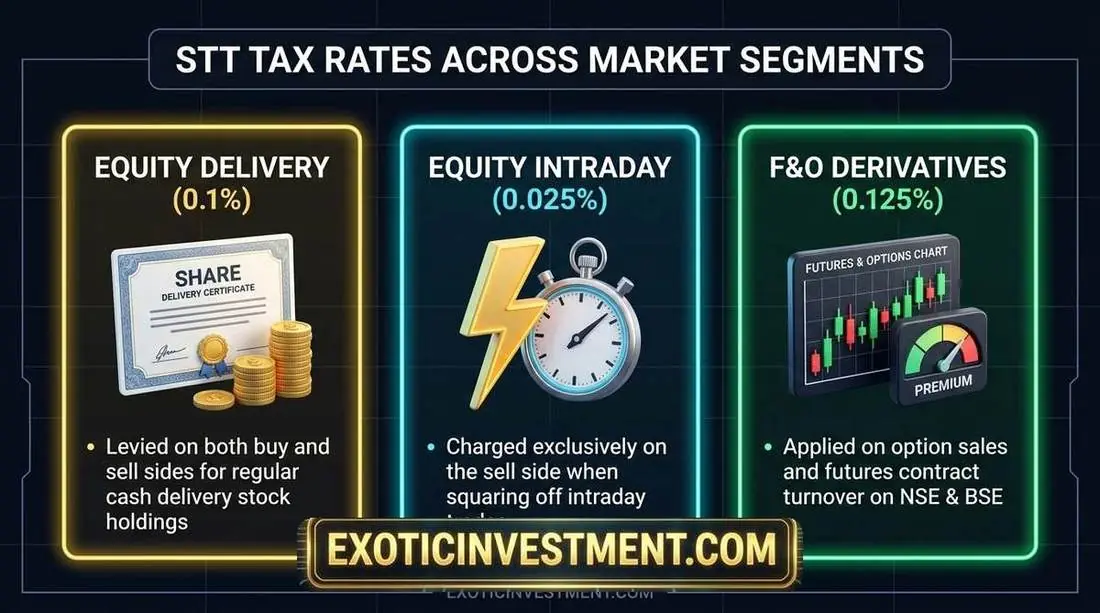
Illustration: Official Securities Transaction Tax Rates Across Indian Market Segments
Budget 2026 STT Rates Table Across Equity and Derivatives
The Union Budget introduced sharp statutory rate hikes specifically targeting the futures and options (F&O) segment to curb excessive speculative churning. Meanwhile, cash delivery and intraday equity rates were held stable to protect genuine long-term retail capital formation. Therefore, every trader must memorize this updated statutory rate schedule across all exchange segments:
| Market Segment | Buyer Side Rate | Seller Side Rate | Basis of Calculation | Budget Revisions |
|---|---|---|---|---|
| Equity Delivery | 0.1% | 0.1% | Total Traded Value (Both sides pay) | Unchanged |
| Equity Intraday | Nil | 0.025% | Sell Turnover Only | Unchanged |
| Equity Futures | Nil | 0.05% | Traded Contract Turnover | Hiked from 0.02% (150% Increase) |
| Options (Premium) | Nil | 0.15% | Option Premium Turnover | Hiked from 0.10% (50% Increase) |
| Options (Exercised) | 0.15% | Nil | Settlement / Intrinsic Value | Buyer pays on settlement |
| Mutual Funds (Equity) | Nil | 0.001% | Redemption / Selling Value | Unchanged |
Notice a very common misconception that trips up beginners on Dalal Street. Specifically, many retail investors mistakenly believe that delivery buyers pay zero STT.
In reality, both the buyer and the seller pay a full 0.1% on equity delivery trades. Therefore, you can compute the exact impact of these multi-tier levies on your net returns using our free Indian stock brokerage calculator.
Similarly, for intraday stock trades, buyers pay zero STT, while sellers pay 0.025% on the sell transaction value. Understanding this asymmetry allows active day traders to structure their stop-loss boundaries with mathematical precision. You can also evaluate your all-inclusive trade costs using our dedicated Zerodha brokerage calculator.
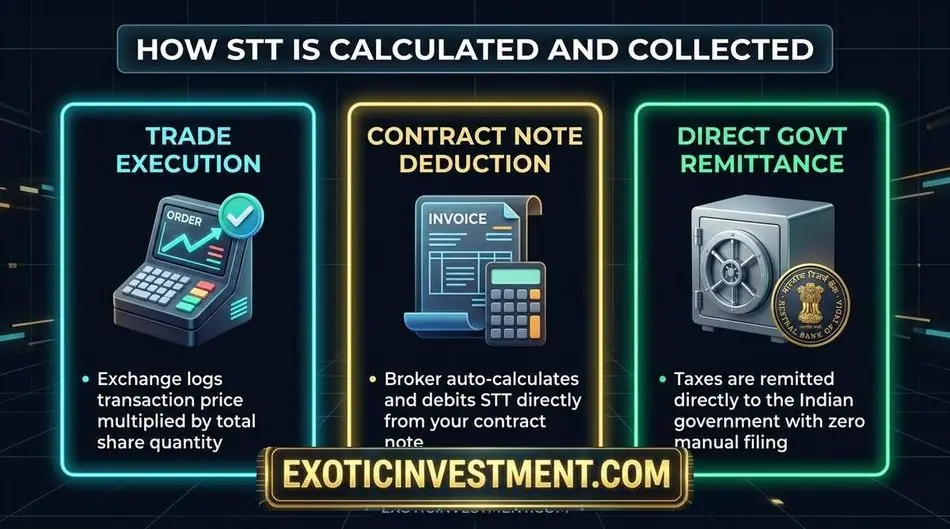
Illustration: Step-by-Step STT Calculation Across Equity Delivery, Intraday, and Derivatives
How STT is Calculated: Step-by-Step Numerical Examples
To grasp how STT functions on your daily contract notes, let us examine real-world calculations across four standard market setups. These examples reveal exactly how much money leaves your trading account on each round trip.
Example 1: Equity Delivery Trade (Both Sides Pay)
Suppose you purchase 100 shares of Reliance Industries at ₹2,500 per share and hold them for three weeks in your Demat account. Later, you sell all 100 shares at ₹2,800 per share. Here is the exact STT computation:
- Buy Leg: Turnover = 100 × ₹2,500 = ₹2,50,000. STT (0.1%) = ₹250.
- Sell Leg: Turnover = 100 × ₹2,800 = ₹2,80,000. STT (0.1%) = ₹280.
- Total STT Paid: ₹250 + ₹280 = ₹530.
In this case, you paid STT on both entry and exit. Thus, to verify how delivery settlements and clearing cycles operate under modern Indian exchange rules, review our complete guide on cash delivery and CNC trade execution.
Example 2: Equity Intraday Trade (Sell Side Only)
Now consider an intraday equity trade in Tata Motors. You buy 500 shares at ₹900 at 10:00 AM and square off the entire position at ₹915 at 2:30 PM on the same trading session:
- Buy Leg: Turnover = 500 × ₹900 = ₹4,50,000. STT = ₹0 (Nil).
- Sell Leg: Turnover = 500 × ₹915 = ₹4,57,500. STT (0.025%) = ₹114.38.
- Total STT Paid: ₹114.38.
Notice that your gross profit was ₹7,500, but STT immediately claimed ₹114.38 before brokerage and exchange transaction fees were applied. Consequently, you can calculate your net pocketed return after all exchange dues using our free stock profit calculator.
Example 3: Nifty Futures Trade (0.05% on Seller Side)
Following the statutory rate hikes, index futures carry higher transaction taxes. Suppose you short 2 lots of Nifty Futures (50 quantity) at 24,500 and buy them back at 24,300 to book a 200-point gain:
- Sell Leg (Entry): Turnover = 50 × 24,500 = ₹12,25,000. STT (0.05%) = ₹612.50.
- Buy Leg (Exit): Turnover = 50 × 24,300 = ₹12,15,000. STT = ₹0 (Nil).
- Total STT Paid: ₹612.50 (Up from ₹245 under the pre-budget 0.02% rate).
This 150% tax increase means futures scalpers must demand wider profit targets to overcome transactional friction. In addition, review our detailed guide on SEBI margin rules in India to understand the upfront capital required for futures positions.
Example 4: Nifty Options Premium Trade (0.15% on Seller Side)
Options trading carries a distinct tax mechanic because STT applies solely to the premium turnover rather than the underlying strike notional value. Suppose you sell 4 lots of Nifty Call options (100 quantity) at a premium of ₹180 per share:
- Sell Leg: Premium Turnover = 100 × ₹180 = ₹18,000. STT (0.15%) = ₹27.00.
- Buy Leg: Premium Turnover = 100 × ₹80 = ₹8,000. STT = ₹0 (Nil).
- Total STT Paid: ₹27.00 (Calculated purely on option premium value).
However, if an in-the-money option is allowed to expire and gets exercised physically, the buyer faces a massive 0.15% STT on the total intrinsic settlement value. Therefore, to understand how options pricing and time decay interact with transaction costs, explore our masterclass on option greeks in India.
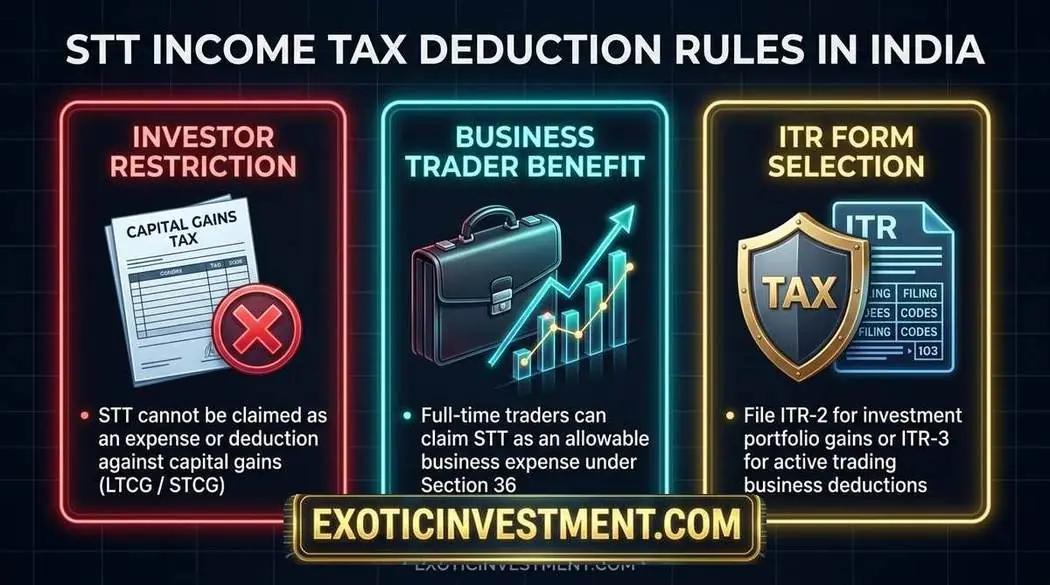
Illustration: Income Tax Treatment of STT: Business Expense vs Capital Gains
STT Income Tax Deduction Rules: Business Expense vs Capital Gains
How does STT interact with your annual income tax return (ITR)? The answer depends entirely on whether the Income Tax Department classifies you as an investor or as a professional business trader. In fact, understanding this distinction can save you lakhs of rupees in tax liabilities.
1. Investors (Capital Gains Framework): If you purchase shares for long-term wealth creation or swing trading, your profits are taxed as Capital Gains under Section 111A or Section 112A. Under Section 48 of the Income Tax Act, STT is strictly NOT deductible from your capital gains calculations.
Because of this rule, you cannot add STT to your cost of acquisition, nor can you deduct it from your sales proceeds. To understand how your net capital gains are computed after exemptions, read our complete guide on stock market profit taxation in India.
2. Traders (Business Income Framework): If you trade intraday equity or derivatives actively, your activity is legally classified as a business. Under Section 36(1)(xv) of the Income Tax Act, professional traders can claim STT as an allowable business expense against their trading revenue.
Consequently, this statutory deduction reduces your net taxable business income directly. Meanwhile, you can track your combined multi-asset portfolios and tax ledgers seamlessly using the eMintage portfolio tracker.
🚀 Master Wealth Architecture & System Trading
Stop losing capital to unexpected tax drag and emotional execution. Build professional capital allocation systems, master equity chart patterns, and trade derivatives with mechanical discipline. Enroll in our flagship MultiBagger Plus Courses & Pro Tools (Plan 5268) to access live market blueprints, automated calculators, and personal mentorship from Dr. Ashok Kumar N Rao.
How to Minimize STT Tax Drag on Dalal Street
An ancient Kannada proverb offers profound guidance on preserving wealth: “ಹನಿ ಹನಿ ಕೂಡಿದರೆ ಹಳ್ಳ, ಸೋರಿಕೆ ನಿಲ್ಲಿಸಿದರೆ ಬಂಗಾರ” (Hani hani koodidre halla, sorike nillisidre bangaara — small drops form a river, but stopping tiny leaks preserves pure gold). In stock market trading, STT and transactional slippage are the silent leaks that drain your compounding engine. Applying disciplined risk control plugs these leaks before they erode your trading capital.
First, reduce overtrading in high-frequency intraday setups. Because every single sell transaction triggers mandatory STT deductions, taking 15 small scalps a day multiplies your tax burden dramatically.
Instead, focus on high-probability swing setups where expected gains are substantially larger than transactional overhead. Thus, you can compute exact quantity thresholds using our free position size calculator.
Second, avoid letting in-the-money (ITM) options expire into physical settlement. If you hold an ITM long call or put option on expiry day, square it off in the open market prior to 3:30 PM. Doing so incurs STT solely on the option premium, avoiding the punishing 0.15% settlement tax levied on total contract value upon physical delivery.
Finally, begin with structured investor education before deploying trading capital into derivatives. Explore our in-depth foundational modules at the Basics of Stock Market Course, read our bestselling Kaliyiri Share Market Book, and access institutional market models through the MultiBagger Plus Annual Subscription.
💡 Frequently Asked Questions on Securities Transaction Tax
1. Do buyers pay STT on equity delivery trades in India?
Yes, absolutely. In fact, both buyers and sellers pay 0.1% STT on the total traded value of equity delivery shares on NSE and BSE. Therefore, you can verify the exact breakdown of charges on your contract note with our free Indian stock brokerage calculator.
2. Can I claim a refund on STT if my trade results in a financial loss?
No, certainly not. In reality, STT is a direct transaction tax levied on the gross volume of the transaction, completely independent of your profitability. Even if you book a substantial loss on a position, STT collected at the time of execution cannot be refunded or adjusted.
3. Why did the government increase STT on futures and options in Budget 2026?
The Finance Ministry and SEBI increased STT on futures to 0.05% and options premium to 0.15% to curb excessive speculative retail churning and promote disciplined capital allocation. As a result, you can review how these statutory shifts impact retail margin exposure in our guide on SEBI margin rules in India.
4. Is STT deductible as an expense when filing income tax returns?
It depends strictly on your tax classification. Specifically, if you file as a professional trader with business income under Section 44AD or normal business accounting, STT is fully deductible under Section 36. However, if you file as an investor under capital gains, STT cannot be deducted from your taxable gains under Section 48.
5. Does STT apply to commodity trading on MCX?
No, commodity derivative contracts traded on the Multi Commodity Exchange (MCX) do not attract STT. Instead, they are subject to Commodities Transaction Tax (CTT), which operates under its own distinct rate framework. Thus, review complete market rules in our guide on commodity trading in India for beginners.