
Listen, boss, if you are planning for retirement, pulling out steady monthly cash without destroying your lifetime savings is your biggest challenge. Consequently, many investors park everything in traditional bank deposits. But rising inflation and high income tax slabs quietly eat up your returns. This is where swp in mutual funds changes the entire game for wealth builders.
Here is the real deal: an SWP or Systematic Withdrawal Plan lets you redeem a fixed amount at scheduled monthly intervals from your folio. Meanwhile, your remaining balance continues compounding in market-linked assets. So, instead of handing your hard-earned money to an insurance company for a rigid annuity, you keep full control of your capital. Plus, understanding equity delivery rules and disciplined cashflow planning ensures your family stays financially independent.
What is SWP in Mutual Funds and How Does It Work?
In simple terms, an SWP acts as the reverse gear of a regular Systematic Investment Plan. First, during your earning years, you use a SIP calculator to plan monthly purchases and build wealth. But when you step into retirement, an SWP reverses the direction: the mutual fund house sells just enough units every month to credit your bank account with cash.
Honestly speaking, the math behind this process is brilliant. For instance, suppose you invest ₹1 Crore in a balanced hybrid fund earning 10% annual returns. So if you withdraw ₹50,000 every month, the remaining ₹94 Lakh stays invested. It continues compounding day after day. As a result, your remaining capital can grow over decades while funding your household expenses without interruption.
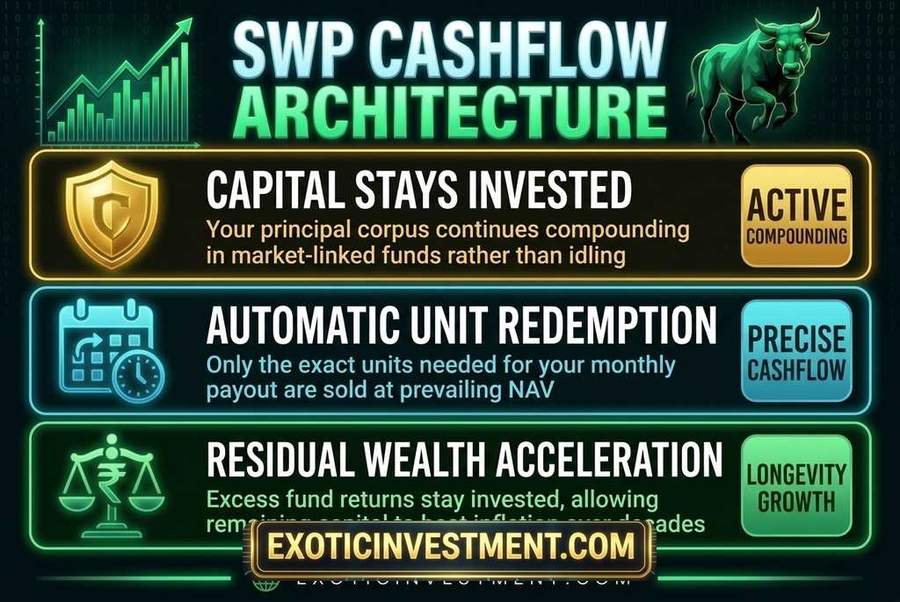
Illustration: SWP Cashflow Architecture and Compounding Residual Mechanics
Automatic Unit Redemption Mechanics
Now, let us examine what happens behind the scenes on redemption day. In reality, the fund manager does not sell arbitrary shares. Instead, the mutual fund software calculates the exact fraction of units matching your rupee payout based on the prevailing Net Asset Value (NAV).
For example, if your chosen monthly payout is ₹30,000 and the fund NAV is ₹100, the system redeems exactly 300 units. If the market dips and NAV drops to ₹75 next month, the AMC redeems 400 units. Conversely, when the market rallies to ₹150, the system redeems only 200 units. Therefore, this dynamic mechanism protects your principal during major bull runs.
Similarly, just as automated systems optimize crypto portfolio accumulation in a crypto DCA calculator, an SWP automates disciplined rupee distribution without emotional second-guessing.
Post-Budget 2024 Tax Advantage: Why SWP Beats Bank Fixed Deposits
Most Indian retirees still keep their life savings in bank fixed deposits because they feel safe. But look at the post-tax reality after the Finance Act 2024 changes. Specifically, in a bank FD, 100% of your earned interest gets taxed at your regular income tax slab. If you fall in the 30% tax bracket, you surrender nearly one-third of your retirement cashflow to taxes.
In contrast, swp in mutual funds offers a superior tax framework. When an AMC redeems your units, tax authorities apply the First-In, First-Out principle. In fact, that means each payout is divided into two parts: your original principal investment and your capital gain. Your principal return is 100% tax-free. Consequently, only the capital gain portion attracts taxation.
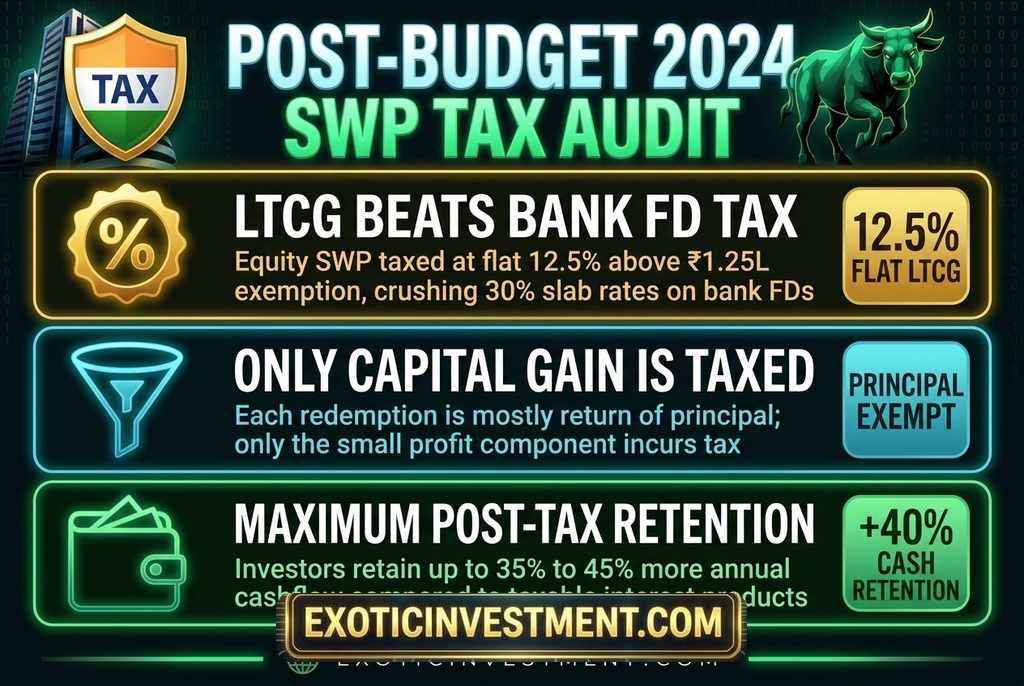
Illustration: Post-Budget 2024 Mutual Fund SWP Taxation vs Bank FD Slabs
The New Long-Term Capital Gains Framework
Under the revised rules, equity mutual fund units held for over 12 months qualify for Long-Term Capital Gains (LTCG) tax at a flat 12.5%. Also, best of all, you receive an annual tax exemption on profits up to ₹1.25 Lakh. You can track this easily using our capital gains tax calculator.
In the initial years of your SWP, capital gains form only a small fraction of each monthly installment. Consequently, your annual taxable gains often stay well below the ₹1.25 Lakh threshold. As a result, you enjoy practically zero tax liability on your monthly cashflow. To check your net earnings, run your figures through our stock profit calculator.
| Feature | Mutual Fund SWP | Bank Fixed Deposit (Monthly) | Senior Citizen Scheme (SCSS) |
|---|---|---|---|
| Capital Growth | Remaining corpus continues compounding | Zero capital growth | Zero (Fixed principal returned) |
| Tax on Payout | 12.5% LTCG strictly on profit part | Slab rate up to 30% on full interest | Slab rate on full payout |
| TDS Deductions | Zero TDS for resident Indians | 10% deducted at source | Deducted if interest exceeds ₹50,000 |
| Liquidity | Full liquidity within 2 business days | Premature withdrawal penalty applies | Lock-in with early exit penalty |
You can model your exact annual tax savings and withdrawal runway using our live SWP Calculator. It lets you simulate custom payout rates against historical market return cycles.
The Safe Withdrawal Rate Trinity Rule in India
In global financial planning, William Bengen established the famous 4% Safe Withdrawal Rate rule. Specifically, under this framework, withdrawing 4% of your starting wealth annually gives you a 95% chance of sustaining cashflow for 30 years without capital exhaustion.
However, in India, inflation runs higher at 5% to 7%, but long-term equity growth is also stronger. In fact, looking at historical index trends, Nifty has delivered an average 12% to 14% annual return. Therefore, Indian financial planners recommend an initial withdrawal rate of 5% to 6% per annum for hybrid portfolios. Also, if you have a lump sum ready, test your multi-year compounding curve with our lumpsum investment calculator.
So, on a ₹1 Crore retirement corpus, initiating an annual withdrawal of ₹6 Lakh translates to ₹50,000 monthly. Consequently, this keeps your cashflow predictable while allowing the underlying portfolio to beat inflation. To track your historical annualized performance, use our XIRR calculator.
The 3-Bucket Strategy: Shielding Against Market Volatility
In Kannada, remember “Nidhanave pradhana” (ನಿಧಾನವೇ ಪ್ರಧಾನ — patience and foresight are supreme). You cannot afford to panic during short-term market corrections in retirement.
One major worry for retirees is Sequence of Returns Risk. Specifically, if the stock market experiences a severe crash right after you start your SWP, withdrawing cash forces you to sell equity units at depressed prices. Therefore, to prevent this danger, professional money managers deploy the 3-Bucket Strategy.

Illustration: Institutional 3-Bucket Retirement Framework to Mitigate Sequence of Returns Risk
Bucket 1: The Liquid Cash Shield
First, allocate 1 to 2 years of living expenses into liquid mutual funds, arbitrage funds, or short-term bank deposits. In addition, your monthly SWP pulls money strictly from this liquid bucket. As a result, short-term market crashes never force you to sell equity assets at a loss. If unexpected market circuit freezes occur, our guide on upper and lower circuit limits explains how exchange halts operate.
Bucket 2: The Stable Hybrid Refill
Second, place 3 to 5 years of expenses into conservative hybrid funds, multi-asset funds, or corporate bond funds. Because of this, this bucket generates stable 8% to 10% returns with low volatility. When Bucket 1 runs low, you systematically transfer profits from Bucket 2 to refill your liquid reserves.
Bucket 3: The Equity Growth Engine
Finally, invest your remaining long-term wealth into flexi-cap, large-cap, or index funds. As a result, this equity component compounds over 7 to 10 years to beat inflation and grow your family legacy. You can model periodic balance adjustments using our portfolio rebalancing calculator.
Best Mutual Fund Categories for SWP Planning
Not every mutual fund scheme suits an SWP. In fact, picking high-risk thematic or small-cap funds for monthly withdrawals is a recipe for stress during market drawdowns. Here are the top fund categories for reliable payouts:
- Conservative Hybrid Funds: These schemes invest 75% to 90% in debt securities and 10% to 25% in equities. They provide high stability and steady cashflow for conservative retirees.
- Balanced Advantage Funds (Dynamic Asset Allocation): These funds dynamically adjust equity and debt levels between 30% and 80% based on market valuations. They automatically trim equity exposure near market peaks and buy during dips.
- Equity Savings Funds: By combining equities, debt instruments, and cash-futures arbitrage, these schemes offer low volatility with equity taxation perks.
- Large & Mid Cap Equity Funds: For investors with a 15-year horizon seeking wealth growth, top-tier diversified funds deliver strong compounding. You can explore high-conviction ideas via our multibagger stocks subscription.
How to Start an SWP: Step-by-Step Execution
Now, setting up an SWP takes only a few minutes online. Follow this direct step-by-step process:
Step 1: Build Your Starting Corpus: First, ensure your investment is parked in your chosen mutual fund scheme. If you are accumulating funds before retirement, boost your savings using a step up SIP calculator.
Step 2: Log In to Your Platform: Next, access your account through your broker portal or mutual fund AMC website. Leading discount platforms like Zerodha Coin and Groww offer seamless SWP setups. You can review your transaction fees with our Zerodha brokerage calculator.
Step 3: Select Folio and Set Parameters: Then, choose your fund folio, enter your fixed monthly withdrawal amount, and pick your preferred payout date. Most retirees prefer the 1st or 5th of each month for easy bill clearance.
Step 4: Confirm and Monitor: Finally, verify your bank mandate details and confirm the order. As a result, the fund house will automate your payouts every month. Review your portfolio balance annually to ensure your withdrawal rate remains within the safe 5% to 6% band.
Recommended Trading Courses & Premium Subscriptions:
- Options Buying Course in Kannada: Options Buying Course in Kannada.
- Technical Analysis in Kannada Course: Technical Analysis in Kannada Course.
- Kaliyiri Share Market Book: Kaliyiri Share Market Book.
- Basics of Stock Market Course: Basics of Stock Market Course.
- Multibagger Stocks Pro Subscription: MultiBagger Plus Courses & Pro Tools Annual Subscription.
💡 Frequently Asked Questions (FAQ)
1. Is SWP in mutual funds safe for senior citizen retirees?
Yes, an SWP is very safe when structured through conservative hybrid or balanced advantage funds. In addition, by keeping an initial 2-year cash buffer in liquid funds, you protect your family from stock market volatility. Test your personalized withdrawal horizon with our interactive SWP calculator.
2. Can my investment corpus last forever with an SWP?
In fact, if your annual withdrawal rate is lower than your portfolio’s net compounding rate, your principal capital can outlive you. For example, withdrawing 5% from a portfolio compounding at 11% allows your wealth to expand continuously. You can calculate long-term compounding milestones with our step up SIP calculator.
3. How is tax calculated on an SWP redemption?
Taxes apply strictly to the capital gains component of each redemption, not your principal return. Equity funds held over 12 months attract 12.5% LTCG on profits above ₹1.25 Lakh. You can evaluate your exact liability using our capital gains tax calculator.
4. Is an SWP better than mutual fund dividend options (IDCW)?
Yes, SWP is far superior. In contrast, mutual fund dividends are completely unpredictable and get taxed directly at your income tax slab rate. An SWP gives you guaranteed cashflow on your chosen date with low capital gains taxation. Learn core market structures in our basics of stock market course.
5. Can I modify, pause, or cancel my SWP at any time?
Absolutely. Also, you can change your monthly payout, pause withdrawals, or stop the SWP completely without exit penalties. Therefore, you retain complete ownership of your mutual fund units. For fundamental rules on personal wealth management, explore the Kaliyiri Share Market book.
6. What happens if the stock market crashes during my SWP?
By implementing our 3-Bucket Strategy, your monthly payouts come from liquid funds during bear markets, leaving your equity funds untouched until they recover. For complete risk management rules during corrections, review our stock market crash survival guide.