
Every bull market in equities makes investors feel invincible. Yet, financial history reminds us that sudden drawdowns are an inevitable reality of capital markets. To survive and thrive across market cycles, every retail investor must master the true stock market crash meaning and its underlying causes.
When stock tickers plunge and red numbers dominate exchange screens, panic can lead to devastating portfolio decisions. So, by studying foundational stock market terms, you can protect your capital with ease. In this detailed guide, we demystify market crashes, analyze famous historical Indian panics, and outline practical wealth defense rules.
👨🏫 Real Market Experience & SEBI Disclosure: Written by Dr.Ashok Kumar N Rao and the Exotic Investment research desk based on 12+ years of active market trading. All insights follow SEBI investor education guidelines. Exotic Investment does not provide unsolicited tips or PMS services. Always practice strict position sizing before taking live trades.
What Does Stock Market Crash Meaning Really Signify?
In simple terms, a stock market crash is a sudden, dramatic drop in share prices across an entire exchange. Typically, an index like the Nifty 50 or Sensex falls by 10% or more within days. Crashes occur when intense fear overtakes greed, prompting massive institutional and retail selling.
Therefore, a crash differs fundamentally from a routine market correction. A standard correction involves an orderly 5% pullback. In contrast, a crash creates widespread liquidity panic. Sellers overwhelm buyers in order books. Soon, stocks hit consecutive lower circuit limits.
Consequently, traders using modern stock broker apps in India witness widening bid-ask spreads and severe volatility. Knowing crash mechanics helps you stay calm. Meanwhile, unprepared participants sell in despair.

Crash anatomy: what causes a stock market crash in india through liquidity spirals and valuation contractions.
Stock Market Crash Meaning vs Corrections and Bear Markets
To evaluate market downturns objectively, you must distinguish between different phases of downward market moves:
First, a market pullback is a mild drop of 3% to 5% that occurs frequently within ongoing bull trends. These minor dips offer healthy opportunities for regular buyers to accumulate shares.
Second, a market correction represents a decline between 10% and 20% from recent peak levels. Corrections unfold over several months as bourses digest elevated valuations.
Third, a genuine stock market crash occurs with sudden violence. Benchmark indices crash by 10% or more in a matter of days. Panic selling triggers market circuit breakers that halt trading temporarily.
Finally, a prolonged bear market occurs when indices remain depressed by over 20% for extended periods exceeding six months. During bear markets, economic recessions and corporate earnings downgrades keep valuations subdued.
Primary Causes Behind a Stock Market Crash in India
Market crashes rarely happen due to a single isolated headline. Instead, they result from converging macroeconomic forces and speculative excesses:
1. Excessive Valuation Bubbles
First, equity prices sometimes rise far faster than earnings. As a result, valuations stretch to unsustainable highs. Unrealistic optimism creates an asset bubble that requires only a small shock to burst.
2. Foreign Institutional Liquidity Outflows
Second, foreign portfolio investors (FPIs) manage thousands of crores across Indian exchanges. When global central banks hike rates, foreign capital flees. Funds rush back to safe dollar yields. Sudden FII dumping dries up market liquidity quickly.
3. Margin Defaults and Broker Auto Square-Offs
Third, leveraged intraday positions amplify downward momentum. When shares drop sharply, brokers issue urgent margin calls. If traders fail to deposit cash, automated Risk Management Systems dump shares at market prices. This forced selling triggers further price drops, leaving over-leveraged traders trapped like a lame duck in stock market short squeezes.
4. Unexpected Geopolitical Shocks and Black Swan Events
Fourth, unforeseen global crises destabilize world trade. Pandemics, bank panics, and conflicts shake confidence. Fear spreads rapidly across international bourses, triggering synchronized sell-offs.
In fact, digital asset traders experience similar volatility cycles. For example, crypto participants measure realized losses and tax obligations using the crypto profit calculator on eMintage to benchmark risk against equity markets.
Famous Historical Stock Market Crashes in India
Studying past crashes provides valuable perspective on market resilience and eventual recovery:

Historical lessons: major stock market crashes in indian history from 1992 to 2020 and subsequent recoveries.
First, the 1992 Harshad Mehta Scam caused the Sensex to plunge by over 54%. Fake bank receipts and defaults exposed huge vulnerabilities. This crisis led to the statutory empowerment of SEBI.
Second, the 2008 crash caused a brutal 60% collapse in the Sensex. The index dropped from 21,000 to below 8,000 points. Indian equities suffered massive foreign institutional outflows as global banks collapsed.
Third, the March 2020 pandemic crash saw a violent 38% drop in just 25 trading sessions. Consecutive halts tested exchange circuit filters. Soon after, a historic multi-year bull run took the Nifty to record highs.
Understanding Exchange Circuit Breakers and Trading Halts
To prevent runaway market panics, Indian exchanges deploy automated circuit breaker mechanisms:
First, SEBI mandates index-level circuit filters at 10%, 15%, and 20% drops on the BSE Sensex or NSE Nifty 50. When an index triggers a 10% drop before 1:00 PM, trading halts completely for 45 minutes.
Second, if the index breaches the 15% threshold before 2:00 PM, markets shut down for an hour and 45 minutes. These mandatory cooling periods stop algorithmic panic selling and give institutional desks time to evaluate facts.
Third, if a 20% crash occurs at any time during market hours, the exchange closes trading for the entire remainder of that day. This ensures clearing houses can settle margin accounts without systemic banking failure.
Execution and Order Rules During Market Turmoil
Fast-moving market panics demand rigorous order entry discipline:
First, never enter market orders during panic hours. Wide spreads can fill orders at deep discounts. Instead, always place limit orders with a gfd order in share market setting to ensure your unexecuted orders cancel cleanly at 3:30 PM.
Second, understand that bear syndicates and market manipulators frequently engineer bear traps during panics. Learn key short selling terms in stock market trading desks to identify operator games.
Third, active order book scalpers practicing jobbing in stock market environments trade strictly with pre-defined stop loss orders to protect their intraday float.
Fourth, examine your transaction expenses. Review our detailed guide to brokerage charges in India, calculate exchange turnover taxes using our STT calculator, and calculate net trading returns with our stock profit calculator.
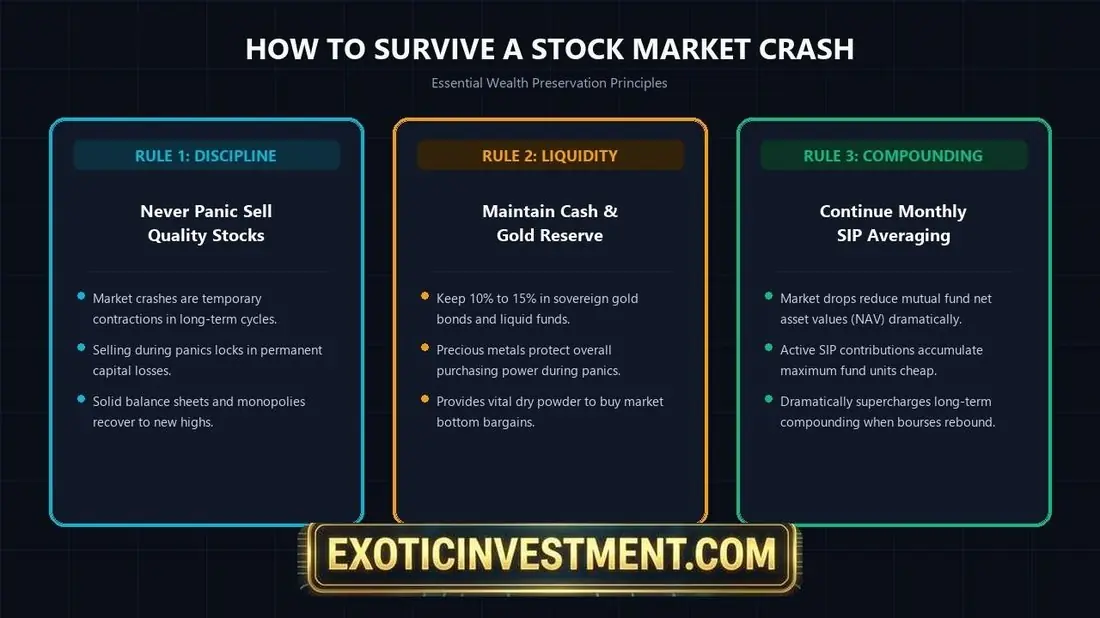
Survival blueprint: how to survive a stock market crash rules for long-term retail wealth preservation.
How to Survive a Stock Market Crash: Essential Rules
Surviving crashes requires mental fortitude and strategic positioning rather than emotional panic:
1. Never Panic Sell Quality Companies
First, selling fundamentally strong businesses during a panic turns temporary paper losses into permanent financial destruction. Market crashes are cyclical events, and dominant enterprises with pricing power invariably recover.
2. Hold a Dedicated Safe-Haven Reserve
Second, maintain an asset allocation shield. Study what happens if stock market crashes what happens to gold, and hold 10% to 15% in sovereign bullion or liquid funds to buy bottom bargains.
3. Keep Systematic Compounding Active
Third, continue your systematic investment plans without interruption. Crashes allow you to accumulate high volumes of mutual fund units at deeply discounted net asset values.
Building Wealth Beyond Market Volatility Cycles
While crashes generate scary headlines, disciplined long-term compounding consistently builds generational wealth.
For instance, maintain consistent equity investments through mutual funds. You can calculate your multi-year compounding targets using our free SIP calculator. You can also measure your portfolio’s annualized return with our CAGR calculator.
Similarly, when transitioning into retirement, you can establish stable monthly cash flows. Learn how systematic withdrawals work in our guide on SWP mutual funds in India, and schedule your payouts using our SWP calculator.
Additionally, look beyond domestic borders to diversify sovereign risk. Learn how to invest globally in our primer on how to invest in Japan stocks from India.
Also, deepen your market knowledge by studying primary share issues. Read our guide on who distributes the shares in India, and review accounting rules for discount on issue of shares to evaluate corporate balance sheets like a seasoned analyst.
Finally, for active traders seeking multi-day price momentum during market recovery waves, examine our complete blueprint for swing trading in India.
Recommended Trading Courses & Premium Subscriptions:
- Options Buying Course in Kannada: Options Buying Course in Kannada.
- Technical Analysis in Kannada Course: Technical Analysis in Kannada Course.
- Kaliyiri Share Market Book: Kaliyiri Share Market Book.
- Basics of Stock Market Course: Basics of Stock Market Course.
- Multibagger Stocks Pro Subscription: MultiBagger Plus Courses & Pro Tools Annual Subscription.
💡 Frequently Asked Questions (FAQ)
What is the difference between a stock market crash and a correction?
A correction is a routine price decline between 5% and 10% that unfolds over weeks. In contrast, a crash is a violent plunge exceeding 10% to 20% driven by panic selling and liquidity freezes.
How long does an Indian stock market crash usually last?
The acute crash phase typically lasts between several weeks and a few months. However, the subsequent economic recovery phase can take anywhere from six months to two years.
Should I stop my mutual fund SIPs during a market crash?
No, stopping SIPs during crashes is one of the worst mistakes an investor can make. Continuing your SIP allows you to accumulate maximum units at rock-bottom prices, supercharging long-term returns.
What triggers circuit breakers on the NSE and BSE?
Exchange circuit breakers halt trading when indices fall by 10%, 15%, or 20% to prevent unchecked panic selling and give market participants time to digest news.
What should beginners do when the stock market crashes?
Beginners should avoid panic selling, ensure they have sufficient emergency cash, maintain regular SIP contributions, and focus on buying fundamentally solid companies at discounted valuations.