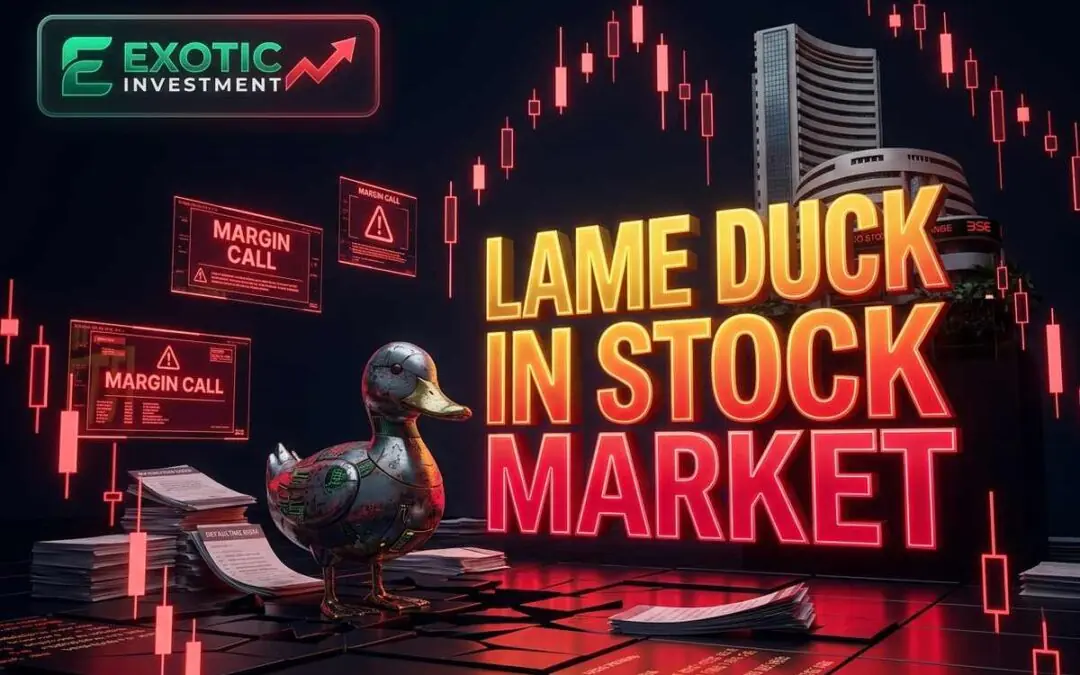
Navigating the stock market requires understanding both how money is made and how traders go broke. In financial history, few terms carry as much caution as a lame duck in stock market trading. Originally coined on the London Stock Exchange in the 1700s, the phrase described defaulting traders. It referred to someone who could not honor their debts. But while exchange technology has changed, the underlying risk of running out of money remains alive today.
In modern Indian markets, strict clearing corporation rules prevent systemic panics. However, retail traders who ignore risk rules can still blow up their accounts overnight. You must understand essential stock market terms so margin obligations never catch you unprepared. Now, let us examine what a lame duck is, how unexpected short squeezes wipe out traders, and how you can protect your hard-earned capital.
👨🏫 Real Market Experience & SEBI Disclosure: Written by Dr.Ashok Kumar N Rao and the Exotic Investment research desk based on 12+ years of active market trading. All insights follow SEBI investor education guidelines. Exotic Investment does not provide unsolicited tips or PMS services. Always maintain adequate cash margins and respect stop-loss rules before executing margin derivative trades.
What Does Lame Duck in Stock Market Mean?
In stock market terminology, a lame duck refers to an exchange member or speculator who cannot meet their financial obligations at settlement. Historically, short sellers hoped share prices would drop. When prices rose sharply instead, they faced massive pay-in deficits. If they failed to deliver the required shares or cash, the exchange declared them a defaulting lame duck.
In the old open-outcry trading rings, such traders literally waddled away in financial disgrace. Today, physical trading rings are gone. In their place, electronic platforms managed by NSE Clearing and BSE Clearing settle trades automatically. An aggressive speculator may take oversized short positions. If the market rallies violently, account equity can plunge below zero.
For cash delivery share trades, this risk is virtually zero. You pay 100 percent upfront for your shares. However, derivative and intraday margin traders face real liquidation hazards if price volatility gaps past their available account collateral.
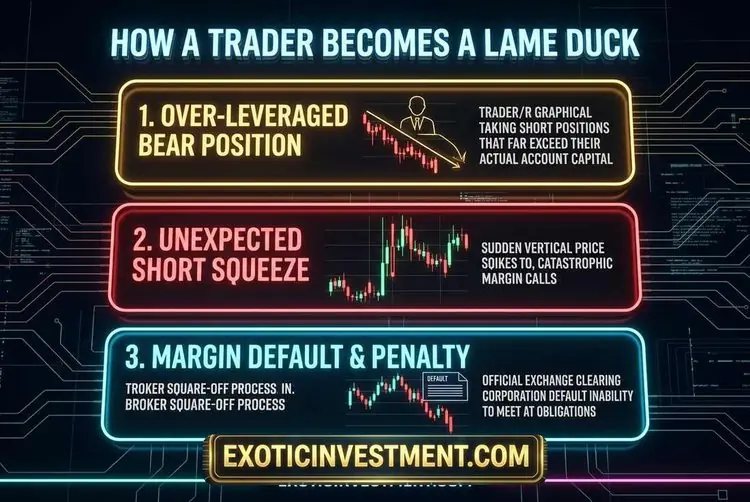
Interactive visual: how an aggressive trader gets trapped and becomes a defaulting lame duck.
How a Trader Becomes a Lame Duck: The Short Squeeze Trap
To understand how a modern trader turns into a lame duck, you must examine short selling. When you buy a stock, your downside is limited to your invested capital. Your upside is theoretically infinite. Short selling works differently. Your gain caps if the stock hits zero. But your potential loss is mathematically unlimited.
Here is the typical sequence that traps undisciplined market participants:
- Heavy Naked Short Positioning: A speculator spots a fundamentally weak company and sells large volumes of futures or call options. They bet that bad earnings will trigger an immediate crash.
- The Sudden Catalyst: Unexpected good news arrives, such as a major institutional buyout, government subsidy, or sudden block deal.
- The Violent Short Squeeze: Buyers flood the order book. As prices shoot upwards, short sellers rush to buy back shares to limit losses. This panic buying fuels an even steeper price surge.
- The Margin Call Deficit: The broker’s risk system demands immediate cash top-ups. If the trader cannot deposit fresh margin by the morning deadline, the broker liquidates their entire account.
Today, modern stock broker apps in India use automated RMS controls. These systems close out trades before accounts go negative. But in fast-moving circuit stocks or overnight weekend gaps, negative balances can still occur.
Lame Duck vs Bear, Bull, and Stag: Key Market Animal Analogies
Financial history uses vivid animal metaphors to describe distinct market behaviors. Comparing these terms helps you understand where a lame duck fits in market psychology:
- The Bull: An optimistic market participant who buys equities expecting rising prices and economic expansion.
- The Bear: A cautious or pessimistic trader who sells assets expecting economic downturns and falling valuations.
- The Stag: An opportunistic short-term player who applies for IPO allotments solely to pocket rapid listing gains on debut day.
- The Lame Duck: A bear who guessed wrong, got trapped in an upward squeeze, and ended up completely unable to pay their settlement dues.
Every transaction attracts exchange levies, STT, and broker fees. Therefore, check our detailed guide to brokerage charges in India. You will see how transaction costs eat into trading capital.
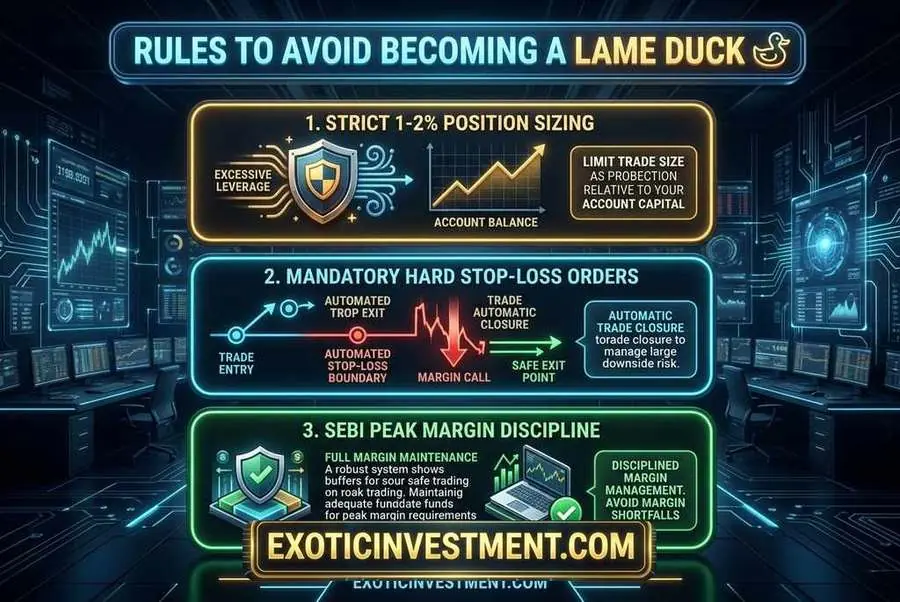
Essential risk management rules: how professional traders protect their accounts from catastrophic defaults.
Modern Risk Controls: How to Avoid Becoming a Lame Duck
Becoming a profitable trader is not about never making mistakes. It is about keeping your losing trades so small that you never face existential ruin. Here are the core risk rules every Indian trader must follow:
1. Respect the 1-2% Account Risk Rule
First, never risk more than 1 to 2 percent of your total account equity on any single trade setup. For example, suppose your trading account holds Rs 5,00,000. Your loss on a single setup must never exceed Rs 5,000 to Rs 10,000. Calculate your exact share size before placing orders, rather than buying arbitrary round lots.
2. Always Use Hard Stop-Loss Orders
Second, never rely on mental stop losses. When markets move rapidly against you, emotional paralysis makes it hard to press the sell button manually. Always enter a system stop-loss order at the moment you enter the trade. You can practice disciplined swing setups by reviewing our guide on swing trading in India.
3. Verify Net Trade Outcomes
Third, calculate prospective trade payoffs and tax liabilities before risking live funds. Use our stock profit calculator to model profit targets. Also, verify statutory government taxes using our STT calculator. Do you trade digital assets alongside equities? Check your post-tax returns using the crypto profit calculator on eMintage to compare your portfolio returns.
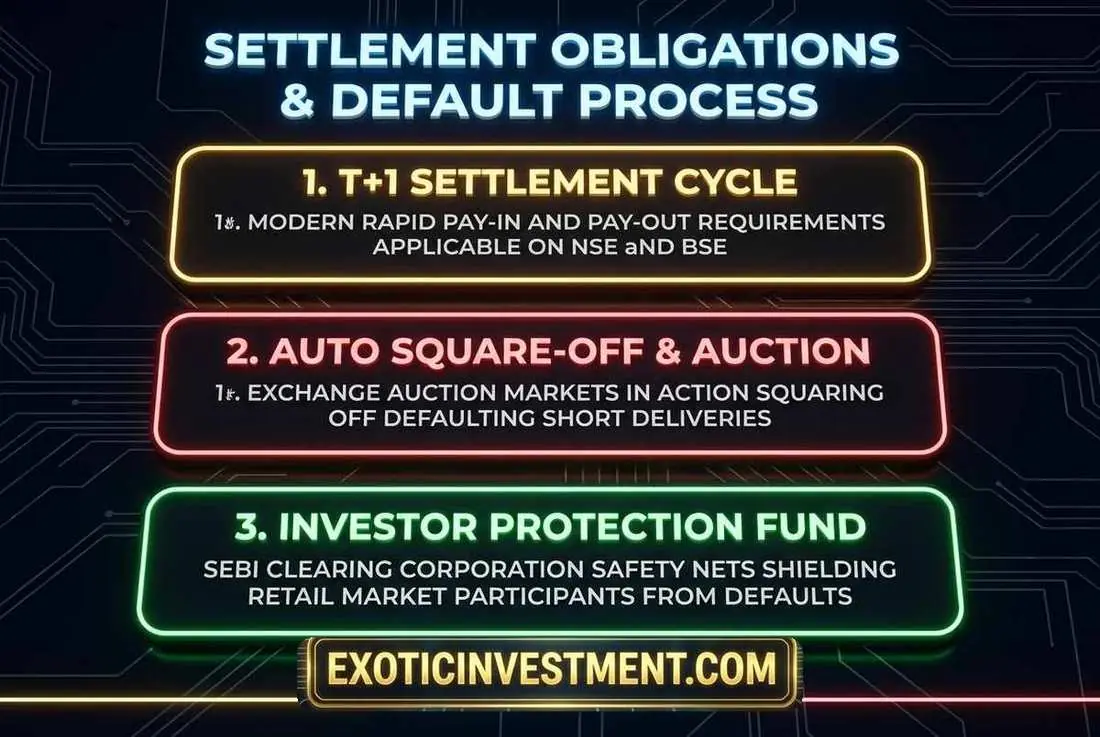
Settlement architecture: how SEBI and clearing corporations handle defaulting broker accounts in India.
Exchange Settlement Cycles and SEBI Safety Mechanisms
In the modern Indian equity framework, the term lame duck rarely applies to retail investors defaulting directly to the exchange. This is because SEBI has built ironclad safety layers to protect the market ecosystem:
- The T+1 Settlement Cycle: Indian bourses operate on the world’s fastest settlement timeline. Both delivery shares and funds settle within 24 hours of trade execution, sharply reducing settlement risk.
- Peak Margin Regulations: SEBI mandates 100 percent upfront margin collection for intraday and derivative trades. Brokers can no longer grant unchecked 20x or 50x intraday margin borrowing that used to fuel client defaults.
- Auction Markets for Short Deliveries: Suppose a seller fails to deliver shares on settlement day. The clearing corporation automatically purchases shares in an auction market. Then, it penalizes the defaulting trader.
- The Investor Protection Fund (IPF): If a registered brokerage firm goes bankrupt, the exchange IPF reimburses eligible retail client claims up to specified statutory caps.
Also, if you participate in primary market listings, learn who distributes shares during IPO book-building. In addition, study corporate equity rules for discount on issue of shares to understand corporate balance sheets thoroughly.
Building Resilient Wealth Beyond Risky Margin Speculation
Speculative trading should only form a small slice of your overall wealth engine. Real financial security comes from long-term compounding across asset classes.
For example, you can build systematic wealth by investing regularly in mutual funds. You can model your multi-year compounding milestones with our SIP calculator and CAGR calculator. As your capital expands, generate passive monthly cash flows. Review our guide on SWP mutual fund rules. Then, test monthly withdrawals with our SWP calculator.
Also, if you want geographical diversification outside Indian equities, explore our international guide on how to invest in Japan stocks from India. Diversifying across independent economies prevents single-market shocks from damaging your family’s future.
Recommended Trading Courses & Premium Subscriptions:
- Options Buying Course in Kannada: Options Buying Course in Kannada.
- Technical Analysis in Kannada Course: Technical Analysis in Kannada Course.
- Kaliyiri Share Market Book: Kaliyiri Share Market Book.
- Basics of Stock Market Course: Basics of Stock Market Course.
- Multibagger Stocks Pro Subscription: MultiBagger Plus Courses & Pro Tools Annual Subscription.
💡 Frequently Asked Questions (FAQ)
What is the origin of the term lame duck in stock market history?
The term originated on the London Stock Exchange in the 1700s. It described traders who defaulted on their settlement debts and had to literally waddle away from the exchange building in disgrace.
Can a retail trader become a lame duck in modern Indian stock markets?
Yes, unexpected gap openings can still wipe out accounts. If a naked short position moves against you overnight, losses can exceed your account balance.
What happens if I cannot pay my margin call to my broker?
If you fail to meet a margin call, your broker’s automated risk system will forcibly square off your open positions. In addition, the broker may levy penal interest on any outstanding debit balance.
How does a short squeeze trigger a lame duck scenario?
Short sellers face sudden price surges. They must buy back shares rapidly to exit. This panic buying drives prices even higher, causing severe margin defaults.
Is cash delivery trading safe from becoming a lame duck?
Yes, cash delivery trading is completely immune from default risk. Because you pay 100 percent upfront for your shares, you can never owe money or face margin liquidation from your broker.