
When you start reading company balance sheets, you might wonder how companies record shares issued below nominal value. Understanding discount on issue of shares in balance sheet statements helps investors evaluate corporate solvency and legal compliance. First, before evaluating complex financial statements, smart investors study basic stock market terms to see how market quotes compare against face value.
What is Discount on Issue of Shares in Balance Sheet Accounting?
Every equity share comes with a nominal or face value fixed by company charter. Usually, that face value is ten rupees or one hundred rupees per share. When a company issues shares below nominal price, that discount creates a capital loss. So, accountants record that shortfall as a discount on issue of shares in balance sheet accounts.
For example, suppose a firm issues a ten-rupee face value share for eight rupees. In this case, the company receives eight rupees in bank cash. The missing two rupees represents the discount. Therefore, the company cannot simply ignore that gap in equity accounting.
Also, when estimating your net cash payout on equity trades, always check your numbers beforehand. You can use our free stock profit calculator to model realistic trading returns accurately.
Historically, under the Indian Companies Act 1956, companies could issue discounted shares under strict conditions. However, the legal environment changed dramatically with the Companies Act 2013. Today, Section 53 strictly prohibits ordinary discount issues. Now, let us examine how accountants treat historical balances and valid statutory exceptions.
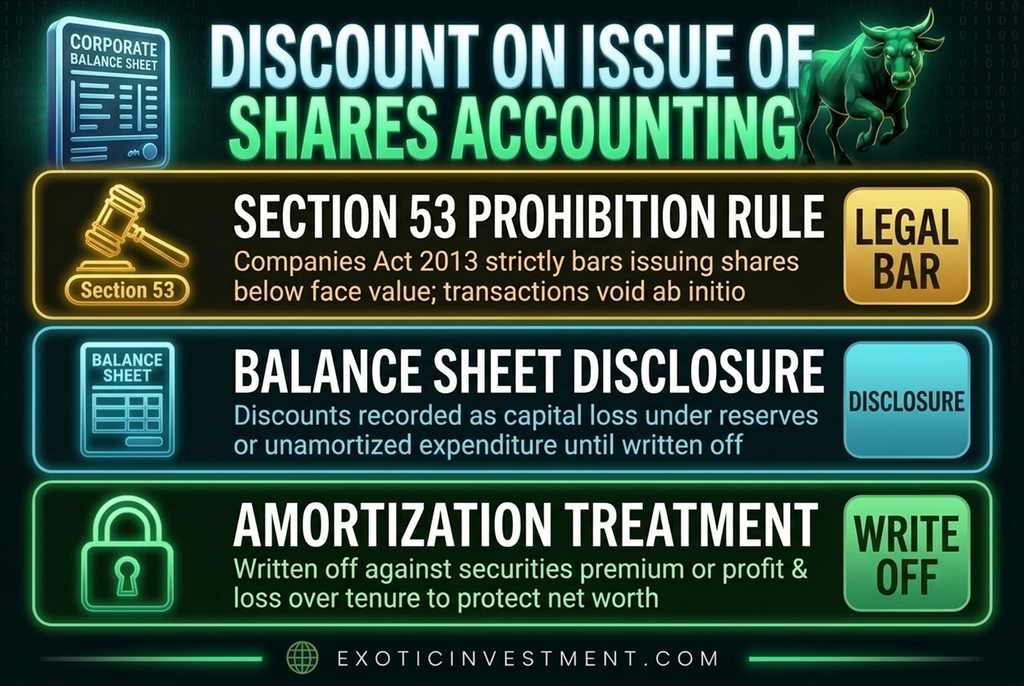
Illustration: Double-entry bookkeeping steps for recording discount on issue of shares in corporate balance sheets.
Section 53 Companies Act Rules on Share Discounts
Section 53 of the Companies Act 2013 sets clear legal boundaries for Indian corporations. In fact, Section 53 makes any issue of shares at a discount completely void. That means an Indian company cannot sell equity below face value during public offerings or rights issues.
Why did Indian lawmakers enact such a strict ban? First, issuing discounted shares dilutes capital protection for corporate creditors. Second, predatory promoters historically used discount allotments to enrich insiders at the expense of retail shareholders. Therefore, modern corporate law bans this practice to preserve retail capital.
So, what happens if a company breaks Section 53 rules? As a result, severe penalties follow immediately. First, the company faces heavy monetary fines. Second, defaulting officers risk imprisonment. In addition, the firm must refund all received funds to subscribers along with twelve percent annual interest.
Plus, whenever companies adjust equity or capital structures, retail investors must plan for taxation. You can easily estimate capital taxes with our stock market tax calculator before executing long-term portfolio changes.
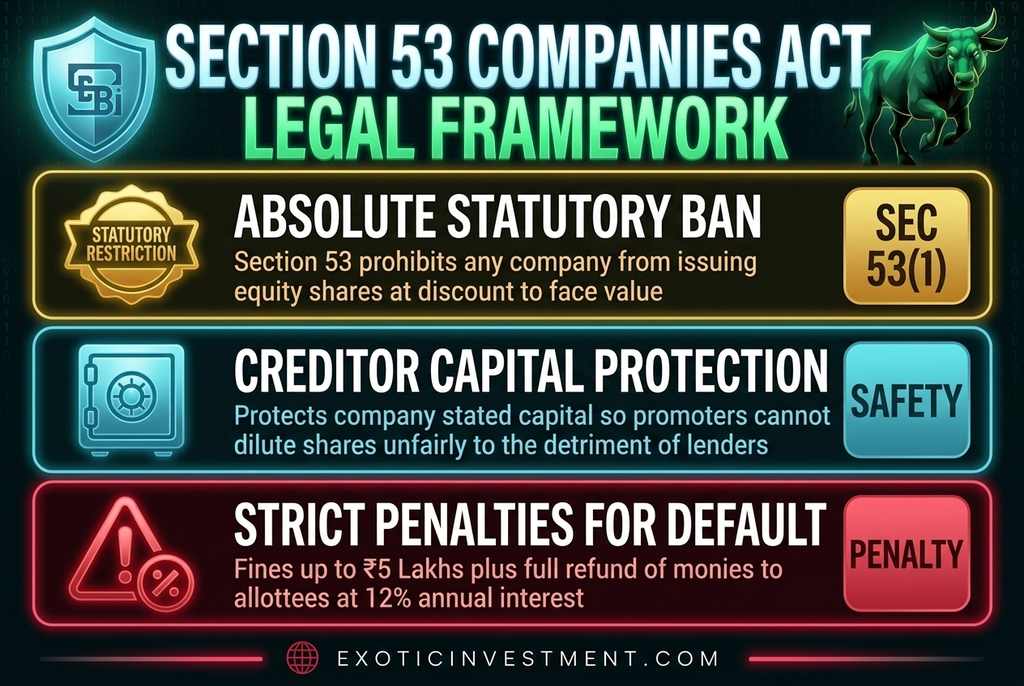
Illustration: Statutory prohibitions and legal penalties under Section 53 of the Companies Act.
Where Does Discount on Issue of Shares in Balance Sheet Appear?
When legal discount balances exist on older records or allowed exceptions, accounting disclosure rules apply. In traditional balance sheet presentations, unamortized share discounts were shown on the asset side under “Miscellaneous Expenditure”.
However, under modern Schedule III of the Companies Act 2013 and Indian Accounting Standards (Ind AS), formatting changed. Consequently, fictitious assets no longer sit on the asset side. Instead, unamortized discounts are deducted directly from Reserves and Surplus on the equity and liabilities side.
Also, companies write off this discount against available Securities Premium Account balances. If securities premium is insufficient, then the firm amortizes the loss against general reserves or current profits over three to five years. In fact, smart investors analyze company valuations using our PE ratio calculator to ensure underlying share value supports book reserves.
In addition, when planning long-term equity growth, tracking steady annual compounding is essential. You can project your targeted portfolio returns with our free reverse CAGR calculator.
Permitted Exceptions: Sweat Equity Shares and Debt Restructuring
Is every discount issue forbidden in India? No, the law grants two notable statutory exceptions where discounted shares remain completely valid.
First, consider Sweat Equity Shares governed by Section 54 of the Companies Act. A company may issue sweat equity shares to its directors or permanent employees at a discount or for non-cash consideration. Specifically, this reward honors extraordinary technical know-how or intellectual property contributions.
Second, consider debt restructuring under Reserve Bank of India (RBI) guidelines and the Insolvency and Bankruptcy Code (IBC). In fact, under Section 53(2A), distressed companies can convert defaulted bank debt into equity shares at a discount. So, this legal mechanism helps struggling firms survive debt crises without liquidating their plants.
Now, before participating in turnaround opportunities, always verify how trades settle. You can learn the practical differences between intraday and investment holdings in our guide on delivery share trades.

Illustration: Permitted legal exceptions for issuing shares at a discount including sweat equity and debt restructuring.
Journal Entries for Recording Share Issue at Discount
Now, let us review the exact journal entries required when accounting for permitted share discounts. First, accountants record the discount during the allotment stage of share capital.
Then, when application money arrives, the bank account is debited and share application account is credited. Next comes the allotment stage where the discount is formally recognized. For instance, here is the standard double-entry bookkeeping entry:
Share Allotment Account Dr. (Amount due from shareholders excluding discount)
Discount on Issue of Shares Account Dr. (Total discount value as capital loss)
To Share Capital Account Cr. (Total nominal face value of allotted shares)
Finally, accountants write off this discount account against available capital reserves. That means the journal entry debits Securities Premium Account and credits Discount on Issue of Shares Account.
Also, when evaluating borrowed capital or funded broker credit in corporate stocks, caution is vital. You can learn how funded accounts function in our guide on the margin trading facility.
Why Understanding Share Discounts Protects Retail Investors
Many beginner investors confuse secondary market price drops with corporate discount issues. However, when a stock trades below face value on NSE or BSE, that represents secondary market price action. In contrast, secondary trading does not affect the company’s issued share capital balance.
Now, if a private company offers you newly minted shares below face value, beware. In fact, that transaction violates Section 53 and holds zero legal standing in court. Therefore, you could lose your entire investment without legal recourse.
Always review whether transactions involve secondary exchange delivery or primary market capital changes. First, protect your capital allocation on every setup by using our position size calculator. Also, learn how exchange price protections guard retail investors by checking our tutorial on upper and lower circuit limits.
Recommended Trading Courses & Premium Subscriptions:
- Options Buying Course in Kannada: Options Buying Course in Kannada.
- Technical Analysis in Kannada Course: Technical Analysis in Kannada Course.
- Kaliyiri Share Market Book: Kaliyiri Share Market Book.
- Basics of Stock Market Course: Basics of Stock Market Course.
- Multibagger Stocks Pro Subscription: Multibagger Stocks Annual Subscription.
Real Market Case Studies: Debt Restructuring and Equity Write-Offs
On our trading desk, we frequently audit corporate turnarounds involving debt-to-equity conversions. For example, in recent years, several debt-laden infrastructure firms negotiated restructuring packages with state banks. Consequently, creditor banks agreed to accept equity shares below prevailing face value under RBI supervision.
When analyzing these balance sheets, investors must verify where the accounting entries settle. First, a massive discount issue increases share count while providing minimal fresh liquidity. As a result, existing equity holders face severe earnings dilution.
Next, investors can simulate multi-year capital compounding using our free lumpsum investment calculator. Also, if you trade actively through discount brokers, calculate your exact turnover fees with our brokerage calculator.
Step-by-Step Balance Sheet Checklist for Smart Investors
Here is how you can evaluate share capital notes on company balance sheets in three simple steps. First, inspect Note 1 of the balance sheet where the company lists authorized and issued share capital. Also, verify whether any shares carry special terms or restricted rights.
Second, inspect Reserves and Surplus in Note 2. Then, verify if any past discount amortization appears under general reserves or securities premium accounts. If you see repeated write-offs, investigate why capital got diluted.
Third, verify the company cash flow statement. Because cash inflows from financing must match actual receipts, any discrepancy signals hidden discounts. Plus, before applying for new listings, check unlisted market trends using our guide on grey market premium.
Frequently Asked Questions on Discount on Issue of Shares
Can an Indian company issue shares at a discount today?
No, Section 53 of the Companies Act 2013 completely bans issuing shares at a discount for normal public or rights offerings. However, the only legal exceptions are sweat equity shares under Section 54 and debt conversion under RBI restructuring schemes. Therefore, before investing in shares, check your budget with our SIP return calculator.
Where does discount on issue of shares appear under modern Schedule III?
Under modern Schedule III and Ind AS, the unamortized discount does not sit under fictitious assets. Instead, it is deducted from Reserves and Surplus or written off against Securities Premium. Also, to understand how small enterprise listings handle capital, read our guide on how to sell SME IPO shares.
What is the penalty for issuing shares at a discount illegally?
If a company violates Section 53, then it faces fines between one lakh and five lakh rupees. In addition, every defaulting officer faces fines and possible imprisonment, and the company must refund all capital with 12% annual interest. So, learn more about depository rules in our guide on demat account terms.
How does secondary market trading at a discount differ from primary issue?
Secondary market trading occurs between existing investors on stock exchanges like NSE and BSE. In contrast, if a stock drops below face value on exchange screens, the company’s balance sheet equity remains unchanged. That means you can explore early-stage shares safely through our guide on how to invest in pre-IPO shares.
What are the tax implications of sweat equity shares issued at a discount?
For recipient employees, the discount on sweat equity shares is taxed as a perquisite under income from salary. Later, when the employee sells those shares, capital gains tax applies on the profit. Finally, to compare systematic investment strategies across asset classes, try the eMintage Crypto DCA Calculator for disciplined long-term planning.