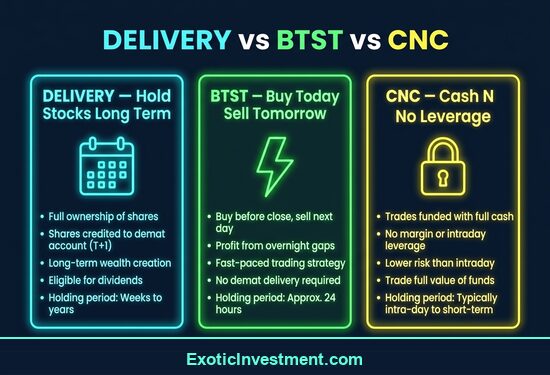
When beginners step into Dalal Street, they constantly ask: what is delivery in share market trading, and how does CNC or BTST work? Whether you are checking live LTP, CMP, and ATP stock price terms or placing a fresh CNC buy order, understanding how share delivery works is essential. Good news — this guide clears all of that up in plain, conversational language. By the end, you will understand exactly how share delivery works, how your Demat account receives shares, and how to avoid costly settlement traps.
What Is Delivery in Share Market? The Plain English Answer
Listen, boss, here is the simplest explanation. In equity trading, delivery means buying shares and holding them for more than one trading day. Unlike intraday trading where you square off your position before 3:15 PM on the same day, a delivery trade gives you actual legal ownership of the company’s shares.
When you place a delivery order, your broker debits purchase funds from your account and transfers the purchased shares directly into your Demat account (managed by NSDL or CDSL). So once shares sit in your Demat account, you own them completely. You can hold them for weeks, months, or decades while collecting dividend income, bonus share allotments, and long-term capital gains. If you are just starting out, taking our Basics of Stock Market Course helps you master fundamental concepts before buying your first delivery share.
So why do traders call it “equity delivery”? Because the physical paper share certificates of the past have been digitized. Today, the clearing corporation delivers digital shares into your electronic Demat holding on the settlement day.
How Delivery Trading Works: The T+1 Settlement Cycle
India became one of the first major global stock markets to adopt the fast T+1 settlement cycle. But what does T+1 actually mean for you as an investor in delivery trading?
Here is how the timeline unfolds step by step. Suppose you buy 100 shares of Reliance Industries on Monday morning at 10:00 AM (Day T). Your broker blocks the purchase funds immediately. On Monday night, the stock exchange clearing corporation processes the trade clearing. On Tuesday evening (Day T+1), the clearing corporation delivers the 100 shares directly into your Demat account.
So by Tuesday night, you can see the shares credited in your CDSL or NSDL holdings statement. That means India’s T+1 cycle gives you full legal ownership within 24 hours of placing your trade. Also, when stocks hit daily circuit limits, check our guide on Upper Circuit vs Lower Circuit rules to avoid getting stuck in illiquid counters during settlement.
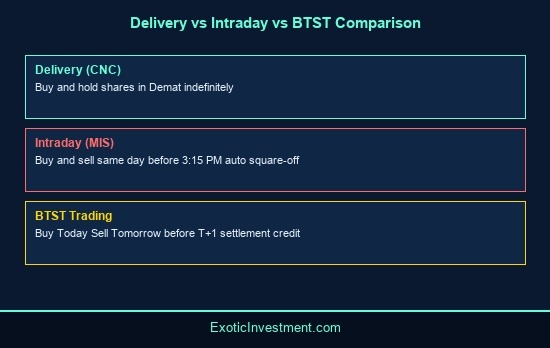
Illustration: T+1 Share Delivery Settlement Cycle Timeline in India
CNC vs MIS vs BTST: Order Types for Delivery in Share Market
When you log into your discount broker app (like Zerodha, Groww, or Upstox), you see product tags like CNC, MIS, and BTST. Let’s break down what each acronym means so you never select the wrong order type.
1. CNC (Cash N Carry): CNC is the standard product type for equity delivery trades. When you select CNC, your broker requires 100% upfront cash margin. No intraday margin borrowing is provided, and your order will not auto-square off at 3:15 PM.
2. MIS (Margin Intraday Square-off): MIS is strictly for intraday trades. Brokers offer 5x margin extension on MIS orders, but you must close the position before 3:15 PM. If you forget, your broker automatically squares off your trade and charges an auto-square-off fee.
3. BTST (Buy Today, Sell Tomorrow): BTST allows you to sell shares on Day T+1 before they officially credit to your Demat account. While BTST saves waiting time, it carries short-delivery risk if the original seller fails to deliver the shares on time. If you want extra margin flexibility beyond CNC delivery, read our guide on how Margin Trading Facility (MTF) works for holding positions.
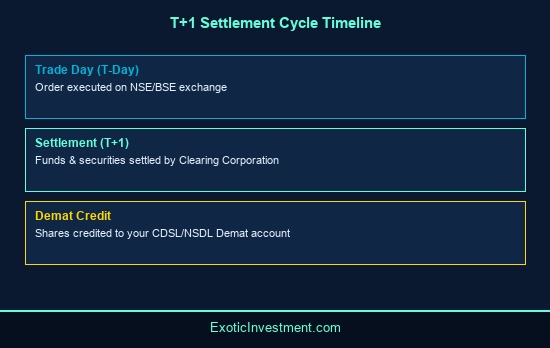
Illustration: Comparison of CNC, MIS, and BTST Order Types in Share Trading
Key Benefits of Delivery Trading for Long-Term Wealth
First, delivery trading carries zero margin borrowing risk. Because you pay 100% of the share price upfront, you can never get a margin call or face forced liquidation during market crashes.
Second, holding delivery shares makes you eligible for all corporate actions. So you receive corporate dividend payouts directly in your bank account, bonus shares credited to your Demat, stock splits, and rights issue entitlements.
Third, when holding delivery shares for 5 to 10 years, calculate your long-term compounding returns using our free Lumpsum Investment Calculator and compare it against disciplined monthly wealth creation via the SIP Return Calculator. Also, investors seeking curated high-growth ideas can join our premium MultiBagger Plus Courses & Pro Tools Annual Subscription for weekly research updates.
Fourth, zero brokerage on equity delivery. Most Indian discount brokers charge zero brokerage on CNC delivery trades. You only pay standard government taxes like STT, GST, and stamp duty.
Share Delivery Charges & DP Fees: What You Pay
Even though brokerage is often free on equity delivery, you should track statutory government taxes and Depository Participant (DP) charges.
Here is the fee breakdown on delivery orders:
1. STT (Securities Transaction Tax): STT is charged at 0.1% on both the buy value and sell value of equity delivery transactions.
2. DP Charges: When you sell delivery shares from your Demat account, CDSL or NSDL charges a flat DP fee (typically ₹13 to ₹18 per stock per day) regardless of quantity.
3. Stamp Duty & GST: Stamp duty is 0.015% on the buy side, while 18% GST applies to brokerage and exchange transaction fees. Estimate your exact net trade gains after taxes with our Stock Market Tax Calculator and check broker-specific fees on our Zerodha Brokerage Calculator. For external financial tools, you can also try Emintage financial calculators for additional market research.
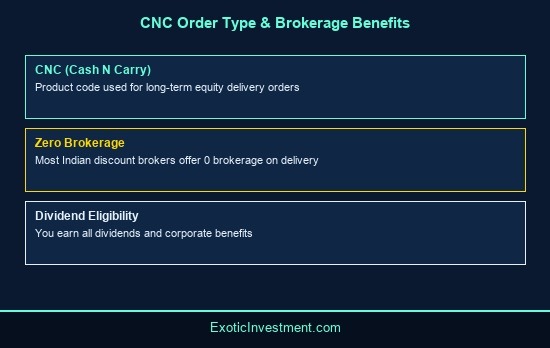
Illustration: Breakdown of Delivery Trading Taxes and DP Charges in India
How to Track Delivery Shares in NSDL and CDSL Statements
Once your shares get delivered, how do you verify that they sit safely in your Demat account and not on your broker’s pool account?
Every month, NSDL and CDSL send you a Consolidated Account Statement (CAS) directly to your registered email ID. This CAS statement lists all your equity delivery holdings across all broker accounts in one place.
Also, you can log into CDSL Easiest or NSDL IDeAS portals directly using your Demat account number (BO ID). Verifying your CAS statement monthly ensures your delivery shares remain safe and unpledged in your own depository holding.
Common Delivery Trading Mistakes & How to Avoid Them
First, do not confuse BTST with guaranteed delivery. If you sell on T+1 via BTST and the seller defaults, the exchange puts the trade into auction, resulting in penalty charges.
Second, avoid spreading capital across 50 small penny stocks. Focus on liquid quality companies with strong balance sheets. Before accumulating delivery positions, evaluate whether a stock is fairly valued using our PE Ratio Calculator.
Third, always track your position sizing. Never allocate more than 5% to 10% of your total portfolio to a single mid-cap or small-cap stock. Use our Position Size Calculator to manage risk effectively.
Mastering Delivery Trading & Recommended Learning Courses
If you want to deepen your stock market knowledge and refine your trade timing, structured education makes all the difference:
To master chart patterns and technical analysis for perfect delivery entries, enroll in our Technical Analysis Course in Kannada or learn options strategies with our popular Options Buying Course in Kannada.
Kannada readers can also grab Ashok Kumar N Rao’s bestselling Kaliyiri Share Market Book, or explore the English paperback edition on the Basics of Indian Stock Market Book page.
Frequently Asked Questions — What Is Delivery in Share Market
FAQ 1: What is delivery in share market trading?
Delivery in share market trading means purchasing equity shares and holding them overnight or longer. The shares get credited to your Demat account on T+1 settlement day, giving you full legal ownership.
FAQ 2: What is the difference between CNC and MIS?
CNC (Cash N Carry) is meant for equity delivery trades with 100% upfront capital and no auto-square-off. MIS (Margin Intraday Square-off) is for intraday trading with margin extension, requiring positions to close before 3:15 PM.
FAQ 3: Are delivery trades free in Zerodha and Groww?
Yes. Discount brokers like Zerodha and Groww charge zero brokerage on CNC equity delivery orders. However, statutory taxes like STT (0.1%), stamp duty, exchange fees, and DP charges still apply.
FAQ 4: What is BTST in share trading?
BTST stands for Buy Today, Sell Tomorrow. It allows you to sell shares on Day T+1 before they get credited to your Demat account. It saves time but carries short-delivery auction risk if the seller defaults.
FAQ 5: When do delivery shares show in Demat account?
Under India’s T+1 settlement cycle, delivery shares credit to your Demat account on the evening of the next working day after your purchase trade date (T+1).
FAQ 6: Can I sell delivery shares on the same day?
Yes. If you buy a stock under CNC and sell it on the same day before 3:15 PM, your broker automatically treats the trade as an intraday transaction.
FAQ 7: What are DP charges on delivery trades?
DP (Depository Participant) charges are flat fees levied by CDSL/NSDL when you sell shares from your Demat account. They range between ₹13 and ₹18 per stock per day.

Trackbacks/Pingbacks