Listen, boss, if you trade Indian stocks long enough, you will hit this wall. You place a market buy order on a flying stock, but nothing happens. Why? Zero sellers exist. Or you try panic-selling a crashing share, but your order stays stuck all day. Why? Zero buyers exist. Welcome to circuit limits. Understanding upper circuit vs lower circuit in share market trading separates smart, disciplined traders from panicked beginners. Whether you are checking live LTP, CMP, and ATP stock price terms or analyzing daily price bands, let’s keep it simple and walk through how price limits work in real life.
What Is Upper Circuit in Share Market?
Here is the real deal. An upper circuit is the maximum price a stock can rise in a single trading day. Stock exchanges like NSE and BSE fix this upper limit to stop market manipulators from pumping illiquid stocks to crazy levels.
When a stock hits its upper circuit, buyers completely overwhelm sellers. Look at the order book — you will see thousands of buy orders lined up, but zero sellers willing to give up their shares. So trading freezes right at that top price. If you are learning equity delivery rules, read our guide on Delivery, BTST & CNC trade execution to see how orders get cleared when circuits break open.
Let’s take a simple example. Suppose a company closed at ₹100 yesterday with a 10% daily price band. Today, its upper circuit limit sits at ₹110. The moment the price hits ₹110, no trades can happen above that line.
What Is Lower Circuit in Share Market?
Now let’s talk about the scary side. A lower circuit is the maximum price drop allowed for a stock in a single day. When bad news, weak earnings, or promoter scams break out, panic selling hits the floor.
Back during the March 2020 market crash, I sat in front of my trading terminal watching Nifty drop so fast that lower circuits triggered across hundreds of stocks in minutes. Thousands of sell orders flooded the order book, but zero buyers stepped up. The stock price locked right at the floor price. If you are starting out, taking our Basics of Stock Market Course helps you understand order book depth before trading volatile shares.
For instance, if a stock closing at ₹100 has a 10% price band, its lower circuit sits at ₹90. Once the price touches ₹90, sell orders stack up with no execution until fresh buyers enter the market.
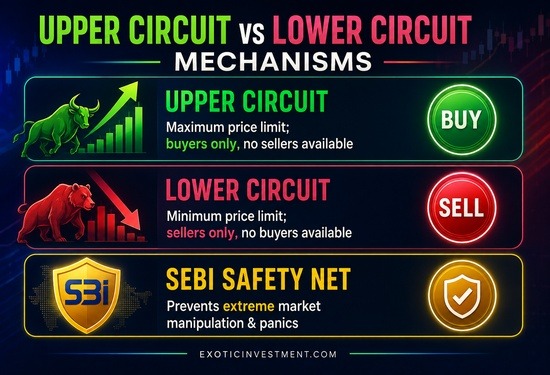
Illustration: Comparison of Upper Circuit vs Lower Circuit Order Book Mechanics
SEBI Circuit Limit Price Bands: 2%, 5%, 10%, and 20%
SEBI sets daily price bands for every stock based on liquidity, market cap, and historical volatility. No confusion here — here is how SEBI breaks them down:
1. 20% Price Band: Large-cap liquid stocks and companies listed in Futures & Options (F&O) carry 20% price bands or no fixed daily caps. When an F&O stock hits 20%, exchanges flex the band by another 5% after a short cooling period.
2. 10% Price Band: Mid-cap companies and moderately active stocks usually get a 10% daily limit.
3. 5% and 2% Price Bands: Speculative penny stocks or companies under SEBI’s ASM (Additional Surveillance Measure) and GSM (Graded Surveillance Measure) carry tight 5% or 2% limits to protect retail traders.
If you trade using borrowed margin, understand how Margin Trading Facility (MTF) works when holding stocks near circuit limits.
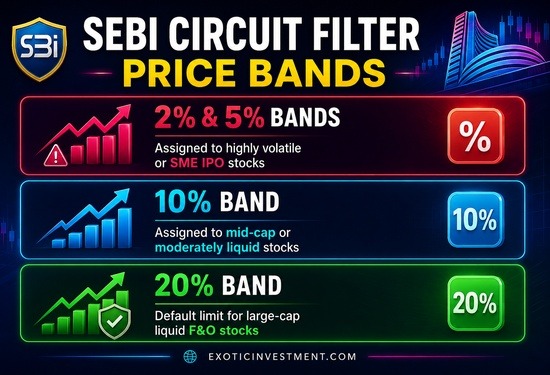
Illustration: SEBI Price Bands Breakdown — 2%, 5%, 10%, and 20% Circuit Limits
Circuit Breakers vs Price Bands: What Is the Real Difference?
Honestly speaking, many retail traders mix up price bands and circuit breakers. But they are completely different mechanisms.
Price bands apply to individual company stocks to restrict single-stock price spikes. On the other hand, circuit breakers apply to market-wide indices like Nifty 50 and Sensex. When broad market panics happen, index circuit breakers halt trading across the entire exchange.
Also, individual stock price bands stay locked for the day (unless flexed for F&O stocks), while index circuit breakers follow strict time-based cooling windows depending on the hour of the day.
Index Circuit Breakers: What Happens When Nifty or Sensex Hits Circuit?
When major market panics hit, SEBI enforces market-wide index circuit breakers at three threshold levels: 10%, 15%, and 20%.
Here is what happens on the trading floor when Nifty or Sensex hits circuit limits:
1. 10% Index Move: If Nifty moves 10% before 1:00 PM, trading halts for 45 minutes, followed by a 15-minute pre-open session. Between 1:00 PM and 2:30 PM, trading halts for 15 minutes. After 2:30 PM, no halt applies for a 10% move.
2. 15% Index Move: If Nifty shifts 15% before 1:00 PM, trading halts for 1 hour and 45 minutes. If triggered after 2:30 PM, trading stops for the rest of the day.
3. 20% Index Move: A 20% index move at any time immediately stops all trading for the rest of the session.
Why Do Circuit Limits Exist? SEBI Investor Protection
Exchanges enforce circuit limits for three clear reasons:
First, circuit limits cool down emotional panic selling and crazy market greed. Freezing price movements gives investors time to read actual news and make rational choices.
Second, circuit limits stop operator groups from rigging penny stock prices artificially.
Third, when managing portfolio taxes and trade costs, calculate your net returns using our Stock Market Tax Calculator and check broker fees on our Zerodha Brokerage Calculator. Also, for long-term wealth projections, test compounding numbers with our Lumpsum Investment Calculator.
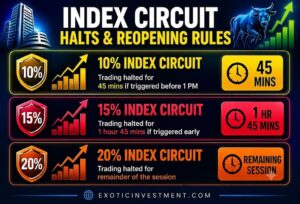
Illustration: Index Circuit Breaker Halts Timeline for Nifty and Sensex
How to Sell Shares Locked in Lower Circuit (Real Exit Tricks)
Getting stuck in a lower circuit stock feels horrible. Since zero buyers exist, standard market sell orders just sit pending. But here are three practical steps from our years on the trading desk:
1. Place an AMO (After Market Order): Log into your broker app between 3:45 PM and 8:57 AM and place an AMO limit sell order at the lower circuit price. Since AMOs get submitted sequentially at market open (9:00 AM pre-open), your order gets front-line priority if any buyer steps in.
2. Work the Pre-Open Window (9:00 AM – 9:08 AM): During the 8-minute pre-open order matching window, liquidity gets matched. Submitting limit sell orders early in pre-open improves your odds.
3. Enforce Strict Position Sizing: Never put more than 2% to 5% of your portfolio into high-risk penny stocks. Check your risk limits using our Position Size Calculator and evaluate stock fundamentals with our PE Ratio Calculator before buying.
Also, investors looking for curated high-growth stock picks can join our premium MultiBagger Plus Courses & Pro Tools Annual Subscription for weekly fundamental research updates.
Recommended Trading Courses & Stock Market Books
If you want to master price action charts, order book reading, and risk management strategies, structured education is your best investment:
Learn technical analysis and chart pattern timing in our Technical Analysis Course in Kannada or master options trading with the Options Buying Course in Kannada.
Kannada readers can also grab Ashok Kumar N Rao’s bestselling Kaliyiri Share Market Book, or explore the English edition on the Basics of Indian Stock Market Book page. For external financial tools, check out Emintage financial calculators for additional market insights.
Frequently Asked Questions — Upper Circuit vs Lower Circuit in Share Market
FAQ 1: What is upper circuit vs lower circuit in share market trading?
An upper circuit is the maximum price a stock can rise in a single trading session where only buyers exist. A lower circuit is the maximum price a stock can fall in a day where only sellers exist.
FAQ 2: Can I sell shares when a stock hits upper circuit?
Yes! Because thousands of buyers are waiting in the order book at the upper circuit price, selling your shares executes instantly.
FAQ 3: Can I buy shares when a stock hits lower circuit?
Yes! Because thousands of sellers are stuck waiting at the lower circuit price, placing a buy order executes immediately.
FAQ 4: How long does a circuit halt last in Indian stock market?
For individual stocks with fixed circuit bands, the halt lasts for the rest of the trading day unless the circuit opens. For market indices like Nifty, halts range between 15 minutes and the full day depending on time and threshold level (10%, 15%, 20%).
FAQ 5: Do F&O stocks have circuit limits?
Stocks trading in the Futures & Options (F&O) segment do not have fixed daily circuit ceilings. They start with a 15% or 20% price band, which gets flexed by an additional 5% after a 15-minute cooling period if reached.
FAQ 6: What is AMO order and how does it help in lower circuit?
An AMO (After Market Order) is placed after market hours. It gets submitted to the exchange at 9:00 AM during pre-open, giving your sell order priority in the execution queue.