
When retail investors bid for an initial public offering (IPO), they often wonder who distributes the shares across thousands of applicant accounts. In the Indian primary market, share distribution is a well-oiled financial chain monitored closely by SEBI. First, before applying for new listings, smart investors study basic stock market terms to evaluate fair opening valuation.
Who Distributes the Shares in India? The Complete IPO Chain
To understand who distributes the shares in India, you must look at the primary market architecture. A company cannot simply email equity certificates to investors. In addition, it cannot transfer shares directly to random bank accounts. Instead, SEBI mandates a specialized intermediary network to handle the entire distribution pipeline.
First, the issuing company appoints SEBI-registered merchant bankers. These merchant bankers structure the entire public offering. Next, the company hires a Registrar and Share Transfer Agent (RTA). In India, top RTAs include Link Intime and KFin Technologies. Consequently, the RTA validates bids, calculates oversubscription ratios, and finalizes allotment.
Finally, central depositories credit the allotted electronic shares into your demat account. So, the distribution is not done by a single person. Instead, it is executed through a coordinated institutional chain. Now, let us examine each link in this chain in detail.
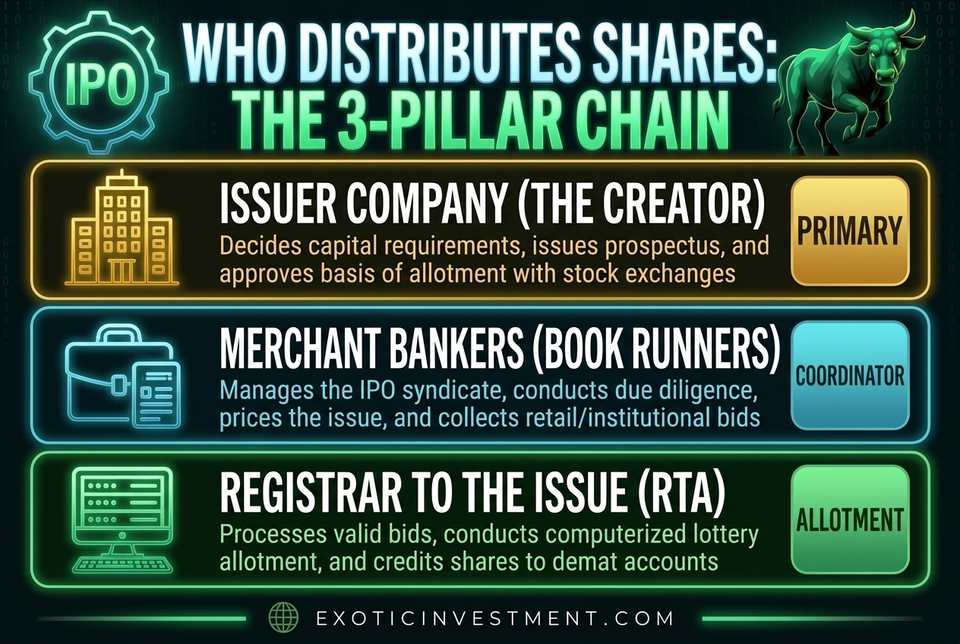
Illustration: The complete step-by-step share distribution process across Indian primary markets.
The Role of Merchant Bankers and Underwriters
Now, let us examine the command center of any public issue: the merchant bankers. Merchant bankers, also known as book running lead managers (BRLMs), handle due diligence and draft the red herring prospectus (RHP). Also, they organize investor roadshows across major financial hubs.
In addition, merchant bankers often act as underwriters. What does an underwriter do? In simple words, underwriters guarantee subscription minimums. If the public does not buy the required 90% quota, then underwriters buy the remaining shares. Therefore, underwriters protect the company against failed public offerings.
Also, merchant bankers coordinate with syndicate brokers and collection banks. When retail traders assess IPO demand before listing, they track unofficial unlisted premiums. To understand how grey market trading signals market sentiment, read our complete guide on grey market premium. In addition, you can model expected listing gains with our stock profit calculator.
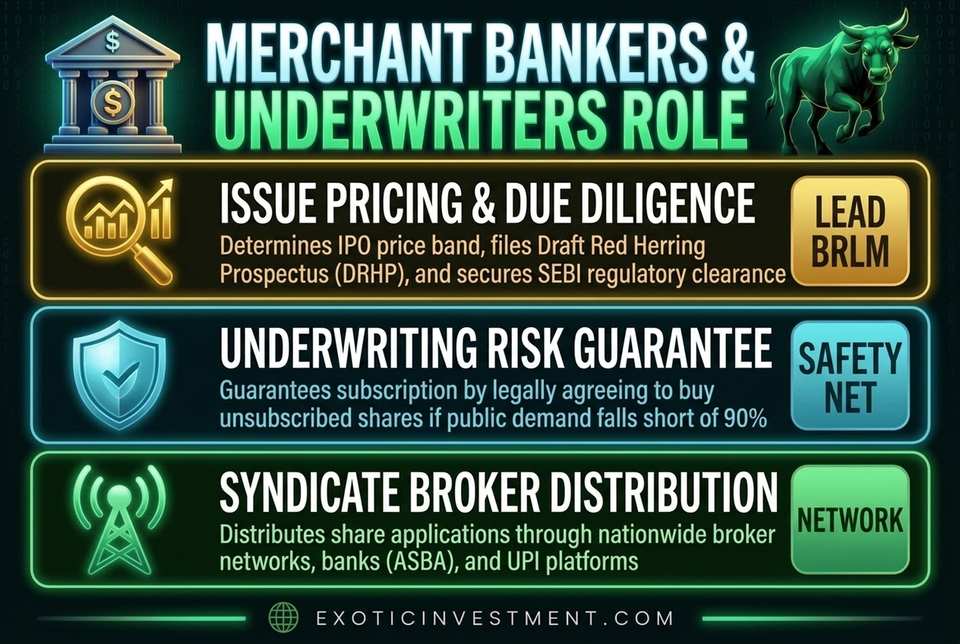
Illustration: The operational responsibilities of merchant bankers and institutional underwriters during share distribution.
The Registrar and Transfer Agent (RTA): The Allotment Engine
While merchant bankers design the issue, the Registrar and Transfer Agent (RTA) does the heavy computational work. Once the bidding window closes on stock exchanges, the RTA takes charge of millions of applicant records.
First, the RTA eliminates invalid or duplicate applications. For example, if an investor submits multiple bids using the same PAN card, the RTA automatically rejects the extras. Next, the RTA matches successful bank mandates through the ASBA (Application Supported by Blocked Amount) system.
Then, if an IPO is heavily oversubscribed, the RTA runs a computer-generated lottery under SEBI rules. In fact, SEBI mandates proportional or lottery allotment to ensure fair treatment for small retail bidders. For early startup equity distribution rules, review our tutorial on how to invest in pre-IPO shares. Also, protect your overall capital allocation with our position size calculator.
Central Depositories: Final Credit to Demat Accounts
Once the RTA finalizes the allotment list, who actually deposits the digital shares into your account? That vital step belongs to the two national depositories: NSDL (National Securities Depository Limited) and CDSL (Central Depository Services Limited).
First, the issuing company creates corporate action instructions for newly authorized shares. Then, the depository credits the exact allotment into your unique Beneficiary Owner (BO) ID. As a result, you receive an automated SMS and email notification directly from CDSL or NSDL confirming your credit.
Finally, your stockbroker syncs with the depository records overnight. So, by the morning of listing day, the allotted shares appear live on your trading app screen. To master depository terminology, read our detailed guide on demat account terms. In addition, you can estimate net post-tax returns using our stock market tax calculator.
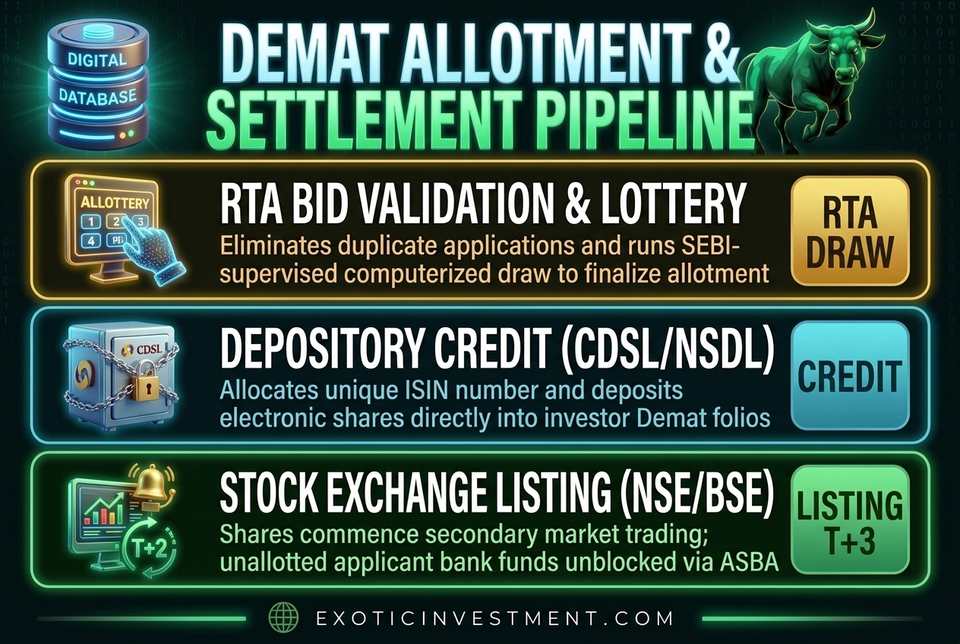
Illustration: Digital share allotment workflow through CDSL and NSDL central depositories.
Primary Market Distribution vs Secondary Market Trading
It is important to distinguish primary share distribution from secondary market stock purchases. In a primary distribution, the company issues fresh shares directly to investors to raise new equity capital.
In contrast, secondary market trading involves transferring existing shares from one investor to another. Once shares list on NSE and BSE, retail traders exchange them freely without involving the original company. So, you can buy or sell delivery shares in seconds through stock exchanges.
To understand the mechanics of exchange settlements and delivery timing, explore our thorough tutorial on delivery share trades. Also, learn how small enterprise issues differ by checking our guide on how to sell SME IPO shares.
Recommended Trading Courses & Premium Subscriptions:
- Options Buying Course in Kannada: Options Buying Course in Kannada.
- Technical Analysis in Kannada Course: Technical Analysis in Kannada Course.
- Kaliyiri Share Market Book: Kaliyiri Share Market Book.
- Basics of Stock Market Course: Basics of Stock Market Course.
- Multibagger Stocks Pro Subscription: Multibagger Stocks Annual Subscription.
How to Check Your IPO Allotment Status Online
Now, how do you verify if the RTA distributed shares to your account? You can check your allotment status in three simple steps without contacting your broker.
First, visit the official website of the assigned RTA, such as Link Intime or KFintech. Next, select the company name from the active public issue dropdown list. Then, enter your PAN number or your DP Client ID and submit the query.
In fact, the portal displays the number of shares applied for and the exact number of shares allotted. If you received zero shares, then your bank unblocks your ASBA funds within twenty-four hours. In addition, before bidding on new listings, evaluate underlying valuation multiples with our free PE ratio calculator.
Common Distribution Glitches and How to Solve Them
Sometimes, retail investors face delays or missing shares after an IPO allotment date. Here are three common distribution issues and how you can resolve them quickly.
First, check for PAN or Demat ID mismatches. If your bank account PAN does not match your demat account PAN, then the RTA cancels the bid immediately. Therefore, always verify that your demat and UPI bank accounts share identical PAN records.
Second, check for UPI mandate authorization failures. If your UPI app fails to release the block on time, then the bank cancels the funds. Consequently, the RTA cannot allocate shares to unblocked funds. To learn how exchange rules protect trading accounts during volatility, explore our guide on upper and lower circuit limits.
Third, monitor listing day volatility carefully. When high-demand stocks open at huge premiums, exchange circuit filters may freeze quotes. Also, if you use borrowed broker funds to trade after listing, understand the risks by reading our guide on the margin trading facility.
Tax Treatment on Newly Distributed IPO Shares
When you receive distributed IPO shares and sell them on listing day, taxation rules apply. In fact, if you sell the shares within twelve months of allotment, then short-term capital gains (STCG) tax applies at twenty percent under current Indian tax law.
However, if you hold the shares for more than twelve months, then long-term capital gains (LTCG) tax applies at twelve point five percent on profits exceeding one lakh twenty-five thousand rupees. In addition, you can calculate your transaction expenses in advance with our free brokerage calculator.
Plus, simulate long-term portfolio growth using our reverse CAGR calculator. Also, model steady one-time investments with our lumpsum investment calculator.
Frequently Asked Questions on Share Distribution
Who distributes the shares in an Indian IPO?
The distribution of IPO shares is executed jointly by SEBI-registered merchant bankers, the Registrar and Transfer Agent (RTA), and central depositories like CDSL and NSDL. Before applying for public issues, plan your investment returns using our lumpsum investment calculator.
What role does the RTA play in share distribution?
The RTA validates retail and institutional bids, eliminates duplicate applications, conducts the allotment lottery, and instructs depositories to credit shares. To evaluate whether a company is reasonably valued before bidding, check our PE ratio calculator.
When do allotted shares appear in my demat account?
Allotted shares are credited to your CDSL or NSDL demat account on the settlement day before the listing date, typically within two working days after the issue closes (T+3 timeline). For systematic monthly investing across mutual funds, try our SIP return calculator.
Can a stockbroker distribute shares directly to clients?
No, stockbrokers only act as depository participants (DPs) and bidding facilitators. Brokers cannot distribute or manufacture shares on their own authority. To understand how execution types differ, read our guide on delivery share trades.
How do crypto token distributions differ from stock share distribution?
Unlike centralized Indian stock distribution governed by SEBI, RTAs, and CDSL/NSDL, crypto token distributions occur via decentralized smart contracts and blockchain wallets without intermediaries. To manage volatility and set automated risk levels across digital asset holdings, explore the eMintage Crypto Stop Loss Take Profit Calculator for disciplined risk control.