
Listen, boss. Capturing clean multi-day momentum without staring at computer screens all day is the dream of every salaried professional in India. You work hard at your job. You cannot sit glued to 1-minute candlestick ticks from 9:15 AM to 3:30 PM. That is why Today, swing trading in india has become the preferred choice for salaried employees and retail traders seeking capital growth alongside their daily routine. Unlike frantic intraday scalping, swing trading lets you capture clean multi-day trends with calm calculation, starting right from your grasp of basic stock market terms.
👨🏫 Real Market Experience & SEBI Disclosure: Written by Dr.Ashok Kumar N Rao and the Exotic Investment research desk based on 12+ years of active market trading. All insights follow SEBI investor education guidelines. Exotic Investment does not provide unsolicited tips or PMS services. Always test swing trading setups with disciplined position sizing before risking live capital. In Kannada, our elders always say: “Hani hani koodidre halla” (ಹನಿ ಹನಿ ಕೂಡಿದರೆ ಹಳ್ಳ — drop by drop creates an ocean). Steady, patient swing gains beat reckless intraday gambling every single time.
What Is Swing Trading in India and How Does It Work?
Swing trading is an active trading methodology designed to capture short-to-medium price swings in equities over several trading sessions. While day traders must square off all trades before 3:30 PM, swing traders hold quality momentum stocks overnight. They ride price expansion through evening news cycles and morning opening gaps to secure substantial gains. To uncover high-probability swing breakout candidates before retail crowds arrive, our research desk uses the institutional screening models inside the MultiBagger Plus Courses & Pro Tools Annual Subscription.
Because you hold positions overnight, every buy order settles through standard delivery and CNC trading rules directly into your Demat account. This holding style frees you from watching every single tick during office hours. You can conduct your technical analysis on quiet evenings, determine entry triggers, and place automated Good-Till-Triggered (GTT) orders directly on your smartphone.
To execute trades efficiently, you need reliable trading software with rapid execution. Top modern stock broker apps in India provide integrated TradingView charting, automated price alerts, and transparent transaction reports. These digital tools allow retail swing traders to compete on equal footing with institutional trading desks.
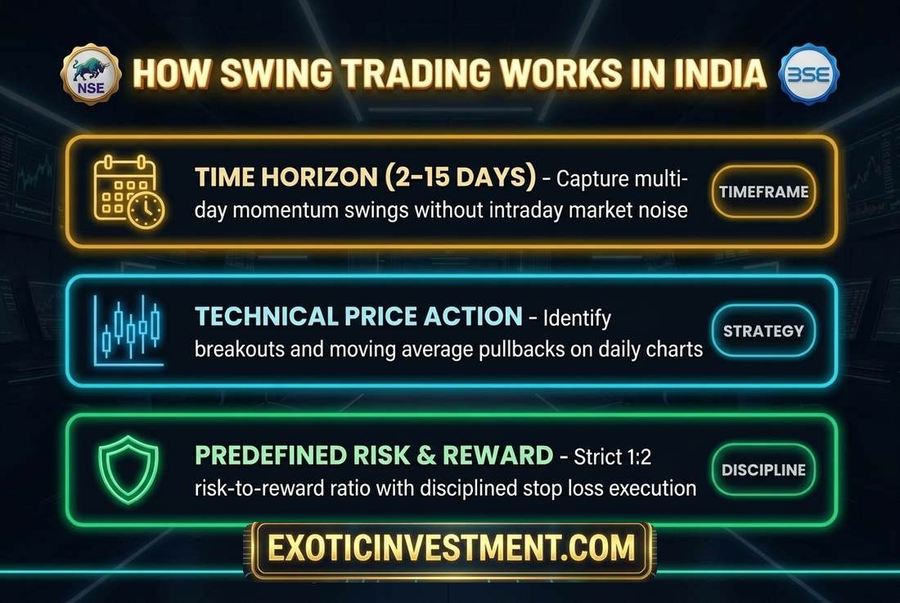
Illustration: Core operational timeline and multi-day execution mechanism of swing trading in Indian equities
Swing Trading vs Intraday vs Positional Trading
Understanding where swing trading sits along the market duration spectrum helps you set realistic return expectations and manage capital effectively. Here is how the three primary trading styles compare:
- Intraday Trading: Traders open and close positions within minutes or hours. This requires intense screen time from 9:15 AM to 3:30 PM, creates emotional fatigue, and racks up high commission turnover.
- Swing Trading: Traders hold positions for 2 days to 3 weeks. This requires thirty minutes of calm evening market analysis, lowers emotional stress, and captures larger percentage moves per trade.
- Positional & Long-Term Investing: Investors hold shares for several months or years based on corporate balance sheets, targeting patient compounding across full economic cycles.
In addition, keeping your turnover low saves thousands of rupees on transaction taxes, exchange turnover fees, and broker commissions. Every executed trade attracts statutory levies. Therefore, smart traders use our free brokerage calculator to measure exact transaction overhead before initiating multi-day positions.
Best Timeframes for Swing Trading in the Indian Stock Market
Selecting the right chart timeframe is the bedrock of technical swing analysis. Using improper charts generates false signals and premature stop-outs:
- The Daily (1D) Chart: This is the primary anchor timeframe for Indian swing traders. It reveals major institutional accumulation bases, key moving average support levels, and authentic price breakouts.
- The Weekly (1W) Chart: Use this higher timeframe to confirm overall market direction. Never initiate bullish swing trades if the weekly chart displays breakdown patterns or overhead supply.
- The 75-Minute or Hourly (1H) Chart: This is your tactical execution timeframe. Once a daily setup triggers, zoom into the 75-minute chart to time low-risk pullback entries with tight stop-loss placement.
By aligning the weekly trend, daily pattern, and hourly trigger, you achieve powerful multi-timeframe confirmation. In fact, this alignment ensures you enter trades with strong institutional momentum rather than fighting against broader market currents.
Top 3 High-Probability Swing Trading Strategies for Indian Equities
Successful swing trading does not rely on dozens of lagging indicators. Instead, it requires mastering a few proven price action patterns that repeat across NSE and BSE equities:
1. High-Volume Resistance Breakout
When an Indian equity consolidates inside a tight price range for several weeks, buyers and sellers reach temporary balance. But when fresh institutional buying arrives with heavy volume, a decisive breakout occurs. Enter on the breakout candle close or on the subsequent retest of the broken level. To avoid buying overpriced hype, always verify valuation fundamentals using our PE ratio calculator before taking aggressive swing entries.
During extreme market rallies, high-momentum breakout stocks can move rapidly toward exchange circuit limits. Understanding these price bands helps you manage exits smoothly without getting locked out of your capital.
2. The 20 EMA Pullback Setup
In Kannada, remember “Nidhanave pradhana” (ನಿಧಾನವೇ ಪ್ರಧಾನ — patience is supreme). Amateur traders chase vertical green candles and buy at the peak. Smart swing traders wait patiently for price to pull back. Instead, they rise in rhythmic waves, pulling back periodically toward dynamic support. In a healthy bull trend, the 20-period Exponential Moving Average (EMA) acts as an institutional trampoline. Look for a bullish hammer or bullish engulfing candle when price tests the rising 20 EMA. Enter when price breaks above the reversal candle high, tucking your stop loss just beneath the recent swing low.
If you prefer trading with added purchasing power while maintaining strict safety buffers, examine the guidelines for the margin trading facility to avoid unnecessary margin calls.
3. Range Support Bounce
Not all equities trend upward continuously. Many quality large-cap and mid-cap stocks oscillate between horizontal support floors and resistance ceilings for months. First, identify an established support level that has held multiple tests. Next, buy when rejection wicks form near support with rising volume. Finally, set your initial target just beneath overhead resistance. This setup delivers high risk-to-reward ratios often exceeding 1:3.
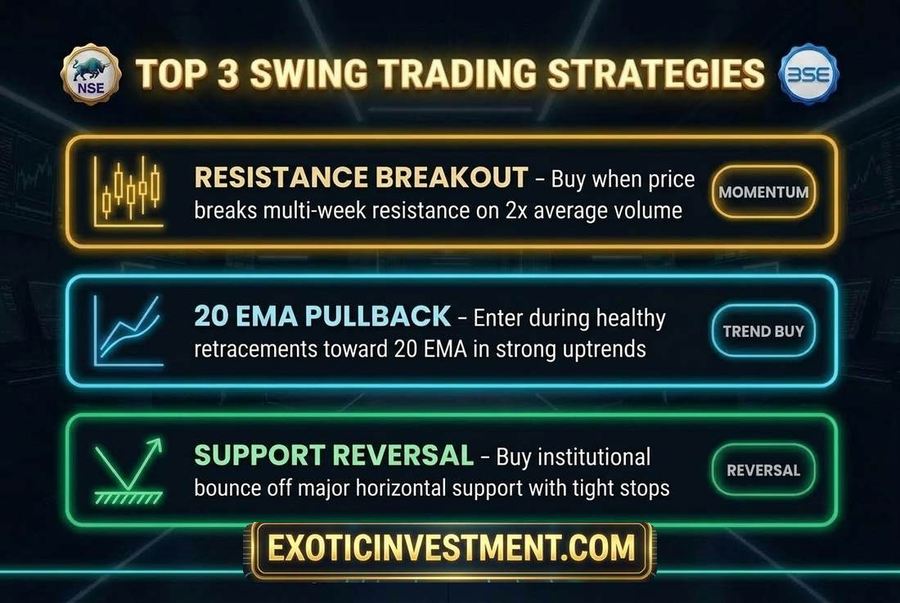
Illustration: High-probability price action breakout and pullback swing trading strategies for NSE and BSE stocks
Risk Management and Position Sizing: The Secret to Long-Term Survival
Even top professional trading setups fail around 35 to 40 percent of the time. Therefore, the true difference between consistent traders and struggling novices is disciplined risk control. You must defend your trading capital during unavoidable drawdown periods.
First, never risk more than 1 to 1.5 percent of your total account capital on any single trade setup. For example, if your trading capital is Rs 5,00,000, your maximum monetary loss on a trade must never exceed Rs 5,000 to Rs 7,500. Calculate your exact share allocation before buying using our free position size calculator to eliminate guesswork and protect your balance.
Second, project your net profit targets accurately before placing market orders. You can evaluate prospective returns and calculate net gains using our stock profit calculator. When holding settled delivery shares overnight, all assets are maintained under strict depository oversight governed by standard demat account terms.
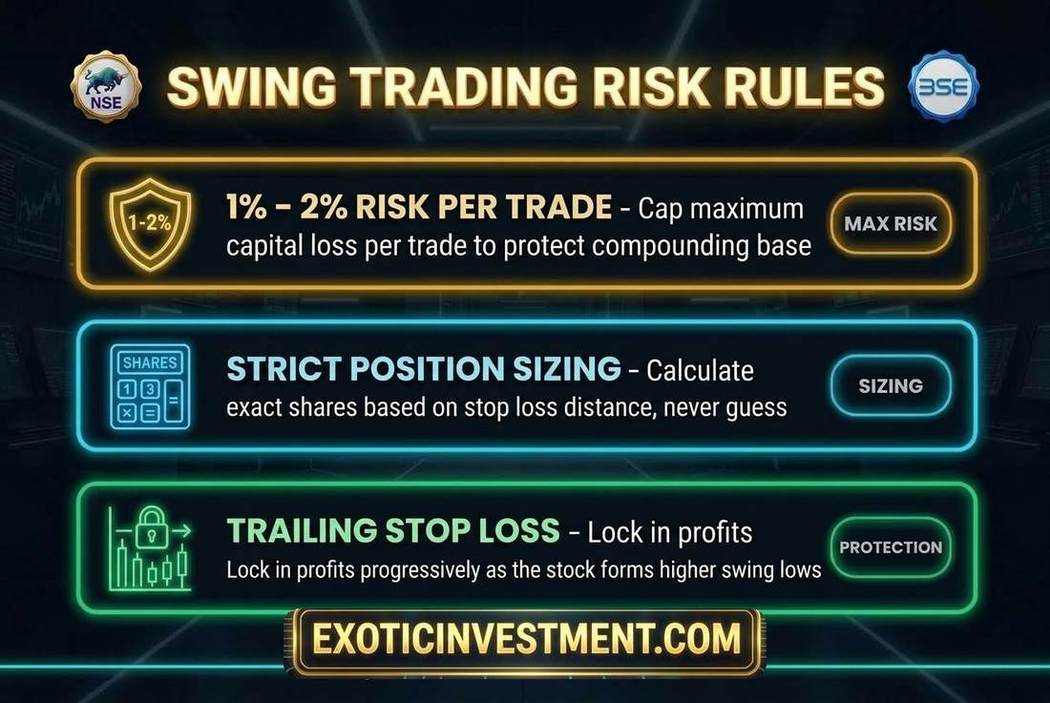
Illustration: Essential capital defense, mathematical position sizing, and stop-loss execution rules for Indian swing traders
Taxation Rules for Swing Traders in India
Because swing traders hold shares overnight for more than one trading day, taxation follows equity capital gains rules rather than speculative business income rules.
Under the updated Indian tax code, listed equity delivery shares held for less than 12 months attract Short-Term Capital Gains (STCG) tax at a flat rate of 20 percent plus applicable surcharge and cess. However, if you hold high-conviction momentum stocks for longer than 12 months, your gains qualify as Long-Term Capital Gains (LTCG). LTCG is taxed at 12.5 percent on gains exceeding Rs 1,25,000 in a financial year. To plan your quarterly tax liabilities accurately, calculate your net obligations with our stock market tax rules calculator.
Building Long-Term Wealth Beyond Active Swing Trading
While swing trading in india offers attractive capital gains, active trading should never be your sole financial engine. Professional traders systematically divert a portion of their realized trading profits into long-term wealth compounding assets.
For instance, you can funnel monthly swing trading gains into equity index funds or high-conviction dividend leaders. You can project your long-term compounding milestones with our Reverse CAGR calculator or model lump-sum allocations with our lumpsum investment growth tool.
If you want to sharpen your technical edge and master professional chart reading, explore our structured training programs below:
Recommended Trading Courses & Premium Subscriptions:
- Options Buying Course in Kannada: Options Buying Course in Kannada.
- Technical Analysis in Kannada Course: Technical Analysis in Kannada Course.
- Kaliyiri Share Market Book: Kaliyiri Share Market Book.
- Basics of Stock Market Course: Basics of Stock Market Course.
- Multibagger Stocks Pro Subscription: MultiBagger Plus Courses & Pro Tools Annual Subscription.
💡 Frequently Asked Questions (FAQ)
What is the minimum capital required for swing trading in India?
You can begin swing trading with Rs 20,000 to Rs 50,000 in India. This capital base allows you to take positions in liquid mid-cap and large-cap stocks while keeping risk per trade below 1.5%. You can determine your exact share quantity using our free position size calculator.
How do professional swing traders identify multi-bagger breakout stocks early?
Professional traders look for quiet institutional accumulation bases, shrinking volume on pullbacks, and explosive expansion on breakout candles. To receive institutional-grade swing trade setups and multi-bagger equity research, subscribe to our MultiBagger Plus Courses & Pro Tools Annual Subscription.
How many days do swing traders typically hold stocks in India?
Swing traders hold stocks between 2 days and 3 weeks to capture multi-session momentum swings. Once your price target is achieved, you can evaluate your net realized gains on our stock profit calculator before rotating capital into fresh setups.
What happens if a swing trade hits an upper circuit or lower circuit limit?
When an equity reaches its upper circuit, buyers queue up with no available sellers, allowing you to lock in gains or trail stops into the next session. However, lower circuits freeze selling liquidity, which is why traders study exchange circuit limits to avoid getting trapped in illiquid counters.
Are overnight delivery trades subject to high brokerage and DP charges?
Because swing trades settle into your Demat account, your depository levies a flat DP charge of Rs 15 to Rs 20 plus GST on sell transactions. You can calculate the exact statutory fees, exchange turnover charges, and broker commissions with our brokerage calculator.