STT Calculator — Securities Transaction Tax India
Calculate statutory Securities Transaction Tax (STT) across Equity Delivery, Intraday, Futures, and Options under Union Budget 2024-2026 rates. View turn-by-turn buy/sell tax splits, effective tax drag, and Section 36(1)(xv) PGBP business tax deductibility diagnostics.
⚙️ Trade Execution Parameters
🔓 Unlock MultiBagger Pro Diagnostics
Elevate your tax efficiency with institutional trading diagnostics designed for Indian high-volume traders.
- Annual STT Drag Audit: Visualize exactly how much capital is siphoned off by transaction taxes.
- Section 36(1)(xv) Tax Shield: Instant guidance on offsetting STT against PGBP business profits.
- Multi-Broker Friction Leakage: Benchmark Zerodha vs Groww vs Angel One total regulatory friction.
- Unbranded Clean PDF Export: Professional tax audit printouts with zero watermarks.
How the STT Engine Works in 4 Steps
Select Segment
Toggle between Equity Delivery, Intraday, Futures, Options Premium, or Exercised Contracts.
Input Trade Details
Enter Buy & Sell prices and share quantity, or select one-click capital presets (₹50K to ₹10L).
Instant Tax Audit
View separate buy-side and sell-side statutory STT levies calculated against gross turnover.
Diagnose Tax Drag
Evaluate your net post-tax return and check Section 36(1)(xv) PGBP business tax deductibility.
Understanding Securities Transaction Tax (STT) on NSE & BSE
Securities Transaction Tax (STT) is an unavoidable regulatory direct tax levied by the Government of India under Chapter VII of the Finance (No. 2) Act, 2004. Unlike brokerage commissions that vary by broker, STT is statutory and uniform across all registered exchanges including the National Stock Exchange (NSE) and Bombay Stock Exchange (BSE). Stock brokers collect this tax on trade execution and remit it directly to the Central Board of Direct Taxes (CBDT).
Recent legislative updates under the Union Budget and Finance Acts have revised transaction tax slabs, notably increasing F&O derivatives transaction taxes to curb speculative churn. To assess how total regulatory friction impacts your trading capital alongside state stamp duties and exchange fees, explore our Indian Stock Brokerage Calculator.
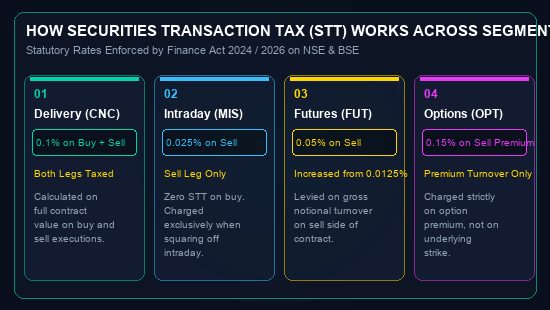
Statutory STT Slabs: Delivery, Intraday, Futures & Options
The table below outlines the statutory STT rates across trading segments as enforced by the Income Tax Department:
| Trading Segment | Buy Side Rate | Sell Side Rate | Taxable Base Valuation | Income Tax Status |
|---|---|---|---|---|
| 📈 Equity Delivery (CNC) | 0.100% (10 bps) | 0.100% (10 bps) | Total Traded Value (Buy & Sell) | Non-deductible (Sec 48) |
| ⚡ Equity Intraday (MIS) | NIL (0.000%) | 0.025% (2.5 bps) | Sell Turnover Only | Deductible (Sec 36(1)(xv)) |
| 📊 Equity Futures (FUT) | NIL (0.000%) | 0.050% (5 bps) | Sell Turnover (Revised) | Deductible (Sec 36(1)(xv)) |
| 🎯 Equity Options (OPT) | NIL (0.000%) | 0.150% (15 bps) | Option Premium Turnover | Deductible (Sec 36(1)(xv)) |
| 🔄 Exercised Options | 0.125% (12.5 bps) | NIL (0.000%) | Full Settlement / Strike Value | Deductible / Capital Gains |
Worked Example: STT Calculation on a ₹1,00,000 Trade
To illustrate how transaction taxes vary across products, consider an execution of 100 shares bought at ₹1,000 (₹1,00,000 buy value) and sold at ₹1,050 (₹1,05,000 sell value):
- Equity Delivery: STT on Buy = ₹1,00,000 × 0.1% = ₹100. STT on Sell = ₹1,05,000 × 0.1% = ₹105. Total STT = ₹205.00 (0.100% of gross turnover).
- Equity Intraday: STT on Buy = ₹0 (Exempt). STT on Sell = ₹1,05,000 × 0.025% = ₹26.25 (Rounded to ₹26). Total STT = ₹26.00.
- Futures Contract: STT on Buy = ₹0. STT on Sell = ₹1,05,000 × 0.05% = ₹52.50 (Rounded to ₹53). Total STT = ₹53.00.
- Options Selling: If you sold 100 option premium points at ₹1,050 (Total Premium = ₹1,05,000), STT = ₹1,05,000 × 0.15% = ₹157.50 (Rounded to ₹158). Total STT = ₹158.00.
To evaluate your net trading margin requirements and avoid unexpected margin shortfalls during volatile market regimes, consult our NSE F&O Margin Calculator.
Income Tax Treatment: Section 48 vs Section 36(1)(xv)
A crucial distinction for Indian traders is the tax deductibility of STT:
- Investors (Capital Gains Taxation): Under Section 48 of the Income Tax Act, STT is expressly prohibited from being deducted as transfer expenditure. When computing Short-Term Capital Gains (STCG at 20%) or Long-Term Capital Gains (LTCG at 12.5%), you cannot add STT to your purchase cost or deduct it from sale consideration. Determine your net capital gains liabilities with our STCG vs LTCG Calculator India.
- Traders (Business Income Taxation – PGBP): Under Section 36(1)(xv), any amount of STT paid by the assessee on taxable securities transactions entered into in the course of business is 100% allowable as a business deduction, provided the income arising from such transactions is included under the head “Profits and Gains of Business or Profession” (PGBP). Full-time F&O and intraday operators can use STT to lower their taxable net business profit.
Ensure your trading records satisfy annual filing thresholds with our F&O Turnover Calculator.
📋 Regulatory References & Data Sources
- Income Tax Act 1961, Proviso to Section 2(1)(a) — Statutory Marginal Relief on Surcharge
- Finance Act 2024 — Surcharge slabs for FY 2024-25 / AY 2025-26 under Section 115BAC
- Central Board of Direct Taxes (CBDT) Circular No. 04/2024 on TDS and surcharge thresholds
- Income Tax Department of India Notification on Section 87A rebate and surcharge parity
- Proviso to Section 115BAC(1A) — marginal relief under the new tax regime
Disclaimer: This calculator is for educational and planning purposes only. It does not constitute financial advice. Consult a SEBI-registered investment advisor for personalised guidance. Tax rules are updated as per the latest Finance Act — verify with a qualified CA before filing.
🛠️ More Helpful Tools & Calculators
💡 Frequently Asked Questions (FAQ)
1. What is Securities Transaction Tax (STT) and who collects it?
Securities Transaction Tax (STT) is a direct federal financial turnover tax governed by Chapter VII of the Finance (No. 2) Act, 2004. It is automatically levied by stock brokers (such as Zerodha, Upstox, or Groww) on all equity, futures, and options transactions routed through registered Indian stock exchanges (NSE and BSE). To see how STT combines with brokerage and state stamp duties, use our Indian Stock Brokerage Calculator.
2. What are the latest STT rates on Equity Delivery trades?
For Equity Delivery (CNC trades where shares are transferred into or out of your demat account), STT is levied at 0.1% on the purchase turnover and 0.1% on the sale turnover. For example, purchasing ₹1,00,000 worth of shares incurs ₹100 STT, and selling them later at ₹1,20,000 incurs ₹120 STT. Learn how holding periods impact your tax liability in our delivery trading guide.
3. Is STT charged on both buy and sell legs in Intraday trading?
No. For equity intraday trades (MIS/CO orders squared off on the same trading day without demat transfer), STT is zero on the buy leg and is levied at 0.025% strictly on the sell leg. If you buy ₹1,00,000 and sell at ₹1,02,000 intraday, STT is charged only on ₹1,02,000 (equal to ₹25.50). Verify execution thresholds with our intraday trading guide.
4. What are the revised STT rates for Futures and Options (F&O)?
Under the statutory amendments introduced in the Union Budget, STT on Futures sale turnover increased to 0.05% (up from 0.0125%), and STT on Options premium sale increased to 0.15% (up from 0.0625%). For options sellers, this represents a significant structural cost shift. Calculate the combined margin and hedge impact using our NSE F&O Margin Calculator.
5. Can STT be claimed as a tax deduction under the Income Tax Act?
It depends strictly on your trader classification. Under Section 36(1)(xv) of the Income Tax Act, full-time active traders declaring trading income under Profits and Gains from Business or Profession (PGBP) can claim STT as an allowable business expense. However, retail investors declaring income under Capital Gains (Section 48) cannot deduct STT when computing capital gains. Assess your tax slabs with our Capital Gains Tax India Calculator.
6. How is STT calculated when an in-the-money (ITM) option is exercised?
When an in-the-money option is exercised upon expiry rather than squared off prior to market close, STT is charged at 0.125% of the total settlement value (strike price multiplied by quantity) paid by the option buyer. This can lead to heavy STT charges exceeding the option premium itself. Understand strike moneyness and expiry traps with our CE and PE Options Explainer.
7. Does STT apply to Commodity (MCX) or Currency trades?
No. STT applies exclusively to equities and equity derivatives on NSE and BSE. Non-agricultural commodities traded on MCX are subject to Commodities Transaction Tax (CTT) at 0.01% on non-agri futures sellers. Currency derivatives (USDINR, EURINR) are completely exempt from both STT and CTT. Calculate commodity leverage with our MCX Margin Calculator.
8. How does STT impact tax audit turnover calculations under Section 44AB?
For F&O and intraday business taxation, turnover under Section 44AB is computed using the ICAI Guidance Note (sum of positive and negative differences per trade). STT itself is not added to turnover; rather, it is deducted as an expense in your trading P&L statement. Determine whether your annual trading volume triggers mandatory tax audit using our F&O Turnover Calculator.
9. What is the difference between STT and digital asset / crypto transaction taxes?
While Indian stock exchanges levy STT ranging from 0.025% to 0.15%, virtual digital assets (VDAs) face a flat 1% Tax Deducted at Source (TDS) under Section 194S on all sell/transfer transactions, accompanied by a flat 30% tax without setoff for losses. Multi-asset traders managing tokenized and Web3 portfolios can track their crypto tax liability with Emintage Crypto Tax Calculator.
10. How can high-volume traders reduce their overall STT drag?
Because STT is non-negotiable and statutory, traders can optimize costs by: (1) shifting intraday swing strategies to lower-taxed legs, (2) declaring trading income under PGBP to claim STT as an allowable deduction against gross receipts under Section 36(1)(xv), and (3) strictly avoiding physical expiry delivery on ITM options contracts. Model your target return requirements after regulatory costs using our Reverse CAGR Calculator.