STCG vs LTCG Calculator India — Finance Act 2024 Tax Slabs

STCG vs LTCG Calculator India — Finance Act 2024 Tax Slabs

Calculate Short-Term Capital Gains (STCG at 20%) and Long-Term Capital Gains (LTCG at 12.5%) with ₹1.25 Lakh exemption under revised Finance Act 2024 rules.

Capital Gains Tax Calculator (Finance Act 2024)

Holding Period & Asset Regime
Trade Values & Realized Proceeds
Prior LTCG Realized This FY (₹) ₹0
Used against the ₹1,25,000 annual exemption limit under Section 112A (Finance Act 2024).
Net Capital Gains Tax Payable
₹48,750
Tax Rate: 12.5% + 4% Health & Education Cess
Gross Realized Gain ₹5,00,000
Section 112A Exemption -₹1,25,000
Taxable Capital Gain ₹3,75,000
Base Capital Gains Tax ₹46,875
4% Health & Education Cess ₹1,875
Total Tax Payable ₹48,750
Net Post-Tax Profit ₹4,51,250
🛡️ Finance Act 2024 Rule:
LTCG on listed shares & equity funds is taxed at 12.5% on gains exceeding ₹1.25 Lakh. STCG is taxed at flat 20% without any basic exemption limit.
Grandfathering & Tax Loss Harvesting PRO Available 🔒
🎓 MASTER TAX-OPTIMIZED TRADING & INVESTING 🚀
×
👑 Multibagger Plus Pro Tax Suite

Grandfathering & Tax Loss Harvesting Scanner

Calculate Jan 31 2018 Fair Market Value grandfathered acquisition cost, offset STCG against business losses, and run multi-year carry-forward audits.

🚀 UNLOCK PRO SUITE — INSTANT ACCESS
30-Day Money Back Guarantee | Trusted by 3,500+ Indian Investors

⚡ How Capital Gains Tax Works in 4 Steps

1

Choose Asset Category

Select holding duration: Short-Term (≤12 months) or Long-Term (>12 months) using the regime toggle.

2

Enter Buy & Sale Value

Input total purchase consideration and gross realized sale proceeds in Indian Rupees.

3

Apply ₹1.25L Exemption

Deduct available Section 112A tax-free threshold from your gross LTCG across equity transactions.

4

View Net Tax & Cess

Review statutory tax at 12.5% or 20% plus 4% Health & Education Cess, and your net realized take-home profit.

🎓 Master Stock Market Basics & Trade Planning!

Want to master technical analysis, spot breakouts, and optimize trade risk management? Enroll in our top-rated stock market basics course today!

🎓 ENROLL IN BASICS OF STOCK MARKET COURSE NOW 🚀

Understanding the Finance Act 2024 Capital Gains Overhaul

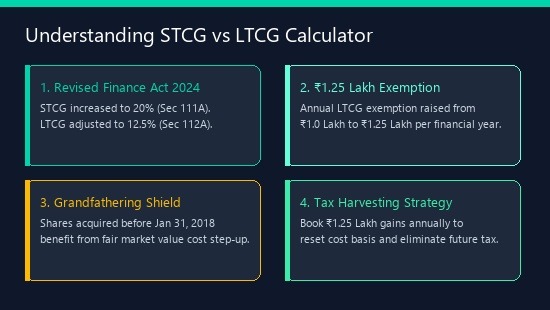
The Union Budget 2024 fundamentally restructured the Indian capital gains tax regime. For listed equity shares and equity-oriented mutual funds, the Short-Term Capital Gains (STCG) tax rate under Section 111A increased from 15% to 20%.

Simultaneously, Long-Term Capital Gains (LTCG) tax under Section 112A increased from 10% to 12.5%, accompanied by a welcome increase in the annual basic exemption threshold from ₹1.00 Lakh to ₹1.25 Lakh per financial year.
STCG vs LTCG Calculator India — Finance Act 2024 Tax Slabs Explainer Diagram

Key Highlights of Section 111A & Section 112A

1. Holding Period Threshold: Listed equity shares and equity mutual funds held for more than 12 months qualify as Long-Term Capital Assets. Assets held for 12 months or less are classified as Short-Term Capital Assets.

2. Grandfathering Mechanism: For equities acquired prior to January 31, 2018, investors can still use the Fair Market Value (FMV) grandfathering shield to safeguard pre-2018 capital appreciation from LTCG taxation.

3. Tax Loss Harvesting: STCG can be offset against both short-term and long-term capital losses. However, LTCG can only be offset against long-term capital losses. Unabsorbed losses can be carried forward for up to 8 assessment years.

📋 Regulatory References & Data Sources
  • Income Tax Act 1961, Section 112A (LTCG on equity) — Finance Act 2024
  • Income Tax Act 1961, Section 111A (STCG on equity) — Finance Act 2024
  • Finance (No. 2) Act 2024 — revised LTCG rate to 12.5% and STCG to 20%
  • Cost Inflation Index notified by Central Board of Direct Taxes (CBDT) under Notification No. 44/2024, CII for FY 2024-25: 363
  • Income Tax Act Section 54EC — capital gains exemption on bond reinvestment
  • Source: Ministry of Finance, Government of India; CBDT circulars

Disclaimer: This calculator is for educational and planning purposes only. It does not constitute financial advice. Consult a SEBI-registered investment advisor for personalised guidance. Tax rules are updated as per the latest Finance Act — verify with a qualified CA before filing.

💡 Frequently Asked Questions (FAQs)

What is the difference between STCG and LTCG on Indian stocks under Finance Act 2024?

Short-Term Capital Gains (STCG) apply when listed equities or equity mutual funds are held for 12 months or less, taxed at 20%. Long-Term Capital Gains (LTCG) apply when held for more than 12 months, taxed at 12.5% on gains exceeding ₹1.25 Lakh. You can evaluate gross trade consideration and regulatory STT deductions on our Indian Stock Brokerage Calculator.

How does the new ₹1.25 Lakh Section 112A annual exemption threshold apply?

Finance Act 2024 raised the tax-free LTCG threshold under Section 112A from ₹1.00 Lakh to ₹1.25 Lakh per financial year across all equity sales combined. If you are rebalancing single investments and planning multi-year tax-efficient profit realization, model your compounding on our Lumpsum Investment Calculator.

How are cryptocurrency capital gains taxed in India compared to equity STCG and LTCG?

Unlike equity capital gains which offer lower rates and exemptions, cryptocurrency transactions in India are taxed under Section 115BBH at a flat 30% without basic exemptions or loss offsets. Compute your net digital asset tax liabilities using the Crypto Tax Calculator India on Emintage.

Why does Section 111A STCG not offer any basic threshold exemption?

Section 111A imposes a flat 20% statutory rate on every rupee of short-term profit to discourage speculative churn. To assess whether a high-momentum stock is overvalued before booking early gains, check valuation multiples using our PE Ratio Calculator.

How does Health and Education Cess impact effective capital gains tax liability?

A mandatory 4% Health & Education Cess is levied on your total capital gains tax liability, elevating the effective STCG rate to 20.8% and LTCG to 13.0%. To analyze how post-tax returns impact disciplined long-term compounding, simulate growth trajectories with our Step-Up SIP Return Calculator.

How are derivatives (F&O) profits taxed compared to equity capital gains?

Futures and options (F&O) trades are treated as non-speculative business income rather than capital gains, and are taxed at personal income slab rates. You can determine tax audit applicability under Section 44AB and ICAI turnover using our F&O Turnover Calculator.

What are the tax rules for options trading and leveraged positions?

Option trading gains are classified as business income, and net losses can be offset against other business earnings. To accurately evaluate contract sensitivities and pricing variables before closing out positions, use our Black-Scholes Greeks Calculator.

How does leveraged crypto trading taxation differ from equity intraday?

Equity intraday losses can be offset against business profits, whereas crypto margin losses cannot be offset against any crypto or non-crypto income. Multi-asset traders can calculate position leverage and liquidation risk with the Crypto Margin Trading Calculator on Emintage.

How does tax-loss harvesting work for equities and mutual funds?

Tax-loss harvesting involves realizing losses before March 31st to offset taxable capital gains. To audit whether underperforming, high-volatility holdings in your portfolio warrant harvesting, analyze relative stock risk using our Beta Calculation for Indian Stocks tool.

Can short-term traders calculate futures leverage and contract profit margins?

Traders managing short-term derivative exposures require real-time margin and payout calculations. If you trade digital asset derivative contracts alongside equity derivatives, model contract leverage and funding fees using the Crypto Futures Calculator on Emintage.

AR
Written & Verified By

Dr.Ashok Kumar N Rao

Stock Market Educator & Author | 3,500+ Students Trained

Alternative Investments advisor and author of 'Basics of Stock Market for Beginners' and 'ಕಲಿಯಿರಿ ಶೇರ್ ಮಾರ್ಕೆಟ್'. All financial tools and content on this site are reviewed personally before publication.