
What is why stock market open on saturday?
👨🏫 Real Market Experience & SEBI Disclosure: Written by Dr.Ashok Kumar N Rao and the Exotic Investment research desk based on 12+ years of active market trading. All insights follow SEBI investor education guidelines. Exotic Investment does not provide unsolicited tips or PMS services. Always test trading setups with disciplined position sizing before risking live capital.
Listen, boss — let’s keep it simple right from the start. Here’s the real deal: the Indian stock market (NSE and BSE) is generally CLOSED on Saturdays. Saturday is a weekly off-day for all major exchanges in India.
But then you might have heard people talking about stock market open saturday situations. What does that mean? There are a few key scenarios that explain this:
Scenario 1 — Global Markets Are Open: While India sleeps, countries like the USA, UK, and others are trading on Saturday mornings (their time zone). This affects sentiment and opening prices in India on Monday.
Scenario 2 — Special Trading Sessions: Occasionally, SEBI announces extended or special trading hours. In rare cases, Saturday trading has been discussed as a pilot program to match global standards.
Scenario 3 — After-Hours & GIFT City: The new GIFT City (Gujarat International Finance Tec-City) exchange operates on different timings. Some international investors can trade on Saturdays through this route.
Scenario 4 — Futures & Options Weekly Expiry: Sometimes, the timing of expiry or holiday adjustments create confusion around which days markets are actually open or closed.
So, no confusion — here’s the bottom line. The regular NSE and BSE equity market does NOT open on Saturday for most retail traders. But understanding WHY this matters and what happens around Saturday trading hours globally will make you a smarter investor.
Now let me walk you through exactly why this topic matters for your trading journey.
Why why stock market open on saturday Matters for Indian Stock Traders
Let’s get honest with each other — this isn’t just some random question. Understanding the Saturday market situation affects your actual trading decisions every single week.
Here is the real deal: If you hold overnight positions from Friday, Saturday’s global movements directly impact your portfolio value when markets reopen on Monday. You need to know this before placing trades on Friday afternoon.
First, let me tell you about gap-up and gap-down openings. When US markets move significantly over the weekend, Indian stocks often open with big gaps on Monday morning. If you understand Saturday global trading patterns, you can prepare for these gaps instead of getting caught off guard.
Second, many beginners lose money because they don’t account for weekend risks. They buy a stock on Friday expecting good returns. But if global markets turn negative on Saturday, their Monday opening loss can be significant — sometimes 3 to 5 percent on individual stocks.
Also, futures and options traders face extra risk. Weekend volatility in global markets can cause massive movements in index futures. If you’re trading Nifty or Bank Nifty futures, Saturday’s S&P 500 and Nasdaq performance becomes your early warning system.
Third, the new GIFT City initiative changes things gradually. Smart traders who understand Saturday and Sunday trading windows in international venues gain an edge in positioning themselves before regular markets open.
Here’s a practical example. Last year, during a particularly volatile US weekend session, several Indian IT sector stocks opened with 4-6% gaps on Monday. Traders who monitored Saturday global sentiment avoided those stocks or set proper stop losses using tools like our stop loss calculator. Others who ignored this ran straight into losses.
Therefore, knowing whether stock market open saturday applies to you and your trading style is not optional — it’s essential for survival in this market.
Key Concepts Related to why stock market open on saturday
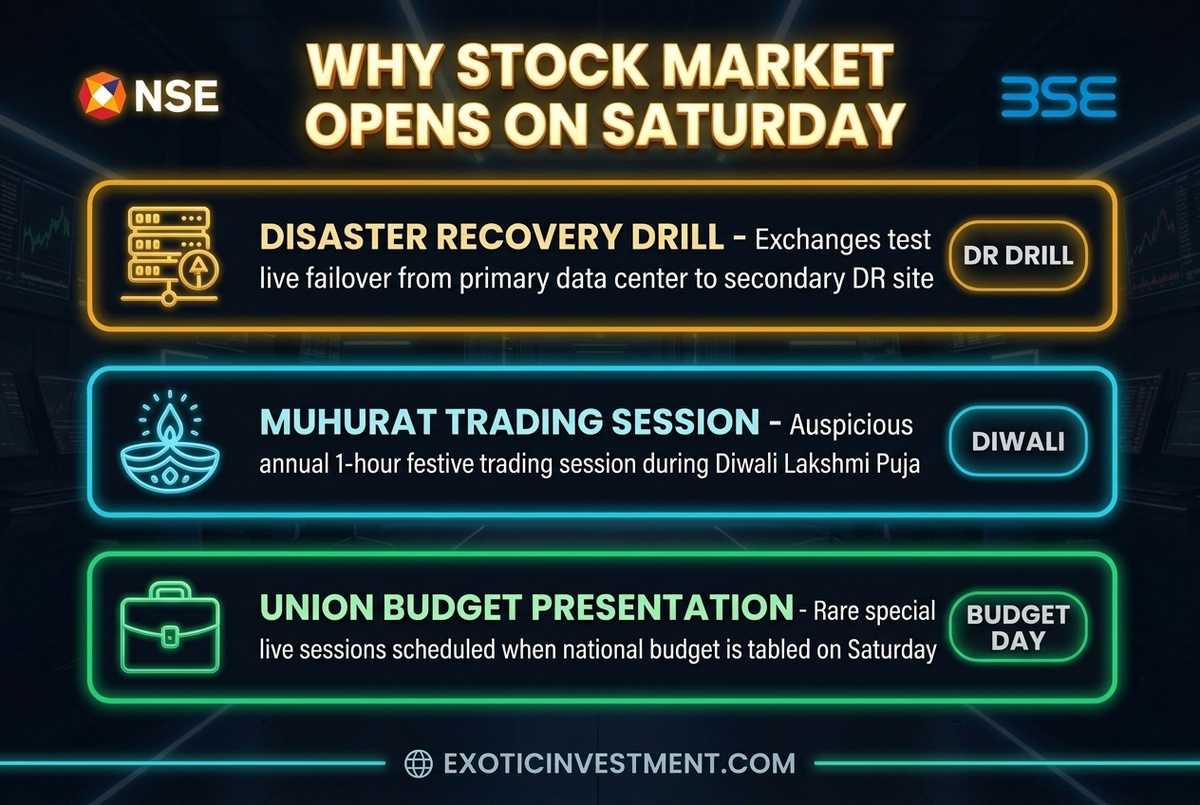
Illustration: Stock Market Open Saturday Special Sessions
Let’s break down the important concepts you must understand. I’ll keep it clear and straight, no jargon overload.
Concept 1 — NSE and BSE Working Days: The National Stock Exchange (NSE) and Bombay Stock Exchange (BSE) operate Monday through Friday. Both Saturday and Sunday are holidays. This is decided by SEBI regulations and exchange operational guidelines.
Concept 2 — GIFT City International Exchange: Gujarat’s GIFT City hosts an international exchanges segment. It operates on different trading days and timings compared to regular NSE/BSE. Some Saturday trading activity exists here for international participants. This is a relatively new development and worth watching closely.
Concept 3 — Pre-Opening Session Timing: Regular NSE pre-opening runs from 9:00 AM to 9:15 AM IST. But understanding how weekend global events influence this session is critical. Your Monday pre-open decisions should factor in Saturday’s international market moves.
Concept 4 — Global Market Correlation: Major Indian indices like Nifty 50 and Bank Nifty have strong correlation with US markets (S&P 500, Nasdaq). Saturday US trading — especially after-hours and futures — sets the tone for Monday’s Indian market open.
Concept 5 — Broker Platform Weekend Support: Most broker platforms including Zerodha Kite, Upstox, and Groww allow order placement on weekends. But these orders only execute when markets open on Monday. Know this distinction clearly.
Concept 6 — Holiday Calendar & Substitution Rules: Sometimes a Saturday holiday gets substituted with a weekday working day. SEBI publishes these calendars well in advance. Always check before planning your trades around weekend periods.
Concept 7 — Position Carry Forward: When markets are closed on Saturday, any intraday positions from Friday must be squared off before market close on Friday. You cannot carry forward intraday positions over the weekend. Only delivery and futures/option positions can be held over the weekend.
Here’s a quick comparison to make it stick:
Regular NSE/BSE: Monday to Friday, 9:15 AM to 3:30 PM
GIFT City International: Different schedule, includes some Saturday activity
Global Markets (USA/Europe): Various schedules, some include Saturday trading
Paper trading platforms (like demo/portfolio trackers): Available 24/7 but don’t confuse simulation with real execution
Each concept builds on the previous one. Now let me show you how to apply all of this step by step.
How to Apply This Knowledge Step by Step
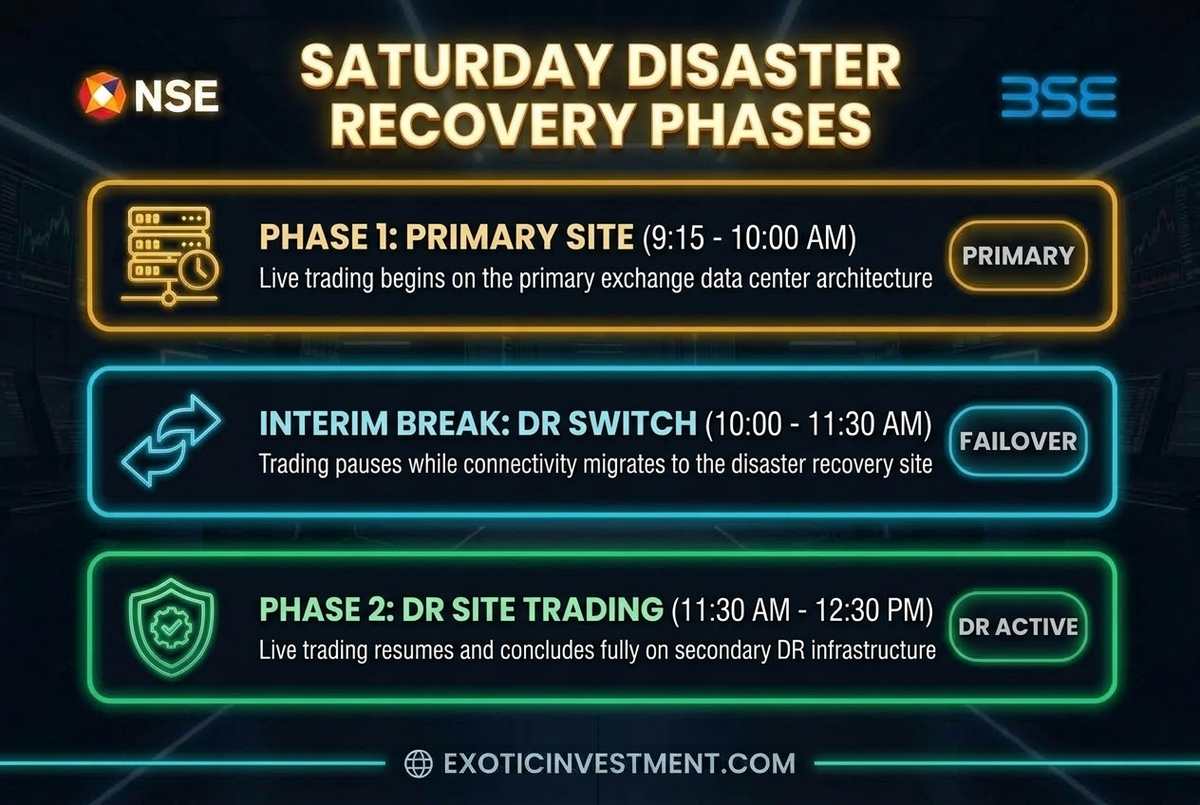
Illustration: Disaster Recovery Live Trading Session NSE
Alright, now comes the practical part. I’m going to walk you through a complete action plan that you can follow every week. No theory overload — just actionable steps.
Step 1 — Check Saturday Global Market Performance: Every Saturday morning (or Sunday evening India time), check how US markets performed. Look at S&P 500, Nasdaq, and Dow Jones directions. If they moved up significantly, expect a positive gap on Monday in India. If they fell hard, prepare for a tough open.
Step 2 — Review Your Friday Closing Positions: Before the Friday market closes at 3:30 PM, review all your holdings. Decide which positions to carry forward over the weekend and which to square off. Never carry intraday positions — they auto-square off anyway, but better to be intentional about it.
Step 3 — Set Stop Losses Using Calculated Levels: Use our stop loss calculator to determine smart stop loss levels for positions you’re holding over the weekend. Don’t guess — calculate based on recent volatility and support-resistance zones. You can also use our pivot point calculator to identify key levels that might trigger during Monday’s open.
Step 4 — Place Weekend Orders Wisely: If you’re using Zerodha, Upstox, or Groww, you can place limit orders on Saturday/Sunday. But remember — these won’t execute until Monday market opens. Set realistic limit prices based on your Saturday global market analysis from Step 1.
Step 5 — Prepare for Monday Pre-Open Session: On Monday morning between 9:00 AM and 9:15 AM, watch the pre-open session carefully. This is where you’ll see the actual gap-up or gap-down pricing. Use our profit calculator to estimate potential outcomes before entering any trade during this volatile window.
Step 6 — Monitor GIFT City Activity: For advanced traders, keep an eye on GIFT City international trading activity during Saturday hours. Any significant movement here can give you early clues about Monday’s direction, especially for large-cap stocks with international exposure.
Step 7 — Plan Your Risk Management Framework: Never risk more than 1-2% of your total capital on a single weekend-held position. Use our calculator tools to plan position sizing properly. And if you track crypto alongside equities, tools like crypto tax calculators and Bitcoin profit calculators can help you understand your full portfolio picture.
Step 8 — Review and Learn: Every Monday evening, review how your weekend-positioned trades performed. Compare your Saturday global market analysis with actual Monday outcomes. This feedback loop sharpens your instinct over time.
Recommended Trading Courses & Premium Subscriptions:
- Options Buying Course in Kannada: Options Buying Course in Kannada.
- Technical Analysis in Kannada Course: Technical Analysis in Kannada Course.
- Kaliyiri Share Market Book: Kaliyiri Share Market Book.
- Basics of Stock Market Course: Basics of Stock Market Course.
- Multibagger Stocks Pro Subscription: Multibagger Stocks Pro Subscription (Checkout link: Buy Pro Subscription).
Common Mistakes and How to Avoid Them
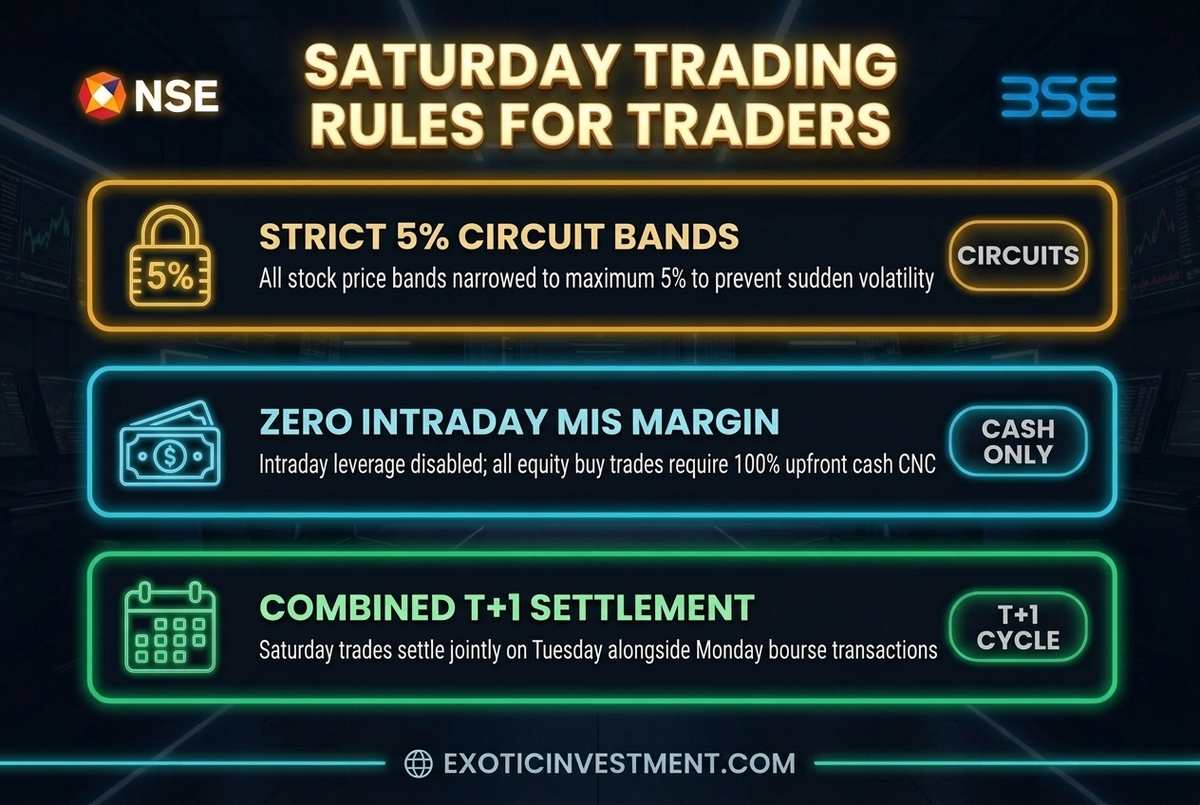
Illustration: Saturday Stock Market Special Trading Rules
Let me share some real mistakes I’ve seen traders make again and again. Avoid these and you’ll immediately stand out from the crowd.
Mistake 1 — Ignoring Global Markets on Saturday: Many traders completely ignore what happens in US markets on Saturday. Then on Monday, they wonder why their stocks opened 4% lower. Solution: Make Saturday global market checking a non-negotiable habit. Even 10 minutes on Saturday morning can save you from bad Monday entries.
Mistake 2 — Carrying Intraday Positions Over Weekend: Some traders hope to hold intraday positions over Saturday. This doesn’t work. Intraday positions auto-square off on Friday evening. If you want weekend exposure, use delivery or futures/option positions with proper margin. Otherwise, you’ll lose positions without even knowing it.
Mistake 3 — Placing Blind Market Orders on Sunday Night: Some brokers allow order placement on Sundays. Putting a market order blindly on Sunday night is dangerous. You have no idea what the weekend global move was. Always use limit orders with prices based on your analysis, never market orders over the weekend.
Mistake 4 — Not Adjusting Stop Loss for Weekend Gaps: A stop loss placed on Friday at Rs 150 means nothing if the stock opens at Rs 142 on Monday. You lost Rs 8 per share instead of Rs 0. Use our stop loss tool to set stops that account for expected gap risk. Always leave breathing room for weekend volatility.
Mistake 5 — Overtrading After a Big Saturday Global Move: When global markets make a huge move on Saturday, Indian traders often overtrade on Monday morning. This is emotional revenge trading. Stay calm. Wait for the first 15-30 minutes of Monday trading to settle. Let the initial volatility cool before entering new positions.
Mistake 6 — Confusing GIFT City With Regular NSE: Some traders think GIFT City Saturday trading means NSE is also open. It’s not. These are separate venues with different rules. Don’t place regular NSE orders expecting them to execute on Saturday. They won’t.
Mistake 7 — Neglecting Weekend News Events: Global geopolitical news, earnings announcements, or central bank decisions sometimes drop on Saturday. These can move markets massively. Keep your phone handy on weekends and quickly scan for major news before finalizing Monday plans.
Avoid these mistakes consistently and you’ll avoid most weekend-related losses that wipe out beginner traders.
Advanced Trading Tips to Master This Topic
Once you’ve handled the basics confidently, here are advanced techniques that separate professionals from amateurs.
Tip 1 — Build a Saturday Global Markets Watchlist: Create a simple tracking sheet for US indices (S&P 500, Nasdaq 100), Asian markets (Nikkei, Hang Seng), and European markets (FTSE, DAX). Note their direction and magnitude on Saturday. This becomes your Monday morning roadmap.
Tip 2 — Use the VIX as a Fear Gauge: The US VIX (Volatility Index) often moves on weekends. A spike in VIX on Saturday signals fear in global markets, which usually translates to cautious opening in India. Combine this with your global market analysis for stronger signals.
Tip 3 — Trade the Monday Open Only After 15 Minutes: Professional traders rarely enter positions in the first 15 minutes of Monday open. The gap-filling action creates false signals. Wait, observe, and then act. This patience alone saves more money than any indicator.
Tip 4 — Correlate Crude Oil and Dollar Index Moves: Saturday crude oil price changes and USD index moves heavily impact Indian oil marketing stocks and export-oriented companies. Check these over the weekend for sector-specific trade ideas on Monday.
Tip 5 — Use Options Strategies for Weekend Risk: Instead of taking naked directional positions over the weekend, consider using options strategies. A covered call on your delivery positions or a defined-risk debit spread can protect your capital while giving you upside exposure. Our Options Buying Course covers these strategies in detail.
Tip 6 — Track FII/DII Weekend Flow Signals: While FII/DII data comes on Mondays, sometimes weekend global institutional flows give early signals. Strong foreign buying in Asian markets on Saturday often predicts FII enthusiasm on Monday in India.
Tip 7 — Maintain a Weekend Trading Journal: Document every Saturday global market observation and Monday outcome. After three months, you’ll spot patterns that no textbook can teach you. This journal becomes your personal edge.
Tip 8 — Understand Tax Implications of Weekend-Gapped Trades: If you hold positions over the weekend and the gap creates a short-term or long-term capital gain, proper tax tracking matters. Use tools like our tax calculators and maintain proper records for filing.
Master these advanced tips over time. Start with two or three, build confidence, then add more to your toolkit.
Final Summary
Let me bring everything together in a clean wrap-up so nothing stays unclear.
The Indian stock market (NSE and BSE) does NOT normally open on Saturday. Saturday remains a weekly holiday for regular Indian equity trading. However, the concept of “stock market open saturday” matters because global markets trade on Saturdays, and their movements directly shape Monday’s Indian market behavior.
Key takeaways for you as an Indian trader:
First, always check US and global market performance on Saturday before finalizing your Monday trading plan. This single habit separates consistent winners from lucky gamblers.
Second, never carry intraday positions over the weekend. Square off everything by Friday 3:30 PM, or consciously convert to delivery/futures positions with adjusted risk parameters.
Third, use proper stop losses calculated for weekend gap risk. Our stop loss calculator and pivot point calculator help you set realistic levels.
Fourth, place only limit orders over the weekend — never market orders. Set prices based on your global market analysis, not emotions.
Fifth, wait 15 minutes after Monday’s open before entering new positions. Let the weekend gap volatility settle.
Sixth, keep learning. The market evolves — GIFT City Saturday trading, potential SEBI policy changes, and shifting global patterns all mean your knowledge must grow too. Our Technical Analysis Course and Kaliyiri Share Market Book are great starting points.
Honestly speaking, understanding the Saturday market dynamic isn’t about finding a secret trick. It’s about building awareness, preparing systematically, and managing risk intelligently. That’s the real edge in Indian stock trading.
Start applying these steps this week. Your future self — and your portfolio — will thank you. Happy trading, boss!