Upstox Brokerage Calculator 2026
Calculate exact Upstox trading commissions, STT (Budget 2026 rates), exchange turnover fees, GST, state stamp duties, DP charges, and breakeven points with live Zerodha & Groww comparisons.
How to Audit Your Upstox Trade in 4 Steps
Select Segment
Choose Equity Delivery (CNC), Intraday (MIS), Equity Futures, or Equity Options across NSE or BSE.
Input Trade Leg
Enter Buy Price, Sell Price, and Share Quantity or click quick capital presets (₹50K, ₹1L, ₹2.5L, ₹5L, ₹10L).
Review Charges
Verify the ₹20 fee cap against STT, exchange turnover fees, SEBI turnover, state stamp duty, and GST.
Check Breakeven
Evaluate your required price move per share and benchmark net savings against Zerodha and Groww side-by-side.
Upstox Brokerage Architecture & Fee Structure Explained
Upstox (operated by RKSV Securities India Pvt. Ltd.) is one of India’s leading discount brokers, backed by institutional investors including Tiger Global and Ratan Tata. Upstox operates on a competitive discount brokerage model with flat fees capped at ₹20 per executed order across most segments. However, subtle tariff nuances differentiate Upstox from competitors like Zerodha and Groww, making a real-time trading charges audit critical for active Dalal Street market participants.
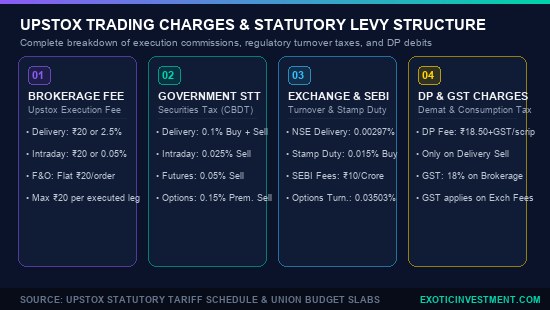
Figure 1: Complete Upstox Brokerage, Statutory Government Taxes & Demat Debit Tariff Schedule
Comprehensive Upstox Tariff Schedule Across Exchange Segments
To avoid execution surprises on your digital contract note, review the statutory breakdown below comparing execution fees and regulatory levies across all asset classes:
| Market Segment | Upstox Brokerage | STT / CTT (Budget 2026) | Exchange Turnover Fees | State Stamp Duty | DP Charges |
|---|---|---|---|---|---|
| Equity Delivery | ₹20 or 2.5% (whichever is lower) | 0.1% Buy + 0.1% Sell | NSE: 0.00297% | BSE: 0.00375% | 0.015% (Buy Leg) | ₹18.50 + GST (₹21.83) |
| Equity Intraday | ₹20 or 0.05% (whichever is lower) | 0.025% (Sell Leg Only) | NSE: 0.00297% | BSE: 0.00375% | 0.003% (Buy Leg) | Nil |
| Equity Futures | ₹20 or 0.05% (whichever is lower) | 0.05% (Sell Leg Only) | 0.00173% (Contract Value) | 0.002% (Buy Leg) | Nil |
| Equity Options | Flat ₹20 per executed order | 0.15% (Premium Sell Leg) | 0.03503% (Premium Value) | 0.003% (Buy Premium) | Nil |
Key Upstox Charges Every Trader Must Understand
1. The Delivery Fee Nuance (Upstox vs Zerodha)
Many beginners assume all discount brokers provide free equity delivery. While Zerodha charges ₹0 for delivery investments, Upstox levies ₹20 or 2.5% per order (whichever is lower). If you invest ₹500 in a single stock, Upstox charges 2.5% (₹12.50). For any order above ₹800, the fee caps at the flat ₹20 rate. Over an annual horizon of 50 delivery purchases, this creates a ₹1,000 baseline fee variance compared to zero-brokerage models.
2. Depository Participant (DP) Demat Charges
Whenever you sell shares from your demat account, the depository (CDSL/NSDL) and the depository participant (Upstox) charge a debit fee. Upstox charges ₹18.50 + 18% GST (equal to ₹21.83) per company scrip per day, regardless of whether you sell 1 share or 10,000 shares. To minimize DP drag, avoid selling small piecemeal tranches of the same company across different trading days.
3. Call & Trade and Auto Square-Off Charges
If you place orders through Upstox telephonic dealing desk, an additional ₹50 + GST (₹59) is charged per executed order. Similarly, if your intraday MIS positions remain unclosed past 3:15 PM, the automated risk engine executes an auto square-off and bills you an extra ₹50 + GST. Disciplined traders set automated stop-loss orders in the app to avoid these administrative surcharges.
📋 Regulatory References & Data Sources
- STT rates: Finance Act 2024 — equity delivery 0.1%, intraday 0.025%
- SEBI circular — transaction charges applicable on NSE/BSE
- Stamp Duty: Indian Stamp Act 1899, as amended by Finance Act 2019 — 0.015% on equity delivery buy side
- GST at 18% on brokerage as per CGST Act 2017
Disclaimer: This calculator is for educational and planning purposes only. It does not constitute financial advice. Consult a SEBI-registered investment advisor for personalised guidance. Tax rules are updated as per the latest Finance Act — verify with a qualified CA before filing.
🛠️ More Helpful Trading & Tax Calculators
💡 Frequently Asked Questions (FAQ)
1. What is the exact brokerage charged by Upstox on Equity Delivery trades?
Unlike Zerodha which charges zero delivery brokerage, Upstox levies ₹20 or 2.5% per executed order (whichever is lower) on equity delivery (CNC). For orders below ₹800 value, the 2.5% cap applies, while larger orders cap at ₹20. Additionally, when you sell shares from demat, a Depository Participant (DP) fee of ₹18.50 + GST (total ₹21.83) applies. To compare total friction, consult our Zerodha Brokerage Calculator.
2. How much does Upstox charge for Intraday stock trading?
For equity intraday (MIS) trades squared off before 3:15 PM, Upstox charges ₹20 or 0.05% of turnover per executed order (whichever is lower). If you place a buy order and a sell order, brokerage is charged on both legs (maximum ₹40 round-trip). Securities Transaction Tax is charged at 0.025% strictly on the sell leg. Model your day trading strategies with our step-by-step intraday guide.
3. What are Upstox F&O brokerage charges under Budget 2026 rules?
Upstox charges ₹20 or 0.05% per order (max ₹20) on Equity Futures, and a flat ₹20 per executed order on Equity & Index Options. However, statutory government levies increased sharply: Futures STT rose to 0.05% (sell leg), and Options STT rose to 0.15% on premium value. You can audit exact statutory tax breakdowns on our dedicated STT Calculator India.
4. What is the breakeven price point in Upstox and how is it calculated?
Breakeven is the exact price increment per share your trade must gain to cover Upstox brokerage, STT, exchange turnover fees, SEBI turnover, state stamp duty, GST, and DP charges. Formula: Breakeven Move = Total Trading Charges ÷ Total Quantity. To manage trade risk before hitting breakeven, configure your stop loss using our Trading Risk Management Calculator.
5. Does Upstox charge DP charges on intraday or F&O trades?
No. Depository Participant (DP) charges apply exclusively when shares are debited from your demat account (i.e., on equity delivery sales). Neither intraday MIS orders nor derivatives contracts trigger demat debits. Upstox charges ₹18.50 + 18% GST (total ₹21.83) per company scrip per day. Check our Indian Stock Brokerage Calculator to compare DP fees across 10 top brokers.
6. What is the Goods and Services Tax (GST) rate applied to Upstox charges?
GST is levied at 18% strictly on service fees: Brokerage + Exchange Turnover Charges + SEBI Regulatory Fees. GST is never charged on STT or state stamp duty because those are sovereign government taxes, not commercial services. Learn how statutory levies impact tax filings in our F&O Turnover Calculator for ITR.
7. How does Upstox brokerage compare with Zerodha and Groww?
Zerodha charges ₹0 for delivery, ₹20 or 0.03% for intraday, and ₹20 flat for F&O. Upstox charges ₹20 or 2.5% for delivery, ₹20 or 0.05% for intraday, and ₹20 for F&O. Groww charges ₹20 or 0.05% across both delivery and intraday. For long-term investors holding portfolios, Zerodha saves ₹20 per trade, while active option scalpers face identical ₹20 execution costs across all three. Audit your returns with our Stock Profit Calculator.
8. What auto square-off call & trade charges does Upstox levy?
If you hold intraday (MIS) positions that remain open after 3:15 PM, Upstox automated risk management systems execute an auto square-off order. Upstox levies an additional penalty of ₹50 + 18% GST (₹59 total) per squared-off order on top of standard brokerage. Avoid unwanted square-off penalties by monitoring intraday momentum setups via our Momentum Stock Screener.
9. Can Upstox brokerage and transaction charges be claimed as tax deductions?
Yes, depending on whether you file taxes as a trader or an investor. For active intraday and F&O traders filing as Profits and Gains of Business or Profession (PGBP), Upstox brokerage, exchange charges, and STT are 100% tax-deductible under Section 36(1)(xv). Investors filing under Capital Gains cannot deduct STT under Section 48, but can add brokerage to their cost of acquisition. Review statutory tax implications on our STCG vs LTCG Calculator.
10. How can I verify Upstox charges against my official digital Contract Note?
Every trading evening, Upstox emails a SEBI-mandated digital Contract Note containing a detailed breakdown of brokerage, STT, state stamp duties, SEBI turnover fees, and GST for each individual trade order. The numbers generated by our engine match Upstox official contract notes down to the paisa. For advanced options Greek pricing and volatility analysis, use our Black-Scholes Greeks Calculator.