Mastering how to start intraday trading in india requires proven execution discipline rather than gambling on social media hype. Day trading allows you to purchase and liquidate equities within the same market session before final closing bells. However, over ninety percent of retail intraday traders lose capital because they trade without pre-defined risk parameters.
Whether you are tracking live LTP, CMP, and ATP stock price terms or funding your first trading account, clarity is vital. This structured guide walks you through every essential mechanical step from broker setup to chart execution. As a result, you will trade Dalal Street price action with professional confidence.
What Is Intraday Trading in India? The Plain English Answer
Intraday trading means buying and selling equities within the exact same trading day before 3:30 PM IST. Because you close all open positions before the market shuts, no actual shares are transferred to your Demat holding. Instead, your brokerage firm settles your cumulative profit or loss directly in cash.
When your exit price is higher than your entry price, you pocket a net trading profit. Conversely, when the market moves against your setup, you incur a realized loss. To compare intraday mechanics with multi-day investments, explore our guide on delivery shares and CNC order execution.
For instance, suppose you buy 100 shares of State Bank of India at ₹800 during morning trade. You liquidate the position at ₹810 around early afternoon. Consequently, you lock in a ₹1,000 gross gain while keeping your Demat portfolio completely untouched.
Intraday (MIS) vs Delivery (CNC): Order Types for Day Traders
When you enter buy or sell orders on your trading software, your broker requires you to choose an order product type. Picking the wrong product code ruins your trading strategy and risks unexpected margin penalties. Therefore, understanding the practical distinction between MIS and CNC is fundamental.
First, MIS (Margin Intraday Square-off) is designed specifically for intraday positions. Brokers provide up to 5x margin extension on MIS trades under SEBI guidelines. However, you must manually exit all MIS trades before 3:15 PM to avoid automatic square-off fees.
Second, CNC (Cash N Carry) represents 100 percent cash delivery for long-term investments. Because you pay the full contract value upfront, your broker never forcibly liquidates CNC holdings. Additionally, when individual stocks hit extreme daily boundaries, check our guide on circuit limits and trading halts.
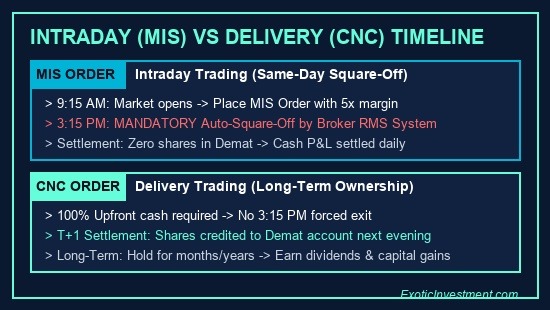
Illustration 1: Comparison of MIS Intraday vs CNC Delivery Order Timelines
How to Select Stock for Intraday One Day Before: 4-Step Filter
Mastering how to select stock for intraday one day before gives you an immense structural advantage over reactive market participants. Instead of chasing erratic opening candles at 9:15 AM, prepared traders scan high-probability setups the previous night. Follow this tested four-step evening screening workflow to construct a focused watchlist:
- Screen for Multi-Day Consolidation Breakouts: Scan daily charts of Nifty 100 stocks to identify narrow-range consolidations (such as NR7 patterns). When a liquid stock trades within a tight range for four consecutive sessions, an explosive directional breakout usually follows the next morning.
- Filter by Daily Trading Volume and Beta: Eliminate low-volume stocks that trade under two million shares daily. Ensure the stock possesses a Beta above 1.2, guaranteeing sufficient price swings to achieve your intraday profit targets.
- Audit Corporate Earnings and Macro News: Check the evening economic calendar for scheduled quarterly financial results, credit rating updates, or institutional stake adjustments. Stocks with fresh fundamental catalysts generate predictable institutional order flow at market open.
- Mark Structural Support and Resistance Zones: Identify the previous day’s high, low, and closing levels on a 15-minute chart. Setting price alerts around these pivot levels allows you to execute swiftly when morning volume surges.
Adhering to this nightly ritual prevents emotional impulse trades during chaotic market opening bells. To evaluate stock fundamentals and historical multiples, review our PE ratio calculator before adding candidates to your watchlist.
Best App for Intraday Trading in India: 2026 Comparison Matrix
Choosing the best app for intraday trading in india directly impacts your order execution speed and net profitability. A trading app that crashes during high-volatility events like RBI monetary announcements causes severe slippage losses. Therefore, retail day traders must evaluate broker terminal stability, charting capabilities, and margin transparency carefully.
To compute your exact statutory expenses across different platforms, use our Zerodha brokerage calculator. Similarly, you can compare net trading margins on our Upstox brokerage calculator to verify true bottom-line profitability.
Step 2: Master a Technical Strategy for Day Trading
Professional traders avoid cluttering their screens with dozens of lagging indicators. Instead, seasoned market participants rely on Volume Weighted Average Price (VWAP) alongside major moving averages. This straightforward combination highlights institutional order accumulation clearly.
First, the VWAP Bullish Setup triggers when 5-minute price candles cross decisively above the VWAP line with surging volume. Traders enter long positions, set stop losses just beneath VWAP, and aim for a 1:2 risk-to-reward ratio. Consequently, this alignment ensures you ride institutional buying momentum.
Second, the VWAP Bearish Setup occurs when price candles breakdown below VWAP on heavy selling volume. Short-sellers initiate intraday positions and place stop losses above the VWAP band. Thus, following these two mechanical setups prevents emotional guesswork during active trading hours.
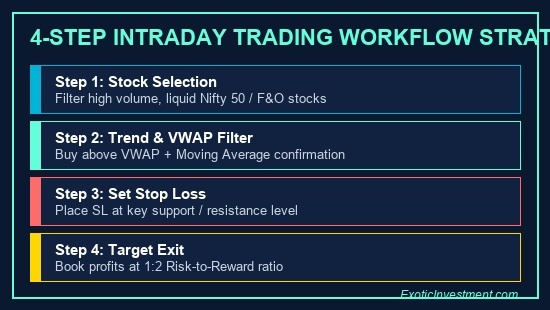
Illustration 2: 4-Step Intraday Trading Strategy Workflow Diagram
Step 3: Brokerage, Taxes & Regulatory Charges
Intraday trading profits are not exempt from statutory tax liabilities under Indian tax law. The Income Tax Department classifies intraday share trading gains as Speculative Business Income under Section 43(5). Therefore, all realized profits are added to your gross total income and taxed at your applicable slab rates.
In addition to income taxes, brokers deduct Securities Transaction Tax (STT) at 0.025 percent on equity sell transactions. State stamp duty, exchange turnover fees, SEBI turnover charges, and 18 percent GST on brokerage also apply. Read our updated overview on what is STT in share market to verify transaction costs.
You can calculate your net post-tax earnings quickly using our stock profit calculator. If you balance day trading with systematic long-term investing, project your multi-year compounding with our SIP calculator.
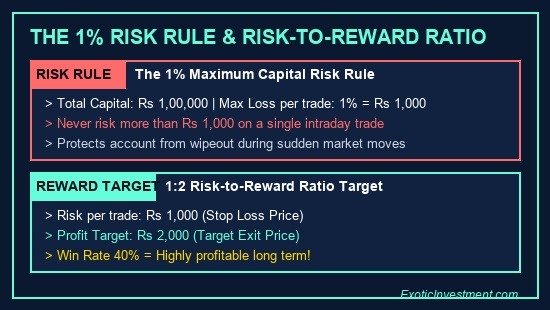
Illustration 3: 1 Percent Risk Rule and Risk-to-Reward Ratio Diagram
Step 4: Master the 1% Capital Risk Rule
Capital preservation is the ultimate rule of longevity in Dalal Street. Professional traders never risk more than one percent of their total trading capital on any single setup. Because unexpected market spikes occur regularly, risking larger fractions guarantees eventual account ruin.
For example, if your total trading capital stands at ₹1,00,000, your maximum permissible loss per trade equals ₹1,000. When your technical chart setup requires a ₹5 stop-loss buffer, you purchase exactly 200 shares. Thus, adhering to strict mathematical position sizing shields your psychology from catastrophic drawdowns.
Before executing live orders, calculate your exact trade boundaries using our stop loss calculator. To monitor both Indian equities and multi-asset wealth simultaneously, track your progress on the eMintage portfolio tracker.
Structured Education: Recommended Courses & Books
Investing in structured market education accelerates your learning curve and saves tens of thousands in preventable market tuition. If you desire structured guidance, explore our flagship educational resources designed for Indian market enthusiasts.
Featured Investor Education Resources:
- Basics of Stock Market Course: Build your foundational market knowledge from basic candlestick patterns to technical setups: Basics of Stock Market Course.
- Options Buying Course in Kannada: Master directional index setups and breakout timing in regional language: Options Buying Course in Kannada.
- Kaliyiri Share Market Rocket Book: Study Dr. Ashok Kumar N Rao’s bestselling guide on Dalal Street compounding: Kaliyiri Share Market Book.
Frequently Asked Questions — How to Start Intraday Trading in India
How to select stock for intraday one day before?
Select stocks the previous evening by screening Nifty 100 constituents for multi-day consolidations or NR7 patterns on daily charts. Verify that the stock has a Beta above 1.2 and daily volume exceeding two million shares, then mark key support and resistance levels.
Which is the best app for intraday trading in India?
Zerodha Kite and Upstox Pro are widely regarded as the best apps for intraday trading in India due to their ultra-low latency, TradingView charting, and reliable order routing. Active scalpers prefer Upstox for built-in option chains, while Zerodha provides an exceptionally clean charting workspace.
What is the minimum capital needed to start day trading?
You can start day trading with ₹5,000 to ₹10,000 using 5x MIS margin on liquid large-cap stocks. However, beginners should trade single-share lots initially to build psychological discipline before committing substantial savings.
What happens if I forget to close my MIS trade before 3:15 PM?
If an MIS order remains open past 3:15 PM, your broker’s automated risk management system forcibly squares off the trade at prevailing market prices. In addition to regular brokerage, you will be billed an auto-square-off penalty fee typically ranging from ₹50 plus GST per order.
How is intraday trading income taxed in India?
Intraday equity profits are classified as Speculative Business Income under Section 43(5) of the Income Tax Act. Consequently, net profits are added directly to your personal taxable income and taxed at your applicable income tax slab rates.