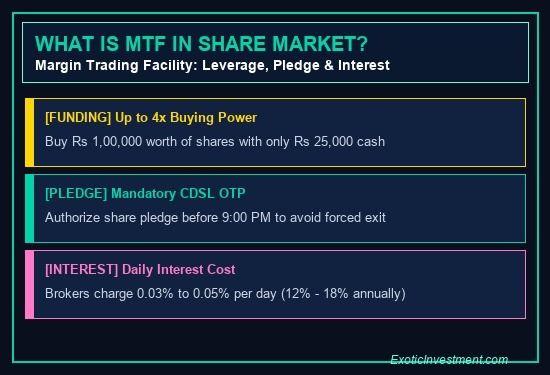
Listen, boss, imagine spotting a high-conviction breakout stock, but having only ₹25,000 cash in your trading account. If you want to buy ₹1,00,000 worth of shares and hold them for months, you must understand what is mtf in share market. Discount brokers like Zerodha, Groww, Angel One, and m.Stock aggressively market Margin Trading Facility (MTF) to retail investors. They promise up to 4x buying power with instant funding. But here is the real deal: borrowed capital cuts both ways. If the stock rallies, you make 4x profits. If the stock crashes, broker margin calls can wipe out your capital in days. Before checking live LTP, CMP, and ATP stock price terms, let’s keep it simple. Here is how MTF works step by step under strict SEBI guidelines.
What is MTF in Share Market? The Core Definition
MTF stands for Margin Trading Facility. It is an exchange-approved funding product that allows investors to buy eligible equity shares by paying only a fraction of the total order value.
Your stockbroker funds the remaining balance. For example, if a stock requires a 25% upfront margin, you pay ₹25,000 cash, while your broker funds ₹75,000. You buy ₹1,00,000 worth of shares immediately.
Unlike intraday MIS orders that forcibly close at 3:15 PM, MTF allows you to hold your shares for days, weeks, or even years. As long as you pay daily interest and maintain margin, your position remains open. If you want to compare MTF against standard cash delivery, read our complete guide on delivery shares and CNC order execution.
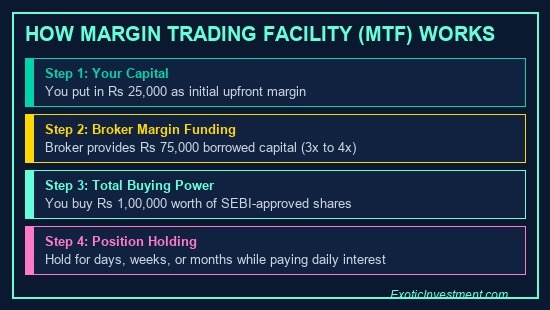
Illustration: How Margin Trading Facility (MTF) 4x Buying Power Works Step by Step
How Margin Trading Facility (MTF) Works in Practice
Let’s look at a realistic trading floor example to understand how MTF operates on your broker app:
Suppose you want to invest ₹2,00,000 in State Bank of India shares. In a standard CNC delivery trade, you must have ₹2,00,000 full cash sitting in your account.
With MTF, your broker requires roughly 25% margin on large-cap Group 1 stocks. You contribute ₹50,000 from your funds. Your broker lends you the remaining ₹1,50,000. You now hold ₹2,00,000 worth of SBI shares.
If SBI shares rise 10%, your position value climbs to ₹2,20,000. You book a ₹20,000 profit on an initial capital of ₹50,000. That equals a massive 40% return on your invested money!
However, what happens if the stock price hits a lower limit? To understand volatility risk, read our guide on circuit limits and trading halts.
SEBI MTF Pledge Rules: The Mandatory CDSL OTP Process
Under SEBI regulations, you cannot simply buy MTF shares and forget about them. SEBI mandates a strict Demat pledge process to protect investor holdings:
1. Trade Execution (T Day): You place an order using the MTF product code on your broker app before market close at 3:30 PM.
2. CDSL / NSDL Pledge Link: Between 4:00 PM and 8:30 PM on the same day, you receive an SMS and email notification from the depository containing a secure authorization link.
3. OTP Authorization Before 9:00 PM: You MUST click the link, verify your PAN, and enter the OTP to authorize pledging the shares in favor of your broker. This deadline is 9:00 PM on T day.
4. Auto-Square-Off Penalty: If you fail to authorize the pledge before 9:00 PM, your broker forcibly sells your shares on T+1 day! In addition, brokers charge an unpledged penalty fee.
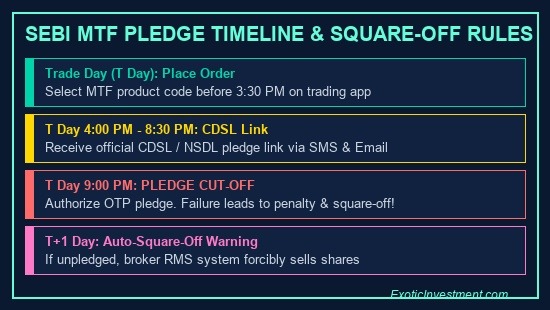
Illustration: SEBI MTF Pledge Timeline: CDSL OTP Authorization and T+1 Square-Off Rules
MTF Interest Rates and Holding Costs Explained
Brokers are financial institutions, not charities. When they lend you money under MTF, they charge interest for every single day you hold the position:
First, interest rates typically range from 9.99% to 18% per annum, depending on your broker and capital size.
Second, interest is calculated on a daily basis (roughly 0.03% to 0.05% per day). For example, if you borrow ₹1,00,000 at 15% per annum, you pay approximately ₹41 per day. Over 30 days, your interest cost totals ₹1,230.
Third, brokers levy a one-time pledge creation charge (₹20 to ₹30 + GST) and a pledge closure charge when you exit. Calculate your net trading costs after broker charges using our free Zerodha Brokerage Calculator, and estimate your tax liabilities with our Stock Market Tax Calculator.
Understanding Margin Calls and Forced Liquidation Risks
This is where retail investors get caught off guard. When you buy shares on borrowed margin, your broker monitors your position value in real time:
1. Maintenance Margin: SEBI rules require brokers to maintain a minimum margin buffer (usually 20% to 25%). If your purchased stock falls in price, your equity margin erodes first.
2. Margin Call Alert: When your available margin drops below the maintenance threshold, your broker issues an urgent Margin Call via SMS and email. You must deposit fresh cash or transfer approved shares as collateral before the specified cut-off time.
3. Forced RMS Liquidation: If you fail to bring fresh funds, the broker forcibly sells your shares to recover their loan. You suffer realized capital loss with zero control over exit timing.
To avoid dangerous over-allocation, always calculate risk-adjusted capital allocation with our free Position Size Calculator, and check business valuations using our PE Ratio Calculator.
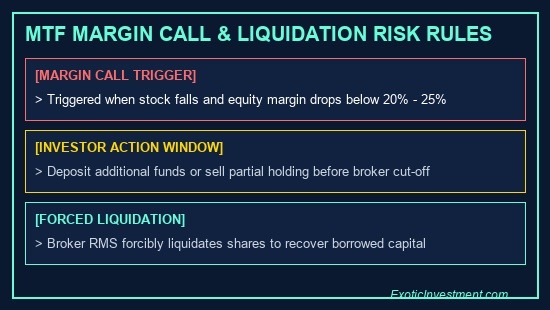
Illustration: MTF Margin Call Trigger Levels and Forced Liquidation Rules
MTF vs Intraday MIS vs Standard CNC Delivery
To choose the right product code, compare the three primary trading modes on Indian exchanges:
1. Standard CNC Delivery: Requires 100% upfront cash. Shares credit to your Demat under India’s T+1 settlement cycle. Zero interest charges, zero margin calls, and zero forced exits.
2. Intraday MIS: Requires only 20% margin (5x buying power). However, all positions must close before 3:15 PM on the same day. No overnight holding allowed.
3. MTF Margin Facility: Requires 20% to 25% margin with multi-day holding capability. However, daily interest applies, and shares must be pledged via CDSL OTP.
Recommended Trading Education & Stock Market Books
If you want to use margin tools effectively without risking capital wipeouts, structured education is your best asset:
Master chart patterns and trend timing in our Technical Analysis Course in Kannada, or build foundational market skills with our Basics of Stock Market Course. If you trade options, explore our Options Buying Course in Kannada.
Kannada readers can also grab Ashok Kumar N Rao’s bestselling Kaliyiri Share Market Book, or explore the English edition on the Basics of Indian Stock Market Book page. For weekly research stock picks, subscribe to our MultiBagger Plus Courses & Pro Tools Annual Subscription. Also check out Emintage financial calculators for external financial modeling tools.
Frequently Asked Questions — What is MTF in Share Market
FAQ 1: What is MTF in share market and how does it work?
MTF (Margin Trading Facility) is a broker funding feature that lets you buy eligible equity shares by paying only 20% to 25% upfront cash. Your broker funds the remaining 75% to 80%, allowing you to hold shares for days or months while paying daily interest. Check trade costs using our free Zerodha Brokerage Calculator.
FAQ 2: What is the mandatory CDSL pledge rule in MTF?
Under SEBI regulations, shares bought under MTF must be pledged in favor of the broker via a CDSL OTP authentication link before 9:00 PM on trade day (T day). Failure to complete OTP verification leads to forced auto-square-off on T+1 day. Read our guide on delivery shares and CNC orders to understand standard settlement.
FAQ 3: How much interest do brokers charge on MTF funding?
Discount and full-service brokers charge between 9.99% and 18% per annum on the borrowed funding amount. Interest is calculated daily (around 0.03% to 0.05% per day) until you square off the position. Estimate your long-term compounding with our Lumpsum Investment Calculator.
FAQ 4: What triggers a margin call in MTF trading?
A margin call triggers when your purchased stock drops in price and your available margin coverage falls below the required maintenance level (typically 20% to 25%). If you do not deposit fresh funds, the broker forcibly liquidates your holding. Calculate risk-adjusted capital limits using our Position Size Calculator.
FAQ 5: Which stocks are eligible for Margin Trading Facility in India?
SEBI permits MTF only on approved Group 1 securities that meet strict liquidity and market capitalization standards. Penny stocks, SME shares, and highly volatile counters are strictly excluded from MTF. Master stock selection rules in our Technical Analysis Course in Kannada.
FAQ 6: How is income from MTF share sales taxed in India?
Gains from MTF trades held for less than 12 months are treated as Short-Term Capital Gains (STCG) taxed at 20%. Gains held over 12 months qualify as LTCG taxed at 12.5% on profits exceeding ₹1.25 Lakh. Interest paid on MTF cannot be deducted against capital gains. Calculate your net tax liability with our Stock Market Tax Calculator.