
Want to figure out how to invest in pre ipo shares without getting ripped off? Let’s cut the fluff right out of the gate. On public stock exchanges, you buy and sell in milliseconds at fluctuating stock price terms. You punch an order into your trading app, and the trade fills. Pre-IPO investing does not work that way. You are buying equity in private companies before their draft red herring prospectus hits regulator desks.
👨🏫 Real Market Experience & SEBI Disclosure: Written by Dr.Ashok Kumar N Rao and the Exotic Investment research desk based on 12+ years of active market trading. All insights follow SEBI investor education guidelines. Exotic Investment does not provide unsolicited tips or PMS services. Always test trading setups with disciplined position sizing before risking live capital.
Look, don’t fool yourself. A lot of retail traders think pre-IPO deals are reserved strictly for Silicon Valley venture funds or deep-pocketed billionaires. That was true ten years ago. Today, the private share market has opened up to regular folks. You can get started with as little as ₹10,000 to ₹50,000 if you know which verified platforms to use.
Here is the straight scoop. Early backers in names like Tata Technologies, Swiggy, and the National Stock Exchange scored jaw-dropping gains before public bidding ever opened. But if you jump in blind, you will lose your shirt. You must run the private valuation through our PE ratio calculator to see if the asking price makes sense compared to listed peers. Let’s walk through the verified portals, the exact Demat settlement steps, and the hard rules you must follow.
Top Verified Platforms to Invest in Pre-IPO Shares in India
Here is the bottom line. You cannot just open Zerodha or Groww and search for an unlisted stock ticker. Unlisted equities do not trade on the public exchange order book. Instead, you trade through verified unlisted equity portals and private share desks.
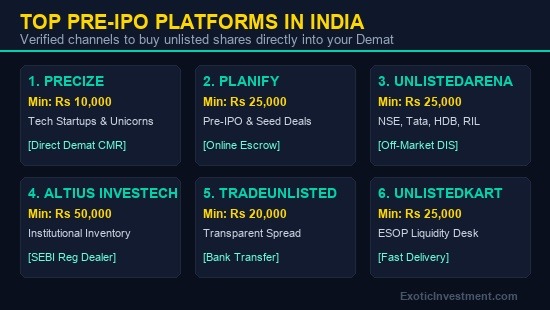
Illustration: Top verified pre-IPO platforms in India comparing ticket size, inventory, and settlement routes.
If you want real deal flow, here are the top verified platforms where individual investors can actually apply today:
1. Precize (precize.in)
Precize is easily one of the slickest fintech portals around for retail investors. They specialize in high-growth tech startups and private unicorns. The minimum ticket size starts around ₹10,000. That makes it super easy to test the waters without betting the farm. You finish quick digital KYC, pick your shares, pay online, and the stock credits your Demat account.
2. Planify (planify.in)
Planify is a heavy hitter in the startup discovery and unlisted investment game. They cover early seed rounds, fast-growing mid-stage businesses, and late-stage pre-IPO candidates. Minimum tickets generally sit between ₹25,000 and ₹50,000. Planify gives you detailed cap tables, founder backgrounds, and projection models before you wire a single dime.
3. UnlistedArena (unlistedarena.com)
UnlistedArena is the go-to over-the-counter desk for mature unlisted giants. If you want bluechip private names like National Stock Exchange (NSE), Tata Capital, HDB Financial Services, or Reliance Retail, start here. Minimum tickets usually run between ₹25,000 and ₹50,000. Settlement happens cleanly through off-market depository transfers.
4. Altius Investech (altiusinvestech.com)
Altius Investech is an old-school, trusted player with deep roots in private wealth networks. They provide clean bid-ask quotes and institutional research reports. The typical entry ticket starts around ₹50,000. They transfer shares directly into your Demat account while keeping compliance airtight.
5. TradeUnlisted (tradeunlisted.com)
TradeUnlisted connects buyers and sellers through verified escrow mechanisms. They offer clear pricing and zero hidden transfer fees. Minimum buy-ins range from ₹20,000 to ₹50,000. They focus heavily on financial services, consumer goods, and green energy plays.
6. UnlistedKart (unlistedkart.com)
UnlistedKart focuses on employee stock option (ESOP) liquidity. They buy blocks of stock directly from startup employees who want cash today. That means you can snag equity in hot startups that are completely sold out on regular dealer sheets.
7. Institutional Pre-IPO Funds (InCred Money, 360 ONE)
If you are an HNI with ₹25 Lakh to ₹1 Crore to put to work, SEBI-registered Category II Alternative Investment Funds (AIFs) are the institutional route. Professional portfolio managers handle the heavy lifting and due diligence. Many wealthy investors who track alternative assets also monitor digital asset swings using a crypto portfolio tracker and test potential upside on a Bitcoin profit calculator over at Emintage to balance their high-risk bets.
| Platform | Min Ticket Size | Primary Inventory | Settlement Route |
|---|---|---|---|
| Precize | ₹10,000 | Tech unicorns, digital startups | Direct CDSL/NSDL Off-Market |
| Planify | ₹25,000 | Seed to pre-IPO startups | Escrow Bank Transfer to Demat |
| UnlistedArena | ₹25,000 | NSE, Tata Capital, HDB Financial | DIS / e-DIS Depository Credit |
| Altius Investech | ₹50,000 | Bluechip unlisted leaders | CMR Direct Demat Transfer |
| TradeUnlisted | ₹20,000 | Mid-market unlisted stocks | Escrow Verified Settlement |
Step-by-Step Buying Process: How Pre-IPO Shares Reach Your Demat
A lot of beginners ask me if they need some fancy private depository to store unlisted shares. Not at all. Your unlisted shares land right inside the exact same Zerodha, Groww, AngelOne, or Upstox account you already use for ordinary trades. You just need to understand basic Demat account terms like your 16-digit BO ID and DP ID.
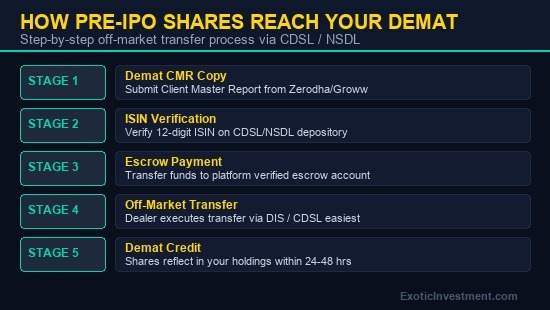
Illustration: 5-stage off-market Demat transfer mechanism for Indian pre-IPO share settlement.
Here is the exact step-by-step playbook to make it happen:
Step 1: Grab Your Client Master Report (CMR)
Log in to your broker’s dashboard and download your CMR copy. Your CMR is a digitally stamped document from CDSL or NSDL. It lists your 16-digit Demat number, DP ID, PAN, and verified bank account. Unlisted platforms need this document to make sure the seller transfers shares to the right human being.
Step 2: Sign Up and Pass KYC
Create an account on your chosen platform like Precize or Planify. Upload your PAN card, Aadhaar, bank statement, and that CMR PDF. Verification usually clears in under a couple of hours.
Step 3: Check the Official ISIN Code
Don’t skip this step. Every legit company in India has a unique 12-digit International Securities Identification Number (ISIN). For instance, National Stock Exchange unlisted shares carry ISIN INE700A01033. Check this code against NSDL and CDSL records before you pay. That keeps scammers from selling you fake paper.
Step 4: Wire the Cash Through Verified Escrow
Once you lock in your share count and price, send your payment via NEFT or RTGS. Always wire funds to the platform’s registered corporate account or verified escrow partner. Never, under any circumstances, send cash to personal UPI handles or random phone numbers.
Step 5: The Seller Executes an Off-Market Transfer
Unlike standard share delivery rules where the exchange clearinghouse handles everything automatically, here the seller files a Delivery Instruction Slip (DIS) or executes an online transfer via CDSL, which is easiest. That moves the equity directly to your Demat ID.
Step 6: Confirm the Demat Credit
Within 24 to 48 hours, CDSL or NSDL will send you an SMS alert confirming the off-market credit. Open your Zerodha or Groww console, and you will see the company name sitting in your holdings. The price stays fixed until your broker updates periodic valuation marks.
SEBI 6-Month Mandatory Lock-in Rules for Pre-IPO Investors
Here is where amateur investors get caught flat-footed. You cannot buy pre-IPO shares and dump them into the opening bell on listing day. SEBI has strict rules about this.
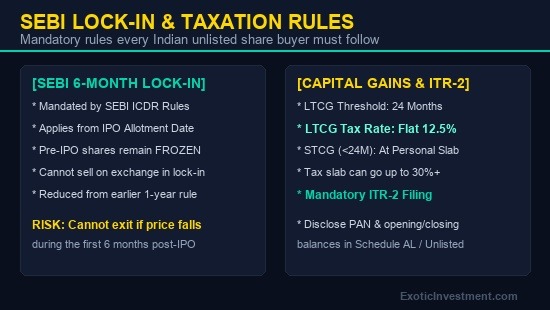
Illustration: SEBI 6-month lock-in rules and capital gains tax brackets for unlisted equity investors.
Under SEBI regulations, all pre-IPO equity held by non-promoters gets hit with a mandatory 6-month lock-in. That clock starts ticking on the exact date of IPO allotment. In the past, SEBI enforced a brutal 1-year lock-in. They trimmed it down to 6 months to give retail investors better liquidity.
During these six months, your shares are frozen solid in your Demat account. Even if the stock opens at a massive premium and suddenly plunges toward circuit breaker limits, you cannot hit the sell button. You are along for the ride.
Many traders keep tabs on the unlisted grey market premium before an IPO to gauge opening sentiment. But remember, grey market hype doesn’t protect you from post-listing drawdowns during your mandatory lock-in period. Once the 6-month window wraps up, your depository unlocks your position. From that morning onward, you can trade them on the open market like any ordinary stock.
Taxation Rules for Pre-IPO Shares in India (Budget 2024 / 2026)
Taxes on unlisted shares will surprise you if you only know public market rules. With listed equities, long-term capital gains kick in after 12 months. With unlisted shares, you must hold for at least 24 months to qualify for long-term rates.
Here is how the taxman cuts the pie:
- Long-Term Capital Gains (LTCG): Hold your pre-IPO shares for more than 24 months, and your gains get taxed at a flat 12.5% without indexation perks.
- Short-Term Capital Gains (STCG): Sell your unlisted shares before 24 months, and your profits get lumped into your personal income. You pay your regular income tax slab rate. If you sit in the 30% bracket, you pay 30% plus cess and surcharge.
- Post-Listing Sale Tax Rules: If the company lists, you clear the 6-month lock-in and sell on the exchange with STT paid; listed tax rules take over. That means gains qualify under Section 112A at 12.5% on profits over ₹1.25 Lakh. You can calculate your exact net bill using our stock market tax calculator.
- Mandatory ITR-2 Filing: You cannot file simple ITR-1 forms if you hold private equity. The tax department forces you to file ITR-2 or ITR-3. You must list the company name, PAN, opening count, new shares bought, and year-end holdings under Schedule AL. If you trade digital assets alongside equities, test your liabilities with a crypto tax calculator to keep all your asset filings clean.
Major Risks to Watch Before Buying Pre-IPO Shares
Let’s get real about the downsides. Private equity can build massive wealth, but it can also trap your cash if you don’t keep your eyes wide open.
1. Cold, Hard Illiquidity
Public stocks trade instantly on live order books. Unlisted shares do not. If you run into an unexpected cash crunch next week, finding an off-market buyer willing to pay fair value can take months. Never put emergency cash here. Keep your baseline savings growing steadily with a disciplined SIP calculator approach instead.
2. The Private Valuation Trap
Private founders love pitching sky-high valuations during venture funding rounds. But public markets don’t care about startup hype. Look at what happened with famous busts like Paytm, Byju’s, or PharmEasy. Retail buyers who paid crazy multiples during peak excitement saw their capital take a 70% to 90% beating. Always test realistic compounding targets with a reverse CAGR calculator before writing a check.
3. Delayed or Scrapped IPOs
A startup might promise an IPO by year-end, but bad market conditions or regulator pushback can push that timeline back three or four years. Some firms pull their filings entirely. Be ready to hold your shares for three to five years without panic.
4. Outright Fraud on Shady Groups
Dozens of sketchy Telegram groups and WhatsApp rooms peddle fake unlisted shares. Unsuspecting buyers wire money and get ghosted. Stick to registered platforms like Precize, Planify, or UnlistedArena. Always size each position prudently using our position size calculator so no single private bet can damage your financial health.
Recommended Trading Courses & Premium Subscriptions:
- Options Buying Course in Kannada: Options Buying Course in Kannada.
- Technical Analysis in Kannada Course: Technical Analysis in Kannada Course.
- Kaliyiri Share Market Book: Kaliyiri Share Market Book.
- Basics of Stock Market Course: Basics of Stock Market Course.
- Multibagger Stocks Pro Subscription: MultiBagger Plus Courses & Pro Tools Annual Subscription.
Frequently Asked Questions on How to Invest in Pre IPO Shares
1. Can I buy pre-IPO shares using my existing Zerodha or Groww account?
Yes, absolutely. You don’t place orders on the broker app, but shares land in your Demat. You send your Client Master Report (CMR) to the unlisted platform, and the seller transfers shares directly to your 16-digit Demat ID.
2. What is the minimum amount required to invest in pre-IPO shares in India?
On retail portals like Precize, Planify, and TradeUnlisted, entry tickets range between ₹10,000 and ₹50,000. Institutional pre-IPO AIF funds start at ₹25 Lakh. You can use our reverse CAGR calculator to test your target portfolio gains before jumping in.
3. Can I sell pre-IPO shares immediately on listing day?
No chance. SEBI ICDR rules enforce a strict 6-month lock-in starting from the IPO allotment date. Your shares stay locked in your Demat account. You can trade them freely on the exchange once the 6-month lock-in wraps up. Review exchange selling mechanics in our how to sell SME IPO shares and Demat liquidity guide.
4. How do I make sure unlisted shares are 100% genuine?
Always verify the company’s 12-digit ISIN code on the official NSDL or CDSL portal. Make sure your wire goes to a verified corporate bank account, and demand a stamped deal sheet. Within 48 hours, check for your official depository SMS alert from CDSL or NSDL.
5. Do I have to pay tax on unlisted shares if I just hold them?
No, you only pay taxes when you sell. However, holding unlisted equity requires mandatory disclosure under Schedule AL of Form ITR-2 when filing annual tax returns. You can model your potential post-tax numbers with our stock market tax calculator.