
What is a Depository in Indian Stock Market? NSDL vs CDSL Explained
👨🏫 Real Market Experience & SEBI Disclosure: Written by Dr.Ashok Kumar N Rao and the Exotic Investment research desk based on 12+ years of active market trading. All insights follow SEBI investor education guidelines. Exotic Investment does not provide unsolicited tips or PMS services. Always test trading setups with disciplined position sizing before risking live capital.
Listen, boss, let’s keep it simple here. A depository in stock market is basically like a bank locker, but for your shares and securities. You don’t hold physical certificates anymore. Everything is in demat form.
The two main depositories in India are NSDL and CDSL. These were set up by SEBI, so there is zero risk of fraud on that front. Your broker gives you a DP account, which means Demat Account.
You might see “what is dp in share market” floating around forums. It just stands for Depository Participant. A DP is the intermediary between you and the depository. Think of it as the branch of a bank in this system.
When you buy shares through Zerodha or Groww or Upstox, your shares land in your demat account automatically within T+1 settlement. That’s the current SEBI rule since July 2023. Fast, right?
Similarly, when you sell, shares get debited from your demat account instantly after the trade executes. The money settles in your bank account instead.
This whole system replaced paper shares back in the late 1990s. Physical certificates meant forgery risk, stamp duty headaches, and delayed transfers. Now it’s all electronic. Much cleaner.
Why Understanding Depository Terms Protects Your Share Ownership
Here’s the thing. Without a demat account, you cannot trade equities in India anymore. It’s mandatory. SEBI made it compulsory way back in 2005. So if you want to invest or trade, opening a DP account is your first step.
Also, holding shares in demat form unlocks several advantages that physical holders never got:
Quick transfer and easy pledge creation for margin trading. This is huge for intraday traders who need collateral quickly.
Auto-credit of corporate benefits. When a company declares bonus, rights, or dividends, they go straight into your demat account. No chasing paper forms.
Safety from theft or damage. A locker can burn or be stolen. A digital record cannot. Period.
If you are checking “what is bo id in share market”, you’re probably looking at how demat accounts connect across platforms. BO ID stands for Beneficiary Owner ID. It’s your unique account number given by CDSL or NSDL. Zerodha uses it, Groww uses it, every broker uses it. It links your broker account to your demat holding.
Another practical benefit: you can pledge shares directly from your broker app for margin requirements. This means you don’t need extra cash for margin-funded trades.
However, there is a small caveat. If you hold too many physical certificates still lying around at home from before 2005, convert them. Old physical shares can become problematic during transfers. Use the depository process to dematerialize them now.
BO ID, DP ID, ISIN & POA/DDPI Explained Simply
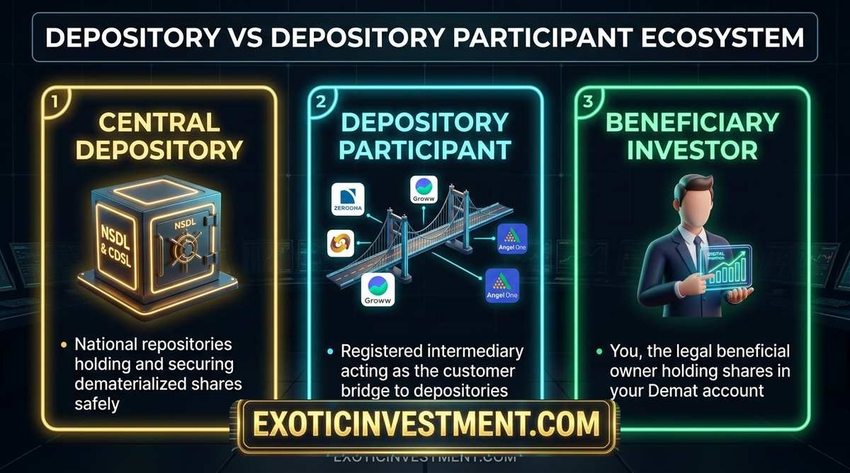
Illustration: Depository vs Depository Participant Ecosystem
Let’s break down the terms you will actually use on a daily basis. First, demat account. This is your electronic wallet for shares, bonds, ETFs, mutual fund units, and even government securities. Every holding lives here.
Second, DP account number. Also called Client ID. When you open an account with any broker, they provide this number. It looks like a long string of digits. Write it down somewhere safe.
Third, ISIN. This is the International Securities Identification Number assigned to each security. Every share has a unique ISIN. You’ll see it on your holding statement always.
Fourth, pledge and unpledge. When you lock your shares as margin, that’s a pledge request. If you need the shares back, you raise an unpledge request through the same broker app.
Fifth, NSDL versus CDSL. NSDL was the first depository, set up in 1996. CDSL came later in 1999. Most brokers now support both. You won’t notice much difference practically.
If you ever wonder about settlement periods, remember T+1. Trade on Monday, shares credited by Tuesday. That’s the current standard across NSE and BSE since the SEBI mandate changed in 2023.
In fact, SEBI also introduced the concept of PIS (Portfolio Investment Scheme) accounts for foreign investors. NRIs use those to invest in Indian markets through their designated bank accounts. Just FYI if you help overseas relatives with trading.
How to Apply This Knowledge Step by Step
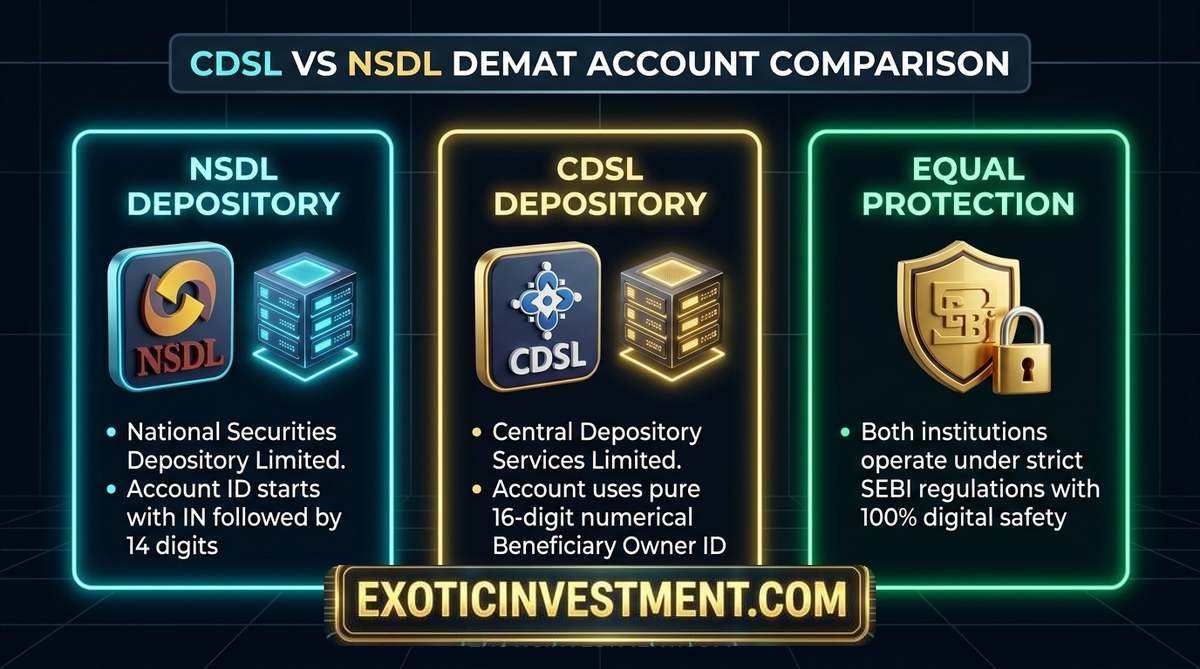
Illustration: CDSL vs NSDL Demat Account Comparison
Let’s walk through this together. First, pick a broker who offers DP services. Zerodha, Groww, and Upstox are popular choices among retail traders. Compare their annual maintenance charges. Some charge ₹400 yearly, some waive it for active traders.
Second, complete KYC. Aadhaar, PAN, bank account linked, and a selfie verification. All done online now. Takes maybe 10 minutes. After approval, you get your Client ID and BO ID.
Third, link your bank account for UPI auto-payments and withdrawal facility. Never skip this step because you cannot withdraw funds without a linked bank account.
Fourth, make your first purchase. Buy one share, say Reliance or Tata Steel. Watch the shares reflect in your portfolio within one business day. That moment feels good, trust me.
Fifth, explore pledge functionality. Go to your broker app, find the pledge option, and try locking a small quantity of shares. See how margin becomes available instantly. This skill pays off when you trade intraday or futures and options.
Also, always cross-check your holdings against your contract notes after every trade. Reconciliation prevents errors. A missed delivery notification once cost a trader thousands of rupees. Don’t ignore confirmations.
Recommended Trading Courses & Premium Subscriptions:
- Options Buying Course in Kannada: Options Buying Course in Kannada.
- Technical Analysis in Kannada Course: Technical Analysis in Kannada Course.
- Kaliyiri Share Market Book: Kaliyiri Share Market Book.
- Basics of Stock Market Course: Basics of Stock Market Course.
- Multibagger Stocks Pro Subscription: MultiBagger Plus Courses & Pro Tools Annual Subscription (Checkout link: MultiBagger Plus Courses & Pro Tools Annual Subscription).
Common Mistakes and How to Avoid Them
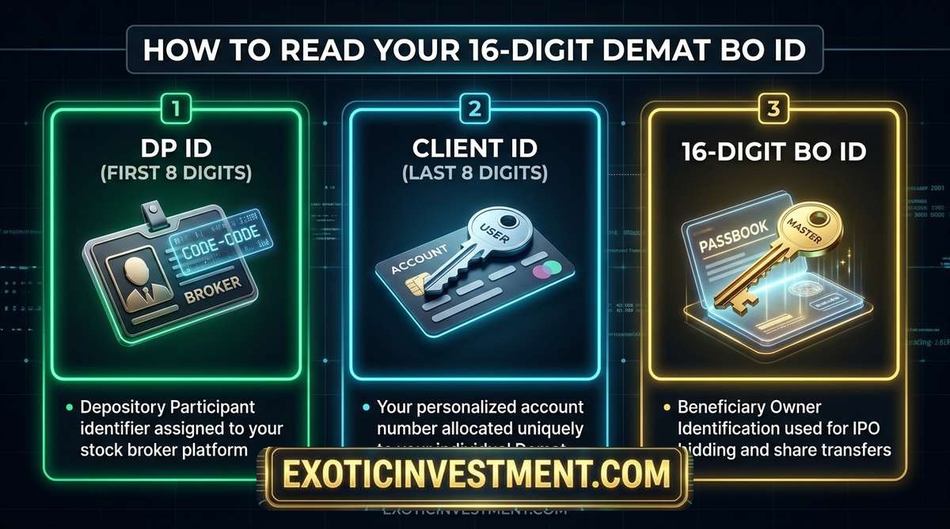
Illustration: How to Read Your 16-Digit Demat BO ID
Many new traders make avoidable mistakes right at the start. Here are the big ones I have seen repeatedly across our community.
Mistake one: not reviewing demat statements. Some people open their broker app once a month and assume everything is fine. Wrong. Check your holdings every week. Mismatched entries can hide inside bulk transfer errors.
Mistake two: forgetting pledge limits. A lot of intraday traders blindly pledge all their holdings without calculating breathing room. This traps them when the market moves against their positions. Always leave some unpledged shares as emergency buffer.
Mistake three: ignoring STT and GST on delivery trades. When you buy delivery shares, Securities Transaction Tax applies. If you square off before the next day, no STT. Understanding this saves serious money over time.
Mistake four: mixing demat and savings concepts. A demat account holds shares. A savings account holds cash. They are separate. Money in your savings won’t show in your demat and vice versa. Never confuse the two screens.
Mistake five: not updating bank details. If your bank account changes mid-year, update it in your broker portal immediately. Otherwise dividend payouts bounce back and forth. Annoying and delays reinvestment.
If you want to protect your capital from these kinds of mistakes, use a stop loss calculator before entering any trade. It keeps emotion out of the picture.
Advanced Trading Tips to Master This Topic
Now let’s go deeper. Experienced traders treat their demat account as a strategic asset, not just a storage locker.
Tip one: build a core-satellite portfolio in demat. Keep 60 to 70 percent in stable large caps for pledge-based margin. Use the remaining 30 to 40 percent for high-beta swings. This balance protects you during drawdowns while letting you profit from momentum.
Tip two: track your average buy price using a proper calculator. Know your exact cost basis before pledging. Don’t guess. Use our stock profit calculator to check realistic targets before entering.
Tip three: understand SIP in equity. Yes, you can automate monthly investments through SIP calculators. Regular investing reduces timing risk significantly.
Tip four: use pivot point analysis alongside your holdings. If you hold a stock near its weekly pivot resistance, consider partial profit booking before earnings season. Our pivot point calculator helps spot these levels fast.
Tip five: minimize brokerage drag. Check broker charges before you switch. Compare Zerodha brokerage, Upstox brokerage, and others based on your actual trading frequency. High-frequency traders should go for flat-fee plans. Long-term investors prefer zero-brokerage equity trades.
Finally, never forget risk management. A depository makes it easy to trade, but easy doesn’t mean profitable. Stick to your position sizing rules. Never risk more than two percent of your capital on a single trade. That discipline separates consistent winners from gamblers every single time.
Final Summary
So here is the bottom line. A depository in stock market is your electronic vault for all securities. NSDL and CDSL run the system under SEBI supervision. Your broker acts as the Depository Participant or DP, giving you a Client ID and BO ID.
Demat format gives speed, safety, and convenience that physical certificates never could. Auto-credited bonuses, instant pledge availability, and T+1 settlements make modern trading possible for millions of Indians.
Open your account, keep your KYC updated, review your holdings weekly, pledge wisely, and always pair your demat knowledge with solid risk management. That combination builds a foundation most traders never bother creating.
Start small. Learn the tools. Scale gradually. The market rewards those who respect the system. Happy trading!
💡 Frequently Asked Questions (FAQ)
What is the difference between NSDL and CDSL in India?
NSDL is India’s oldest depository primarily promoted by NSE, while CDSL is promoted by BSE. Both are strictly regulated by SEBI and maintain electronic records of your shares. Learn about regulatory oversight in our who regulates the Indian stock market guide.
What is a BO ID and where can I find it in my broker app?
BO ID (Beneficiary Owner Identification) is your unique 16-digit Demat account number. In CDSL it is a single 16-digit number, while in NSDL it is ‘IN’ followed by 14 digits. You can locate it under profile settings in your stock broker apps in India.
Are my shares safe if my stock broker goes bankrupt?
Yes. Your shares are held directly with NSDL or CDSL in your BO ID, not in your broker’s bank account. Even if your broker faces bankruptcy, your securities remain completely safe. Review share custody details in our delivery, BTST, and CNC trade guide.
When are DP charges deducted from your trading account?
Depository Participant (DP) charges (typically ₹13.5 to ₹20 + GST per stock per day) are deducted whenever you sell delivery shares from your Demat account. See complete tariff breakdowns in our brokerage charges in India guide.
How can investors monitor their total holdings across multiple brokers?
You can track your entire portfolio across all brokers through CDSL easiest or NSDL IDeAS portals, and use our institutional research tools via the MultiBagger Plus Courses & Pro Tools Annual Subscription.