Listen, boss, if you are actively trading or investing in equities, looking strictly at the headline broker fee is a dangerous mistake. For example, many beginners see flashy advertisements promising zero commissions or flat ₹20 trades. Consequently, they assume trading costs are practically zero. But when the daily contract note arrives, they wonder why their profits vanished. This is why understanding brokerage charges in india and learning LTP, CMP, and ATP stock price terms is vital for long-term trading survival.
Here is the real deal: your true trading friction does not just go to your broker. In fact, on high-turnover intraday or derivative trades, broker fees make up less than 30% of total deductions. The remaining 70% goes straight to statutory government taxes like Securities Transaction Tax (STT), exchange turnover levies, stamp duty, and GST. So, let us keep it simple and break down every single paisa so you can protect your capital using our Indian stock brokerage calculator.
The Anatomy of Trade Costs: Brokerage vs Regulatory Taxes
Now, when you place an order on your trading terminal, your capital faces two distinct cost layers: Broker Commissions and Statutory Regulatory Taxes. However, while you can reduce broker fees by choosing an efficient discount broker, statutory levies are legally non-negotiable across India.
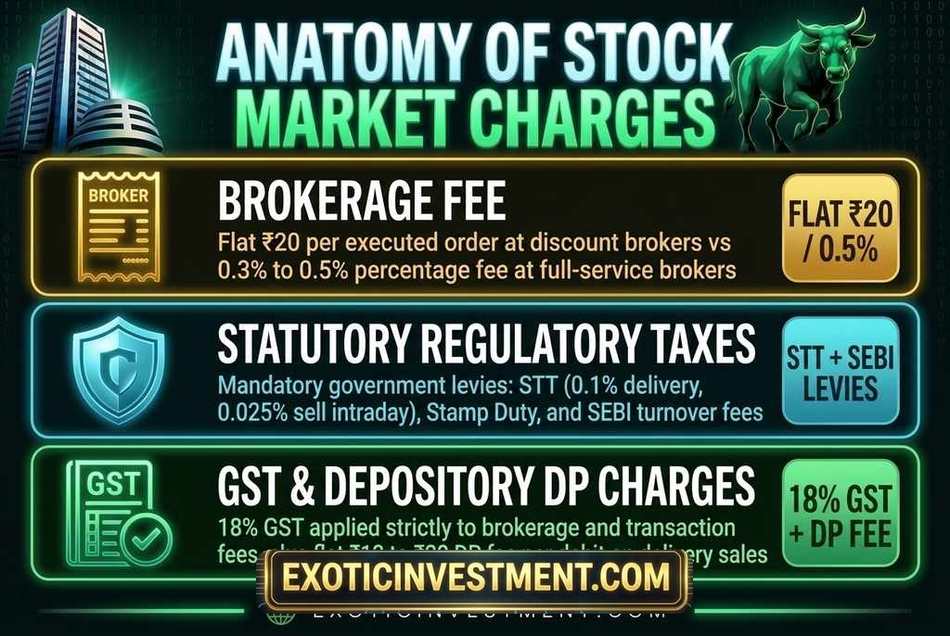
Illustration: Anatomy of Indian Equity and Derivative Trading Levies
1. Brokerage Fee
First, brokerage is the fee charged by your broker for providing order routing software, real-time charting, and trading infrastructure. For instance, top discount brokers charge a flat fee of ₹20 per executed order or 0.03% of trade turnover, whichever is lower. Also, you can inspect exact contract note splits on our Zerodha brokerage calculator.
2. Securities Transaction Tax (STT)
Second, STT is a direct central tax collected by the Ministry of Finance on every exchange transaction. Following the Finance Act 2024 revisions effective October 1, 2024, the government updated derivative tax rates. Specifically, delivery trades attract 0.1% on both buy and sell legs. Meanwhile, intraday equity cash attracts 0.025% on the sell side only. Similarly, futures trading incurs 0.02% on sell turnover. In addition, for options traders, STT is charged at 0.1% on premium turnover. To test capital requirements for shorting options, use our NSE F&O margin calculator.
3. Exchange Turnover Fees & SPAN Requirements
Third, both NSE and BSE levy turnover charges to maintain high-speed matching engines and risk systems. For example, NSE charges approximately 0.00297% for cash equity and futures, and 0.03503% on option premium volume. If you execute multi-leg option spreads, review our SPAN margin calculator F&O to evaluate exchange margin discounts.
4. GST and Depository DP Charges
Fourth, Goods and Services Tax (GST) is levied at standard 18%. In fact, GST applies only to service charges: (Brokerage + Exchange Turnover Fees + SEBI charges). As a result, it does not apply to trade turnover or STT. Plus, when you sell shares from your demat account, depositories like CDSL and NSDL collect a flat Depository Participant (DP) fee of ₹13.50 to ₹20 per scrip per day. For full details on demat accounts, explore our guide to demat account terms and BO ID.
Discount Brokers vs Full-Service Brokers: The Real Cost Gap
Now, many traders in our private 1,300+ member WhatsApp group ask whether they should open an account with discount brokers or traditional full-service bank brokers. So, let us look at the actual numbers without marketing bias.
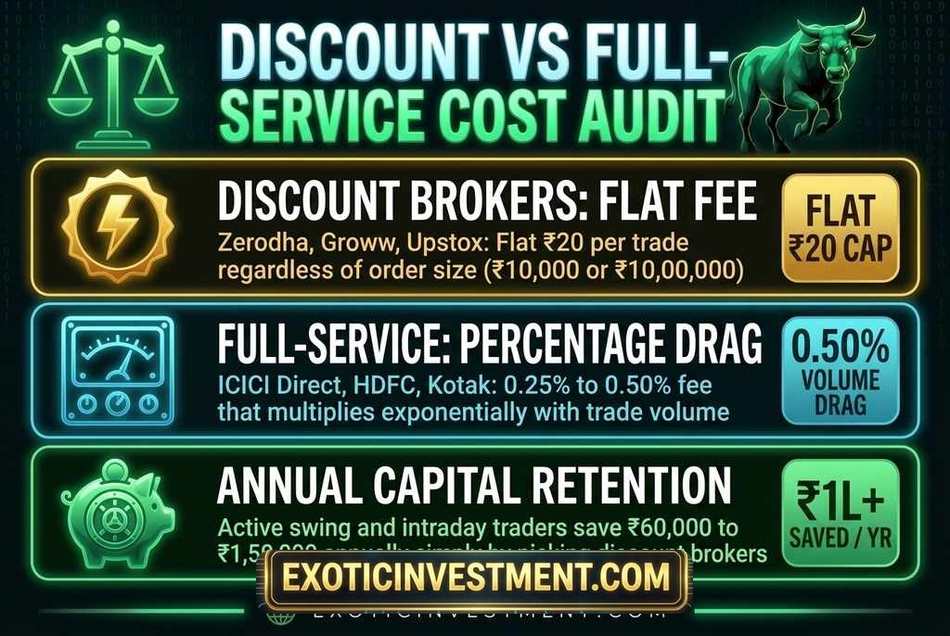
Illustration: Flat-Fee Discount vs Percentage-Based Full-Service Cost Model
The Turnover Percentage Drag
Honestly speaking, percentage-based commissions destroy active trader accounts. For instance, full-service brokers charge 0.25% to 0.50% on equity turnover. Specifically, if you buy and sell ₹10 Lakh worth of stock intraday, a full-service broker charges you ₹5,000 in brokerage alone! In contrast, on a discount broker like Zerodha or Upstox, that same trade costs you exactly ₹40. You can verify this difference instantly using our Upstox brokerage calculator.
Over a full trading year of 250 days, an active swing trader gives away over ₹1,50,000 in excess commissions by using legacy brokers. Therefore, unless you rely on branch relationship managers, modern discount platforms provide the mathematically superior foundation. In fact, just as crypto traders manage execution friction with an eMintage crypto stop loss calculator, equity traders must minimize broker fees to keep profits intact.
2026 Broker Comparison Table: Top SEBI Registered Brokers
Next, here is an institutional comparison of brokerage fees and account structures across India’s leading stock brokers:
| Broker Name | Delivery Brokerage | Intraday Brokerage | F&O Brokerage | DP Charges (Per Debit) |
|---|---|---|---|---|
| Zerodha | Zero (Free) | 0.03% or ₹20 max | ₹20 flat per executed order | ₹13.50 + GST |
| Groww | 0.05% or ₹20 max | 0.05% or ₹20 max | ₹20 flat per executed order | ₹13.50 + GST |
| Upstox | 2.5% or ₹20 max | 0.05% or ₹20 max | ₹20 flat per executed order | ₹18.50 + GST |
| Angel One | Zero (Free) | 0.03% or ₹20 max | ₹20 flat per executed order | ₹20.00 + GST |
| ICICI Direct | 0.55% turnover | 0.05% turnover | ₹20 to ₹95 per lot | ₹25.00 + GST |
Before executing live trades, verify your net delivery settlement rules with our delivery, BTST, and CNC trade guide.
How to Calculate Your Breakeven Tick Before Trading
In fact, professional intraday traders never take a position without knowing their exact breakeven price. Specifically, your breakeven tick represents the minimum price movement required strictly to cover round-trip brokerage, STT, turnover charges, and GST.
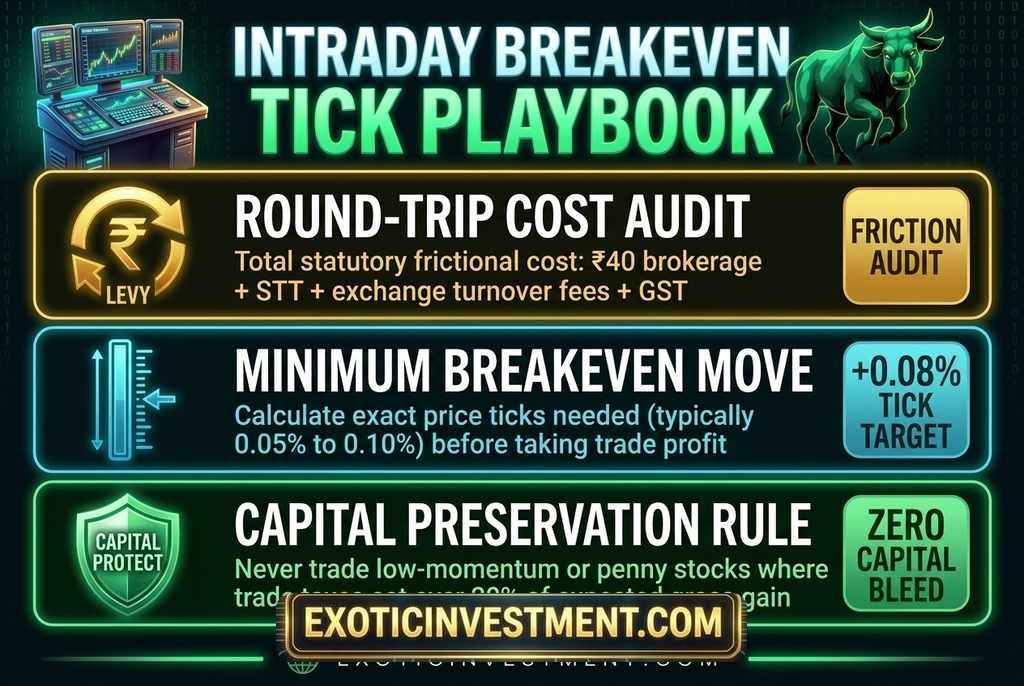
Illustration: Round-Trip Trade Friction and Minimum Breakeven Tick Strategy
Practical Breakeven Formula
So, here is how to calculate your breakeven tick on any stock:
Breakeven Points = (Total Round-Trip Brokerage + STT + Turnover Charges + GST + Stamp Duty) / Total Share Quantity
For example, if you buy 1,000 shares of Tata Motors at ₹1,000 and total round-trip friction equals ₹250, your breakeven move is ₹0.25. Consequently, if the stock ticks up only ₹0.20 and you exit, you book an accounting loss despite positive gross price action. Therefore, always account for order execution costs using our order cost slippage calculator.
Also, always pair your breakeven analysis with strict risk controls. Set your exit levels using our stop loss calculator and determine proper capital allocation with our position size calculator India. Then, when placing basket trades, review our guide to BFO basket fund orders.
Trade Discipline and Risk Management Rules
Now, to keep brokerage friction low, retail traders must avoid common account-draining habits. Here are three critical rules enforced on our institutional trading desk:
- Avoid Overtrading: In Kannada, remember “Maathu aadidre hoythu, mutthu odedre hoythu” (ಮಾತು ಆಡಿದರೆ ಹೋಯ್ತು, ಮುತ್ತು ಒಡೆದರೆ ಹೋಯ್ತು — words once spoken cannot be retrieved, a pearl once shattered is lost forever). In trading, your hard-earned profits are like precious pearls—one reckless, impulsive order can shatter months of steady gains. Taking 15 to 20 small intraday trades a day generates thousands in friction charges for brokers and exchanges. Focus strictly on 2 or 3 high-probability setups per session.
- Beware of Auto Square-Off Penalties: Second, if you trade intraday (MIS) and fail to exit before 3:15 PM, brokers charge an auto square-off penalty of ₹50 + 18% GST per order. Always close your intraday positions manually.
- Respect Circuit Band Halts: Third, never hold illiquid stocks near circuit levels. Check our guide on upper circuit vs lower circuit rules and follow the 10 essential stock market rules.
Recommended Trading Courses & Premium Subscriptions:
- Options Buying Course in Kannada: Options Buying Course in Kannada.
- Technical Analysis in Kannada Course: Technical Analysis in Kannada Course.
- Kaliyiri Share Market Book: Kaliyiri Share Market Book.
- Basics of Stock Market Course: Basics of Stock Market Course.
- Multibagger Stocks Pro Subscription: MultiBagger Plus Courses & Pro Tools Annual Subscription.
💡 Frequently Asked Questions (FAQ)
1. What are the lowest brokerage charges for intraday trading in India?
In fact, leading discount brokers like Zerodha, Groww, and Angel One offer the lowest rates at flat ₹20 per executed order or 0.03% of turnover. As a result, for high-volume traders, flat-fee discount models prevent commission bloat. You can simulate your exact fees on our Zerodha brokerage calculator.
2. Why do brokers charge DP charges when selling shares?
Specifically, DP charges are collected by central depositories (CDSL/NSDL) and your broker whenever shares are debited from your demat account upon delivery sale. In addition, this flat fee applies once per day per scrip regardless of quantity sold. For an explanation of depository operations, read our demat account terms and depository guide.
3. Are brokerage charges and STT tax-deductible against capital gains?
First, brokerage charges, exchange turnover fees, and GST are fully deductible from trade proceeds when computing capital gains tax. However, under Section 36 of the Income Tax Act, STT is not deductible for non-business investors. You can evaluate your post-tax returns using our capital gains tax calculator India.
4. Does zero brokerage mean 100% free trading?
No. Specifically, even when a broker charges zero commission on delivery, you must still pay mandatory statutory levies including STT (0.1%), exchange turnover fees, stamp duty, and SEBI charges. Test your true costs across all brokers using our Indian stock brokerage calculator.
5. What is the difference between Day orders and GFD orders?
For example, day orders remain active until market close at 3:30 PM, whereas Good For Day orders remain valid throughout the complete trading session across market phases. To learn order types in depth, review our guide to GFD orders in share market.