
What is stock market rules?
Listen, boss. The stock market is not a gambling den. It has its own set of rules, and ignoring them will cost you hard money.
Stock market rules are the guidelines set by regulators, exchanges, and your own broker that tell you what you can and cannot do. In India, SEBI is the main boss who writes these rules. SEBI stands for Securities and Exchange Board of India.
These rules cover everything. From how you buy a share on NSE to how much borrowed margin you can take on Zerodha or Groww. They also decide what happens when the market crashes suddenly.
The share market rules change time to time. As a result, you need to stay updated. Old strategies that worked in 2018 may not work today.
Here is the thing. Every trader needs to understand these rules before putting even one rupee into the market. That means you, whether you are a total beginner or someone with five years of experience.
Why stock market rules Matters for Indian Stock Traders
Let me ask you something. Have you ever seen someone lose ₹50,000 in a single day on intraday trading?
I have. It happens all the time. And 9 out of 10 times, the reason is simple. The trader ignored a basic rule.
Stock market rules protect you. They keep rogue brokers from cheating you. They ensure fair play on both NSE and BSE. Without these rules, the Indian market would be a free-for-all. No one would trust it.
Also, rules help manage risk. SEBI introduced stricter position limits after the 2020 market crash. Why? Because too many retail traders were taking massive margin-funded positions without understanding the downside.
Now let me explain something important. Rules also define tax obligations. If you make profit from equity delivery, you pay zero capital gains tax if you hold for over a year. But if you trade intraday, every profit is treated as business income. That means a completely different tax rate.
In fact, SEBI recently changed TCS rules on foreign portfolio investment. Ignoring such changes can land you in hot water with the Income Tax Department.
So here is why rules matter for you specifically:
First, they prevent your account from getting blocked by your broker.
Second, they help you avoid heavy penalties from SEBI or the exchange.
Third, they save your money from unnecessary tax mistakes.
Finally, they give you a clear framework to trade confidently instead of gambling blindly.
Key Concepts Related to stock market rules

Illustration: Golden Rules for Disciplined Stock Market Investing
Okay, now let us break down the key ideas you absolutely must know. I will keep it simple and direct.
SEBI Regulations: SEBI is the ultimate authority. It regulates everything from IPOs to mutual funds to derivatives trading. Any broker you use, be it Zerodha, Groww, or Upstox, must follow SEBI rules. Violate those rules, and SEBI can fine them heavily. As a result, your money stays safer compared to unregulated markets.
Exchange Rules (NSE & BSE): Both exchanges have their own trading hours, circuit filters, and settlement cycles. For example, a stock can fall only a certain percentage in a day. This is called a circuit breaker. If it hits the lower circuit, you cannot sell. Understanding this saves you from panic selling at the wrong time.
Position Limits: SEBI puts a cap on how many shares or futures contracts you can hold. For F&O segment, position limits change weekly. If you exceed them, the exchange will square off your position forcibly. That means you lose money without even wanting to sell.
Exchange Controls & Regulatory Safeguards
Tax Rules: This is where most Indians get confused. Short-term capital gains from equity (held less than one year) attract 20% tax as per the new budget norms. Long-term gains above ₹1.25 lakh per year attract 12.5%. Intraday profit is added to your income and taxed at your slab rate. Also, STT (Securities Transaction Tax) is collected on every transaction. You must factor this into your trading cost.
Broker Rules: Every broker sets its own margin requirements. Zerodha gives you positional margins differently than intraday margins. Groww might show you different collateral values. Always check the Zerodha brokerage calculator or Upstox brokerage calculator before placing any trade.
Stop Loss Rules: Never enter a trade without a stop loss. It is not optional. It is mandatory. Use our stop loss calculator to figure out the right level before you trade. This small step separates professional traders from gamblers.
Circuit Breakers and Market Halts
Circuit Breaker Mechanism: When the market falls too fast, trading gets suspended for 15 minutes. This happens at three levels: 10%, 15%, and 20%. During this time, you cannot place any order. This rule exists to cool down panic selling.
How to Apply This Knowledge Step by Step

Illustration: Disciplined Investor Routine from Pre-Market to Journaling
Right, now let us put all this into action. Follow these steps and you will be trading smarter from day one.
Step 1: Open a proper trading account. Choose a SEBI-registered broker. Zerodha, Groww, and Upstox are solid choices for beginners. Make sure they offer both demat and trading facilities. Also verify their customer support quality before you commit.
Step 2: Understand your broker’s rulebook. Every broker has slightly different margin rules. Read them carefully. Know how much margin you need for intraday versus delivery versus F&O. Use our calculators mentioned above to plan your trades accurately.
Step 3: Learn the SEBI circulars. SEBI releases new rules almost every month. Follow their official website or trusted financial news sources. Do not rely only on WhatsApp forward messages. Those are often wrong and outdated.
Executing and Reviewing Trades
Step 4: Set your personal trading rules. This is the most important step. Write down your own rules on paper. Decide your maximum daily loss limit. Decide your maximum position size. Decide which stocks you will trade and which you will avoid completely. Stick to these rules without exception.
Step 5: Use risk management tools. Always use stop loss. Always calculate your risk before entering a trade. Use our profit calculator to know your exact risk-reward ratio before pressing the buy button.
Step 6: Track your trades properly. Maintain a trading journal. Note down every trade, your entry reason, exit reason, and the lesson learned. This habit alone will improve your results by 40% within six months. No exaggeration.
Step 7: Review and adapt. At the end of every month, review your trades. Check which rules you broke. Check which rules saved you from loss. Adjust your strategy accordingly. Markets change, so should your approach.
Recommended Trading Courses & Premium Subscriptions:
- Options Buying Course in Kannada: Options Buying Course in Kannada.
- Technical Analysis in Kannada Course: Technical Analysis in Kannada Course.
- Kaliyiri Share Market Book: Kaliyiri Share Market Book.
- Basics of Stock Market Course: Basics of Stock Market Course.
- Multibagger Stocks Pro Subscription: MultiBagger Plus Courses & Pro Tools Annual Subscription (Checkout link: MultiBagger Plus Courses & Pro Tools Annual Subscription).
Common Mistakes and How to Avoid Them
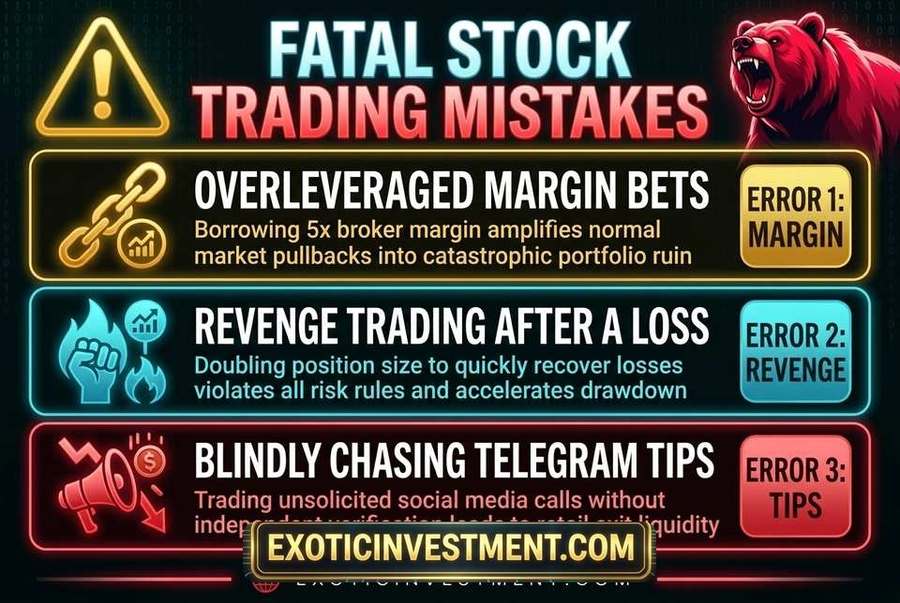
Illustration: Fatal Trading Traps That Wipe Out Retail Traders
Let me tell you the mistakes I see every single day. Almost all of them are avoidable if you know what to watch out for.
Mistake 1: Trading without a stop loss. This is the number one killer of trader accounts. You buy a stock at ₹500, it goes to ₹480, and you refuse to sell because “it will come back.” It does not come back. You end up losing 20% on a single trade. Always use our stop loss calculator and never skip this step.
Mistake 2: Overtrading on margin. Many new traders think borrowed margin is free money. It is not. borrowed margin amplifies both your profit and your loss. If you use 5x borrowed margin and the market moves just 2% against you, you lose your entire capital. Keep your borrowed margin below 2x unless you are an expert.
Psychological & Behavioral Pitfalls
Mistake 3: Following tipsters blindly. Telegram groups, YouTube gurus, WhatsApp forwards. None of them care about your money. They care about their subscription fees or referral commissions. Do your own research first. Then cross-check with credible sources.
Mistake 4: Ignoring tax implications. Many traders forget that F&O profits are fully taxable as business income. They also forget about AIS (Annual Information Statement) and how the IT department tracks every transaction. File your returns correctly every year. Keep all trade statements ready.
Strategic Execution Errors
Mistake 5: Chasing momentum stocks without analysis. Just because a stock is in the news does not mean you should buy it immediately. Often, by the time retail investors hear about a stock, the smart money has already exited. Use our pivot point calculator to find actual support and resistance levels before entering any trade.
Mistake 6: Not having an exit strategy. You enter a trade but never decide where you will exit if it goes wrong. This is emotional trading, not systematic trading. Always decide your exit point before you enter. Mark it on the chart. Stick to it.
Advanced Trading Tips to Master This Topic
Now that you know the basics, here are some advanced tips that separate good traders from great ones.
Master the concept of position sizing. Never risk more than 2% of your total capital on a single trade. If you have ₹5 lakh, your maximum loss on one trade should be ₹10,000. This rule alone will keep you in the game for years.
Execution Discipline & Risk Scaling
Use the 3:1 risk-reward ratio. If you are risking ₹5,000, your target profit should be at least ₹15,000. Even if you win only 40% of your trades, you will still be profitable. This is mathematics, not luck.
Understand institutional behavior. FIIs and DIIs move billions. When they accumulate, the market goes up. When they distribute, the market corrects. Track FII-DII data daily. It is available on the NSE website for free.
Learn to read order flow. Level 2 data shows you the depth of buy and sell orders. Use this information along with pivot points to anticipate where price might reverse. Our pivot point calculator helps with this analysis significantly.
Build a checklist before every trade. Write down a pre-trade checklist. Is the stop loss placed? Is the position size correct? Is the trend in your favor? Is there any major news today? Go through this list every time before you click buy or sell.
Trading Psychology and Risk Discipline
Keep a trading diary with emotions noted. Record not just numbers but also how you felt during the trade. Were you angry? Greedy? Fearful? This self-awareness builds emotional control, which is the biggest edge a trader can develop.
Diversify across segments. Do not put all your money in equity delivery. Consider allocating a small portion to index funds via SIP in mutual funds for long-term stability. Keep the rest for active trading. This balanced approach protects your wealth while allowing growth.
Stay disciplined during high volatility. When the market is wild, reduce your position size by half. Volatility cuts both ways. Protect your capital first. Profit will come later.
Use technology wisely. Set price alerts on your broker app. Use automated stop losses wherever possible. Let the system protect you when you cannot watch the screen all day.
Never trade with borrowed money. This cannot be stressed enough. Only trade with money you can afford to lose. Taking a loan to trade is the fastest path to financial ruin. Period.
Final Summary
Let me bring everything together in a quick recap for you.
Stock market rules exist to protect you, not to restrict you. SEBI sets the framework. Exchanges like NSE and BSE provide the platform. Your broker executes your trades within those boundaries. And you, the trader, must follow all of these layers to stay safe and profitable.
The biggest takeaway is this: knowledge beats luck every single time. Learn the rules. Follow the rules. Respect the rules. Your money will thank you.
Start small. Build your knowledge base first. Use our stop loss calculator, our profit calculator, and our pivot point calculator regularly. These free tools will make you a far better trader than 90% of the retail population.
Remember, the market rewards discipline and punishes冲动 (impulse). Stay calm. Stick to your plan. Keep learning. And most importantly, never stop studying the rules because they keep evolving.
Honestly speaking, the traders who last long in this market are not the ones who make the biggest profits in a month. They are the ones who survive ten years. And survival comes from following rules, not breaking them.
All the best, boss. Trade smart, stay safe, and keep growing your wealth the right way.