
BFO Full Form in Share Market: Basket Orders & Execution Mechanics
👨🏫 Real Market Experience & SEBI Disclosure: Written by Dr.Ashok Kumar N Rao and the Exotic Investment research desk based on 12+ years of active market trading. All insights follow SEBI investor education guidelines. Exotic Investment does not provide unsolicited tips or PMS services. Always practice strict position sizing before taking live trades.
Listen, boss, let’s cut right to the chase. When you are scrolling through Telegram groups, WhatsApp channels, or even YouTube trading tutorials in India, you will see the word bfo full form in stock market thrown around like nobody’s business. But what exactly does it mean? Is it some fancy SEBI rule? No.
BFO stands for “Buy For Option.” That means it is when you, the retail trader, purchase an options contract — either a Call option or a Put option — instead of writing or selling it. Think of it this way: in the F&O segment, there are two sides to every trade. One person buys, and one person sells. BFO means you are the buyer side.
This is actually a very big deal for Indian traders. Let me explain. When you are a BFO buyer, your risk is strictly limited. You can only lose the premium you paid. But when you are the seller side, your risk can go unlimited. So if someone says, “I am a BFO player,” they mean they only buy options.
The same meaning applies when you search for bfo full form in share market. Both terms point to the exact same concept. You are buying options — Calls or Puts — from brokers like Zerodha, Groww, or Upstox with the hope that the market moves in your direction.
Now, here is the thing. A lot of new traders confuse BFO with regular equity delivery trading. Let me clear that up right now. In delivery trading, you actually buy shares and hold them. In BFO trading, you are buying a contract — an option on a stock or index — not the actual shares themselves. Your profit or loss depends entirely on the movement of that option’s premium.
So if you are just getting started, remember this simple point: BFO means you are on the buying side of options. You pay a premium. You hope for a move. And if the market goes against you, the worst that happens is you lose that premium amount. Nothing more.
Why Basket Orders Give Derivative Traders a Tactical Execution Edge
Okay, now you know what BFO means. But why should you, an Indian trader, actually care about this? Why is the bfo full form in stock market trending so much on social media and trading communities across India? Let me give you the real picture.
First and foremost, BFO trading is the safest entry point into the derivatives segment. The F&O segment is where most beginners lose money. Why? Because they start as sellers. They think, “Let me sell options and collect premium.” But sellers face unlimited risk. As a result, a single wrong call can wipe out weeks or even months of profits. Honestly speaking, this happens to many traders every single day.
Second, the government of India has made rules tighter for F&O traders. SEBI now mandates a mandatory 50% margin for F&O trading. That means you need at least ₹50,000 to trade in F&O segment actively. However, as a BFO buyer, you only need the premium amount, which is much lower. A good call option might cost you anywhere from ₹5 to ₹100 per lot depending on the stock and expiry.
Third, BFO aligns perfectly with how most Indian traders think. You look at a chart, you see a breakout or breakdown pattern, and you buy a corresponding Call or Put option. That is it. Simple. No margin calls. No sudden broker notices telling you to deposit more funds.
Also, let’s talk about time decay, also known as Theta. This is the silent killer in options trading. When you are a BFO buyer, Theta works against you every passing minute. But when the market moves strongly in your favor quickly, Theta becomes less of a problem. This is why BFO traders prefer to trade during high-volatility periods — like in the first and last hour of the trading session on NSE.
Another important reason BFO matters is that it teaches discipline. Since your loss is capped, you learn to manage your positions properly. You set exit points. You use stop losses effectively. Over time, this builds a solid risk management framework that helps you in all types of trading, not just options.
If you want to calculate your potential profits before entering any BFO trade, always use a proper stock profit calculator in Indian Rupees. This will help you plan your trades better and avoid emotional decisions based on gut feeling alone.
Margin Benefits, Multi-Leg Orders & Broker Platforms
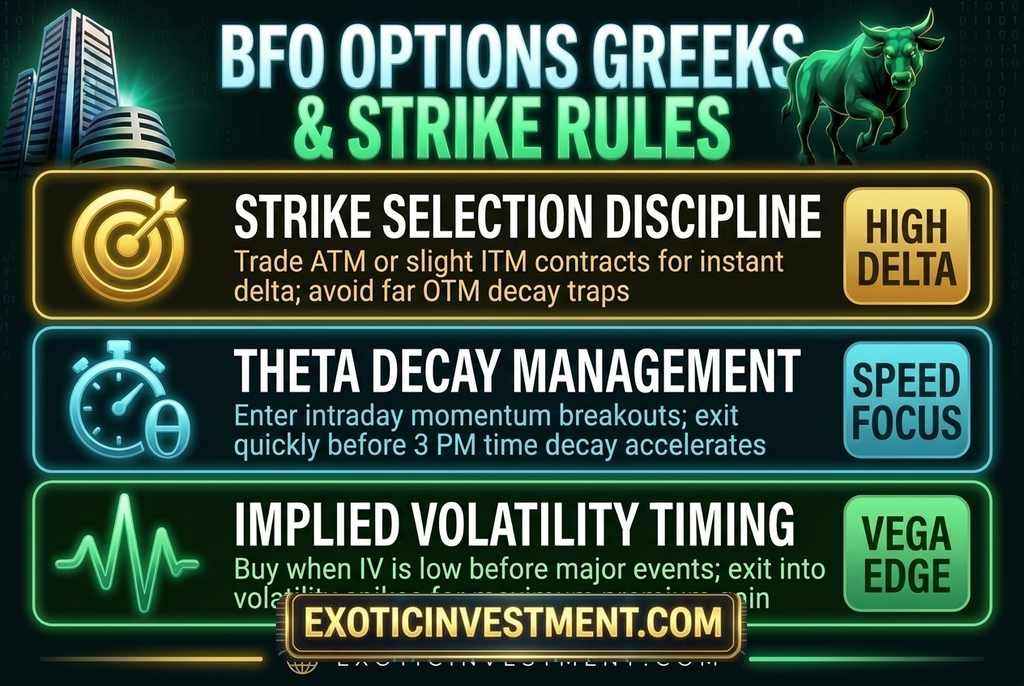
Illustration: BFO Options Greeks and Strike Selection Framework
Before you jump into BFO trading blindly, you need to understand the key concepts that support it. These concepts form the backbone of successful options buying. Let me break them down for you in simple terms.
Strike Price: This is the price at which you have the right to buy or sell the underlying asset. When you are doing BFO, you choose the strike price carefully. ATM (At The Money) options move the fastest. OTM (Out of The Money) options are cheap but risky. ITM (In The Money) options are expensive but safer. Most experienced BFO traders prefer ATM or slightly ITM options because they give the best delta movement.
Premium: This is the price you pay to buy the option contract. The premium is made up of two parts — intrinsic value and time value. As expiry gets closer, time value drops fast. This is called Theta decay, and it eats away at your profits if the market does not move quickly enough in your direction.
Delta: Delta tells you how much the option premium will change for every ₹1 movement in the underlying stock or index. For example, a Call option with a delta of 0.5 will gain ₹0.50 for every ₹1 the stock goes up. When you are a BFO buyer, higher delta means faster profit accumulation. That is why ITM options are preferred — they have deltas closer to 1.
Vega: Vega measures how sensitive your option premium is to changes in implied volatility. When volatility spikes — like during budget announcements, RBI policy decisions, or major global events — option premiums become very expensive. As a BFO buyer, you should ideally enter trades when IV is low and exit when IV spikes. Buying expensive options during high IV is a recipe for loss even if your directional view is correct.
Expiry: Every options contract has an expiry date. In India, weekly expiries happen every Thursday for indices like Nifty and Bank Nifty. Monthly expiries are on the last Thursday of the month. As a BFO trader, you must understand that options lose value as expiry approaches. If you buy a weekly option and the market does not move within one or two days, your premium will decay significantly.
Support and Resistance Levels: These are the foundation of every good BFO trade. You never buy a Call option randomly. You buy it when the stock bounces off a strong support level. Similarly, you buy a Put option when the stock fails to break a resistance level. Knowing how to identify these levels correctly is what separates profitable BFO traders from those who lose money consistently.
For beginners, it is also helpful to understand tools like pivot points which can help you identify key support and resistance levels automatically. This saves time and gives you a structured approach to finding entry points.
How to Apply This Knowledge Step by Step
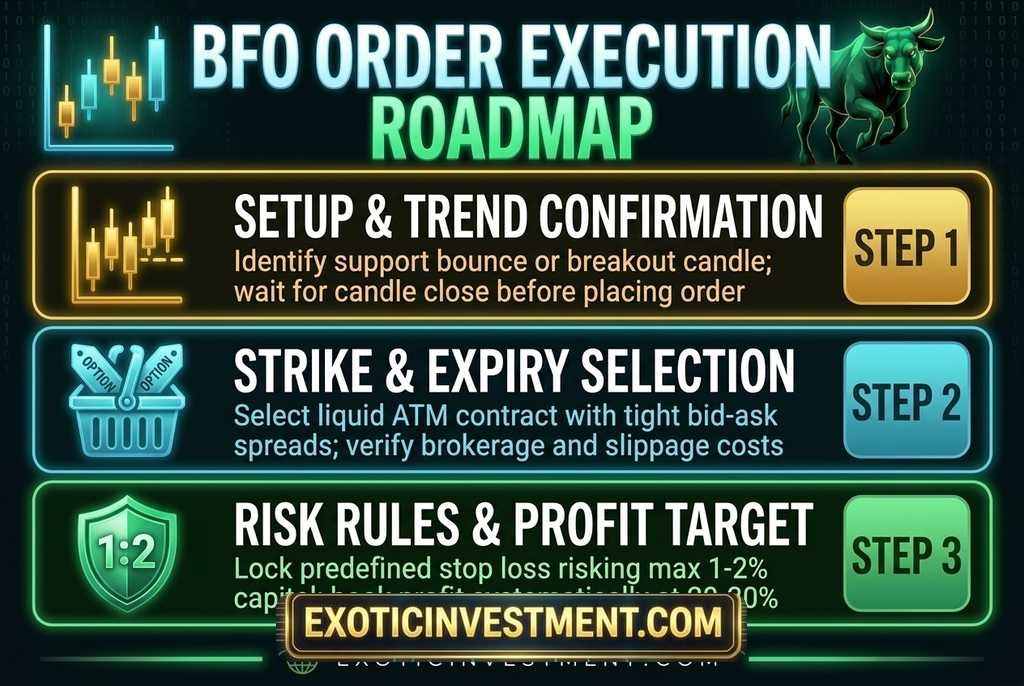
Illustration: Step-by-Step BFO Order Placement and Risk Execution Roadmap
Right, now let us get practical. How do you actually apply BFO trading in the Indian stock market? I will walk you through this step by step so that there is no confusion. Follow these steps in order, and you will be placing your first BFO trade with confidence.
Step 1: Open a Demat and Trading Account
You need a broker that supports the F&O segment. Popular choices among Indian traders include Zerodha, Upstox, and Groww. Make sure your account is enabled for F&O trading before you proceed further. This usually requires you to complete a risk acknowledgment form and show proof of income.
Step 2: Learn to Read Candlestick Charts
Before you buy any option, you must be able to read price action. Learn basic candlestick patterns like hammer, engulfing, doji, and shooting star. These patterns tell you when the market might reverse. Use free platforms like TradingView or the charting tools available inside your broker app.
Step 3: Identify the Trend and Key Levels
Open the daily chart of the stock or index you want to trade. Mark the nearest support and resistance levels. Is the market in an uptrend, downtrend, or range-bound? This will tell you whether you should look for Call options or Put options. Do not guess. Look at the data.
Step 4: Wait for the Right Setup
Do not buy options just because the market is moving. Wait for a confirmed setup. For example, if the Nifty is approaching a strong support level and you see a bullish engulfing candle forming, that is your signal. Now you can consider buying a Call option. Always wait for the candle to close before entering.
Step 5: Choose the Right Strike Price and Expiry
For intraday BFO trading, choose ATM or slightly ITM options. Go for weekly expiry if you are trading intraday. If you are a swing trader holding positions for a few days, monthly expiry gives you more time. Also, keep track of the brokerage charges so you know the true cost of each trade.
Step 6: Set Your Stop Loss
This is the most important step. Every BFO trade must have a predefined stop loss. You can use a stop loss calculator to determine the right level based on your risk percentage. Never enter a trade without knowing where you will exit if things go wrong. Most successful traders risk only 1% to 2% of their capital on any single trade.
Step 7: Book Your Profit or Cut the Loss
Have a clear target in mind before you enter. If your target is 20% profit on the premium, exit there. Do not get greedy. Similarly, if your stop loss hits, exit immediately. Do not hope that the market will come back. Hope is not a strategy in options trading.
Step 8: Review and Learn
At the end of every trading day, review your trades. What went well? What went wrong? Did you follow your plan? Maintaining a trading journal is one of the most powerful habits you can build. It will help you improve faster than anything else.
Recommended Trading Courses & Premium Subscriptions:
- Options Buying Course in Kannada: Options Buying Course in Kannada.
- Technical Analysis in Kannada Course: Technical Analysis in Kannada Course.
- Kaliyiri Share Market Book: Kaliyiri Share Market Book.
- Basics of Stock Market Course: Basics of Stock Market Course.
- Multibagger Stocks Pro Subscription: MultiBagger Plus Courses & Pro Tools Annual Subscription (Checkout link: MultiBagger Plus Courses & Pro Tools Annual Subscription).
Common Mistakes and How to Avoid Them
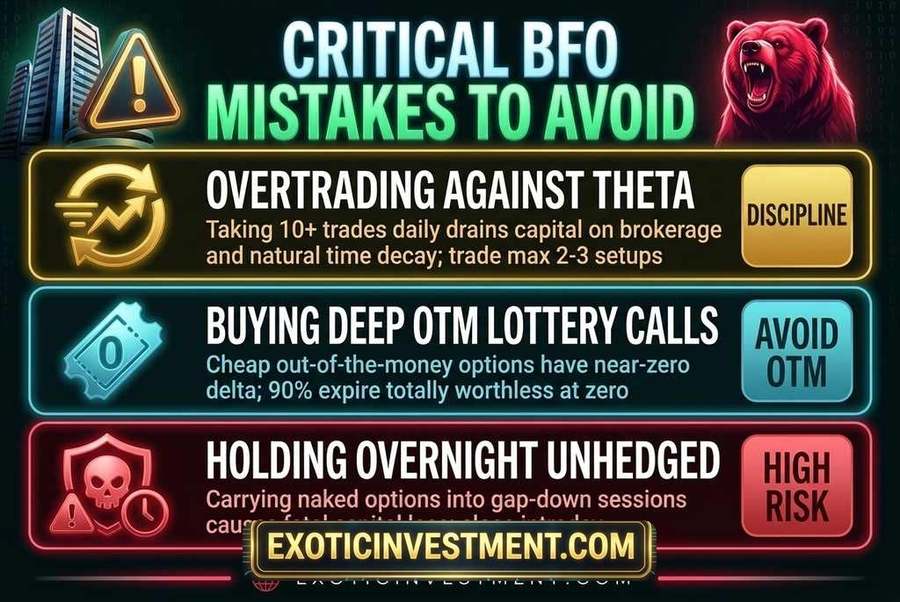
Illustration: Critical BFO Trading Traps and Capital Protection Rules
I have seen too many traders burn their capital in BFO trading because they repeat the same mistakes over and over again. Let me save you that pain. Here are the most common errors and how you can dodge them easily.
Mistake 1: Buying OTM Options Like a Lottery Ticket
Many new traders buy deep OTM Call or Put options because they are very cheap. A ₹5 premium looks tempting, right? But here is the harsh truth — 90% of the time, these expire worthless. The stock has to move dramatically for OTM options to become profitable. Avoid this trap. Stick to ATM or ITM options where the probability of success is much higher.
Mistake 2: Not Using Stop Loss
This is perhaps the biggest mistake Indian traders make. They buy an option, the premium starts falling, and they just wait and hope. By the time they realize the loss, the premium has dropped 60 or 70%. Always, and I mean always, use a strict stop loss. Use a stop loss calculator to plan your exits properly. There is no shame in cutting a small loss.
Mistake 3: Trading During Low Volatility Periods
If you buy options when the market is completely flat and range-bound, Theta decay will destroy your position slowly. This is what we call getting “gambled” in the Indian trading slang. Avoid BFO trades during lunch hours (12:30 PM to 1:30 PM) when Nifty usually moves very little. Trade during high-volume periods only.
Mistake 4: Overtrading
Just because you have capital in your trading account does not mean you should place ten trades a day. Overtrading leads to tired decision-making, higher brokerage costs, and emotional burnout. Keep your trades to 2 or 3 high-quality setups per day maximum. Quality over quantity, always.
Mistake 5: Revenge Trading After a Loss
You take a hit. Your stop loss gets triggered. Now you feel angry and want to recover the money quickly by placing another trade immediately. This is revenge trading, and it is deadly. After a losing trade, step away from the screen for at least 30 minutes. Calm down. Come back with a clear head. Your capital is more important than proving yourself right.
Mistake 6: Ignoring Implied Volatility
Many traders check the price direction but forget to check IV. If IV is extremely high, option premiums are inflated. Even if the market moves in your direction, the premium might not increase much because IV could collapse. Always check the IV rank or IV percentile before entering a BFO trade. If IV is above 70%, be extra cautious about buying options.
Advanced Trading Tips to Master This Topic
Once you have mastered the basics of BFO trading, these advanced tips will take your game to the next level. These are the strategies that consistent profitable traders use every single day.
Tip 1: Use the 15-Minute Opening Range Strategy
Wait for the first 15-minute candle to form after the market opens. Note the high and the low of that candle. If the price breaks above the high, buy a Call option. If it breaks below the low, buy a Put option. This is a proven intraday BFO strategy that works well on liquid stocks and indices like Nifty 50 and Bank Nifty.
Tip 2: Combine Price Action with Option Chain Data
Never rely on charts alone. Open the option chain on your broker platform or on NSE’s website. Look at the PCR (Put-Call Ratio). If PCR is above 1.3, the market might be overbought. If PCR is below 0.7, the market might be oversold. Use this data alongside your price action analysis for stronger conviction trades.
Tip 3: Trade Only Liquid Stocks and Index Options
Stick to Nifty 50 stocks and index options like Nifty, Bank Nifty, and Sensex. These have tight bid-ask spreads and deep liquidity. When you trade illiquid stock options, you might not be able to exit at your desired price. The spread can eat into your profits significantly. Liquidity is king in BFO trading.
Tip 4: Master the Art of Scaling Out
Instead of exiting your entire position at once, scale out. For example, if your target is 30% profit, book 50% of your position at 15% profit and let the rest run with a breakeven stop loss. This way, you lock in gains while still keeping exposure to further upside. This technique reduces emotional stress and improves your overall win rate.
Tip 5: Keep a Detailed Trading Journal
Record every single trade you take. Include the date, time, stock name, strike price, premium paid, entry reason, exit reason, profit or loss, and emotional state during the trade. After 50 trades, review the journal. You will spot patterns in your behavior that you never noticed before. This self-awareness is what ultimately separates winners from losers.
Tip 6: Understand the Role of RBI and Global Cues
Indian markets do not move in isolation. Watch the US market close, the Gift Nifty opening, and any RBI policy announcements. These external factors create massive intraday moves that BFO traders can capitalize on. For example, if the US Federal Reserve hints at rate cuts, Indian markets often gap up, and Call buyers make quick profits.
Tip 7: Use a Proper Position Sizing Framework
Never put more than 10% of your total trading capital into a single BFO trade. If you have ₹1,00,000 for trading, do not risk more than ₹10,000 on any one trade. This ensures that even a string of five consecutive losses will not devastate your account. Position sizing is the unsung hero of long-term trading success.
Also, always calculate the actual cost of your trades including brokerage and taxes. Using a brokerage calculator for your specific broker will give you an accurate picture of your net profit after all charges are deducted.
Final Summary
Alright, let me wrap this up nicely for you. We covered a lot of ground today on the bfo full form in stock market, and I hope everything is crystal clear now.
BFO simply means “Buy For Option.” You are the buyer side in the options segment. Your risk is capped at the premium you pay, but your profits can be substantial if you pick the right trades at the right time. This is why BFO is the preferred approach for millions of Indian retail traders who want to participate in the F&O segment safely.
Remember the key takeaways from this article. First, always trade ATM or ITM options rather than chasing cheap OTM lottery tickets. Second, never enter a trade without a predefined stop loss and target. Third, keep your position size small and never revenge trade after a loss. Fourth, combine price action with option chain analysis for higher probability setups. Fifth, maintain a trading journal to track your progress and learn from your mistakes.
The Indian stock market offers incredible opportunities for disciplined traders. Whether you trade on Zerodha, Upstox, or Groww, the principles of BFO trading remain the same. Patience, discipline, and continuous learning are what separate profitable traders from those who simply gamble.
If you are serious about mastering options buying, I highly recommend going through our Options Buying Course in Kannada or our Technical Analysis in Kannada Course. These courses will give you the structured knowledge and practical skills needed to trade BFO successfully.
Start small. Learn continuously. Manage your risk fiercely. And remember — the market will always be there tomorrow. Do not rush. Build your skills steadily, and the profits will follow naturally. Good luck, traders!
💡 Frequently Asked Questions (FAQ)
What does BFO stand for in Indian trading platforms?
In Indian trading terminals, BFO commonly denotes BSE Futures & Options segment or Basket Facility Orders. Basket orders allow traders to bundle up to 20 or 50 individual orders and submit them simultaneously. Calculate your transaction expenses using our Zerodha brokerage calculator.
Do basket orders provide immediate margin benefit for option hedging?
Yes. When placing multi-leg strategies like iron condors or spreads, brokers apply exchange portfolio margin relief instantly if hedging legs are placed first in the basket. Master these setups in our Options Buying Course in Kannada.
Can retail investors use basket orders for buying equity delivery shares?
Absolutely. You can build thematic baskets for long-term compounding and buy entire stock clusters with a single click. Track your portfolio gains using our stock profit calculator.
What happens if one leg of a basket order is rejected due to margin shortfall?
Most broker apps execute all valid legs and reject only the order that failed margin verification. To avoid accidental unhedged exposure, always calculate position limits with our position size calculator.
How do institutional desks manage execution slippage with basket orders?
Institutions slice large basket orders into smaller algorithmic blocks across exchange order books. Learn these execution strategies in our 7 stock market secrets big institutions use and subscribe to the MultiBagger Plus Courses & Pro Tools Annual Subscription.