Calculate real-time SPAN margin, exposure margin, and multi-leg spread hedge discounts for Nifty, BankNifty, and stock derivatives with institutional precision.
⚡ How the F&O Margin Calculator Works
Select Index / Stock
First, pick your underlying instrument (Nifty 50, BankNifty, Finnifty, or Stock) with automatic lot size calibration.
Choose Trading Strategy
Next, pick your execution mode: Naked Option Selling, Long/Short Futures, Hedged Spreads, or Option Buying.
Configure Lots & VIX
After that, set your lot count, strike premium, and market volatility multiplier (Low, Normal, or Elevated India VIX).
Review Capital & Breakeven
Finally, inspect your SPAN margin, exposure margin, hedge benefit relief, and exact breakeven ticks required.
Understanding the Mechanics of an F&O Margin Calculator
Trading derivatives on the National Stock Exchange (NSE) requires a thorough understanding of margin frameworks. Unlike equity cash delivery where you pay 100% of the share price, trading index futures or selling options involves leveraged commitments governed by SEBI’s upfront margin rules.
An f&o margin calculator models the precise capital required to initiate and hold derivative positions. In India, total upfront margin consists of two non-negotiable pillars: SPAN Margin (Standard Portfolio Analysis of Risk) and Exposure Margin. Whether you are executing a directional futures trade or writing an out-of-the-money option strangle, knowing your exact capital requirement protects you from peak margin shortfall penalties and forced broker square-offs.
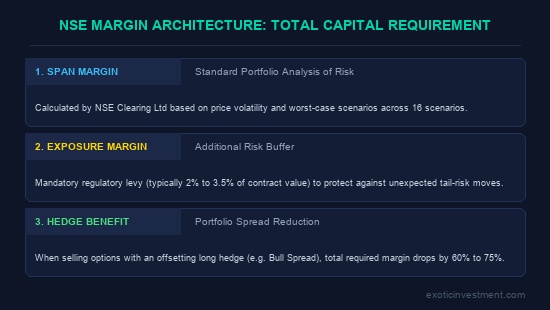
SPAN Margin vs Exposure Margin: How NSE Computes Your Requirement
The Clearing Corporation of India (NSE Clearing Ltd) recalculates margin requirements multiple times per minute during live market hours. Here is how both components function:
| Margin Component | Governing Body & Purpose | Typical % Rate | Volatility Sensitivity |
|---|---|---|---|
| SPAN Margin | Covers worst-case portfolio loss across 16 real-time price & volatility risk arrays (NSE Clearing Ltd). | 8.5% – 12.5% | Dynamic: Expands automatically during sharp India VIX spikes or gap events. |
| Exposure Margin | Statutory regulatory safety cushion mandated by SEBI to absorb unforeseen tail risks beyond VaR. | 2.0% (Index) / 3.5% (Stocks) | Fixed: Remains constant throughout trade duration regardless of intraday price swings. |
| Total Upfront Margin | 100% upfront margin mandatory before order routing to the exchange order book (SEBI Peak Margin norms). | 10.5% – 15.0% Total | Peak Enforced: 4 intraday snapshot audits; shortfall triggers RMS penalty. |
Why Option Selling Requires High Capital vs Option Buying
A common beginner misconception is wondering why buying an option costs ₹5,000 while selling the exact same option requires ₹1.15 Lakh. The explanation is rooted in asymmetrical risk profiles:
- Option Buyer: Risk is strictly capped at the premium paid. If Nifty moves in the wrong direction, the option expires worthless at ₹0. The exchange never demands additional margin because maximum possible loss is paid upfront.
- Option Seller (Writer): Maximum profit is capped at the premium collected, while theoretical risk is unlimited. If an index rallies 800 points overnight on budget news, an unprotected call seller faces catastrophic liabilities. Consequently, the exchange demands full SPAN and Exposure margin to ensure clearinghouse solvency.
The Spread Advantage: Unlocking Up to 70% Margin Benefit
You can dramatically lower option selling capital requirements through hedged multi-leg strategies. By purchasing a protective out-of-the-money option alongside your short leg (e.g. Bull Put Spread, Bear Call Spread, or Iron Condor), you cap your maximum drawdown. The NSE SPAN risk algorithm recognizes this protection and grants an immediate margin relief of 60% to 75%. Instead of committing ₹1.2 Lakh to sell 1 lot of Nifty Call, a hedged vertical spread requires as little as ₹35,000 to ₹42,000!
📋 Regulatory References & Data Sources
- NSE Master Circular on Trading Operations & Derivative Contracts
- SEBI Master Circular for Mutual Funds & Derivative Exposure limits
- Securities Contracts (Regulation) Rules 1957 — Contract settlement guidelines
Disclaimer: This calculator is for educational and planning purposes only. It does not constitute financial advice. Consult a SEBI-registered investment advisor for personalised guidance. Tax rules are updated as per the latest Finance Act — verify with a qualified CA before filing.