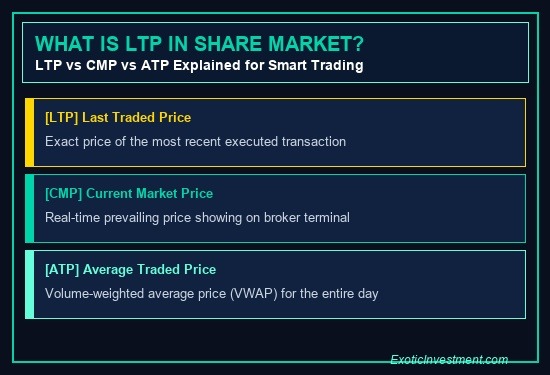
Listen, boss, if you ever placed a stock market order only to see it execute at a completely different price than what was flashing on your screen, you need to know what is ltp in share market. When you open Zerodha, Groww, or Angel One, three confusing price acronyms flash constantly: LTP, CMP, and ATP. Most beginners treat them as the exact same thing. But here is the real deal: confusing these terms leads to heavy execution slippage and bad fills. Whether you place long-term delivery shares and CNC orders or trade intraday momentum, let’s keep it simple. Here is everything you must know about stock price mechanics.
What is LTP in Share Market? The Core Definition
Let’s start with the absolute foundation. LTP stands for Last Traded Price. It is the exact rupee price at which the most recent trade occurred between a buyer and a seller on the stock exchange.
Every time a transaction completes on the National Stock Exchange (NSE) or Bombay Stock Exchange (BSE), the exchange matching engine records that trade price. That recorded number instantly becomes the new LTP. In active stocks like Reliance Industries or HDFC Bank, thousands of shares change hands every second. As a result, the LTP flickers and updates multiple times per second during trading hours.
However, when trading halts due to extreme volatility, the LTP freezes completely. To understand how exchange halts work, read our complete guide on circuit limits and trading halts.
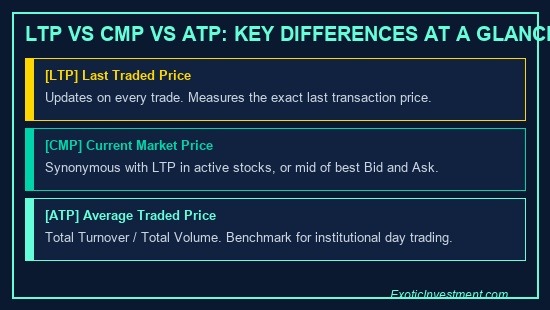
Illustration: Key Differences Between LTP, CMP and ATP at a Glance
CMP Meaning: How Current Market Price Differs from LTP
CMP stands for Current Market Price. In daily retail trading conversations, traders use LTP and CMP interchangeably. When someone asks, “What is the CMP of Tata Motors?”, they usually look at the latest LTP flashing on the trading app.
However, from an institutional trading perspective, there is a technical distinction:
First, LTP is purely backward-looking. It tells you what price someone paid one millisecond ago.
Second, CMP often represents the mid-point between the current best buying bid and the best selling ask in the order book. In highly liquid Nifty 50 stocks, the bid-ask spread is typically just 5 paise. Therefore, LTP and CMP match almost perfectly.
In illiquid small-cap stocks, the bid-ask gap can reach 2% to 5%. For example, the last executed trade (LTP) might be ₹100. However, the current seller demands ₹104. If you place a blind market order, your purchase executes at ₹104, handing you instant slippage loss. If you use margin funding for multi-day positions, learn how the margin trading facility (MTF) works before trading wide-spread stocks.
What is ATP in Share Market? The Volume Weighted Benchmark
ATP stands for Average Traded Price. In institutional and professional trading terminology, ATP is the exact daily Volume Weighted Average Price (VWAP).
Unlike LTP, which only reflects a single transaction, ATP calculates the average price of all shares traded throughout the entire trading session from 9:15 AM onward.
Here is the mathematical formula used by exchange clearing corporations:
ATP = Total Traded Turnover (in Rupees) / Total Traded Shares Quantity
For instance, suppose 1,000 shares trade at ₹100 in the morning, and 2,000 shares trade at ₹106 in the afternoon. The total turnover equals ₹3,12,000. Dividing by 3,000 shares gives an ATP of ₹104.00, even though the LTP is sitting at ₹106.00.
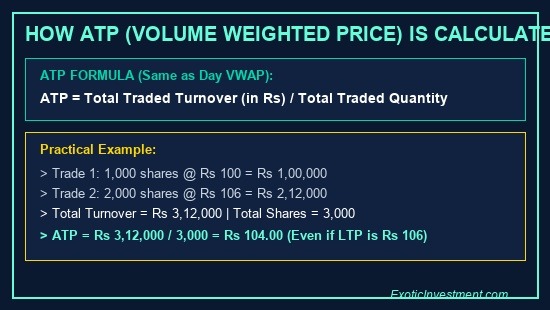
Illustration: How ATP (Volume Weighted Average Price) is Calculated Step by Step
How the Order Book and Bid-Ask Spread Move the LTP
To understand why the LTP changes, you must understand how the electronic order book works. The order book consists of two queues: Bids (Buyers) and Asks (Sellers).
Buyers line up offering the lowest price they want to pay. Sellers line up demanding the highest price they want to receive. As long as buyers stay below sellers, no transaction happens.
So how does a trade execute? A trade happens when an aggressive buyer places a Market Order or matches the seller’s limit price. When that match occurs, the exchange clears the order, and the agreed price becomes the new LTP.
In our private WhatsApp trading community of 1,300+ active traders, we repeatedly caution beginners against using Market Orders during the 9:15 AM market opening. Huge institutional blocks execute at the open, creating temporary liquidity vacuums that cause massive price slippage.
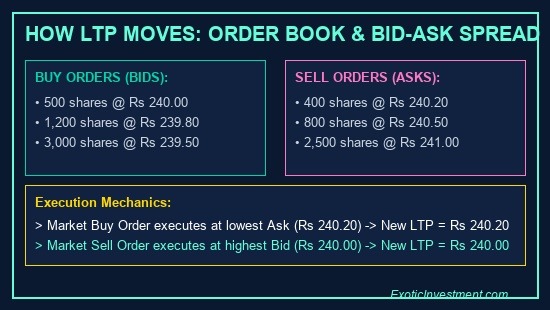
Illustration: Order Book Market Depth: How Bids and Asks Set the New LTP
Why ATP is Vital for Day Traders and Institutional Investors
Smart intraday traders never rely on LTP alone. They use ATP as a primary benchmark to judge market strength:
1. The Bullish Benchmark: When the current LTP trades firmly ABOVE the day’s ATP, it indicates strong buyer control. Intraday institutional algorithms typically buy on dips toward the ATP line.
2. The Bearish Benchmark: When the LTP trades firmly BELOW the day’s ATP, sellers dominate. Buying a stock below its ATP is often catching a falling knife.
3. Official Closing Price Calculation: On the NSE and BSE, the official daily closing price is NOT the final LTP at 3:30 PM! Instead, SEBI rules mandate using the volume-weighted average price (ATP). The exchange calculates this across all trades executed between 3:00 PM and 3:30 PM. This prevents rogue operators from manipulating closing prices with small orders in the final seconds.
Calculate your exact trading brokerage and statutory fees using our free Zerodha Brokerage Calculator, and estimate net tax liabilities with our Stock Market Tax Calculator.
Key Order Types: Market Orders vs Limit Orders
Now that you understand what is ltp in share market, you must use the right order type to protect your capital:
1. Limit Orders (Recommended): A limit order specifies the maximum price you are willing to pay, or the minimum price you will accept to sell. If you set a buy limit at ₹500, your order will NEVER execute at ₹500.50. It guarantees price control.
2. Market Orders: A market order instructs your broker to execute immediately at whatever price is available right now. While execution is instant, you surrender price certainty.
Before placing live trades, calculate your exact share quantity with our free Position Size Calculator, and check business valuation multiples using our PE Ratio Calculator.
Recommended Trading Education & Stock Market Books
If you want to master price action charts, order flow reading, and volume analysis, structured education accelerates your learning curve:
Master candlestick reading and moving averages in our Technical Analysis Course in Kannada, or build a rock-solid foundation with our Basics of Stock Market Course. If you trade derivatives, explore our Options Buying Course in Kannada.
Kannada readers can also grab Ashok Kumar N Rao’s bestselling Kaliyiri Share Market Book, or view details on the Basics of Indian Stock Market Book page. For premium research stock picks, subscribe to our MultiBagger Plus Courses & Pro Tools Annual Subscription. Also check out Emintage financial calculators for external financial modeling tools.
Frequently Asked Questions — What is LTP in Share Market
FAQ 1: What is the main difference between LTP and CMP in the share market?
LTP is the exact price of the single most recent trade executed on the exchange. CMP is the current market price shown on your broker app. In liquid stocks, LTP and CMP are identical. In illiquid stocks, CMP may reflect the mid-point of the bid-ask spread. Check your trade costs using our free Zerodha Brokerage Calculator.
FAQ 2: Why is the closing price different from the final 3:30 PM LTP?
Under SEBI regulations, the official daily closing price of a stock on NSE and BSE is the volume-weighted average price (ATP) of all trades between 3:00 PM and 3:30 PM. It is not simply the last price traded at 3:30 PM. Learn chart reading in our Technical Analysis Course in Kannada.
FAQ 3: Can the LTP change after the market closes at 3:30 PM?
Yes. The exchange runs a post-closing session between 3:40 PM and 4:00 PM where trades execute strictly at the day’s official closing price. However, the closing price itself remains fixed. Learn how overnight holdings settle in our guide on delivery shares and CNC orders.
FAQ 4: How does placing a market order affect execution against the LTP?
A market order matches the best available ask price in the order book. If liquidity is low, your fill price can be substantially higher than the flashing LTP. Always use Limit Orders to control your execution price. Calculate risk-adjusted share quantities with our Position Size Calculator.
FAQ 5: Why is ATP important for intraday trading strategies?
ATP acts as the day’s Volume Weighted Average Price (VWAP). When price trades above ATP, buyers control momentum. When price trades below ATP, sellers dominate. Intraday traders use ATP as a dynamic support and resistance line. Project capital growth scenarios with our Lumpsum Investment Calculator.
FAQ 6: What taxes apply when booking profits based on intraday LTP moves?
Intraday profits are treated as Speculative Business Income under Section 43(5) of the Income Tax Act, taxed at your personal slab rate. Delivery gains held over 12 months are taxed as LTCG at 12.5% above ₹1.25 Lakh. Calculate your exact tax liability with our Stock Market Tax Calculator.

Trackbacks/Pingbacks