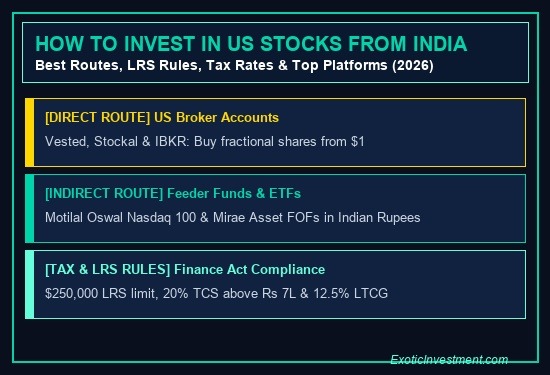
Listen, boss, you use an iPhone every morning. You search on Google and shop on Amazon. Why restrict your wealth to domestic stocks? Many Indian investors wonder how to invest in US stocks from India without getting stuck in red tape. The truth is simple. Investing in Wall Street giants from Bangalore, Mumbai, or Delhi is 100% legal and easier than opening a fixed deposit. You can own fractional shares of Apple, Microsoft, or Nvidia starting with just one single dollar. Before tracking international price quotes alongside domestic LTP, CMP, and ATP stock price terms, let’s keep it simple. Here is the complete breakdown of direct brokers, feeder funds, RBI remittance rules, and updated tax rates.
How to Invest in US Stocks from India: The 3 Main Routes
When diversifying your portfolio across the Atlantic, you have three distinct avenues. Each route suits different capital sizes and comfort levels:
1. Direct US Brokerage Account: You open an account with a specialized international investing platform like Vested Finance, Stockal, or Interactive Brokers. You wire US Dollars under the RBI LRS route. Then you buy shares directly on NASDAQ and NYSE.
2. Indian Mutual Funds (Feeder Funds & FOFs): Indian fund houses run feeder funds. They collect rupees and invest into an underlying US fund. Examples include the Motilal Oswal Nasdaq 100 Fund of Fund or Mirae Asset NYSE FANG+ ETF Fund of Fund. You do not need an overseas trading account or foreign bank wire.
3. India-Listed ETFs on NSE and BSE: You can purchase India-listed ETFs like MON100 during normal market hours. You use your standard Indian Demat account. If you trade through Indian exchanges, review our guide on delivery shares and CNC order execution.
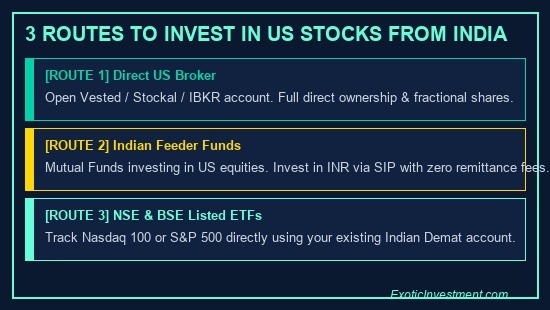
Illustration: Three Practical Routes to Invest in US Stocks from India: Direct vs Feeder Funds vs ETFs
Route 1: Opening a Direct US Brokerage Account
If you want full control to pick individual tech innovators, the direct route is unmatched. Today, digital platforms make setting up an overseas account quick and paperless:
How the Process Works:
You sign up on platforms like Vested Finance or Stockal using your Indian PAN card, Aadhaar card, and address proof. Your account is typically approved within 24 to 48 hours. The broker partners with an SEC-registered US broker-dealer. This gives your investments SIPC insurance up to $500,000.
Fractional Shares Advantage:
In India, you cannot buy half a share of MRF or Page Industries. But in the US market, fractional investing is standard. If Alphabet trades at thousands of dollars per share, do not worry. You can invest just $1. This makes building a diversified basket accessible to every retail investor.
Transferring Money via LRS:
To fund your account, you remit money from your Indian bank under the RBI LRS route. Leading banks like HDFC, ICICI, and Axis offer instant digital LRS remittance with fixed forex markups.
RBI LRS Limits and Tax Rules You Must Know
Before sending your first dollar overseas, you must master the regulatory and tax framework governing foreign assets:
1. RBI Liberalised Remittance Scheme (LRS) Limit:
Under RBI rules, resident Indians can remit up to $250,000 per financial year. That equals roughly ₹2.1 Crores for foreign stock investments.
2. TCS (Tax Collected at Source) on Remittances:
Under Section 206C(1G), foreign remittances face 20% TCS on amounts above ₹7 Lakh in a financial year. Up to ₹7 Lakh, the TCS rate is zero! Remember that TCS is not an additional tax. It is an advance tax collected by the bank. You can adjust it against advance tax. Or claim a full refund when filing your annual ITR.
3. Capital Gains Tax on US Stocks (Post-Finance Act 2024 Rules):
For Indian tax purposes, foreign equities are treated as unlisted assets. Following the latest tax amendments:
- Long-Term Capital Gains (LTCG): If you hold US shares over 24 months, gains face 12.5% LTCG without indexation.
- Short-Term Capital Gains (STCG): If you sell within 24 months, gains are added to your income and taxed at your slab rate.
4. US Dividend Withholding Tax:
When US firms pay dividends, the US IRS withholds 25% tax at source under the India-US DTAA. You can claim this as Foreign Tax Credit in India. Just file Form 67 with your tax return. Calculate your capital gains and tax liabilities accurately using our free Stock Market Tax Calculator, and model your long-term compound growth with our Lumpsum Investment Calculator.
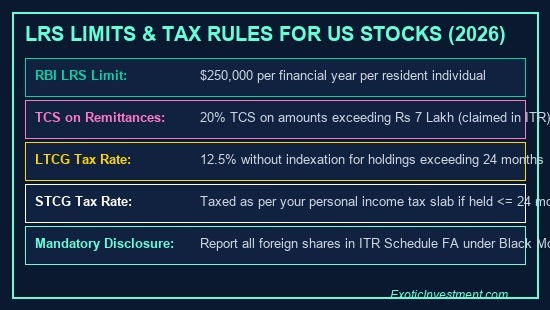
Illustration: LRS Remittance Limits, TCS Slabs and Capital Gains Tax Rates on US Equities
Best Platforms to Invest in US Stocks from India
Selecting the right platform depends on your trading frequency, portfolio size, and technical needs:
1. Vested Finance:
Vested is the most popular platform for Indian beginners. It charges zero commission on stock trades. It also offers pre-built portfolios called “Vests.” You deposit funds easily through partnered banks with paperless digital LRS transfers.
2. Stockal:
Stockal offers seamless access to US markets with zero brokerage options. Its standout feature is “Stacks” — pre-configured thematic baskets created by global research houses. It suits investors who want expert-curated portfolios without picking single stocks.
3. Interactive Brokers (IBKR):
Interactive Brokers is the institutional-grade choice for active traders and serious investors. It offers pro charts, global exchange access, options trading, and the lowest forex conversion rates. However, its interface carries a steeper learning curve.
Assess valuation multiples of global compounders using our free PE Ratio Calculator, and model required compounding returns with our Reverse CAGR Calculator.
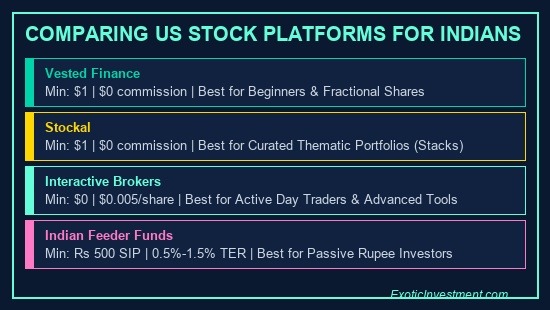
Illustration: Comparing Top US Stock Investing Platforms for Indian Retail Investors
Route 2 and 3: The Passive Rupee Route (Feeder Funds & ETFs)
If wiring US Dollars and handling foreign tax schedules feels intimidating, you can invest in Wall Street without leaving the Indian Rupee ecosystem:
1. International Mutual Funds (Feeder Funds):
You can start a monthly ₹500 SIP in Indian mutual funds that track global indices. Popular choices include Motilal Oswal Nasdaq 100 FOF and Franklin India Feeder US Opportunities Fund. You invest in INR from your regular Indian bank account. The AMC handles currency conversion and foreign tax filings automatically.
2. India-Listed US ETFs:
ETFs like Motilal Oswal Nasdaq 100 ETF (ticker: MON100) trade directly on the NSE and BSE. You buy and sell them just like domestic shares through Zerodha, Groww, or Angel One. Keep in mind that SEBI caps overseas fund limits. This can cause market price premiums over NAV.
Calculate your portfolio sizing and risk limits with our free Position Size Calculator, and compare domestic transaction levies with our Zerodha Brokerage Calculator.
Summary Checklist: How to Start Investing in US Stocks Safely
Here is a practical checklist before placing your first overseas trade:
- Determine Your Route: Choose between direct platforms (for individual stocks) or feeder funds (for passive index SIPs).
- Factor in Currency Exchange Spreads: Account for bank wire fees and foreign exchange markups (typically 0.5% to 1.5%).
- Budget for 20% TCS: If remitting over ₹7 Lakh, keep liquid funds ready to handle the upfront 20% TCS deduction.
- Mandatory ITR Schedule FA Disclosure: If you hold direct US stocks, report them in Schedule FA of your ITR. This avoids Black Money Act penalties.
Recommended Trading Education & Stock Market Books
If you want to master technical chart reading, global macro analysis, and risk management strategies, structured education is your best investment:
Learn price action and candlestick setups in our Technical Analysis Course in Kannada, or build foundational market skills with our Basics of Stock Market Course. If you trade options, explore our Options Buying Course in Kannada.
Kannada readers can also grab Ashok Kumar N Rao’s bestselling Kaliyiri Share Market Book, or explore the English edition on the Basics of Indian Stock Market Book page. For weekly research stock picks, subscribe to our MultiBagger Plus Courses & Pro Tools Annual Subscription. Also check out Emintage financial calculators for external financial modeling tools.
Frequently Asked Questions — How to Invest in US Stocks from India
FAQ 1: Is it legal for Indian residents to invest in US stocks?
Yes. Under RBI’s Liberalised Remittance Scheme (LRS), resident Indians can legally remit up to $250,000 per financial year for investing in foreign equities. You can calculate your long-term wealth targets with our free Lumpsum Investment Calculator.
FAQ 2: What is the minimum amount needed to invest in US stocks?
You can begin with as little as $1 on platforms like Vested Finance and Stockal because US exchanges support fractional share investing. Compare your trading charges using our Zerodha Brokerage Calculator.
FAQ 3: How are US stock capital gains taxed in India after Budget 2024?
Under the Finance Act 2024, foreign equities held over 24 months qualify as long-term and are taxed at 12.5% without indexation. Shares held for 24 months or less are taxed at your income slab rate. Calculate your exact tax liability with our Stock Market Tax Calculator.
FAQ 4: What is the TCS rate on remitting money for US stocks?
Under Section 206C(1G), remittances exceeding ₹7 Lakh in a financial year attract 20% TCS. Remittances up to ₹7 Lakh incur 0% TCS. The TCS is an advance tax credit claimable in your ITR. Plan your portfolio allocations using our Position Size Calculator.
FAQ 5: Do I have to declare US stock holdings in my Indian tax return?
Yes. If you own direct US shares, you must disclose them in Schedule FA (Foreign Assets) of your ITR. Failure to disclose foreign holdings attracts heavy penalties under the Black Money Act. Learn valuation multiples with our PE Ratio Calculator.
FAQ 6: Can I buy US stocks directly through Zerodha or Groww?
Zerodha and Groww do not currently offer direct US stock trading. However, you can buy Indian mutual funds (feeder funds) or India-listed ETFs like MON100 through them in Indian Rupees. Master technical chart timing in our Technical Analysis Course in Kannada.

Trackbacks/Pingbacks