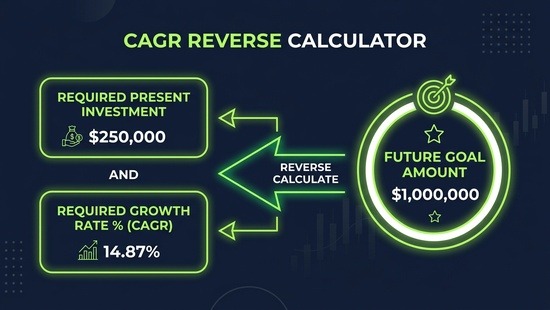
Use our reverse CAGR calculator to find future wealth, the exact investment needed today, or the growth rate your portfolio must hit to reach any financial goal.
Get inflation-adjusted goal projections, LTCG tax modelling (Budget 2024 — 12.5% above ₹1.25L), and asset class recommendations based on your required CAGR.
Most calculators tell you what returns you get. This cagr reverse calculator flips the question — start from your goal and work backwards to find the exact numbers you need. Specifically, it covers three distinct planning scenarios.
1
Choose Your Planning Mode
Select Future Value, Required Investment, or Required CAGR tab based on your goal. Use the preset ₹25L / ₹50L / ₹1Cr / ₹5Cr buttons to fill values instantly.
2
Adjust Sliders or Type Values
Move sliders or type directly into the fields. Every input fires a live recalculation. No submit button needed — it works as you type.
3
Read Your Key Metric
The hero number at the top of the output panel shows your answer. Check the donut chart, Rule of 72 callout, and feasibility rating for deeper context.
4
Share or Save Your Plan
Copy a pre-filled shareable link, post results to your WhatsApp group, or save your strategy to your Pro profile for later reference.
Want to master technical analysis, spot breakouts, and configure risk average levels like a professional trader? Enroll in our top-rated basics of stock market course today!
What does a reverse CAGR calculator India user need it for?
Basically, Indian investors use a reverse CAGR calculator India to set a concrete wealth target first, then work backwards to find the required investment or required return. Specifically, this flips the usual compounding logic on its head. Additionally, compare your holdings with our Beta Calculation for Indian Stocks.
How much do I need to invest to get 1 crore in 10 years?
To find how much to invest to get 1 crore in 10 years, switch to the Required Investment tab, set goal = ₹1 Crore, CAGR = 12%, Duration = 10 years. Subsequently, the calculator shows you need roughly ₹32.2 Lakhs today. Consequently, compounding handles the remaining ₹67.8 Lakhs for you. Furthermore, check our Lumpsum Investment Calculator for a deeper breakdown.
What CAGR do I need to get 5 crore in 15 years?
To discover what CAGR to get 5 crore in 15 years, use the Required CAGR tab. For example, enter PV = ₹25L, FV = ₹5 Crore, Duration = 15. As a result, you find you need roughly 21% CAGR — our tool flags this as 🟡 Ambitious territory requiring active stock selection.
What is the reverse CAGR formula in Excel?
The reverse CAGR formula in Excel for required rate is: =(FV/PV)^(1/n)-1. Indeed, for required present value it is: =FV/(1+CAGR)^n. Therefore, this tool saves you the manual formula work entirely. Moreover, pair it with our Option Pricing Calculator for advanced scenarios.
What is the difference between reverse CAGR vs XIRR?
The difference in reverse CAGR vs XIRR is that CAGR assumes a single lumpsum holding period. XIRR, however, handles multiple cash flows at irregular dates — for example, SIP investments. Consequently, use the cagr reverse calculator for lumpsum goals, and XIRR for SIP returns.
Why do investors need a CAGR required for financial independence India target?
Planning for CAGR required for financial independence India means you need higher target returns than Western FIRE benchmarks because Indian inflation runs at 5-7% versus 2-3% in the US. Specifically, most Indian FIRE planners target 14-16% CAGR. Therefore, this calculator’s feasibility labels help you set realistic expectations.
What is the reverse CAGR meaning in simple words?
The reverse CAGR meaning is straightforward: instead of calculating what your money grows to, you calculate what rate or starting amount you need to reach a fixed goal. Undoubtedly, this is the single most practical financial planning tool for goal-oriented investors. Similarly, check our Step Up SIP Return Calculator.
How to calculate required CAGR for a specific goal?
To learn how to calculate required CAGR for goal, apply the formula: CAGR = (FV/PV)^(1/n) – 1. Alternatively, use Tab 3 of this calculator to get the answer instantly. As a result, you also get a benchmark comparison against Nifty 50, Gold, PPF, and FD returns.
What is a realistic CAGR in India for equity investors?
A realistic CAGR in India for long-term equity investors falls between 12-14% annually, matching historical Nifty 50 performance. Indeed, small and mid-cap funds have delivered 16-22% over long horizons, but with significantly higher volatility. Therefore, our feasibility labels help you decide which fund category to target.
How does reverse CAGR for SIP vs lumpsum differ?
The reverse CAGR for SIP vs lumpsum calculation differs because SIP involves multiple periodic investments, requiring XIRR for accuracy. Consequently, a lumpsum reverse CAGR is straightforward — one capital deployment, one outcome. Therefore, use this tool for lumpsum scenarios and our dedicated SIP Return Calculator for monthly investments.