
Mastering risk to reward ratio and position sizing is the single defining difference between professional market operators and struggling retail traders. Most beginners focus 95% of their energy trying to predict where the Nifty or Bank Nifty will move next. But seasoned desk traders know the truth: trading is a game of mathematical probabilities, not prediction. Before risking real money, understanding basic stock market terms gives you the foundation required to execute trades without emotional confusion.
Listen, boss, you can have a 70% win rate and still blow up your trading account if your losing trades are three times larger than your winners. Conversely, an asymmetric risk-to-reward system keeps you highly profitable even if you lose on 60% of your trades. Let’s keep it simple: profitability comes down to trade math, position sizing discipline, and strict capital defense.
What Is Risk-to-Reward Ratio in Stock Trading?
The risk-to-reward ratio (R:R) compares how much capital you risk on a trade against the potential profit target you aim to capture. For example, if you buy a stock at ₹500 with a technical stop-loss at ₹480 (risking ₹20 per share) and set a target price of ₹540 (aiming to gain ₹40 per share), your risk-to-reward ratio is 1:2. You are risking 1 rupee to make 2 rupees.
Why is this ratio so powerful? Because it defines your minimum required win rate to break even. With a 1:1 ratio, you must win at least 50% of your setups just to cover exchange charges and broker commissions. But when you enforce a minimum 1:2 ratio, you only need to win 34% of your trades to stay in net profit. You can test these exact profit targets using our free stock profit calculator before taking entry.
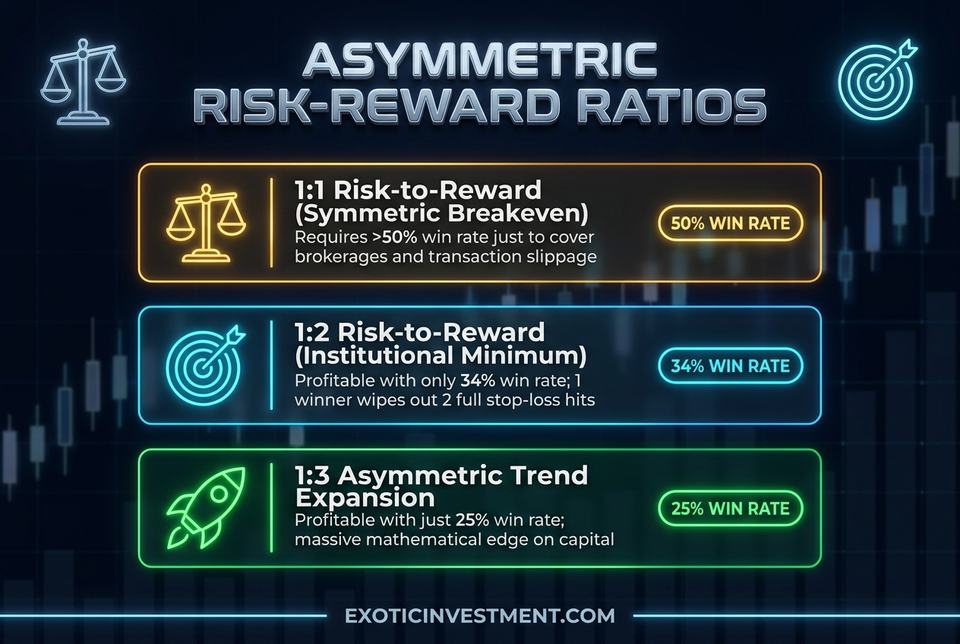
Illustration: Asymmetric Risk-Reward Ratios and Required Win Rates for Profitability
The 1% Rule of Account Risk and Position Sizing
Having a favorable risk-reward ratio is useless if you take random quantity sizes. This is where mathematical position sizing enters. Professional trading desks follow the strict 1% Rule: never risk more than 1% of your total trading capital on any single trade setup.
Let’s look at the exact step-by-step formula:
- Calculate Maximum Account Risk (₹): If your total trading capital is ₹5,00,000, risking 1% means your maximum allowable loss on the trade is strictly ₹5,000 (₹5,00,000 × 0.01).
- Determine Technical Stop-Loss (₹ per share): Identify where your technical setup is invalidated on the chart. If you enter at ₹250 and your technical stop is at ₹240, your risk per share is ₹10.
- Calculate Allowed Quantity: Divide your Maximum Account Risk by the Risk Per Share: ₹5,000 ÷ ₹10 = 500 Shares.
Notice what happened here: your stop-loss distance dictates your share quantity, not your emotions or bank balance. If a trade setup has a wider ₹25 stop-loss, your quantity automatically drops to 200 shares (₹5,000 ÷ ₹25). You can calculate this instantly with our dedicated position size calculator.
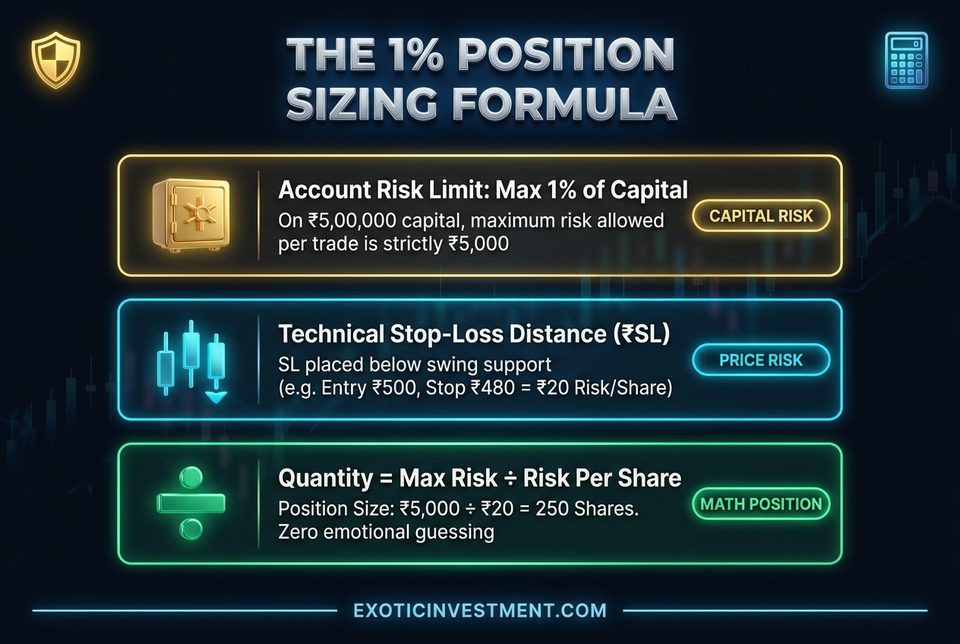
Illustration: The 1% Position Sizing Mathematical Formula for Indian Traders
The Psychology of Revenge Trading and the Pearl Rule
Why do traders abandon their risk management rules? Usually after suffering two or three consecutive stop-loss hits. The trader feels anger, doubles their position size to recover losses quickly, and takes an unplanned impulse trade. This destructive cycle is called revenge trading.
In Kannada, our ancestors shared an unforgettable truth: “ಮಾತು ಆಡಿದರೆ ಹೋಯ್ತು, ಮುತ್ತು ಒಡೆದರೆ ಹೋಯ್ತು” (Maathu aadidre hoythu, mutthu odedre hoythu — words spoken cannot be recalled, and a shattered pearl cannot be mended). In trading, your wrong trades and undisciplined revenge bets are like broken pearls. One reckless trade without a stop-loss can shatter months of profits and destroy your capital permanently. When you hit a stop-loss, accept the loss cleanly as a normal business expense and step away from the terminal.
Always remind yourself: “ನಿಧಾನವೇ ಪ್ರಧಾನ” (Nidhanave pradhana — patience is supreme). Quality setups appear every single week on Dalal Street. Preserving capital ensures you are ready when high-probability breakouts unfold.
Execution Rules: System Stop-Loss vs Mental Stop-Loss
Never rely on a “mental stop-loss”. When a stock breaches your support level, emotional attachment often freezes your ability to click the sell button. You start hoping for a rebound, turning a small 1% loss into a catastrophic 15% drawdown.
Always place a hard system stop-loss order in your terminal the exact moment your entry order fills. Understanding order types such as SL-L (Stop-Loss Limit) and market depth protects you during rapid market moves. You can study complete order mechanics in our guide on delivery, BTST and CNC trading rules. In addition, keep track of daily exchange volatility bands by reviewing upper and lower circuit limits.
Also, factor in transaction costs. Frequent trades with tight stop-losses generate significant STT, exchange turnover fees, and GST. Always check net breakeven points with our zerodha brokerage calculator and evaluate tax consequences with our stock market tax calculator.
🚀 Build Institutional Trading Discipline & Chart Mastery
Ready to trade like an institutional desk with tested risk-reward ratios and mechanical execution? Join our comprehensive MultiBagger Plus Courses & Pro Tools (Plan 5268) to access live trading blueprints, position sizing templates, and mentorship from Dr.Ashok Kumar N Rao.
💡 Frequently Asked Questions (FAQ)
1. What is the best risk-to-reward ratio for intraday trading?
For intraday trading in Indian equities, a minimum risk-to-reward ratio of 1:1.5 or 1:2 is recommended. Setting targets smaller than 1:1.5 makes it difficult to overcome brokerage charges and statutory taxes over a large sample of trades. Calculate your exact lot sizes with our position size calculator.
2. Can I use the 1% risk rule on small trading accounts?
Yes, absolutely. If your capital is ₹50,000, your 1% risk limit is ₹500 per trade. This teaches you strict discipline and ensures you never blow up your account during early learning phases. As Kannada wisdom teaches: “ನೋಡಿ ತಿಳಿ ಮಾಡಿ ಕಲಿ” (Nodi thili maadi kali — observe, understand, execute, and learn). Check long-term compounding with our reverse CAGR calculator.
3. How do I trail my stop-loss to lock in profits?
You can trail your stop-loss behind rising 20-period Exponential Moving Averages (EMA) or beneath the most recent swing low on daily or hourly charts. When the stock reaches your 1:1 profit zone, move your stop-loss to breakeven to eliminate capital risk. Track trade metrics with our stock profit calculator.
4. Why do most retail traders fail at position sizing?
Retail traders fail because they fix their share quantity based on available margin rather than chart risk. Buying 1,000 shares simply because your broker offers 5x intraday margin exposes you to massive capital loss on a tiny 2% adverse move. Always determine your stop-loss first, then calculate quantity.
5. How does risk management protect against market gaps?
Overnight gap-downs can bypass your stop-loss order in cash delivery trades. To protect against gap risk, avoid holding high-beta stocks overnight before major earnings announcements or economic events, and keep individual position allocations capped below 10% to 15% of total portfolio value.