
Stepping onto the trading floor without mastering stock market terms is like driving on the Bengaluru-Mysuru expressway without knowing what road signs mean. Every second on the National Stock Exchange (NSE) and Bombay Stock Exchange (BSE), millions of rupees change hands through flashing order books, blinking tickers, and cryptic acronyms. If you cannot instantly distinguish your LTP from your CMP, or your MIS orders from your CNC trades, you risk costly execution mistakes. In this complete mentor guide, we break down essential share market terms with crystal clarity so you can navigate terminal screens like an institutional trader.
What Are the Core Stock Market Terms for Price Discovery?
When you open your broker terminal at 9:15 AM, the first numbers you see are prices. But which price actually matters for your trade execution? Let’s keep it simple right from the start.
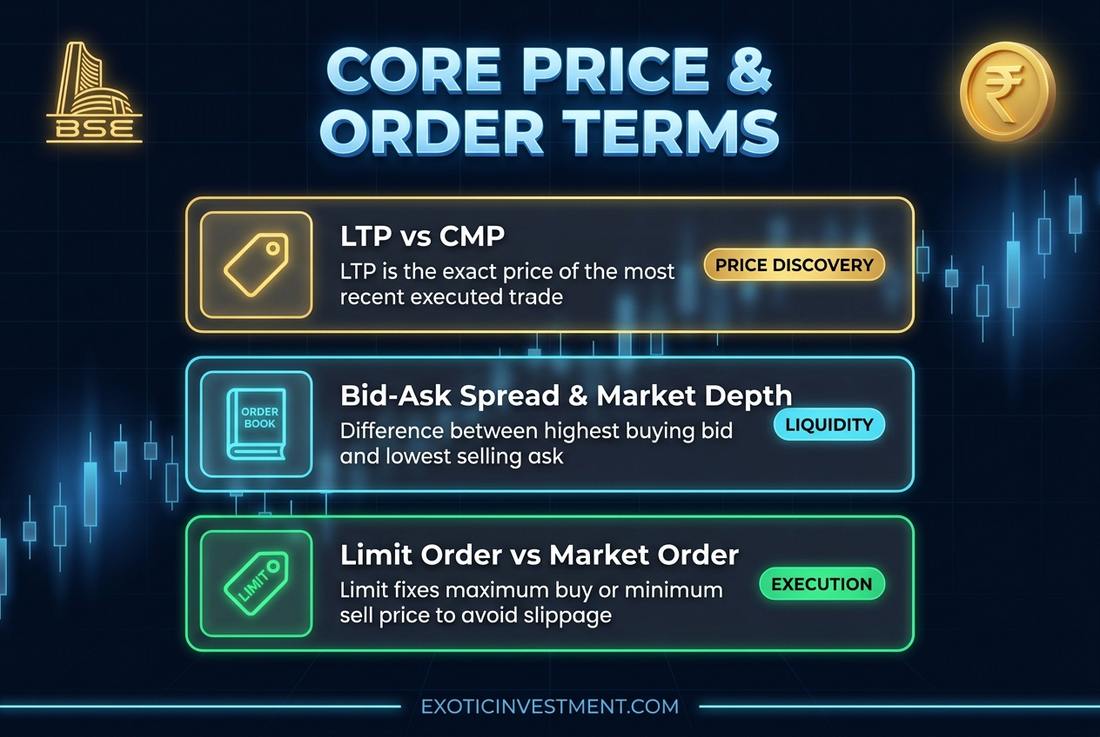
Illustration: Core price discovery and order execution terms in the Indian stock market.
Here are the fundamental price terms every Indian market participant must know:
- LTP (Last Traded Price): The exact price at which the most recent trade occurred on the exchange. Unlike indicative quotes, LTP represents completed cash transactions.
- CMP (Current Market Price): The ongoing quote displayed on your watchlist. While CMP usually matches LTP during active market hours, small differences can emerge in volatile opening seconds. Review our deep dive on LTP, CMP, and ATP stock price terms.
- Bid Price and Ask (Offer) Price: The Bid is the highest price a buyer is willing to pay right now. The Ask is the lowest price a seller is willing to accept. The gap between them is the Bid-Ask Spread. In highly liquid large-cap shares like Reliance or Infosys, the spread is barely 5 to 10 paise. In illiquid small-cap shares, wide spreads cause unexpected slippage.
- Market Depth (5-Depth Order Book): The live list displaying the top 5 bids and top 5 asks awaiting execution on the exchange. Always remember our mentor rule: big institutions frequently hide true orders using iceberg algorithms, so never rely blindly on 5-depth quantities alone.
Before entering any buy trade, always calculate your net expected gain using our free stock profit calculator to account for entry and exit prices accurately.
Essential Order Execution Terms: How Trades Move on the Exchange
Placing an order is not just about clicking a green buy button. You must tell your broker exactly how, when, and at what price you want the transaction completed.
- Market Order: An instruction to buy or sell immediately at the best available price on the order book. Market orders prioritize speed over price. During morning market volatility, a market order can execute several rupees away from your intended price.
- Limit Order: An order where you set the maximum price you will pay to buy, or the minimum price you will accept to sell. If market price does not reach your limit, your order stays unexecuted. In Kannada, our elders say: “Nodi thili, maadi kali” (ನೋಡಿ ತಿಳಿ, ಮಾಡಿ ಕಲಿ — observe to understand, practice to master). Master placing limit orders patiently instead of chasing runaway candles with hasty market orders.
- Stop-Loss Order (SL & SL-M): A defensive order that automatically activates once a specific trigger price is touched. A regular SL places a limit order, while SL-M places an immediate market order. Always calculate your exact share quantity with our position size calculator before setting your stop-loss.
- Trailing Stop-Loss: An order where your exit stop price automatically adjusts upward as the stock moves in your favor, locking in paper profits while giving your winning trade room to run.
Trading Products and Settlement Terms: MIS, CNC, and T+1
When placing orders on modern Indian trading terminals, you will encounter different product codes. Choosing the wrong code can lead to unexpected square-offs.
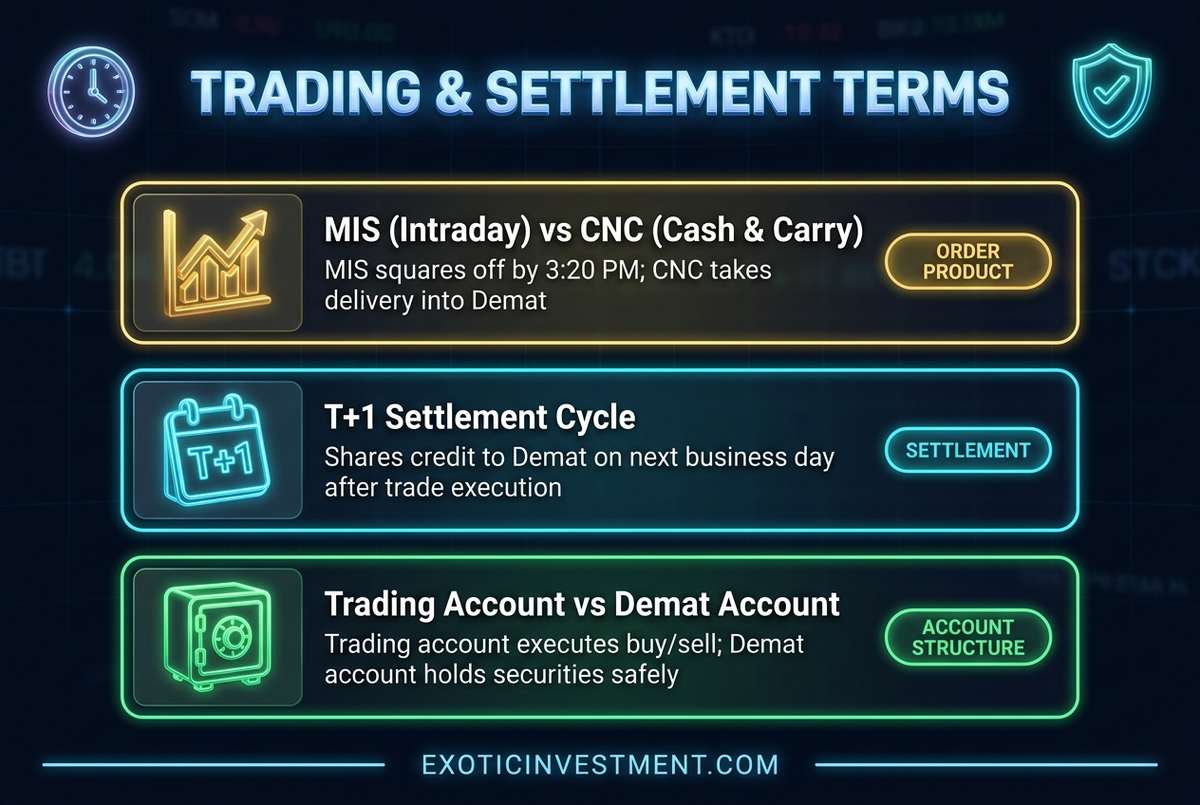
Illustration: MIS versus CNC product types and the Indian T+1 electronic settlement timeline.
- MIS (Margin Intraday Square-off): Intraday product code. You must close the position before 3:20 PM on the same day. If you fail to exit, your broker’s risk management system will automatically square off your position and deduct an auto-square-off penalty fee. Check exact fee breakdowns with our Zerodha brokerage calculator.
- CNC (Cash and Carry): Equity delivery product code. You pay 100% of the trade value upfront, and the shares transfer directly into your Demat account for long-term holding. Learn how delivery transfers work in our complete delivery, BTST, and CNC trade guide.
- BTST (Buy Today, Sell Tomorrow): Selling delivery shares before they officially settle into your Demat account. In India’s rapid T+1 settlement cycle, shares purchased on Monday credit to your Demat on Tuesday evening.
- Trading Account vs Demat Account: Your trading account acts as the cash highway to buy and sell on NSE and BSE. Your Demat account acts as the secure electronic bank vault where your securities rest safely with NSDL or CDSL. Read our complete guide to Demat account terms and DP BO ID.
Risk and Regulatory Terms: Safeguarding Your Capital
In the stock market, protecting your hard-earned money takes priority over chasing profits. Remember the timeless Kannada truth: “Maathu aadidre hoythu, mutthu odedre hoythu” (ಮಾತು ಆಡಿದರೆ ಹೋಯ್ತು, ಮುತ್ತು ಒಡೆದರೆ ಹೋಯ್ತು — words once spoken cannot be retrieved, a pearl once shattered is lost forever). In trading, your capital is like a precious pearl. Just one reckless trade without risk rules can shatter months of disciplined savings in seconds.
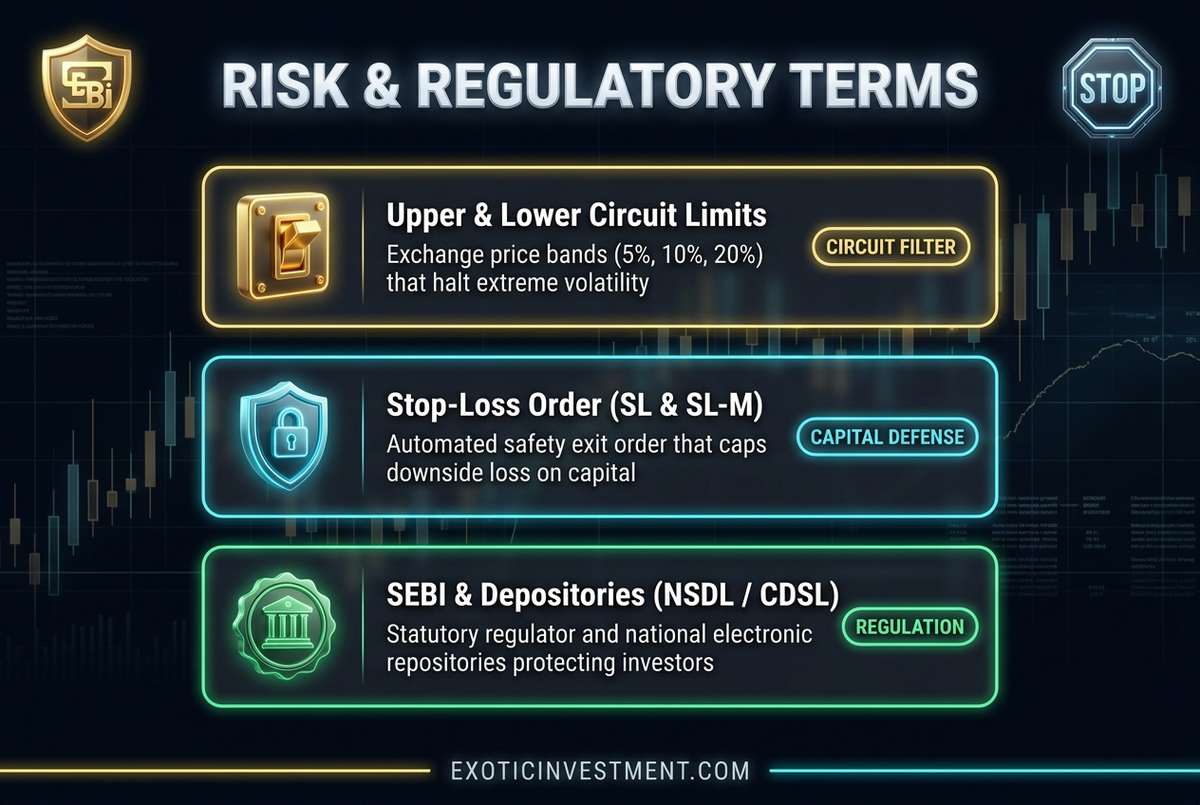
Illustration: Upper and lower circuit filters and SEBI depository investor safeguards.
- Upper Circuit and Lower Circuit: Price boundaries set by stock exchanges to curb irrational volatility. A stock hitting its upper circuit freezes trading because there are only buyers and no sellers. A stock hitting lower circuit freezes because there are only sellers and no buyers. Review the specific band mechanics in our guide on upper circuit vs lower circuit rules.
- Market Capitalization (Large-Cap, Mid-Cap, Small-Cap): The total market value of a company’s outstanding shares. In India, top 100 companies form Large-Caps, 101 to 250 form Mid-Caps, and beyond 250 are Small-Caps. Always evaluate business valuation using our PE ratio calculator before investing in small-cap companies.
- Bull Market vs Bear Market: A Bull market denotes sustained optimism with rising stock prices and broad economic expansion. A Bear market denotes prolonged price drops of 20% or more accompanied by fear and institutional selling. In Kannada, remember: “Nidhanave pradhana” (ನಿಧಾನವೇ ಪ್ರಧಾನ — patience is supreme). True wealth builds during patient accumulation phases.
- SEBI (Securities and Exchange Board of India): The statutory regulatory body that oversees stock exchanges, brokers, mutual funds, and depositories to protect retail investor interests. Learn how regulatory oversight works in our who regulates the Indian stock market guide.
Recommended Trading Courses & Premium Subscriptions:
- Options Buying Course in Kannada: Options Buying Course in Kannada.
- Technical Analysis in Kannada Course: Technical Analysis in Kannada Course.
- Kaliyiri Share Market Book: Kaliyiri Share Market Book.
- Basics of Stock Market Course: Basics of Stock Market Course.
- MultiBagger Plus Courses & Pro Tools Annual Subscription (Plan 5268): MultiBagger Plus Courses & Pro Tools Annual Subscription.
💡 Frequently Asked Questions (FAQ)
1. What is the difference between LTP and CMP on my broker screen?
LTP (Last Traded Price) reflects the exact price of the most recent completed order on the exchange. CMP (Current Market Price) represents the general live quote shown on watchlists. During active trading hours, CMP and LTP are almost identical. You can model your net realized gains on completed trades using our stock profit calculator.
2. Why should retail traders avoid placing market orders at 9:15 AM?
During the market open between 9:15 AM and 9:20 AM, order flow is extremely volatile and bid-ask spreads widen significantly. A market order matches against whatever ask price is available on the book, often causing severe execution slippage. Always use limit orders and verify brokerage expenses with our Zerodha brokerage calculator.
3. What happens if I forget to close an intraday MIS position before 3:20 PM?
If you hold an open MIS order past your broker’s square-off cutoff (typically 3:15 PM to 3:20 PM), the broker’s automated risk management desk forcibly closes your trade at prevailing market prices and charges an auto-square-off fee of ₹50 plus GST. Learn how order products function in our delivery, BTST, and CNC trade guide.
4. How do upper and lower circuits protect everyday retail investors?
Circuit limits stop sudden panic dumps or speculative operator pumps by freezing trading when a stock moves 5%, 10%, or 20% in a single day. This gives participants cooling-off time to digest news. Understand circuit band rules in our upper circuit vs lower circuit rules guide.
5. Where can beginners learn professional chart reading and stock screening?
Start with structured education instead of social media tips. Explore our foundational Basics of Stock Market Course, read the bestselling Kaliyiri Share Market Book, and access our pro institutional screeners through the MultiBagger Plus Courses & Pro Tools Annual Subscription.