
Investing in dividend yield stocks in india offers retail investors a predictable path to building passive cash flow, but chasing yield blindly remains one of the fastest ways to lose capital on Dalal Street. Many beginners see a stock offering a 10% dividend yield and jump in without understanding the balance sheet. In fact, understanding basic stock market terms is essential before committing capital. Yield is simply annual dividend per share divided by the current share price. When a stock price collapses due to deteriorating business fundamentals, its optical yield shoots up, creating a classic value trap.
Listen, boss, building a dividend portfolio is not about buying every PSU stock or high-yielding metal company. It requires evaluating operational cash flows, business moats, and corporate governance. In this guide, our research desk breaks down the exact rules to select resilient dividend payers, identify dangerous yield traps, and optimize your tax liabilities under the latest Indian income tax slabs.
What Are Dividend Yield Stocks in India and How Do They Work?
When an Indian listed company generates net profit at the end of a financial quarter, its board of directors faces two choices. First, it can retain the profit on its balance sheet to fund business expansion, capital expenditure, or debt reduction. Second, it can distribute a portion of surplus cash directly to shareholders as dividends. Companies that consistently distribute cash with yields higher than the Nifty 50 average (typically 1.2% to 1.5%) are classified as dividend yield stocks in india.
For example, if a company trades at ₹500 and pays an annual dividend of ₹25 per share, its dividend yield is 5%. But remember, dividends are paid out of actual cash reserves. If earnings drop next year, that dividend payout can be slashed overnight. Therefore, assessing the underlying earnings stability using our stock profit calculator allows investors to verify whether corporate payouts match bottom-line profits.
Old-school market wisdom in Kannada reminds us: “ನೋಡಿ ತಿಳಿ ಮಾಡಿ ಕಲಿ” (Nodi thili maadi kali — observe carefully, understand the business numbers, execute with clarity, and learn). Never buy a stock simply because someone on social media posted an attractive dividend percentage. Study where the cash originates before taking delivery positions.
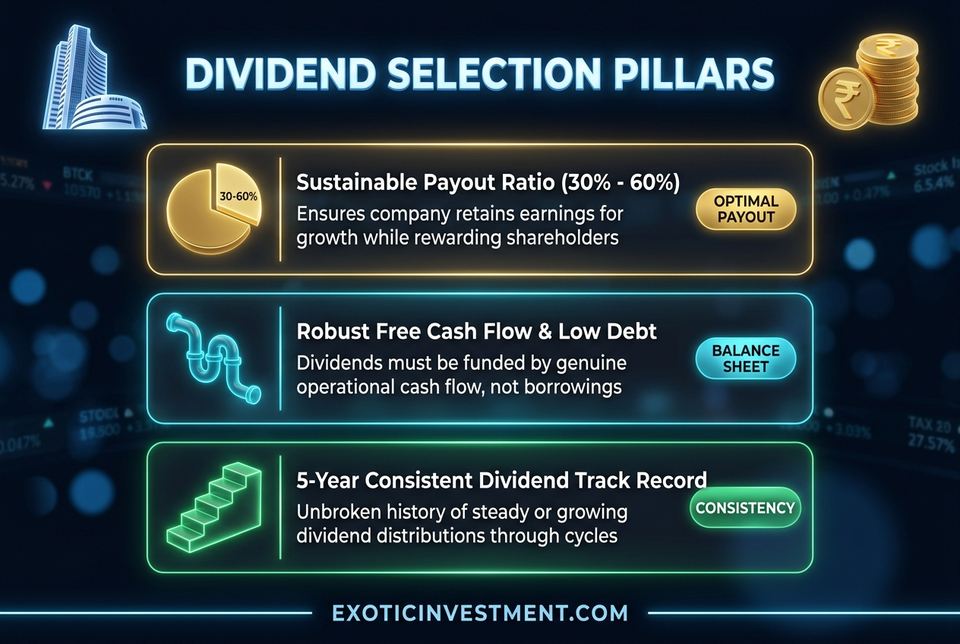
Illustration: The 3 Core Pillars of High Dividend Yield Stock Selection in India
The 3 Pillars of Selecting High Dividend Yield Stocks in India
To avoid capital erosion while collecting steady payouts, professional fund managers rely on three mathematical filters. Let’s look at each filter in detail.
1. Sustainable Dividend Payout Ratio (30% to 60%)
The dividend payout ratio measures the percentage of net profit paid out as dividends. A healthy payout ratio sits between 30% and 60%. If a company pays out 100% or more of its profit, it has zero room to invest in growth or withstand an industry downturn. Conversely, companies retaining 40% to 70% of profits can reinvest in high-return assets while steadily rewarding equity owners.
2. Positive Free Cash Flow and Low Debt
Net profit on an income statement can be manipulated using accounting adjustments, but free cash flow never lies. High-quality dividend payers produce consistent positive operating cash flow after deducting capital expenditures. Plus, companies with low debt-to-equity ratios (ideally below 0.5) do not have large interest burdens competing against shareholder dividend distributions.
3. 5-Year Consistent Dividend Track Record
A single special dividend from an asset sale or subsidiary divestment does not make a company a reliable dividend payer. Look for companies with at least 5 to 10 consecutive years of steady or growing dividend payments across bull and bear market cycles. This consistency reflects management integrity and durable business demand.
Beware the Dividend Trap: When High Yield Means High Risk
One of the most dangerous errors among retail investors is confusing high dividend yield with safety. A stock with a sudden 12% yield often signals distress rather than generosity. Let’s keep it simple: share price forms the denominator in the yield formula. When smart institutions dump a stock due to debt defaults, regulatory fines, or structural business obsolescence, the share price tanks. Because previous historical dividends remain on record, the calculated yield mathematically surges.

Illustration: Warning Signals of Destructive Dividend Traps in Indian Equities
As the classic Kannada proverb warns: “ಮಾತು ಆಡಿದರೆ ಹೋಯ್ತು, ಮುತ್ತು ಒಡೆದರೆ ಹೋಯ್ತು” (Maathu aadidre hoythu, mutthu odedre hoythu). In stock market investing, your hard-earned capital is like a precious pearl. One wrong trade or one blind allocation into a toxic dividend trap can shatter your capital permanently like a pearl breaking off. When the company inevitably cuts its dividend to avoid bankruptcy, the stock collapses another 30%, wiping out years of collected payouts in days.
Always inspect company valuations with a reliable PE ratio calculator to ensure the business is not in secular decline before buying for yield.
Tax Treatment of Dividend Income in India: Finance Act Rules
Before April 2020, Indian companies paid Dividend Distribution Tax (DDT) before distributing cash, making dividends tax-free in the hands of investors up to ₹10 Lakh. However, the Finance Act 2020 abolished DDT and shifted the entire tax incidence to the shareholder. Understanding these tax rules is vital when computing your real net return.

Illustration: Income Tax Slabs and TDS Deductions on Dividend Income in India
1. Taxed at Individual Marginal Slab Rates
Today, all dividend income is added to your total income under the head “Income from Other Sources”. It is taxed at your applicable income tax slab rate (e.g., 5%, 10%, 20%, or 30% plus surcharge and cess). If you fall into the 30% tax bracket, nearly one-third of your dividend cash flow goes to the government. You can evaluate your total liability using our stock market tax calculator to avoid end-of-year tax surprises.
2. Section 194 TDS Deductions (> ₹5,000)
Indian companies deduct Tax Deducted at Source (TDS) at 10% under Section 194 if your total dividend from that single company exceeds ₹5,000 in a financial year. If your PAN is not linked or not updated in your Demat account, TDS is deducted at a punishing 20%. Ensure your KYC details are up to date by reviewing demat account terms and DP details with your broker.
3. Growth Mutual Funds vs Direct Dividend Stocks
Because direct dividends are taxed annually at your slab rate, high-income earners often lose significant compounding velocity. In contrast, investing in mutual fund growth options allows capital gains to compound tax-free until redemption. Reinvesting returns steadily reflects the golden Kannada principle: “ಹನಿ ಹನಿ ಕೂಡಿದರೆ ಹಳ್ಳ” (Hani hani koodidre halla — every small drop compounded patiently builds an ocean of wealth).
Dividend Reinvestment vs Cashing Out: The Compounding Effect
What should you do when dividend payouts credit into your linked bank account? Many investors spend the dividend on discretionary lifestyle purchases. However, reinvesting those dividends back into quality businesses delivers true exponential compounding. You can model this difference using our reverse CAGR calculator or our lumpsum investment calculator.
When you reinvest dividends during market corrections, you acquire additional shares at discounted valuations without putting in fresh capital from your salary. Over a 15-year horizon, dividend reinvestment often accounts for 40% to 50% of the total wealth accumulated in equity portfolios.
How to Buy and Manage Dividend Stocks in Your Demat Account
Executing a dividend strategy requires disciplined trade settlement. When you buy shares for dividend eligibility, you must purchase them at least one day before the ex-dividend date. Due to the T+1 settlement cycle on NSE and BSE, shares must settle in your Demat account on the record date. You can learn the complete mechanics in our detailed breakdown of delivery and CNC trading rules.
Plus, never allocate your entire portfolio into dividend stocks alone. Maintain a balanced allocation combining capital growth stocks, dividend payers, and defensive cash. Always calculate appropriate position sizes with our position size calculator to keep individual stock exposure capped at comfortable limits.
🚀 Master Professional Wealth Building & Stock Selection
Want to learn how our institutional research desk screens high-dividend, high-growth multi-bagger stocks with mathematical precision? Join our elite MultiBagger Plus Courses & Pro Tools (Plan 5268) to access live screener templates, portfolio review sessions, and daily market guidance from Dr.Ashok Kumar N Rao.
💡 Frequently Asked Questions (FAQ)
1. What is an ideal dividend yield in the Indian stock market?
An ideal dividend yield in India typically ranges between 3% and 6%. While the Nifty 50 average yield hovers around 1.3%, sustainable dividend stocks offer higher payouts backed by healthy cash flows. Yields exceeding 8% to 10% warrant extreme caution, as they frequently signal a failing business or one-off cyclical peak. Always evaluate risk using our position size calculator before buying high-yield stocks.
2. Can I receive dividends if I buy shares on the ex-dividend date?
No, you will not receive the dividend. To be eligible, you must purchase the shares on or before the cum-dividend date (at least one trading day prior to the ex-dividend date). This ensures the shares settle in your Demat account by the record date under T+1 settlement rules. Read our guide on share delivery BTST and CNC trading to understand settlement timing.
3. How is dividend income taxed under the New Tax Regime?
Under both the New and Old Tax Regimes, dividend income is added to your total income under “Income from Other Sources” and taxed at your applicable slab rate. There is no special lower concessional rate for dividends. Calculate your exact tax brackets with our free stock market tax calculator to plan advance tax payments accurately.
4. Are PSU stocks the best dividend yield stocks in India?
Public Sector Undertakings (PSUs) in sectors like energy, power, and mining often offer attractive dividend yields due to government mandate requirements. However, investors must monitor commodity cycles and government capital expenditure demands. A balanced portfolio pairs selected PSUs with private cash cows that have strong pricing power. Check potential returns with our reverse CAGR calculator.
5. How does dividend yield differ from dividend payout ratio?
Dividend yield measures annual dividend relative to current share price (Dividend / Stock Price). Dividend payout ratio measures how much of the company’s net profit is distributed to shareholders (Total Dividends / Net Profit). A company can have a high dividend yield but a dangerous 120% payout ratio. Check profit metrics using our stock profit calculator before investing.