Choosing between direct vs regular mutual funds is one of the most critical financial decisions an Indian investor makes. On the surface, an extra 1% annual fee charged by regular plans seems harmless. Many investors assume that paying 1% to their bank relationship manager or mutual fund distributor is a fair cost. But when that 1% fee compounds over a 20 to 25-year investment horizon, it silently drains 20% to 25% of your total lifetime retirement wealth. Understanding basic stock market terms helps you recognize how fee structures impact long-term compounding.
Listen, boss, wealth creation in mutual funds is a marathon. Every single basis point you save in annual fund management fees stays directly inside your investment corpus, compounding for you rather than paying distributor commissions. In this guide, our research team breaks down the mathematics of the expense ratio gap, explains how the commission architecture functions, and shows you how to switch seamlessly to direct plans.
What Is the Difference Between Direct and Regular Mutual Funds?
In January 2013, the Securities and Exchange Board of India (SEBI) mandated that every mutual fund scheme in India must offer two distinct plans: a Regular Plan and a Direct Plan. Both plans have the exact same fund manager, invest in the exact same portfolio of stocks and bonds, and carry the exact same market risk. The only difference is how you purchase them and the fees deducted.
- Regular Plan: Purchased through an intermediary—such as a bank, financial distributor, broker, or agent. The Asset Management Company (AMC) pays the distributor an ongoing yearly commission called a “trail commission” (typically 0.5% to 1.25% per year) deducted directly from your fund value.
- Direct Plan: Purchased directly from the AMC, through platforms like MFCentral, or through direct Demat brokers. Because no distributor is involved, zero commissions are paid. The total expense ratio (TER) is significantly lower, resulting in a permanently higher Net Asset Value (NAV).
You can verify how compounding returns grow over long periods with our free reverse CAGR calculator or calculate expected corpus values using our lumpsum investment calculator.
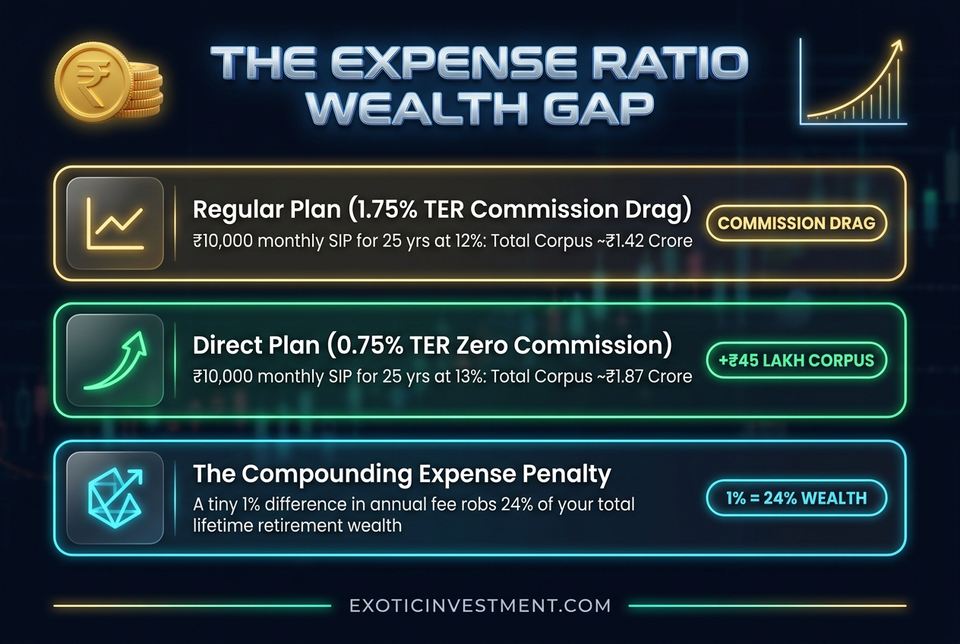
Illustration: The Compounding Wealth Gap Between Direct and Regular Mutual Funds
The Mathematical Wealth Gap: How 1% Costs You ₹45 Lakh
Let’s look at real market numbers to understand the compounding impact of an expense ratio gap:
Suppose you start a monthly Systematic Investment Plan (SIP) of ₹10,000 for 25 years in an equity fund. Let’s assume the underlying portfolio generates a 13% gross annual return before expenses.
- In a Direct Plan (Expense Ratio: 0.75%): Your net annual return is 12.25%. After 25 years, your total invested capital of ₹30 Lakh grows into an impressive corpus of approximately ₹1.87 Crore.
- In a Regular Plan (Expense Ratio: 1.75%): Your net annual return is 11.25% due to the 1% distributor commission. After 25 years, your final corpus reaches approximately ₹1.42 Crore.
Look at that difference: you lost ₹45 Lakh in wealth simply because you remained in a regular plan. That ₹45 Lakh did not go to fund management expertise; it was paid out month after month as distributor trail fees. You can evaluate your investment gains with our stock profit calculator.
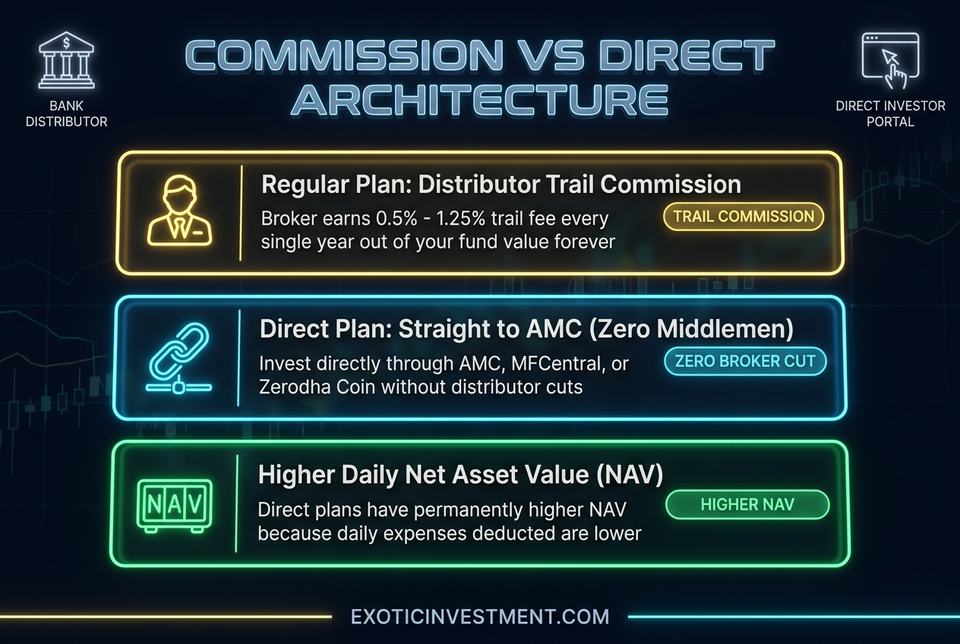
Illustration: Distributor Trail Commission Flow vs Direct-to-AMC Architecture
How to Switch from Regular to Direct Plans Seamlessly
Switching your existing mutual fund portfolio from regular to direct plans is straightforward, but it requires understanding tax and exit load implications:
- Check Exit Loads and Capital Gains Tax: A switch from regular to direct is classified by the Income Tax Department as a redemption and fresh reinvestment. Ensure your equity fund units have completed 1 year of holding to qualify for Long Term Capital Gains (LTCG) tax at 12.5%, and use the ₹1.25 Lakh annual tax-free LTCG exemption limit. Calculate tax with our stock market tax calculator.
- Stop Existing Regular SIP Mandates: Log into your bank net banking or distributor portal and cancel ongoing regular SIP auto-debit mandates to stop fresh commission bleed.
- Start Fresh Direct SIPs: Open an account directly on the AMC website, through the official registrar platform MFCentral, or via zero-commission direct portals.
In Kannada, our timeless proverb states: “ಹನಿ ಹನಿ ಕೂಡಿದರೆ ಹಳ್ಳ” (Hani hani koodidre halla — every small drop compounded patiently creates an ocean of wealth). Saving 1% every year is the cleanest, risk-free way to boost your family wealth.
🚀 Build Complete Financial Freedom & Portfolio Mastery
Want to learn how to structure an all-weather portfolio combining direct index funds, high-conviction value stocks, and options hedging? Join our elite MultiBagger Plus Courses & Pro Tools (Plan 5268) for institutional tools and personal mentorship from Dr.Ashok Kumar N Rao.
💡 Frequently Asked Questions (FAQ)
1. Do direct plans have different fund managers than regular plans?
No. Both direct and regular plans of the same mutual fund scheme share the exact same fund manager, identical investment holdings, and the same investment philosophy. The only difference is the absence of distributor commissions in direct plans.
2. Does switching from regular to direct attract capital gains tax?
Yes. Tax authorities treat a switch as a redemption of regular units followed by a fresh purchase of direct units. For equity funds held over 12 months, gains above ₹1.25 Lakh per financial year are taxed at 12.5% LTCG. Short-term gains are taxed at 20% STCG. Plan your switches strategically across financial years.
3. How can I identify if my existing mutual funds are regular or direct?
Check your Consolidated Account Statement (CAS) from CAMS or KFintech. The scheme name will explicitly display either “Direct Plan” or “Regular Plan”. If the name includes the word “Regular”, you are paying ongoing distributor commissions.
4. Are returns in direct plans guaranteed to be higher?
Yes, mathematically guaranteed. Because the total expense ratio of a direct plan is lower by 0.5% to 1.5% every year, that exact cost saving is retained within the fund NAV, guaranteeing higher net returns compared to the regular plan of the same scheme.
5. Can I invest in direct mutual funds through Demat accounts?
Yes, several discount brokers offer direct mutual fund investments in Demat form with zero brokerage. Alternatively, you can invest in non-Demat (statement of account) format directly through the AMC or MFCentral.