
When planning your long-term financial freedom, comparing step-up sip vs regular sip is the single most profitable exercise you can perform. Most salaried professionals in India set up a flat ₹5,000 or ₹10,000 monthly Systematic Investment Plan (SIP) in mutual funds, and then leave it untouched on auto-debit for a decade. While investing regularly is commendable, maintaining a fixed SIP while your salary grows by 8% to 15% every year is a massive missed opportunity. By stepping up your monthly contribution by just 10% once a year, you can almost double your final wealth without feeling any pinch in your daily lifestyle. In this complete wealth creation guide, we break down real mathematical returns, inflation protection mechanics, and execution rules so you can supercharge your compounding journey.
What Is the Real Returns Difference: Step-Up SIP vs Regular SIP?
Compounding works wonders on its own, but compounding with expanding principal capital creates institutional-grade wealth. Let’s look at the cold, hard mathematics comparing a fixed ₹10,000 monthly SIP against a 10% annual Step-Up SIP over a 20-year horizon at an assumed 12% annual CAGR.
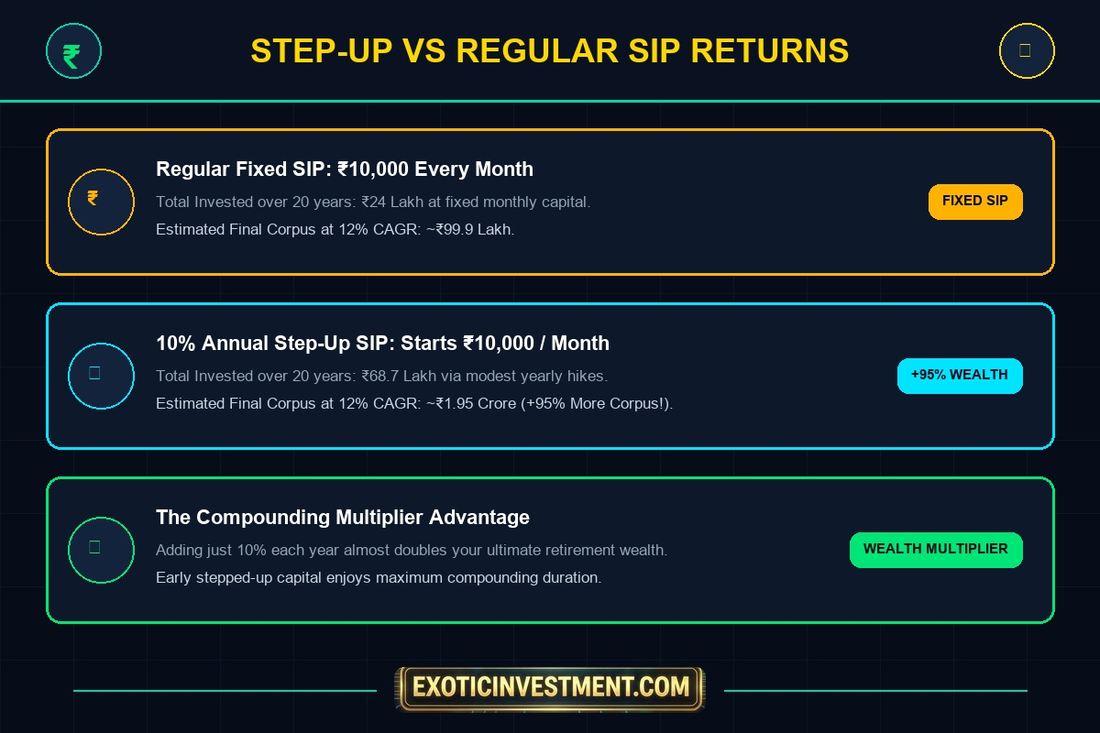
Illustration: 20-year wealth comparison between a fixed ₹10k SIP and an annual 10% Step-Up SIP.
Look at the numbers side by side:
- The Regular Fixed SIP Scenario: You invest a flat ₹10,000 every month for 20 years. Your total out-of-pocket investment comes to exactly ₹24,00,000 (₹24 Lakh). At a realistic 12% long-term equity return, your expected maturity corpus reaches approximately ₹99.9 Lakh. That is nearly ₹1 Crore — a very solid outcome for a salaried investor. You can verify these baseline numbers with our free SIP return calculator.
- The 10% Annual Step-Up SIP Scenario: You start with the exact same ₹10,000 in Year 1. In Year 2, you step it up to ₹11,000 per month. In Year 3, to ₹12,100 per month. By Year 20, your total capital invested amounts to ₹68.7 Lakh. But look at your maturity corpus: it explodes to a staggering ₹1.95 Crore!
- The Wealth Multiplier Effect: You invested an additional ₹44.7 Lakh over 20 years, but your final wealth increased by almost ₹95 Lakh! That is the exponential power of compounding on progressively expanding capital bases. In Kannada, there is a golden truth: “Hani hani koodidre halla” (ಹನಿ ಹನಿ ಕೂಡಿದರೆ ಹಳ್ಳ — small drops make a huge lake). Small annual increments of ₹1,000 to ₹2,000 snowball into generational fortunes.
If you have surplus idle savings or bonus payouts, test how lump-sum additions accelerate your timeline using our lumpsum investment calculator.
Why Step-Up SIP Is Your Ultimate Weapon Against Inflation
Inflation is the silent wealth thief that eats away the purchasing power of your money while you sleep. In India, long-term retail inflation hovers around 5% to 7% annually.

Illustration: How aligning your mutual fund top-up with annual salary hikes defeats lifestyle inflation.
Here is why a fixed SIP leaves you vulnerable, and how Step-Up SIP solves the problem:
- The Purchasing Power Trap: A ₹10,000 monthly SIP in 2026 buys a certain standard of living. At 6% inflation, that same ₹10,000 will have the purchasing power of barely ₹4,970 in twelve years. If your contribution stays flat, your real savings rate is shrinking every single year in real purchasing terms.
- The Lifestyle Creep Hazard: Most employees receive annual salary increments of 8% to 12%. When your income rises from ₹80,000 to ₹90,000 per month, that extra ₹10,000 easily gets absorbed by upgrades in dining, gadgets, or vacations. By automating a 10% Step-Up SIP, you divert a portion of your raise into mutual funds before lifestyle inflation consumes it.
- Effortless Wealth Without Pinch: Because your SIP increases only when your salary increases, you never feel a financial strain. Your take-home pay still grows, but your future wealth compounding pace doubles. In Kannada, our elders remind us: “Nidhanave pradhana” (ನಿಧಾನವೇ ಪ್ರಧಾನ — patience is supreme). Systematic, unhurried compounding outlasts impulsive stock tips every time.
Once you reach retirement age, you can reverse this cash flow seamlessly into steady monthly income by reviewing our comprehensive guide on SWP in mutual funds meaning and tax rules.
3 Step-by-Step Rules to Execute Step-Up SIP on Your Broker App
Setting up a Step-Up SIP is simple and can be completed directly on your registered investment platform in less than two minutes.

Illustration: Three key execution rules to automate and cap your top-up SIP mandates safely.
- Rule 1: Choose Percentage vs Fixed Amount Top-Up: Mutual fund platforms like Zerodha Coin, Groww, and MFCentral give you two options: percentage top-up (e.g. 10% yearly) or fixed top-up (e.g. ₹1,000 yearly). For salaried professionals with percentage raises, a 10% annual top-up is optimal. For self-employed individuals with variable income, a flat ₹1,000 annual top-up keeps contributions predictable. In Kannada, remember: “Nodi thili, maadi kali” (ನೋಡಿ ತಿಳಿ, ಮಾಡಿ ಕಲಿ — observe to understand, practice to master). Start with a comfortable 5% to 10% top-up and scale up as your cash flows stabilize.
- Rule 2: Align with Bank OTM Autopay Mandate: When you set up bank autopay via e-mandate or One-Time Mandate (OTM), ensure your mandate ceiling is set high enough (e.g. ₹50,000 or ₹1,00,000). If your initial SIP is ₹10,000 and your bank mandate limit is set to exactly ₹10,000, your bank will reject the stepped-up installment in Year 2. Setting a higher mandate ceiling costs zero and prevents future auto-debit failures.
- Rule 3: Set an Optional Maximum Contribution Cap: If you worry that a 10% annual increase might become unmanageable in year 15 or 18, you can specify a maximum contribution cap (for example, capping monthly investment at ₹50,000). Once your monthly SIP reaches the cap, it continues as a regular fixed SIP at that elevated level for the remaining duration.
- Tax Implications on Redemptions: Remember that capital gains on mutual fund units follow standard equity taxation rules. Review current capital gains tax rates using our stock market tax calculator before executing withdrawals.
To calculate the exact required annual growth rate to meet your target milestone, explore our reverse CAGR calculator.
Recommended Trading Courses & Premium Subscriptions:
- Options Buying Course in Kannada: Options Buying Course in Kannada.
- Technical Analysis in Kannada Course: Technical Analysis in Kannada Course.
- Kaliyiri Share Market Book: Kaliyiri Share Market Book.
- Basics of Stock Market Course: Basics of Stock Market Course.
- MultiBagger Plus Courses & Pro Tools Annual Subscription (Plan 5268): MultiBagger Plus Courses & Pro Tools Annual Subscription.
💡 Frequently Asked Questions (FAQ)
1. Can I convert an existing regular SIP into a Step-Up SIP?
Most modern broker apps and mutual fund portals allow you to enable the top-up or step-up feature on active SIP mandates with a single toggle. If your specific broker app does not support editing active mandates, simply stop the old regular SIP and start a new Step-Up SIP with your desired top-up frequency. Check broker app features in our stock broker apps in India guide.
2. What is the best frequency for stepping up a mutual fund SIP?
An annual (yearly) step-up frequency is universally recommended for salaried individuals. It aligns seamlessly with annual salary appraisal cycles and performance bonuses, ensuring the increase feels effortless. Project your expected wealth milestone using our SIP return calculator.
3. What happens if I face a financial emergency and cannot afford the stepped-up amount?
You always maintain complete control over your investments. You can pause the SIP, reduce the monthly installment, remove the step-up feature, or modify your top-up percentage at any time without any exit penalty from the mutual fund AMC. Always keep a liquid emergency fund before aggressively compounding equity assets.
4. Does Step-Up SIP attract higher mutual fund expense ratios or broker charges?
No. Mutual fund expense ratios (TER) are charged as a flat percentage on total Assets Under Management (AUM) and do not increase because you use top-up features. Direct mutual fund platforms execute SIP top-ups at zero additional commission. Verify equity delivery brokerage rates with our Zerodha brokerage calculator.
5. How can investors screen top-performing mutual funds and multi-bagger equity ideas?
Focus on fund houses with proven 10-year risk-adjusted rolling returns and low portfolio turnover. For investors seeking direct stock alpha and institutional breakout setups, explore our curated screeners and foundational training through the MultiBagger Plus Courses & Pro Tools Annual Subscription.