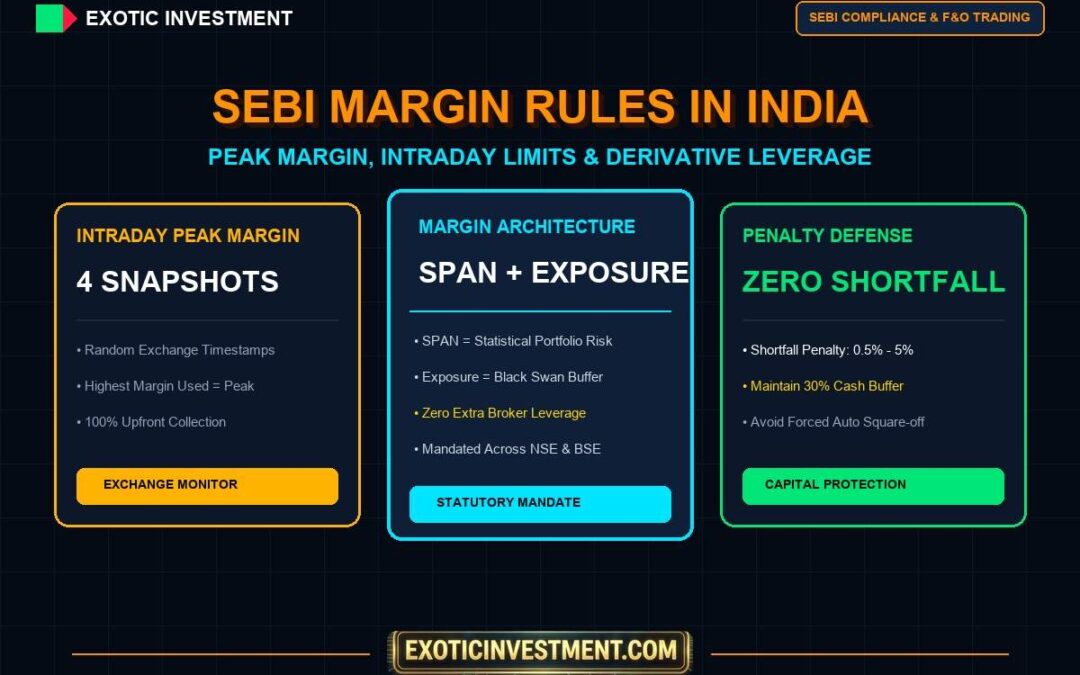
If you traded Indian derivatives prior to 2020, you probably remember the wild west days of discount broking. Retail traders with just ₹10,000 in their accounts were handed 20x to 40x intraday leverage, allowing them to short hundreds of Bank Nifty option lots or trade huge Nifty futures contracts. Then 9:15 AM volatility hit, sudden market circuit limit spikes wiped out retail ledgers within three minutes, and brokers faced severe counterparty default risks. The Securities and Exchange Board of India (SEBI) stepped in with ironclad regulations to halt systemic leverage blowouts. Today, understanding sebi margin rules fno trading frameworks is mandatory if you want to trade derivatives without facing forced broker square-offs or costly regulatory penalty notices.
Our elders in Karnataka have a timeless saying: “ಮಾತು ಆಡಿದರೆ ಹೋಯ್ತು, ಮುತ್ತು ಒಡೆದರೆ ಹೋಯ್ತು” (Maathu aadidre hoythu, mutthu odedre hoythu). In daily conversation, words once spoken cannot be recalled; once a genuine pearl shatters into pieces, no jeweler can repair it. In trading, your risk capital is that precious pearl. When traders gamble with excessive borrowed leverage, a single rogue price spike shatters their account beyond recovery. SEBI margin regulations are not designed to choke active market participants—they are statutory guardrails built to prevent catastrophic capital destruction. Let us walk through how intraday peak margins work, how SPAN and Exposure requirements are calculated, and how to structure your derivative trades with discipline.

The Evolution of Peak Margin: How Exchanges Capture Intraday Leverage
The biggest shift in Indian trading history occurred with the phased introduction of the Peak Margin system. Previously, margin obligations were calculated only at the end of the day (EOD) based on your closing open positions. Brokers routinely allowed hyper-leveraged positions throughout the trading day as long as clients squared off by 3:20 PM. SEBI dismantled this practice by making intraday margin monitoring real-time and random.
Here is how the peak margin framework operates across the National Stock Exchange (NSE) and Bombay Stock Exchange (BSE):
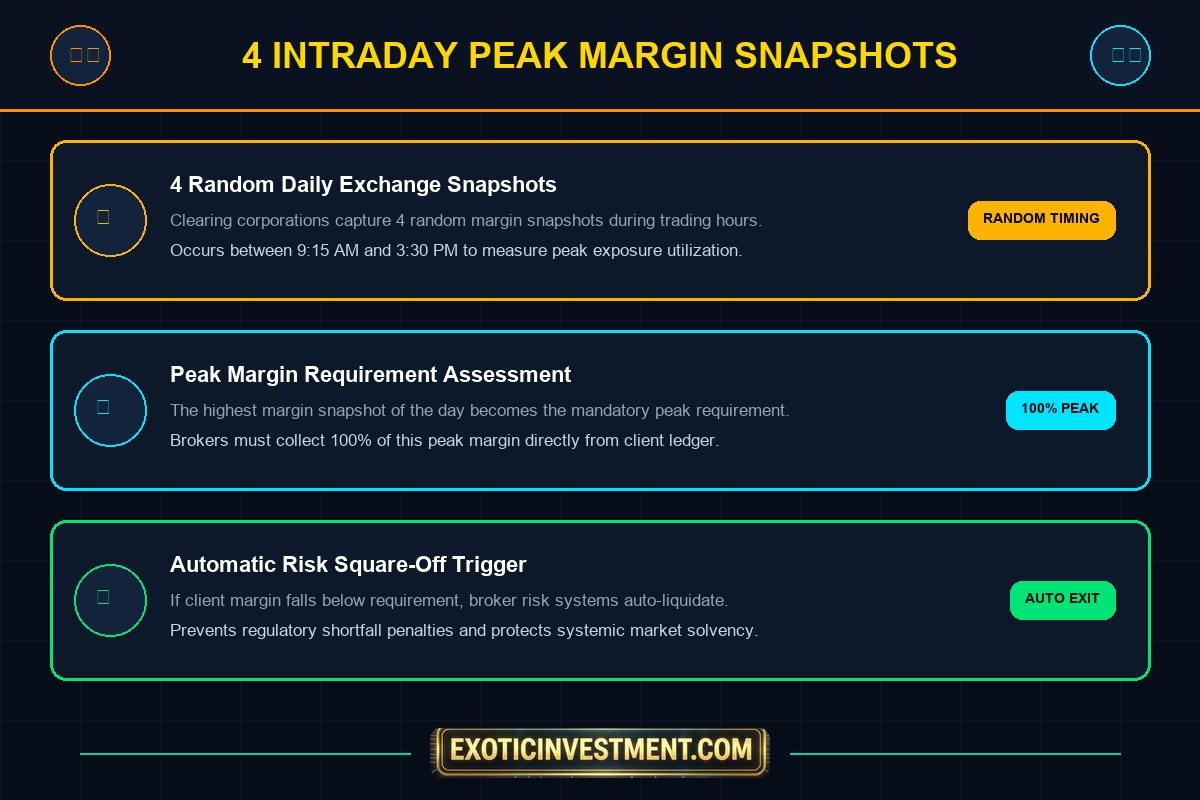
- Four Random Daily Snapshots: During the active trading session between 9:15 AM and 3:30 PM, the clearing corporations (NCL and ICCL) take four random computer snapshots of open positions across all client trading accounts.
- Peak Requirement Identification: The snapshot with the highest total margin utilization is selected as the client’s “Peak Margin” obligation for that day.
- 100% Upfront Collection Mandate: Your broker must collect 100% of this peak requirement directly from your ledger balance or approved pledged collateral. If your account shows even a slight shortfall during that peak snapshot, the exchange slaps an automatic penalty directly on the broker, which the broker legally passes on to the client if the client initiated the unhedged order.
The Two Pillars of Derivative Margin: SPAN and Exposure
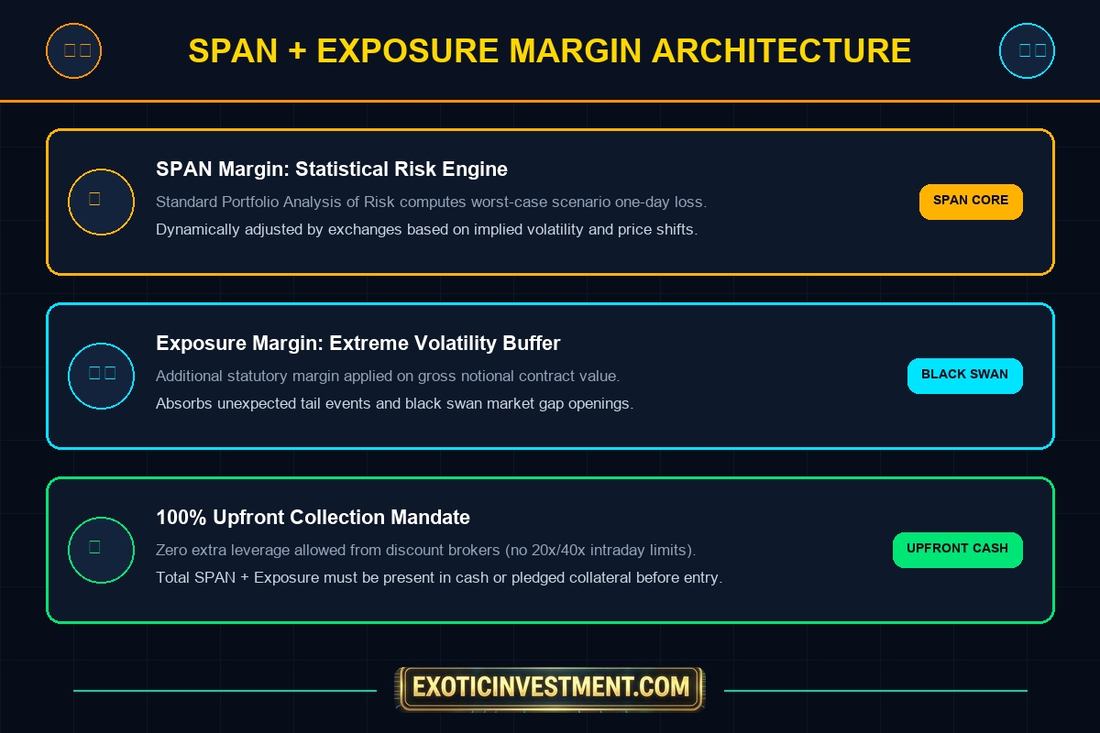
Whenever you initiate a futures contract or write (short) an option, your trading terminal blocks two distinct margin components: SPAN Margin and Exposure Margin. Knowing how these two work together prevents nasty margin call surprises.
Total Margin Requirement = SPAN Margin + Exposure Margin
Both components must be 100% present in your available margin before the broker order engine routes your execution to the exchange matching book.
1. SPAN Margin (Standard Portfolio Analysis of Risk)
Originally developed by the Chicago Mercantile Exchange (CME) and customized for Indian markets, SPAN is a sophisticated algorithm that models portfolio risk across sixteen different market scenarios. It calculates the theoretical maximum loss your positions could suffer in a single trading day based on price moves, volatility changes (India VIX), and time decay. Because SPAN looks at net portfolio risk, hedged spreads (such as Bull Call Spreads or Iron Condors) receive substantial margin relief.
2. Exposure Margin
While SPAN covers statistical probability, Exposure Margin serves as a shock absorber for tail-risk events that fall outside standard probability models—such as sudden election surprises, war outbreaks, or sudden currency devaluations. In Indian equity indices, Exposure Margin is generally set at 2% to 3% of the gross contract value, while individual equity stocks carry 5% or higher depending on underlying volatility.
When tracking complex derivatives across international asset classes or managing multi-platform crypto margin calculations, traders frequently use analytical suites at emintage.com to verify risk thresholds, funding costs, and collateral buffers across non-traditional instruments.
Intraday MIS vs Overnight NRML: Margin Differences Explained
Traders often ask why discount brokers offer MIS (Margin Intraday Square-off) and NRML (Normal / Overnight) order codes if SEBI mandates 100% margin on both. Here is the operational reality on Dalal Street:
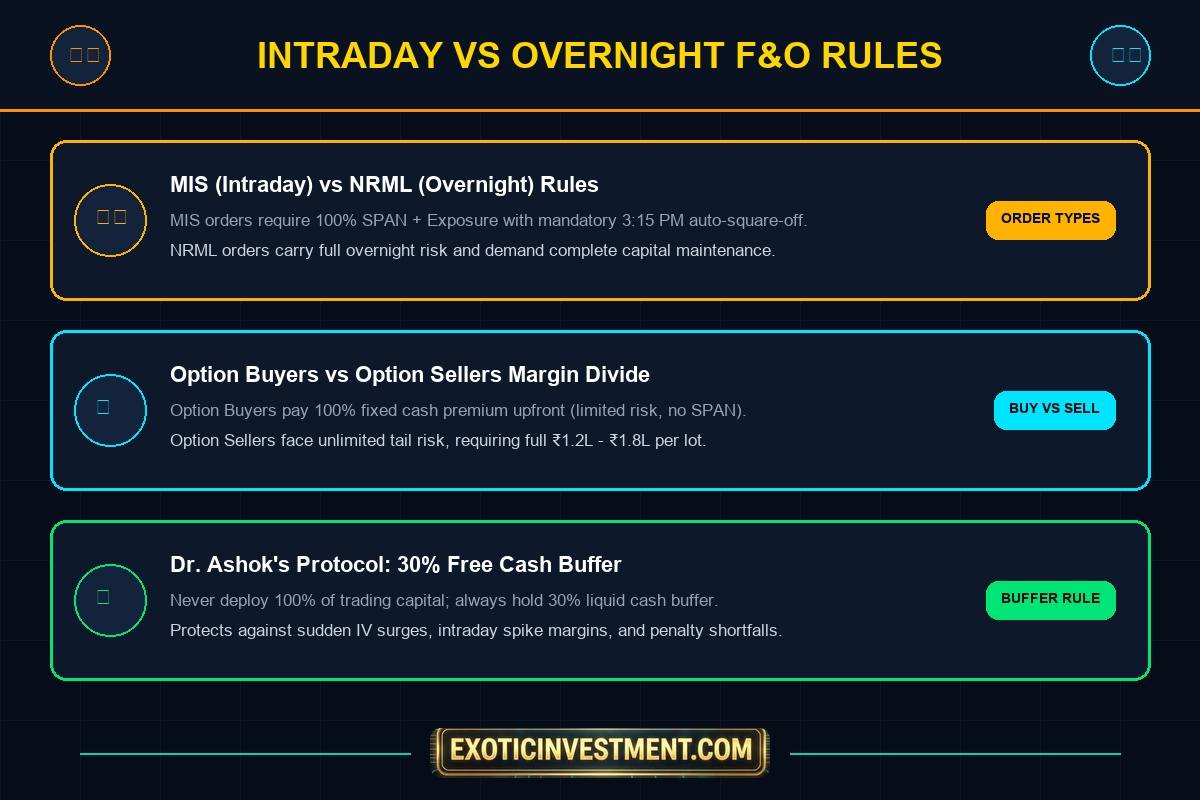
In simple terms, under SEBI peak margin guidelines, you cannot get 10x or 20x extra leverage on MIS orders anymore. Both MIS and NRML require full SPAN plus Exposure margin. The primary function of MIS today is automated intraday risk liquidation for active day traders who want zero overnight exposure.
Margin Shortfall Penalties: How SEBI Enforces Discipline
What happens if your account experiences a margin shortfall? Shortfalls occur when market volatility spikes sharply midday, causing SPAN margin requirements to expand beyond the cash sitting in your ledger. SEBI has established strict statutory penalty slabs:
- Shortfall < ₹1 Lakh and < 10% of Requirement: 0.5% penalty on the shortfall amount.
- Shortfall ≥ ₹1 Lakh or ≥ 10% of Requirement: 1.0% penalty on the shortfall amount.
- Repeated Shortfalls (> 3 instances in a month): 5.0% severe penalty on every subsequent shortfall day.
Brokers despise margin penalties because clearing corporations monitor non-compliance closely. Therefore, modern broker risk engines are programmed to automatically execute risk square-offs (RMS square-off) the instant your available margin drops below 80% to 85% of maintenance requirements.
Dr. Ashok’s Golden Rules for Margin Safety
At our Exotic Investment trading floor, we teach our students to respect regulatory margin mechanics before placing a single option trade. Keep these three practical rules embedded in your trading setup:
- Never Deploy More Than 70% of Total Capital: If you have ₹5 Lakh in your trading account, never initiate trades that consume ₹4.9 Lakh of margin. Always maintain a 30% liquid cash buffer (at least ₹1.5 Lakh). When India VIX spikes from 12 to 18 during earnings announcements or global tensions, your SPAN requirement expands automatically. Your cash buffer absorbs this expansion and keeps you free from penalties.
- Use Multi-Leg Defined-Risk Spreads: Naked option selling requires ₹1.3 Lakh to ₹1.7 Lakh per lot in Bank Nifty. But if you buy an out-of-the-money hedge leg (forming a Credit Spread or Iron Fly), SEBI margin rules give you up to 70% margin benefit. You trade with lower capital, defined maximum loss, and zero penalty stress.
- Remember “ನೋಡಿ ತಿಳಿ ಮಾಡಿ ಕಲಿ” Before Every Order: “ನೋಡಿ ತಿಳಿ ಮಾಡಿ ಕಲಿ” (Observe first, understand clearly, then execute). Check the margin calculator on your broker terminal before clicking execute. Check your ledger after taking the trade. Never execute unhedged intraday trades without knowing the exact rupee cost.
To master advanced options hedging strategies, multi-leg spread execution, and institutional risk management frameworks, join our specialized workshops and interactive trading community at Exotic Investment Courses.
Frequently Asked Questions (FAQs)
1. What is peak margin in Indian stock trading?
Peak margin is a SEBI mandate where clearing corporations take four random intraday snapshots of open positions across client accounts. The snapshot with the highest margin utilization is selected as the peak requirement for the day, which must be 100% collected upfront by the broker.
2. Does SEBI margin rule apply to option buyers?
Option buyers only pay the total option premium upfront (Lot Size multiplied by Premium). They do not pay SPAN or Exposure margin because an option buyer’s downside risk is strictly limited to the premium paid.
3. Why did my broker auto-square off my intraday position before 3:15 PM?
Brokers have automated risk management systems (RMS) that trigger immediate liquidations if an open trade incurs substantial losses that erode your maintenance margin below acceptable risk limits, preventing negative account balances and exchange penalties.
4. Can I use pledged shares for F&O margin in India?
Yes. You can pledge eligible equity shares, mutual funds, and Sovereign Gold Bonds (SGBs) held in your Demat account to receive margin collateral after exchange haircuts. However, SEBI rules require a minimum 50:50 cash-to-collateral ratio for carrying overnight F&O positions.
5. What is the 50:50 cash-collateral rule in derivatives?
Under exchange rules, for overnight futures and option writing positions, at least 50% of the required margin must be maintained in liquid cash or cash equivalents (such as liquid mutual funds or government treasury bills). The remaining 50% can be covered by non-cash collateral pledges.
About the Author: Dr. Ashok Kumar N Rao
Dr. Ashok Kumar N Rao is a seasoned market mentor, SEBI-registered research analyst, and founder of Exotic Investment. With over two decades of experience analyzing Indian equity markets, derivatives architecture, and macroeconomic cycles, Dr. Ashok trains retail investors and institutional desks in risk-first portfolio construction and systematic market execution.
Disclaimer: Equity derivatives (Futures and Options) involve substantial risk of loss and are not suitable for every investor. SEBI studies indicate that 9 out of 10 individual traders in equity F&O segments incur net losses. All content provided above is strictly for educational and informational purposes. Consult a certified financial advisor before trading.