For most Indian retail participants, market trading begins and ends with Nifty and Bank Nifty options. But every evening around 5:00 PM, while equity cash terminals power down on Dalal Street, an entirely different global trading arena wakes up across India. Barrels of West Texas Intermediate Crude Oil, kilograms of pure bullion gold, and tonnes of industrial copper start trading furiously on the Multi Commodity Exchange of India (MCX). If you work a regular 9-to-5 corporate job or want to hedge your equity portfolio against macroeconomic inflation, learning commodity trading in india for beginners offers an extraordinary institutional advantage.
Whenever new students walk into my mentorship rooms, I give them an essential piece of advice rooted in Kannada heritage: “ನೋಡಿ ತಿಳಿ ಮಾಡಿ ಕಲಿ” (Nodi thili, maadi kali — observe first, understand clearly, then execute). Commodities do not care about quarterly corporate earnings reports, promoter share pledges, or domestic political speeches. They respond directly to international supply disruptions, OPEC+ production quotas, central bank bullion purchases, and global industrial manufacturing output. But before you press the buy button on a single contract, you must master exchange lot sizes, margin frameworks, extended trading hours, and compulsory delivery rules to protect your hard-earned capital.
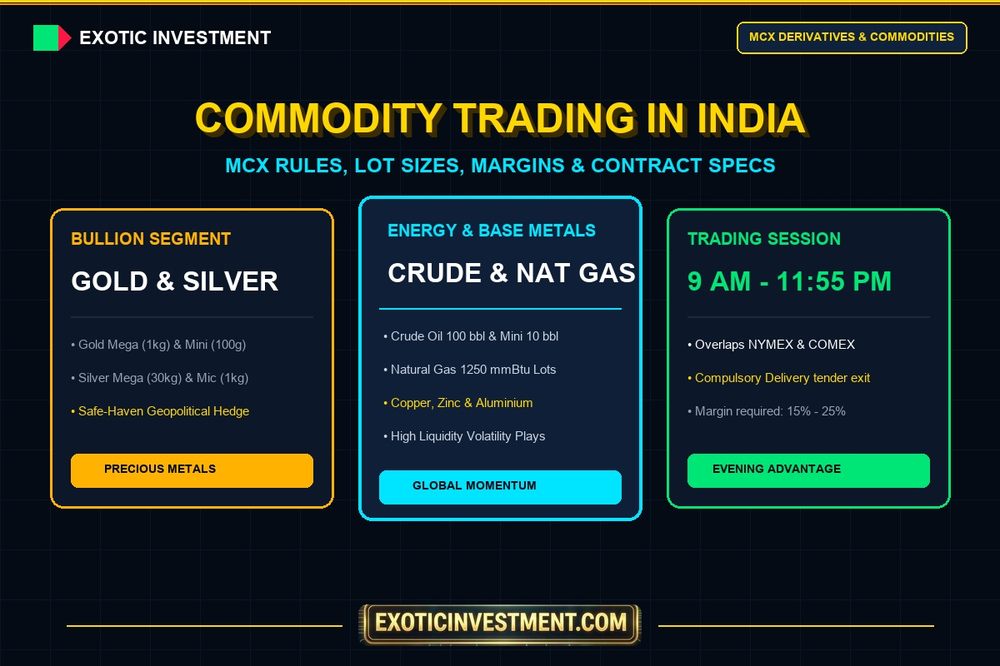
The MCX Commodity Universe: The Three Core Segments
The Multi Commodity Exchange of India (MCX) is the premier commodity derivatives exchange regulated by SEBI. Traded contracts fall into three distinct asset classes, each governed by unique economic forces and contract specifications:
1. Bullion: Gold & Silver
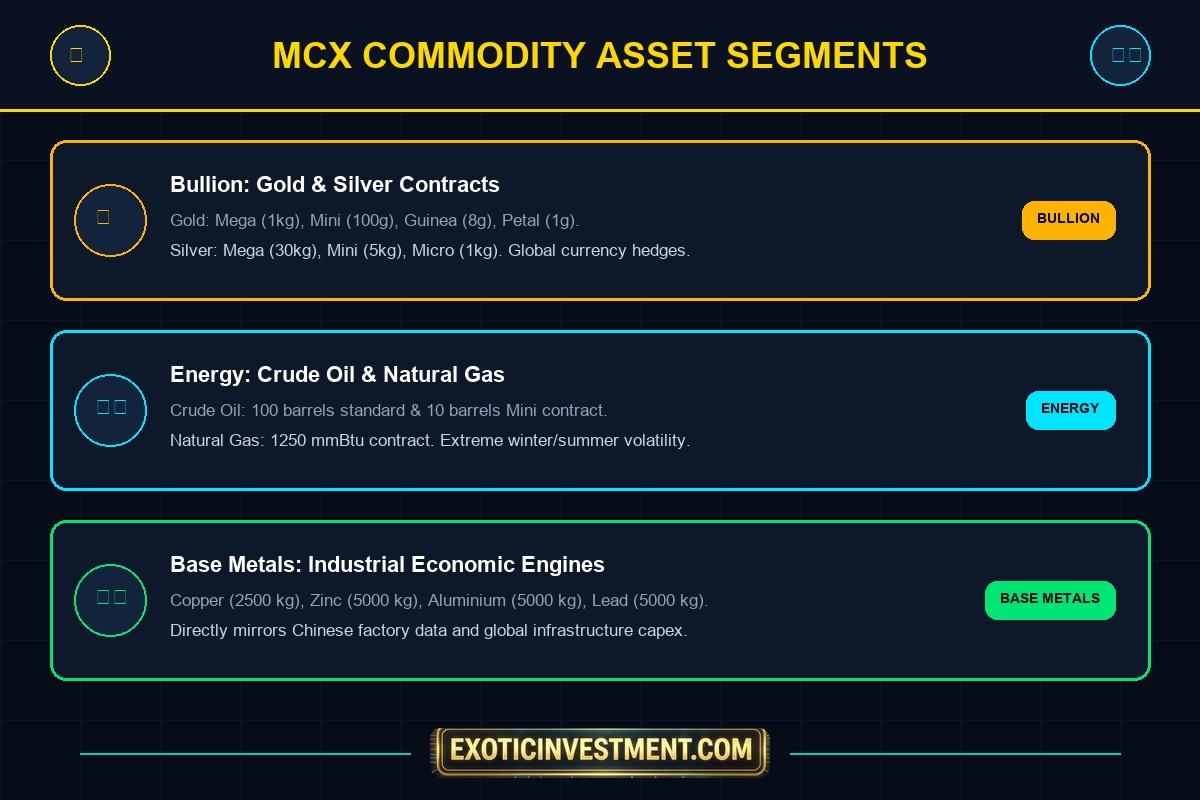
Gold and silver are the bedrock of Indian household wealth and global monetary reserves. On MCX, bullion contracts are structured to accommodate both deep-pocketed physical jewelers and retail scalpers:
- Gold Standard (Mega): Lot size is 1 Kilogram (1000 grams). Quotation is per 10 grams. At ₹76,000 per 10g, contract value is ₹76 Lakh.
- Gold Mini: Lot size is 100 grams. Ideal for intermediate traders with smaller capital pools.
- Gold Guinea & Gold Petal: Micro contracts representing 8 grams and 1 gram respectively, allowing beginners to trade gold with modest capital.
- Silver Mega, Mini & Micro: Silver Mega has a 30 Kilogram lot size, Silver Mini is 5 Kilograms, and Silver Micro is 1 Kilogram. Silver exhibits explosive intraday percentage swings due to its twin identity as both an investment asset and an industrial metal.
2. Energy: Crude Oil & Natural Gas
Energy contracts are the most actively traded momentum instruments on MCX. Crude Oil tracks global Brent and WTI pricing, moving in standard 100-barrel lots (or Crude Mini 10-barrel lots). Natural Gas trades in 1,250 mmBtu contracts. Both instruments offer high liquidity and tight bid-ask spreads, making them favorites for evening day traders.
3. Base Metals: Industrial Capex Drivers
Copper (2,500 kg), Zinc (5,000 kg), Aluminium (5,000 kg), and Lead (5,000 kg) represent real-world physical manufacturing. Their price trends correlate directly with Chinese manufacturing PMI numbers, automotive demand, and infrastructure development. Base metals move cleanly on technical trend-following setups.
When tracking commodity pricing across cross-border exchanges, crypto-backed tokenized assets, or evaluating multi-currency hedging spreads, professional desks look at tools on emintage.com to evaluate real-time collateral ratios and currency conversion costs.
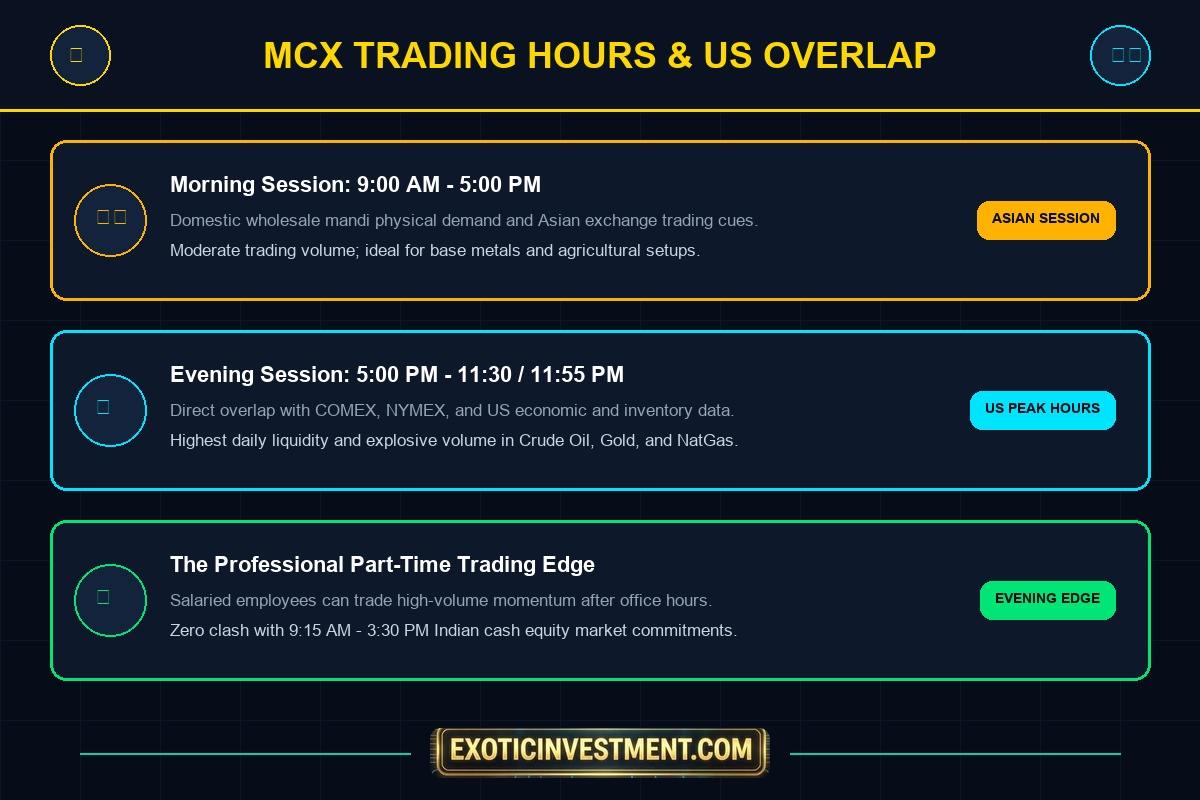
MCX Trading Hours: The Working Professional’s Advantage
One of the greatest benefits of commodity trading in India is its trading schedule. While equity markets close at 3:30 PM, MCX operates through two distinct trading windows:
For salaried IT professionals, doctors, and business owners who cannot monitor equity price screens between 9:15 AM and 3:30 PM, the MCX evening session provides pure high-liquidity trading opportunities after office hours without disturbing their primary professions.
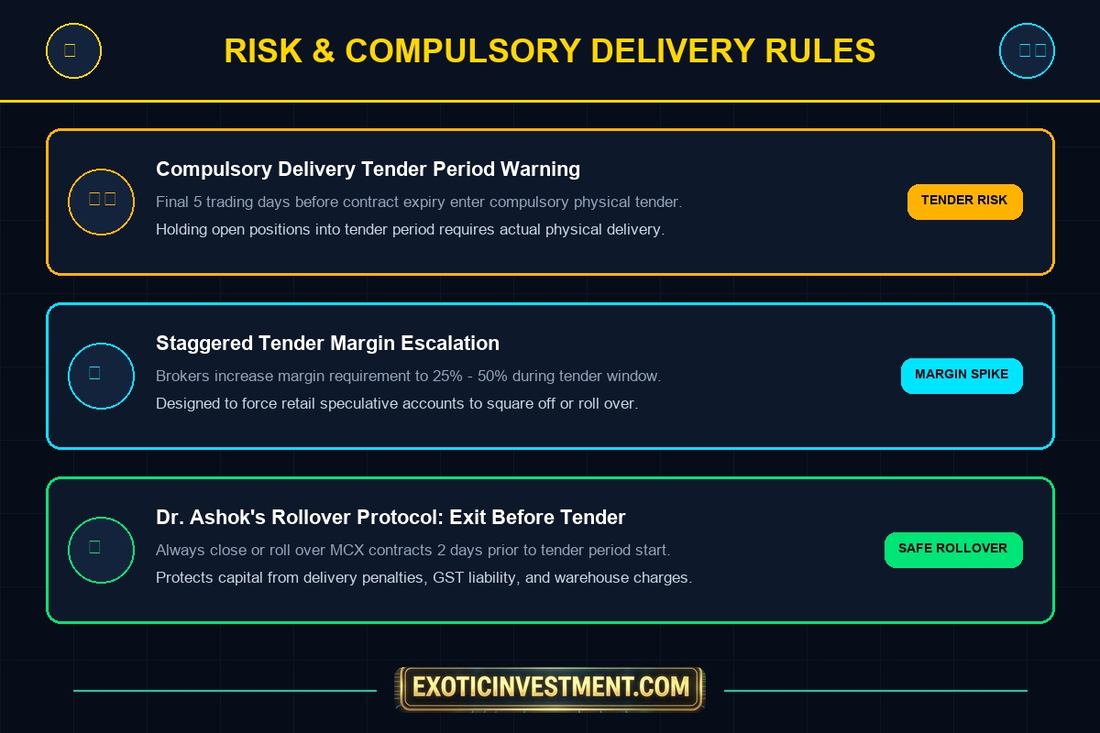
Margin Requirements & Compulsory Delivery Rules
Trading commodity futures requires upfront capital commitment governed by SEBI margin rules. Understanding how commodity leverage differs from equities is vital for survival.
1. Commodity Margins (SPAN + Extreme Loss Margin)
Unlike equity cash where you pay full share price, commodity futures require an initial margin typically ranging between 12% and 25% of the total contract value. For instance, trading 1 lot of Natural Gas futures with a contract value of ₹3,00,000 may require an initial margin of approximately ₹50,000 to ₹70,000 depending on prevailing implied volatility. The remaining balance represents exchange leverage.
2. The Compulsory Physical Delivery Trap
Here is where many equity traders get severely burned. In index derivatives (Nifty / Bank Nifty), all expired contracts are settled in cash. In contrast, almost all MCX commodity contracts (Gold, Silver, Base Metals) are Compulsory Physical Delivery contracts.
Five trading days prior to contract expiry date, the contract enters what is known as the Tender Period. If you hold an open long or short position into the tender period, the exchange assumes you intend to deliver or take physical possession of real bullion bars or metal ingots in approved SEBI warehouses. To discourage speculative default, exchanges impose massive staggered tender margins escalating from 25% to 50% of total contract value.
An ancient Kannada proverb states: “ಮಾತು ಆಡಿದರೆ ಹೋಯ್ತು, ಮುತ್ತು ಒಡೆದರೆ ಹೋಯ್ತು” (Maathu aadidre hoythu, mutthu odedre hoythu). A broken pearl cannot be put back together; a careless trade that rolls into the physical tender period can saddle an unprepared retail trader with massive warehouse charges, delivery penalties, and GST liability. Always square off or roll over your contracts to the next active expiry at least two days before the tender window starts.
Dr. Ashok’s 4 Rules for Commodity Beginners
Before deploying your first rupee on MCX, commit these four foundational rules to memory:
- Start Small with Mini and Micro Lots: If you are new to commodity trading, do not start with a 30kg Silver Mega contract where a 100-point sudden move equals ₹3,000 in seconds. Start with Silver Micro (1kg) or Gold Petal (1g). Master price behavior, order placement, and execution slippage before scaling up size.
- Track Global Inventories and Economic Calendars: Never trade Crude Oil on Wednesday evening without checking the US Energy Information Administration (EIA) crude inventory release at 8:00 PM IST. Never trade bullion without tracking US Non-Farm Payrolls (NFP) and Federal Reserve interest rate announcements. Global macros dictate commodity trends.
- Never Average Down Losing Commodity Trades: Commodities can experience brutal structural trends that last months. Averaging down an unhedged falling knife in Natural Gas or Copper will destroy an entire trading account. Respect your predetermined technical stop-loss ruthlessly.
- Compounding Beats Speculation: As we say in Kannada: “ಹನಿ ಹನಿ ಕೂಡಿದರೆ ಹಳ್ಳ” (Hani hani koodidre halla — drop by drop makes a great stream). Steady 2% to 3% monthly risk-adjusted returns on commodity setups compound into massive annual wealth. Practice “ನಿಧಾನವೇ ಪ್ರಧಾನ” (Nidhanave pradhana — patience is supreme).
For traders seeking structured mentorship in technical price action, multi-asset macro correlation models, and systematic derivative trading, explore our flagship courses at Exotic Investment Courses.
Frequently Asked Questions (FAQs)
1. How can a beginner start commodity trading in India?
To start commodity trading, open a Commodity Trading Account with a SEBI-registered broker. Complete your MCX segment activation by submitting your latest 6-month bank statement or ITR as income proof. Once approved, fund your account and begin with mini or micro contracts.
2. What are the market timings for MCX commodity trading?
MCX operates Monday through Friday from 9:00 AM to 11:30 PM IST (extended to 11:55 PM IST during US Daylight Saving Time). Agricultural commodities trade from 9:00 AM to 5:00 PM IST.
3. What happens if I do not square off my commodity contract before expiry?
If you hold a compulsory delivery contract (such as Gold or Silver) into the tender period (last 5 trading days), your broker will either forcibly square off the position at market price with auto-liquidation penalties, or you will be liable for physical delivery, warehouse charges, and heavy exchange penalties.
4. What is the minimum capital required for commodity trading?
For micro contracts like Silver Micro (1kg) or Gold Guinea (8g), you can begin trading with ₹10,000 to ₹15,000 in capital. For standard mega contracts in Crude Oil or Silver, a disciplined trader should maintain at least ₹2 Lakh to ₹3 Lakh to absorb intraday volatility safely.
5. Is commodity trading profit taxable in India?
Yes. Non-delivery commodity derivatives trading is treated as Non-Speculative Business Income under the Indian Income Tax Act. Net profits are added to your total income and taxed according to your applicable income tax slab rates, while business expenses and STT can be deducted.
About the Author: Dr. Ashok Kumar N Rao
Dr. Ashok Kumar N Rao is a seasoned market mentor, SEBI-registered research analyst, and founder of Exotic Investment. With over two decades of experience analyzing Indian equity markets, derivatives architecture, and macroeconomic cycles, Dr. Ashok trains retail investors and institutional desks in risk-first portfolio construction and systematic market execution.
Disclaimer: Commodity futures and options involve substantial risk of loss and are not suitable for all investors. Leverage can work against you as well as for you. Past performance is no guarantee of future results. Consult a qualified financial advisor before trading real capital.