Trading Nifty and Bank Nifty options without understanding option greeks in india is like flying an aircraft blindfolded through a thunderstorm. Thousands of retail traders enter weekly expiry contracts hoping for quick lottery jackpots, only to watch their premiums vanish into thin air by 3:30 PM on Thursday. Even when Nifty moves 50 points in their predicted direction, their call option mysteriously loses value. The culprit is not market manipulation; it is mathematics. In this trading desk masterclass, we demystify Delta, Gamma, Theta, and Vega with real Indian market examples so you can trade derivatives with complete mathematical edge.
What Are the 4 Core Option Greeks and How Do They Work?
Every option contract on the National Stock Exchange (NSE) is governed by mathematical sensitivity parameters known as Greeks. These numbers tell you exactly how much your option price will change when the underlying index moves, when time ticks away, or when volatility surges.
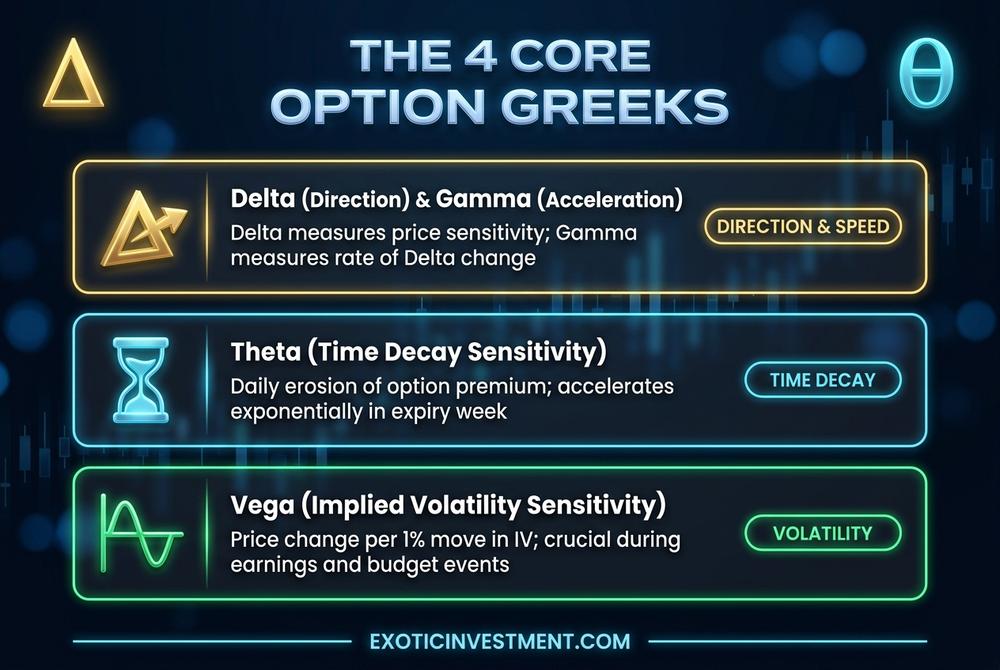
Illustration: The four core option Greeks — Delta, Gamma, Theta, and Vega — explained for Indian market traders.
Here is your essential Greek cheat-sheet:
- Delta (Directional Sensitivity): Delta measures how much an option premium moves for every 1-point change in the underlying index or stock. An At-The-Money (ATM) Nifty call option has a Delta of roughly 0.50. That means if Nifty rises by 100 points, your option premium gains approximately ₹50. Call options have positive Delta (0 to +1.0), while Put options have negative Delta (0 to -1.0).
- Gamma (Delta Acceleration): Gamma measures the rate of change of Delta for every 1-point move in the underlying. Think of Delta as speed and Gamma as acceleration. During expiry days, Gamma for ATM options explodes, turning humble ₹20 options into ₹150 monster moves within minutes — or crushing them to zero with equal speed.
- Theta (Time Decay Sensitivity): Theta represents the daily erosion of option premium as time expires. Options are wasting assets with a strict expiration clock. If Nifty stays completely flat today, your long option will still bleed value overnight due to Theta decay.
- Vega (Volatility Sensitivity): Vega measures how much option premium changes for every 1% shift in Implied Volatility (IV). When India VIX spikes during election results or Union Budget sessions, option premiums inflate heavily due to Vega expansion.
Before taking any live option trade, always verify your net transaction costs with our Zerodha brokerage calculator.
The Option Buyer vs Seller Greek Matrix: Who Holds the Edge?
In Indian derivative markets, institutional desks and proprietary trading firms make consistent fortunes by exploiting the Greek imbalance between buyers and sellers.
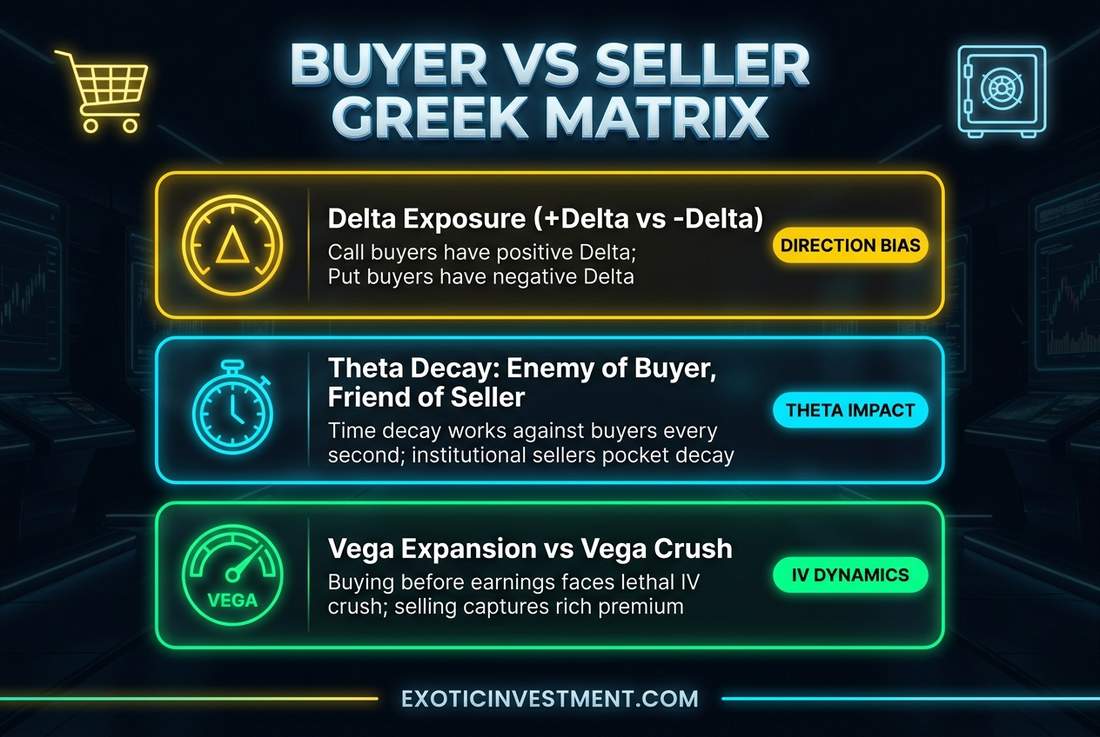
Illustration: The Greek risk matrix comparing retail option buyers against institutional option writers.
Look at the mathematical realities:
- Theta is the Option Buyer’s Silent Enemy: When you buy a call or put, Theta acts as a ticking tax against your position. You need price to move fast enough and far enough in your direction to outrun daily Theta decay. In Kannada, our elders say: “Nodi thili, maadi kali” (ನೋಡಿ ತಿಳಿ, ಮಾಡಿ ಕಲಿ — observe to understand, practice to master). Observe how time decay accelerates in the final 48 hours of weekly contracts before buying cheap out-of-the-money options.
- Theta is the Institutional Seller’s Best Friend: Big institutions write options to collect rich extrinsic value. Even if the market goes sideways or moves slightly against them, time decay steadily burns premium straight into their pocket. Learn how institutions engineer these trades in our deep dive on 7 stock market secrets big institutions use.
- Vega Expansion vs IV Crush: Buying options right before high-profile quarterly earnings announcements is a classic amateur mistake. IV is sky-high, so you pay inflated premiums. The moment earnings come out, volatility collapses instantly (IV crush), destroying option value even if the stock moves in your direction.
You can master high-probability option buying setups with defined risk in our specialized Options Buying Course in Kannada.
Greek Risk Management Rules: Surviving Nifty and Bank Nifty Expiries
Trading options without risk management is financial destruction. Remember the timeless Kannada truth: “Maathu aadidre hoythu, mutthu odedre hoythu” (ಮಾತು ಆಡಿದರೆ ಹೋಯ್ತು, ಮುತ್ತು ಒಡೆದರೆ ಹೋಯ್ತು — words once spoken cannot be retrieved, a pearl once shattered is lost forever). In derivative trading, your trading capital is like a precious pearl. Just one reckless expiry bet on uncalculated Greek exposure can shatter months of hard work in a single hour.
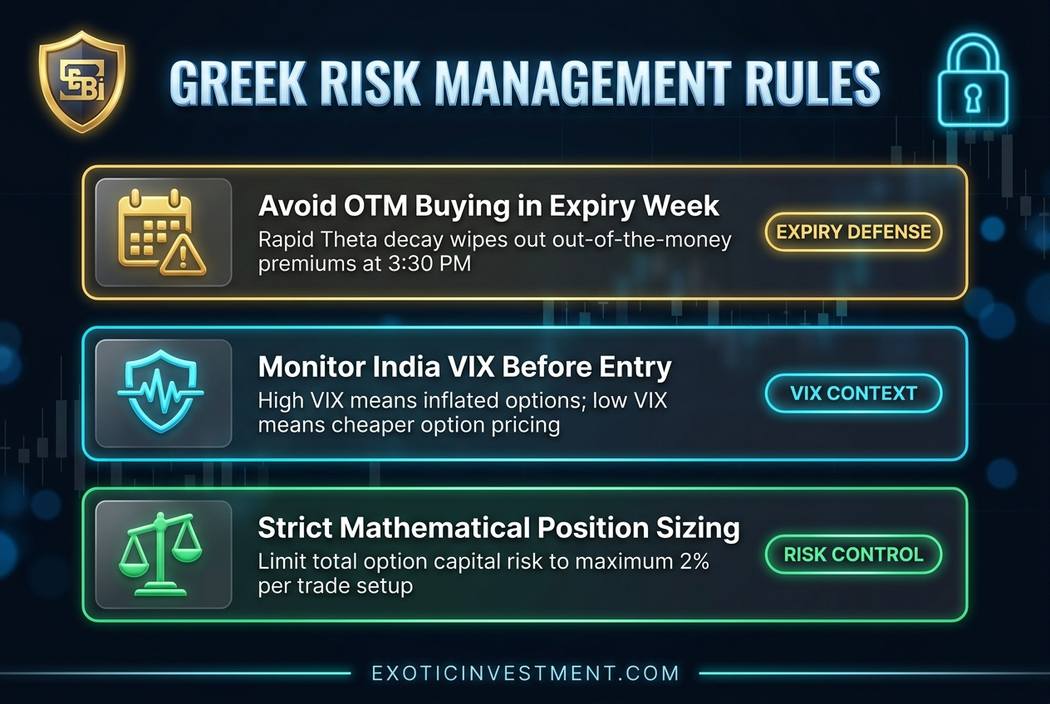
Illustration: Essential Greek risk management rules for retail option traders in Indian markets.
- Rule 1: Never Buy Deep Out-of-the-Money (OTM) Options on Expiry Day: A ₹5 call option 300 points away from CMP looks cheap, but its Delta is barely 0.05 and its probability of expiring worthless is over 95%. Retail traders lose crores every month chasing zero-hero hero trades. Always trade In-The-Money (ITM) or close At-The-Money (ATM) contracts where Delta is high enough to participate in real price moves.
- Rule 2: Monitor India VIX for Context: When India VIX is below 12, option premiums are cheap, favoring selective directional buying. When India VIX surges above 18 to 22, options are expensive, favoring non-directional credit spreads. Check our guide on leading indicators in stock market to gauge market volatility.
- Rule 3: Enforce Strict Mathematical Position Sizing: Never allocate more than 2% to 3% of your total trading capital to any single option trade. Use our free position size calculator to fix your maximum allowable lot size before executing the trade.
- Rule 4: Compound Realized Profits Systematically: Siphon profits from active option trading into long-term compounding assets. In Kannada, remember: “Nidhanave pradhana” (ನಿಧಾನವೇ ಪ್ರಧಾನ — patience is supreme). Calculate your compounding growth goals with our reverse CAGR calculator.
Recommended Trading Courses & Premium Subscriptions:
- Options Buying Course in Kannada: Options Buying Course in Kannada.
- Technical Analysis in Kannada Course: Technical Analysis in Kannada Course.
- Kaliyiri Share Market Book: Kaliyiri Share Market Book.
- Basics of Stock Market Course: Basics of Stock Market Course.
- MultiBagger Plus Courses & Pro Tools Annual Subscription (Plan 5268): MultiBagger Plus Courses & Pro Tools Annual Subscription.
💡 Frequently Asked Questions (FAQ)
1. Why does my Nifty call option lose value even when Nifty moves higher?
This happens primarily due to Theta (time decay) or Vega (volatility crush). If Nifty rises slowly over several hours, the loss from Theta decay can exceed the gain from Delta. Alternatively, if Implied Volatility drops sharply after an event, the option premium deflates regardless of index direction. Model your net realized gains on completed trades using our stock profit calculator.
2. What is a good Delta value for retail option buyers?
Professional option buyers target contracts with a Delta between 0.50 and 0.70 (At-The-Money or slightly In-The-Money). These options move closely with the underlying index and suffer significantly less percentage decay than deep out-of-the-money lottery contracts. Master these entries in our step-by-step Options Buying Course in Kannada.
3. At what time of the day is Theta decay the fastest on weekly expiry?
Theta decay accelerates exponentially in the final 3 hours of weekly expiry day, between 12:30 PM and 3:30 PM. Out-of-the-money options lose value rapidly every 15 minutes unless an explosive Gamma momentum surge occurs. Verify order execution rules with our guide on stock broker apps in India.
4. How does India VIX impact option pricing on NSE?
India VIX is the benchmark measure of market volatility expectation over the next 30 days. Higher India VIX expands Vega, making all option premiums more expensive. Lower India VIX compresses Vega, making options cheaper. Learn how institutional desks exploit volatility cycles in our swing trading in India roadmap.
5. Where can traders access real-time option chain Greeks and pro analysis tools?
You can view basic Greeks on the NSE official website or access our curated institutional option screeners, weekly setups, and professional video courses through the MultiBagger Plus Courses & Pro Tools Annual Subscription.