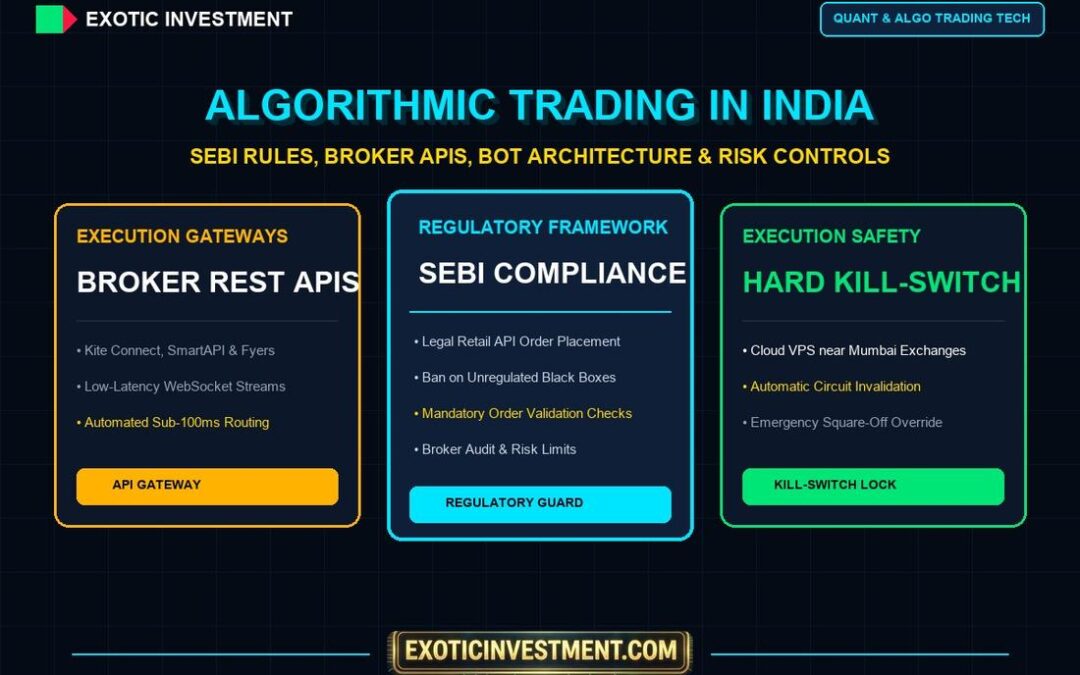
Every morning at 9:15 AM when the opening bell chimes across the National Stock Exchange (NSE), millions of retail traders frantically punch buy and sell orders on their smartphone screens. But before your finger even touches the glass, institutional execution engines have already ingested market depth, processed order-flow imbalances, and executed tens of thousands of trades in under 50 milliseconds. The harsh truth on Dalal Street today is simple: human fingers cannot compete with code. If you want to eliminate emotional errors, execute disciplined risk rules, and trade systematically, learning algo trading in india for retail traders is the ultimate technological equalizer.
Our traditional Kannada proverb offers the exact blueprint for algorithmic success: “ನೋಡಿ ತಿಳಿ ಮಾಡಿ ಕಲಿ” (Nodi thili, maadi kali — observe first, understand clearly, then execute). Algorithmic trading is not a magical money printer or an automated lottery ticket. It is pure software engineering applied to market inefficiencies. Building a trading bot requires understanding broker REST APIs, WebSocket tick streaming, SEBI regulatory compliance, and bulletproof fail-safes. Let us walk through how retail traders can legally build, backtest, and deploy automated trading strategies in Indian markets without falling into common regulatory or technical traps.
The Retail Algo Tech Stack: From Strategy to Broker Execution
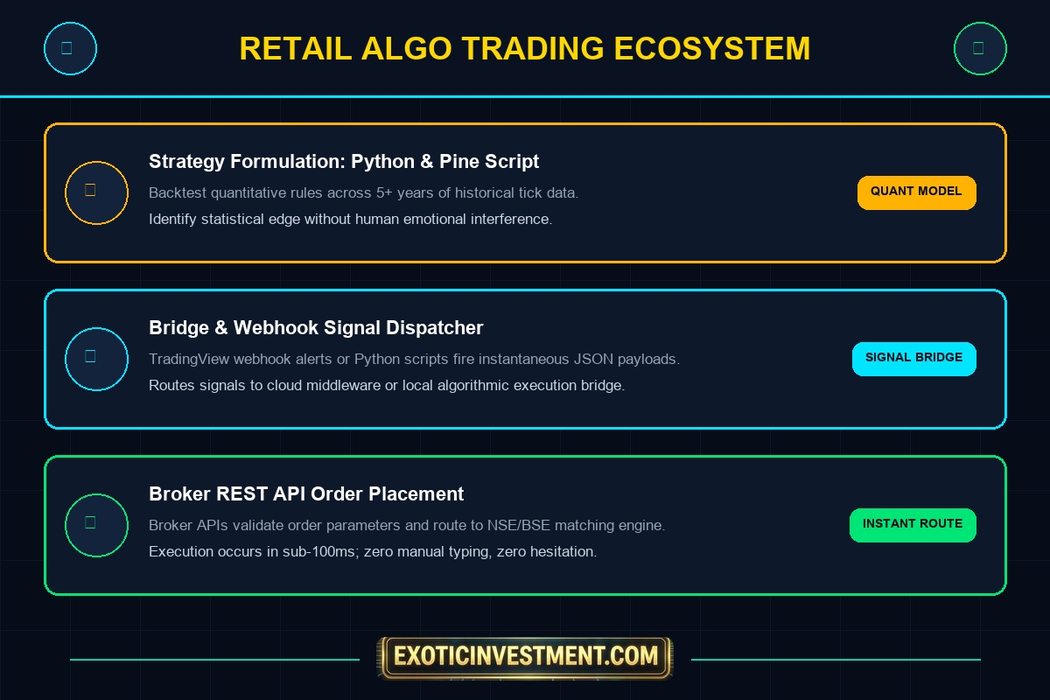
A complete algorithmic trading setup consists of three modular layers working in seamless synchronization:
1. Strategy & Backtesting Engine (The Brain)
This is where your quantitative rules live. Whether you write custom Python scripts using Pandas and NumPy, program indicator logic in TradingView’s Pine Script, or run institutional backtests in Amibroker, your strategy must define three non-negotiable parameters: exact entry trigger, technical stop-loss invalidation, and profit target exit. An algorithm without a historical statistical edge is simply automated capital suicide.
2. The Signal Bridge (The Dispatcher)
Once your strategy identifies an entry condition (such as a 20 EMA pullback breakout on a 5-minute chart), it generates an alert. The signal bridge converts that alert into a standardized JSON payload and pushes it via webhooks to your cloud server or local execution bridge. Popular retail bridges in India include custom Python Flask/FastAPI servers, Quantman, or AlgoTest.
3. Broker REST API & WebSocket Feed (The Hands)
Modern Indian discount brokers provide institutional-grade trading APIs. Zerodha (Kite Connect), Upstox API, Angel One (SmartAPI), and Fyers offer high-speed REST endpoints that receive your JSON order instruction, authenticate your unique API key and access token, and route the order directly to the exchange matching book in sub-100 milliseconds.
For traders developing quantitative cross-asset models, testing decentralized webhooks, or exploring algorithmic crypto bot connectivity, advanced analytics suites at emintage.com offer developer-focused tools to simulate real-time order-book execution without risking live capital.
SEBI Regulatory Framework: What is Legal and What is Banned
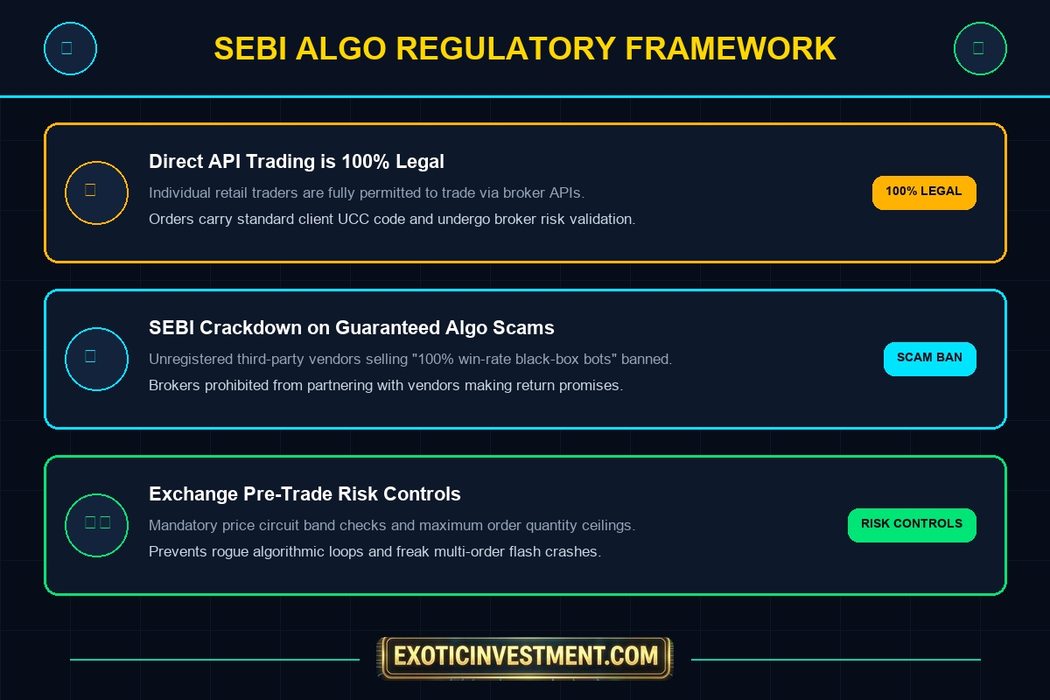
Many beginners worry whether algorithmic trading is legal for individual retail traders in India. The short answer is: Yes, 100% legal, provided you comply with SEBI guidelines.
1. Individual API Access is Permitted
SEBI fully permits retail investors to utilize open APIs provided by registered brokers to execute orders for their own personal accounts. When your code fires an order through Kite Connect or SmartAPI, it carries your Unique Client Code (UCC) and goes through standard exchange pre-trade risk validations.
2. Crackdown on Unregulated Black-Box Schemes
What SEBI has strictly cracked down on are unregistered third-party vendors and finfluencers selling “black-box algo bots” promising guaranteed monthly returns (e.g., “Earn 20% every month on auto-pilot!”). SEBI mandates that brokers cannot partner with or provide API access to unregulated platforms that lure retail investors with false performance claims. Always build your own code or use SEBI-compliant execution interfaces.
3. Exchange Risk Controls
Every algorithmic order must respect exchange circuit filters, price bands, and order quantity limits (such as the maximum quantity limit per order in Nifty and Bank Nifty contracts). If your algorithm fires orders outside permissible circuit limits, the exchange will reject them instantly.
Infrastructure & Safety: Why You Need a Mumbai Cloud VPS
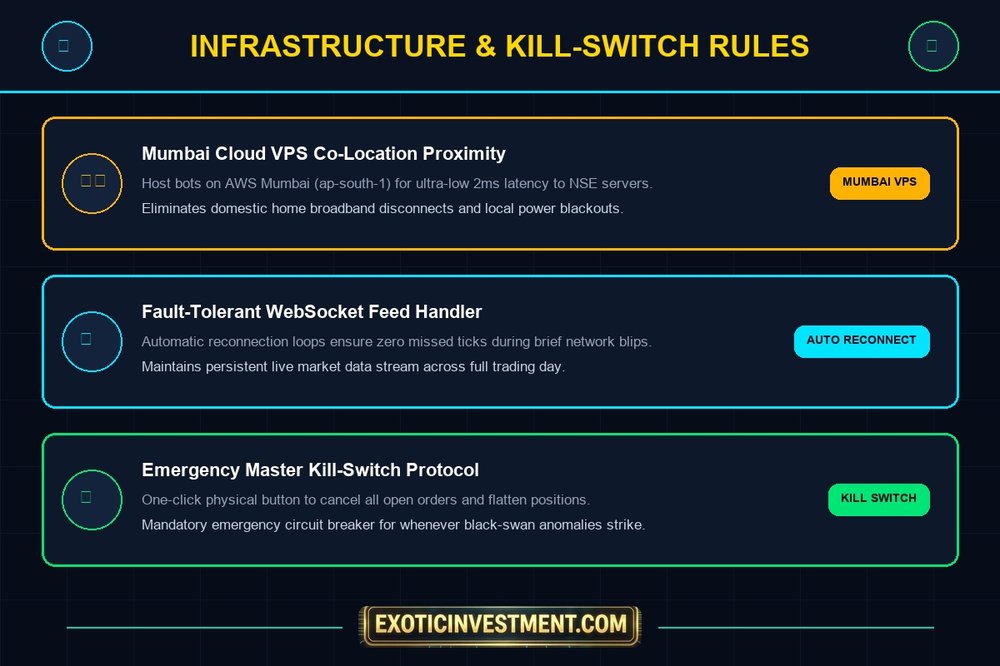
Running a trading bot from your home laptop over standard Wi-Fi is an amateur mistake that leads to catastrophic failures. Home broadband experiences micro-disconnects, Windows updates force surprise reboots, and local power cuts happen without warning. Professional algo traders deploy their code on an enterprise Cloud Virtual Private Server (VPS).
The Emergency Kill-Switch: Protecting Your Pearls
In our Kannada heritage, we often warn: “ಮಾತು ಆಡಿದರೆ ಹೋಯ್ತು, ಮುತ್ತು ಒಡೆದರೆ ಹೋಯ್ತು” (Maathu aadidre hoythu, mutthu odedre hoythu). Words once spoken can never be brought back; once a pearl shatters, it cannot be glued whole again. In algorithmic trading, your risk capital is that precious pearl. An undetected software bug, an infinite while-loop, or a frozen API connection can fire 500 duplicate orders in two seconds, wiping out an entire trading account before you can open your mobile app.
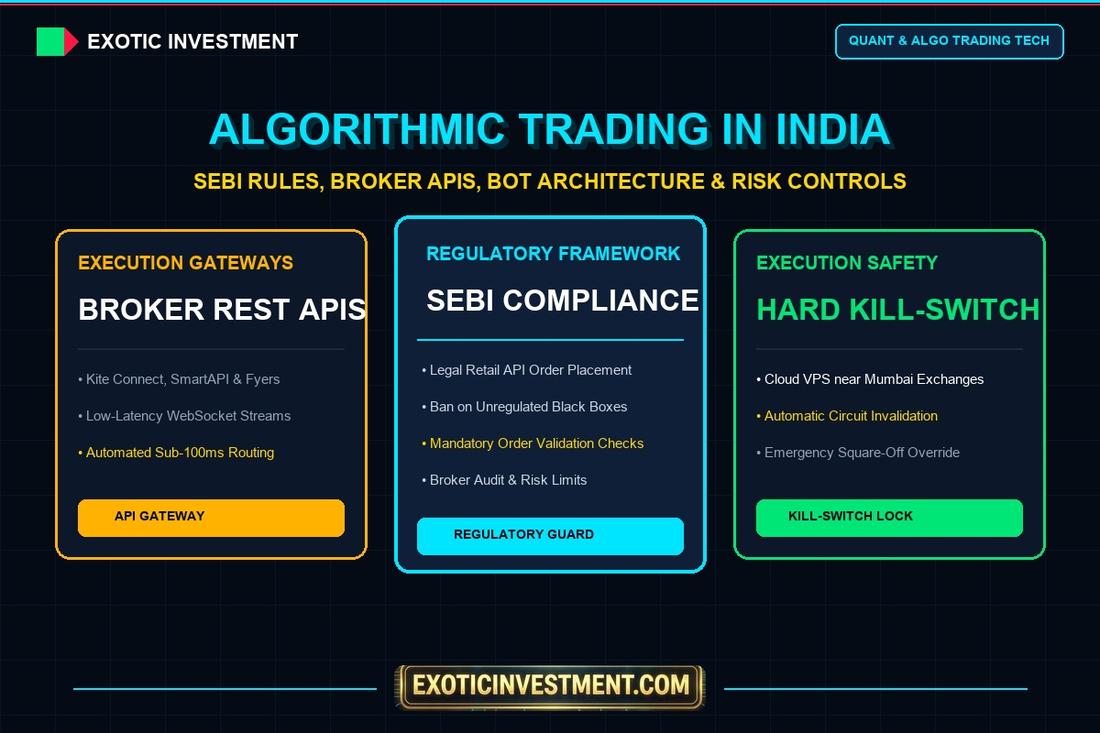
Every algorithmic trading bot you deploy must have a Hard Kill-Switch built directly into its architecture:
- Daily Maximum Loss Ceiling: If your account incurs a predetermined loss (e.g., 2% of total capital), the bot terminates all active loops, cancels all pending open limit orders, flattens all open positions at market price, and revokes its own API access token for the remainder of the day.
- Consecutive Loss Brake: If the bot triggers three consecutive stop-outs in a single morning, it enters a mandatory two-hour cooldown mode to prevent over-trading in choppy, trendless market conditions.
- Physical One-Click Kill Button: Always keep a dedicated mobile web shortcut or desktop button that sends an emergency master cancel instruction directly to your broker’s RMS system with zero code dependencies.
Dr. Ashok’s 4 Rules for Algorithmic Success
- Never Deploy an Algo Without 500+ Simulated Trades: Paper trade your bot for at least 60 trading sessions in forward live market conditions. Backtests on historical data always suffer from curve-fitting and look-ahead bias. Forward testing reveals real-world slippage, STT impact, and exchange latency.
- Automate Your Risk, Not Your Greed: The primary purpose of an algorithm is not to generate 100% returns overnight. It is to enforce flawless risk management—executing stops instantly without emotional bargaining or hesitation. Remember: “ಹನಿ ಹನಿ ಕೂಡಿದರೆ ಹಳ್ಳ” (Hani hani koodidre halla — drop by drop makes a great stream). Steady 2% to 3% monthly compounding creates institutional wealth over time.
- Monitor Your Execution Daily: Algorithmic trading is not “set and forget.” You must conduct morning health checks at 9:00 AM: verify API token generation, confirm WebSocket tick feeds, and verify available ledger margin before market open. Practice “ನಿಧಾನವೇ ಪ್ರಧಾನ” (Nidhanave pradhana — patience is supreme).
- Maintain Redundant Emergency Access: Always keep your broker’s standard mobile application logged in and ready on your phone with biometric authentication. If your cloud server loses connectivity, you can manually intervene within five seconds.
To master institutional algorithmic architecture, quantitative strategy development, and Python backtesting models, join our structured training modules at Exotic Investment Courses.
Frequently Asked Questions (FAQs)
1. Is algorithmic trading legal for retail traders in India?
Yes. SEBI fully permits retail traders to execute automated trades through official broker APIs (such as Zerodha Kite Connect, Upstox, Angel One SmartAPI). However, selling unregulated black-box bots with promised returns is illegal.
2. What programming language is best for developing trading algorithms?
Python is the undisputed global industry standard for algorithmic trading due to its rich ecosystem of financial libraries (Pandas, NumPy, Backtrader) and official SDK support from major Indian brokers. Pine Script on TradingView is also widely used for rapid charting and webhook dispatching.
3. How much does a broker trading API cost in India?
Costs vary by broker. Zerodha charges ₹2,000 per month for Kite Connect API (plus ₹2,000 for historical data API). Other brokers, like Upstox, Angel One (SmartAPI), and Fyers, offer their trading APIs completely free of monthly charges for registered account holders.
4. Do I need a high-end supercomputer to run a trading bot?
No. You do not need a expensive local PC. In fact, running bots on a local computer is risky. Professional traders use a basic Cloud Virtual Private Server (VPS) hosted in Mumbai (e.g., AWS, DigitalOcean, or Hostinger), which costs just ₹500 to ₹1,500 per month and provides 24/7 power, high uptime, and 1ms latency to NSE servers.
5. What is the biggest risk in retail algorithmic trading?
The greatest risk is execution failure due to software bugs, API rate-limit rejections, or unexpected market liquidity gaps. Without a robust hard kill-switch and strict position sizing, a faulty loop can execute excessive duplicate orders and cause severe capital losses within seconds.
About the Author: Dr. Ashok Kumar N Rao
Dr. Ashok Kumar N Rao is a seasoned market mentor, SEBI-registered research analyst, and founder of Exotic Investment. With over two decades of experience analyzing Indian equity markets, derivatives architecture, and macroeconomic cycles, Dr. Ashok trains retail investors and institutional desks in risk-first portfolio construction and systematic market execution.
Disclaimer: Algorithmic and quantitative trading involve substantial risks of financial loss. Automated execution does not guarantee profitable returns. All code structures and frameworks presented above are strictly for educational and informational purposes. Consult a certified financial advisor before deploying automated capital.