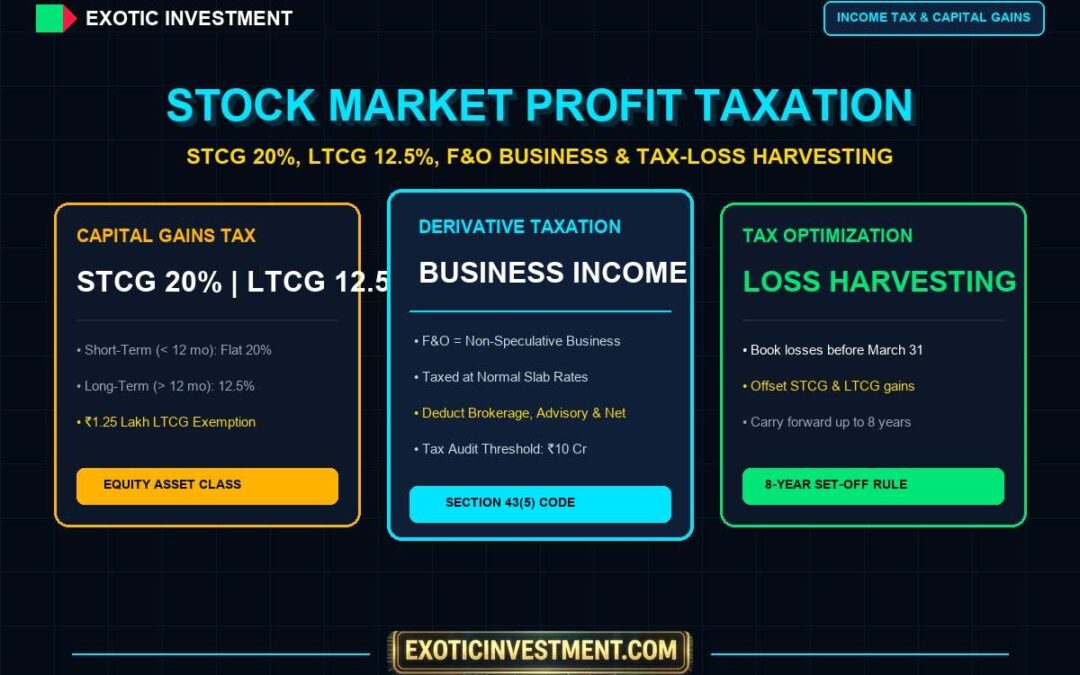
Every March, as the financial year draws to a close, my phone rings constantly with calls from stressed traders. They proudly made ₹15 Lakh during the mid-cap bull run, but when their chartered accountant presents the tax computation, shock sets in. Between revised capital gains slabs, Securities Transaction Tax (STT), intraday turnover rules, and Section 44AB tax audit thresholds, half their hard-earned profits vanish if they failed to plan their tax liability ahead of time. Making profitable trades is only half the battle; knowing stock market profit taxation in india is what determines how much wealth you actually take home to your family.
In Karnataka, our trading ancestors taught us: “ನೋಡಿ ತಿಳಿ ಮಾಡಿ ಕಲಿ” (Nodi thili, maadi kali — observe first, understand clearly, then execute). Tax planning is not something you scramble to fix on July 30 right before filing your ITR. It is an ongoing structural discipline that starts on April 1. Following the landmark Union Budget amendments, equity tax rates have shifted significantly: Short-Term Capital Gains (STCG) increased to 20%, Long-Term Capital Gains (LTCG) jumped to 12.5%, and the tax-free LTCG threshold expanded to ₹1.25 Lakh. Let us break down how equity delivery, intraday speculation, and derivative business incomes are taxed under the Income Tax Act.
Equity Capital Gains: The New STCG and LTCG Framework
When you buy and sell delivery equity shares or equity-oriented mutual funds held in your Demat account, your profits are categorized as Capital Gains based strictly on your holding period:
1. Short-Term Capital Gains (STCG) under Section 111A
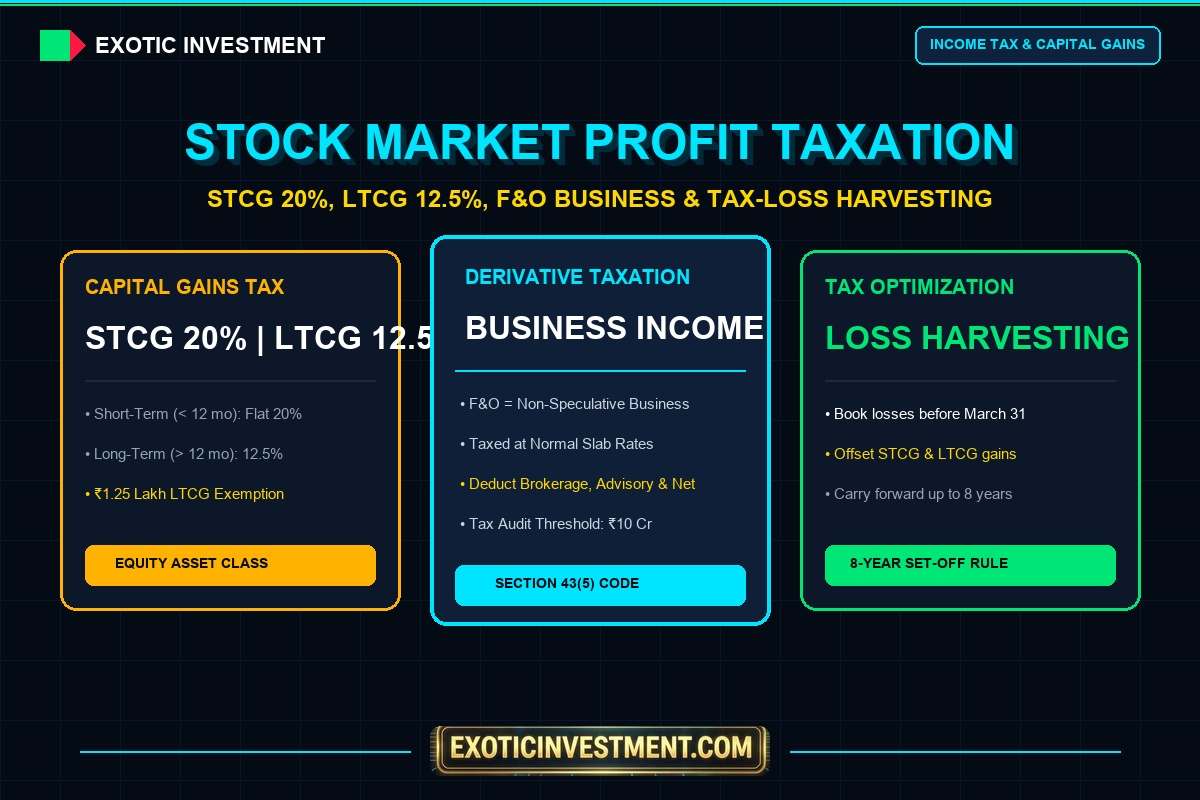
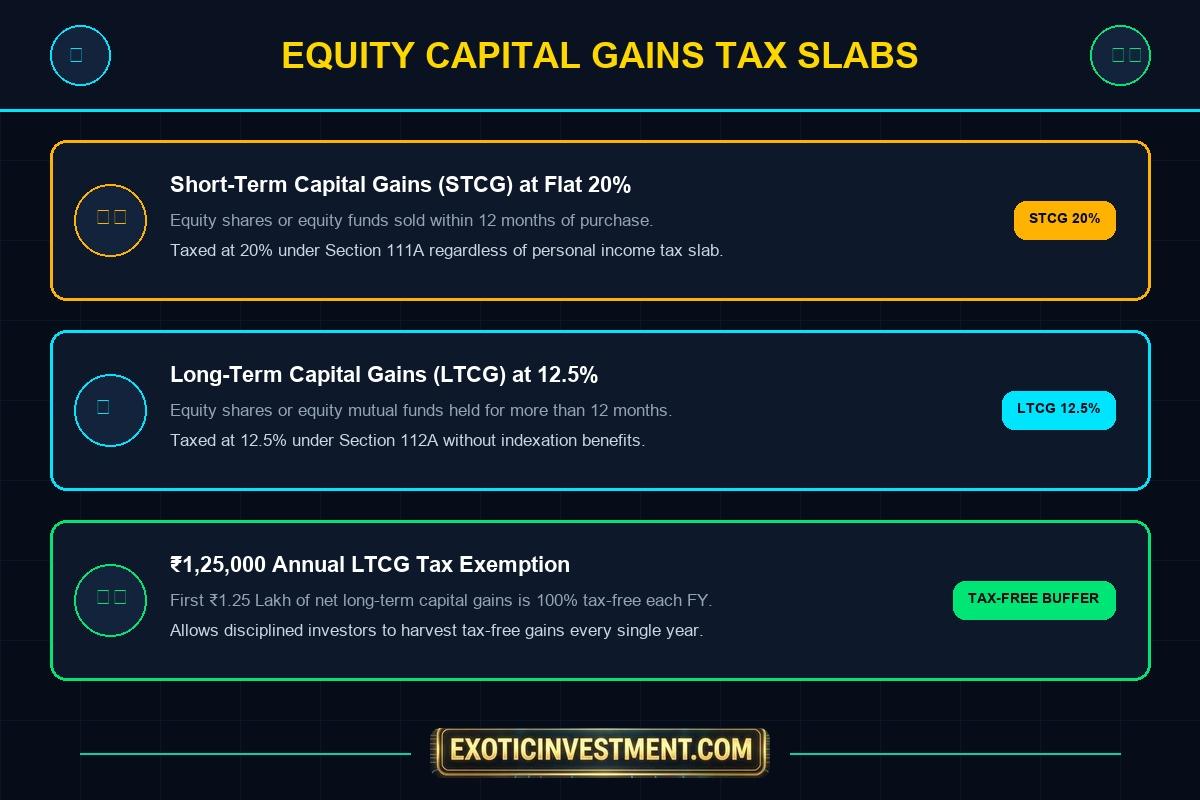
If you hold listed equity shares or equity mutual fund units for 12 months or less before selling, any profit generated is classified as Short-Term Capital Gain. Under the revised tax code, STCG is taxed at a flat rate of 20% (up from the earlier 15%), plus applicable surcharge and 4% Health & Education cess. This flat 20% rate applies regardless of whether your total income places you in the 5% or 30% personal income tax slab.
2. Long-Term Capital Gains (LTCG) under Section 112A
If you hold equity shares or equity mutual funds for more than 12 months, the profit qualifies as Long-Term Capital Gain. The current tax framework provides two key provisions:
- ₹1,25,000 Annual Exemption: The first ₹1.25 Lakh of aggregate long-term capital gains earned across all equity holdings in a financial year is completely tax-free (increased from ₹1.00 Lakh).
- 12.5% Flat Tax Rate: Any net LTCG exceeding ₹1.25 Lakh is taxed at a flat rate of 12.5% without indexation benefits.
When tracking complex portfolios that span both domestic equities and international or web3 assets, investors use the tax calculation suites at emintage.com to track cost basis, currency conversion gains, and cross-asset liability estimates accurately.
Intraday vs F&O: Speculative vs Non-Speculative Business Income
A massive point of confusion among Indian traders is how intraday cash trading and derivative futures & options (F&O) contracts are treated. The Income Tax Department treats them under completely different legal buckets:
The Huge Tax Deduction Advantage of F&O Trading
Because F&O is legally classified as business income, you are running a formal trading enterprise in the eyes of the tax department. This means you can legally deduct all legitimate trading expenses from your gross trading profits before calculating tax liability:
- Brokerage charges, exchange turnover fees, SEBI charges, and STT.
- Depreciation on trading laptops, multiple monitors, and mobile phones (up to 40% per year).
- High-speed fiber internet and mobile phone bills used for market research.
- Market advisory fees, charting software subscriptions (TradingView, charting platforms).
- Financial education courses and trading mentorship programs (such as Exotic Investment Courses).

Tax-Loss Harvesting: How to Legally Slash Your Tax Bill
One of the most effective strategies professional asset managers use is Tax-Loss Harvesting. It involves intentionally selling stocks or mutual funds sitting on unrealized paper losses before March 31 to offset realized capital gains booked during the year.
Let us look at a real Dalal Street example. Suppose in November you sold a winning swing trade in Tata Motors and booked ₹3,00,000 in short-term capital gains. Left untouched, you will owe 20% tax on this gain (₹60,000). However, you have an underperforming small-cap stock in your portfolio currently sitting on an unrealized loss of ₹1,80,000.
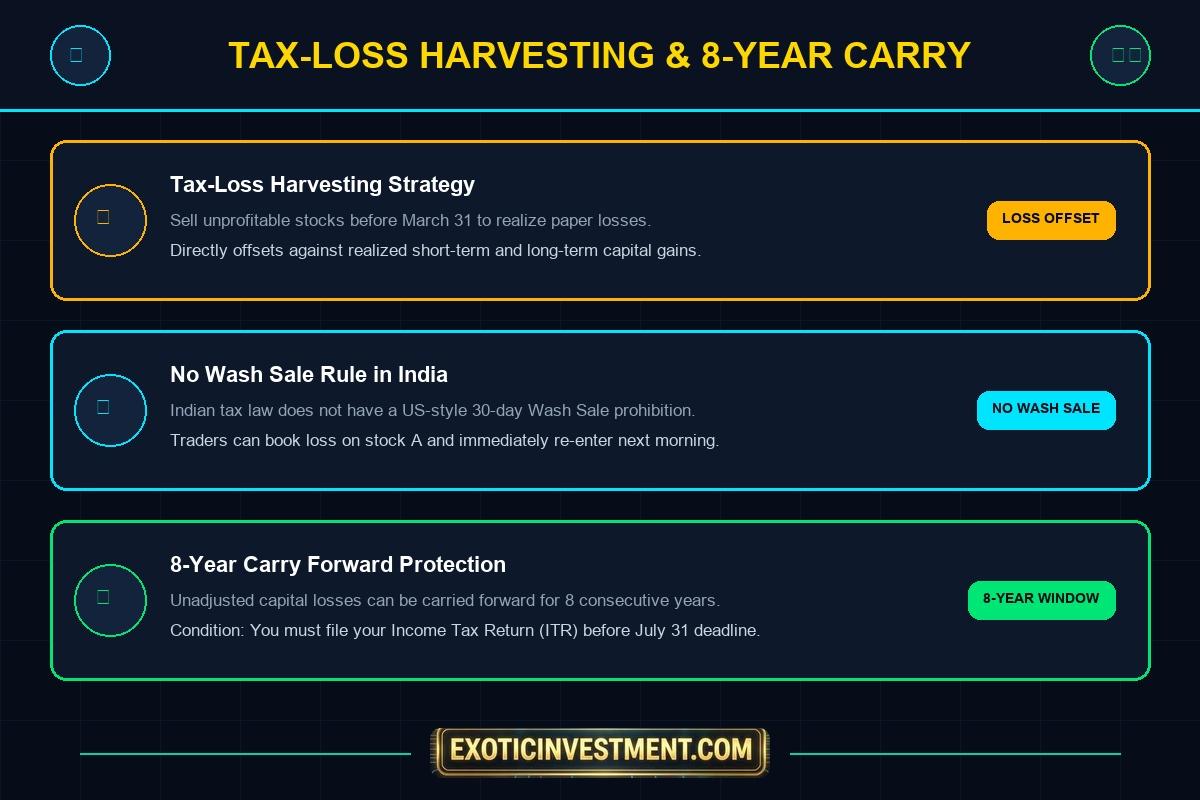
By selling that losing stock before March 31, your net taxable short-term capital gain drops from ₹3,00,000 to ₹1,20,000 (₹3,00,000 – ₹1,80,000). Your tax liability drops from ₹60,000 to ₹24,000—saving you ₹36,000 in cold hard cash! In India, there is currently no “Wash Sale Rule” like in the United States, meaning you can repurchase the stock the next morning if you still believe in its long-term fundamental recovery.
The 8-Year Loss Carry-Forward Rule: A Critical Safety Net
An ancient Kannada proverb reminds us: “ಮಾತು ಆಡಿದರೆ ಹೋಯ್ತು, ಮುತ್ತು ಒಡೆದರೆ ಹೋಯ್ತು” (Maathu aadidre hoythu, mutthu odedre hoythu). Spoken words can never return; a shattered pearl can never be glued back together. When trading markets turn hostile and you suffer severe losses, your capital shatters like that pearl. But the Income Tax Act provides a legal mechanism to recover: the Carry Forward of Losses.
If your overall capital gains or F&O business for the year results in a net loss, you can carry that loss forward for 8 consecutive financial years to offset against future trading profits. However, there is one non-negotiable legal condition: You MUST file your Income Tax Return (ITR) before the official due date (usually July 31 for individuals). If you file even one day late after the due date, you permanently forfeit the right to carry forward those losses.
Dr. Ashok’s 4 Rules for Bulletproof Tax Compliance
- Never Hide F&O or Intraday Trades: Every trade you take on NSE and BSE is tagged with your PAN and Aadhaar, and reported directly to the Income Tax Department through the Annual Information Statement (AIS) and Form 26AS. Claiming you forgot to declare derivative trades will trigger automated scrutiny notices with heavy penalty interest under Section 270A.
- Harvest Your ₹1.25 Lakh Tax-Free LTCG Every March: If you hold blue-chip shares sitting on large multi-year profits, sell ₹1.25 Lakh worth of gains before March 31, and buy them right back the next day. This steps up your purchase price for free and resets your cost basis without paying a single rupee of tax. Remember: “ಹನಿ ಹನಿ ಕೂಡಿದರೆ ಹಳ್ಳ” (Hani hani koodidre halla — drop by drop makes a stream).
- Monitor Your Turnover for Section 44AB Tax Audit: In F&O, turnover is calculated as the sum of absolute profits plus absolute losses across all closed trades. If your trading turnover exceeds ₹10 Crore, or if your turnover is between ₹2 Crore and ₹10 Crore with declared profit less than 6%, a formal Tax Audit by a Chartered Accountant is mandatory.
- Practice Systematic Patience: Compounding requires peace of mind. As we remind our students, “ನಿಧಾನವೇ ಪ್ರಧಾನ” (Nidhanave pradhana — patience is supreme). Proper accounting and disciplined tax compliance let you trade with complete focus and confidence.
For traders wanting comprehensive training in systematic portfolio management, quantitative trading algorithms, and institutional capital preservation models, visit our programs at Exotic Investment Courses.
Frequently Asked Questions (FAQs)
1. What is the current STCG and LTCG tax rate for Indian shares?
Short-Term Capital Gains (STCG) on equity shares held for 12 months or less is taxed at a flat 20%. Long-Term Capital Gains (LTCG) on shares held for more than 12 months is taxed at 12.5% on net gains exceeding the annual exemption limit of ₹1,25,000.
2. Can F&O trading losses be offset against salary income?
No. Under Indian tax laws, business losses (including non-speculative F&O losses) cannot be offset against salary income. However, F&O losses can be freely offset against any other business income, capital gains, rental income, or interest income earned in the same financial year.
3. Which ITR form should a stock trader file?
If you only have delivery equity capital gains and salary income, file ITR-2. If you trade intraday equity cash or derivatives (Futures & Options), you have business income and must file ITR-3 (or ITR-4 under presumptive taxation Section 44AD if eligible).
4. Does India have a Wash Sale Rule like the US?
No. India currently does not enforce a Wash Sale Rule. Investors can sell an underperforming stock to harvest the tax loss before March 31 and re-enter the same stock the next day, provided the transaction is genuine and conducted at prevailing market exchange prices.
5. Is Securities Transaction Tax (STT) deductible from income tax?
For delivery investors claiming Capital Gains (STCG/LTCG), STT cannot be deducted as an expense. However, for derivative (F&O) and active day traders filing under Business Income, STT is 100% tax-deductible as a valid business operating expense under Section 36.
About the Author: Dr. Ashok Kumar N Rao
Dr. Ashok Kumar N Rao is a seasoned market mentor, SEBI-registered research analyst, and founder of Exotic Investment. With over two decades of experience analyzing Indian equity markets, derivatives architecture, and macroeconomic cycles, Dr. Ashok trains retail investors and institutional desks in risk-first portfolio construction and systematic market execution.
Disclaimer: Tax laws are subject to amendment by Parliament and varying interpretations by the Income Tax Department. The above content is for educational purposes and does not constitute formal legal or tax advice. Consult a certified Chartered Accountant (CA) for filing your annual returns.