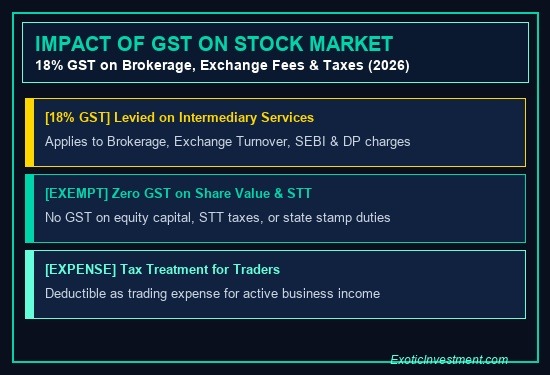
Listen, boss, if you ever checked your broker contract note at the end of a trading day, you probably noticed a line item for 18% GST eating into your net profits. Many beginner traders get nervous, wondering if the government is taxing their entire stock investment. But here is the real deal: understanding the impact of gst on stock market trading is much simpler than it looks. GST does NOT apply to your share purchase price or your capital gains. It applies strictly to service charges levied by brokers and stock exchanges. Before checking live LTP, CMP, and ATP stock price terms, let’s keep it simple. Here is the complete breakdown of how GST affects your brokerage, DP charges, and net trading returns.
What is the Impact of GST on Stock Market Trading? The Basics
When the Goods and Services Tax (GST) was introduced in India, it replaced older service taxes and national education cesses. Under Indian tax laws, financial intermediation is categorized as a service.
As a result, a standard rate of 18% GST applies to all fees charged by market intermediaries. When you trade on the National Stock Exchange (NSE) or Bombay Stock Exchange (BSE), your stockbroker acts as a service provider.
Your broker adds 18% GST to brokerage charges, clearing fees, and demat maintenance services. If you trade long-term delivery positions, read our guide on delivery shares and CNC order execution to see how holding periods influence statutory fees.
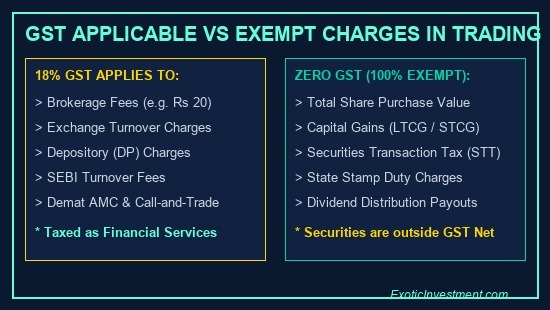
Illustration: GST Applicable vs Exempt Charges in Stock Market Trading
Charges Subject to 18% GST vs 100% Exempt Charges
To calculate your trading expenses accurately, you must know exactly where GST applies and where it does not:
1. Charges Subject to 18% GST:
- Brokerage Charges: Your broker adds 18% GST directly to order fees (e.g. ₹20 brokerage + ₹3.60 GST).
- Exchange Turnover Charges: Transaction charges levied by NSE, BSE, or MCX attract 18% GST.
- SEBI Turnover Fees: Regulatory charges collected on behalf of SEBI attract 18% GST.
- Depository (DP) Charges: When you sell delivery shares from your Demat account, the depository fee (typically ₹13.50 to ₹15.93) attracts 18% GST.
- Call & Trade Charges: Additional fees for placing phone orders or RMS auto-square-off carry 18% GST.
2. Charges 100% EXEMPT from GST:
- Principal Share Value: You pay zero GST on the actual money used to buy or sell equity shares.
- Securities Transaction Tax (STT): STT is a direct statutory levy and carries zero GST.
- State Stamp Duty: Stamp duty collected by state governments is 100% exempt from GST.
- Capital Gains Taxes: Profits from LTCG and STCG fall under Income Tax, not GST. Also, when stocks hit extreme ceilings, read our guide on circuit limits and trading halts.
Real-World Contract Note Example: How 18% GST is Calculated
Let’s look at a realistic trade from our trading desk to understand the exact rupee impact of GST on your daily trades:
Suppose you place an intraday trade buying and selling 100 shares of Reliance Industries at ₹1,000 per share. Your total trade turnover equals ₹1,00,000.
Here is how the charges and 18% GST break down on your digital contract note:
First, your discount broker charges ₹20 flat brokerage on the buy leg and ₹20 on the sell leg. Total brokerage equals ₹40.00. The 18% GST on brokerage is exactly ₹7.20.
Second, exchange turnover charges total ₹3.50. The 18% GST on exchange fees is ₹0.63.
Third, the SEBI regulatory fee is ₹0.10, adding another ₹0.02 in GST.
In total, you pay roughly ₹7.85 in GST on a ₹1,00,000 turnover trade. That represents less than 0.008% of your total trading capital! To calculate your exact fees, use our free Zerodha Brokerage Calculator, and estimate your annual tax liabilities with our Stock Market Tax Calculator.
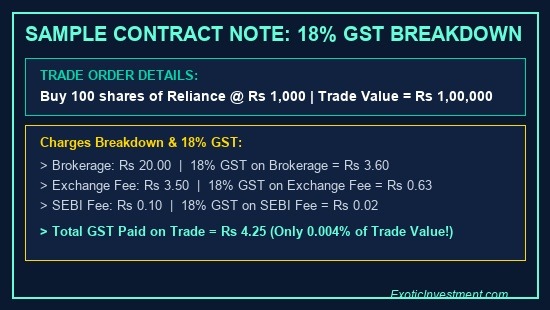
Illustration: Sample Contract Note: Step-by-Step 18% GST Mathematical Breakdown
Input Tax Credit (ITC) for Traders: Retail vs Business Entities
In our private WhatsApp trading community of 1,300+ traders, members often ask: Can I claim back the 18% GST paid on my trading brokerage?
The answer depends entirely on your legal tax registration status:
1. Individual Retail Investors: Individual retail investors cannot claim Input Tax Credit (ITC). However, if you file taxes as a trader under Speculative or Non-Speculative Business Income, the entire GST amount paid is treated as a legitimate business expense. You deduct it against your trading profits to reduce your net taxable income.
2. Registered Proprietary Desks and LLPs: Corporate trading firms, proprietary trading desks, and registered LLPs with an active GSTIN can claim 100% Input Tax Credit on brokerage GST. They can offset this credit against any outward GST collected on other business services.
Calculate your risk-adjusted capital limits using our free Position Size Calculator, and evaluate fundamental ratios with our PE Ratio Calculator.
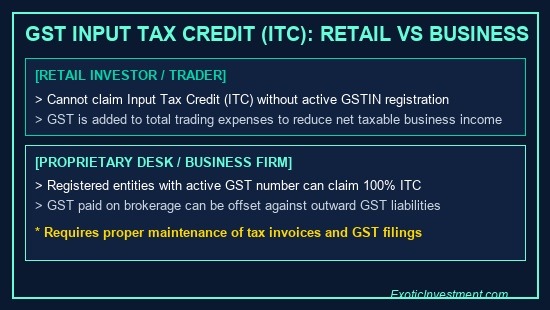
Illustration: GST Input Tax Credit (ITC) Rules for Retail vs Corporate Trading Desks
GST on F&O Trading and Commodity Markets
Futures and Options (F&O) traders trade high volumes, making understanding GST critical for active strategies:
In Futures trading, 18% GST applies to the flat broker order fee and the exchange turnover charge. It does NOT apply to the gross notional contract value.
In Options trading, 18% GST applies to the flat brokerage fee (e.g. ₹20 per executed order) and exchange charges calculated on the option premium turnover.
Under SEBI risk disclosures, 9 out of 10 retail traders incur net losses in the equity F&O segment. Controlling transaction costs and understanding GST impact ensures you do not suffer avoidable capital erosion.
Recommended Trading Education & Stock Market Books
If you want to master cost-effective trading execution, technical chart reading, and risk management strategies, structured education is your best investment:
Learn price action and candlestick setups in our Technical Analysis Course in Kannada, or build foundational market skills with our Basics of Stock Market Course. If you trade options, explore our Options Buying Course in Kannada.
Kannada readers can also grab Ashok Kumar N Rao’s bestselling Kaliyiri Share Market Book, or explore the English edition on the Basics of Indian Stock Market Book page. For weekly research stock picks, subscribe to our MultiBagger Plus Courses & Pro Tools Annual Subscription. Also check out Emintage financial calculators for external financial modeling tools.
Summary Checklist: How to Track and Minimize Trading GST
Here is a practical checklist used by experienced traders to monitor and manage trading costs:
- Review Digital Contract Notes: Always verify that 18% GST matches your broker’s published rate card.
- Select Flat-Fee Discount Brokers: Paying a flat ₹20 fee reduces your GST to ₹3.60 per executed order. In contrast, percentage-based brokers charge significantly higher fees.
- Deduct GST on Tax Filings: If you report trading as business income, maintain records to claim GST as an allowable business deduction.
- Avoid Unnecessary DP Charges: Consolidate small sales to avoid multiple ₹15.93 DP debits on the same day.
Frequently Asked Questions — Impact of GST on Stock Market
FAQ 1: What is the rate of GST applied to stock market trading in India?
The standard rate of GST applied to stock market trading services in India is 18%. It applies to broker commissions, exchange turnover charges, SEBI fees, and depository DP charges. Check your exact trade costs with our free Zerodha Brokerage Calculator.
FAQ 2: Do investors pay GST on the value of shares bought?
No. Equity shares and securities are explicitly defined as financial instruments outside the GST net. You never pay GST on the purchase price of shares or on capital gains. Read our guide on delivery shares and CNC orders to understand standard trade settlement.
FAQ 3: Is GST charged on Securities Transaction Tax (STT)?
No. STT is a direct sovereign tax levied by the central government. Under Indian tax rules, no tax can be levied on another statutory tax. Therefore, STT and state stamp duty carry zero GST. Calculate your total annual tax liability with our Stock Market Tax Calculator.
FAQ 4: Can retail individual traders claim Input Tax Credit (ITC) for GST?
Individual retail traders without a registered GSTIN cannot claim Input Tax Credit. However, traders declaring business income can claim the GST paid as a deductible business expense. Calculate your position sizes with our Position Size Calculator.
FAQ 5: Does GST apply to DP charges when selling shares?
Yes. Depository Participant (DP) charges represent a service fee for debiting shares from your Demat account. Brokers levy 18% GST on the base DP charge (e.g. ₹13.50 + 18% GST = ₹15.93 per company per day). Learn chart setups in our Technical Analysis Course in Kannada.
FAQ 6: How does GST impact long-term wealth compounding in stocks?
Because GST only applies to small service fees (roughly 0.005% of turnover), its impact on multi-year delivery compounding is negligible compared to capital gains taxes. Run long-term compounding scenarios with our free Lumpsum Investment Calculator.