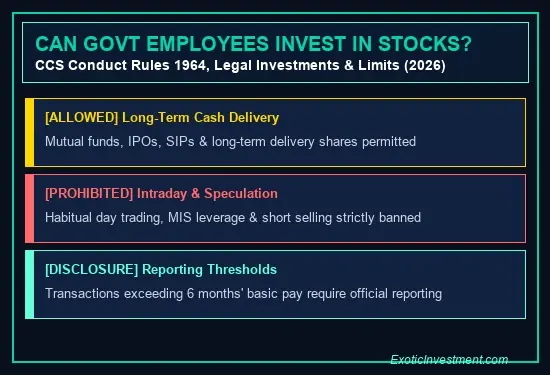
Listen, boss, you might serve as a Central officer, state employee, or PSU manager. You wonder: can government employees invest in stock market legally? Or will opening a Demat account trigger a departmental inquiry? Let’s clear the confusion once and for all. The short answer is yes — government servants can legally invest in stocks, mutual funds, and IPOs. However, strict service conduct rules apply. The government permits wealth building through long-term investments, but strictly bans habitual day trading, speculative margin credit, and insider deals. Before checking LTP, CMP, and ATP stock price terms, let us look at CCS Conduct Rules. Here are the disclosure limits and legal strategies.
Can Government Employees Invest in Stock Market? The Short Answer
Yes, government employees in India can invest in the stock market. However, you must distinguish clearly between long-term investing and speculative day trading.
Under Rule 16 of CCS (Conduct) Rules 1964, government staff can make occasional investments. Stocks, mutual funds, bonds, and IPOs are permitted.
What the rules prohibit is frequent purchase or sale of shares. Buying shares for long-term cash delivery is legal. But running a daily intraday trading desk is strictly illegal. To understand how cash delivery works, read our detailed guide on delivery shares and CNC order execution.
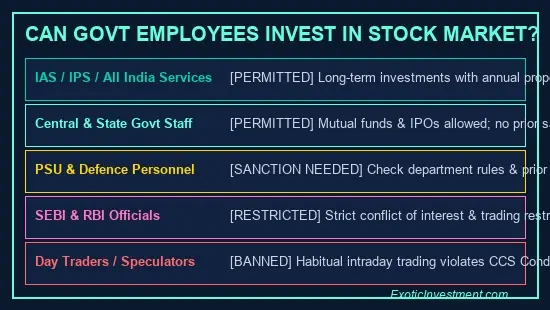
Illustration: Role Permissions & Investment Rules for Central, State, PSU and Defence Employees
Key Rules Under CCS (Conduct) Rules 1964
To keep your government service record spotless, you must follow four core principles under the CCS Conduct Rules:
1. Absolute Ban on Speculative Trading (Rule 16):
The rules explicitly forbid government servants from engaging in speculative stock trading. This means zero intraday MIS orders, zero short selling, and zero F&O day trading. If vigilance audits notice hundreds of transactions monthly, the department will treat it as a commercial business.
2. Financial Disclosure Thresholds:
Government servants must report major financial transactions to their Departmental Head or Competent Authority. Under CCS guidelines, report transactions exceeding prescribed limits. For Group A and B officers, reporting triggers if trades exceed 6 months’ basic pay.
3. Annual Immovable and Movable Property Returns:
All government officers must declare equity holdings in annual property returns. This includes Demat balances, mutual funds, and gold bonds.
4. Strict Prohibition of Insider Trading:
If you have access to non-public policy decisions or tender awards, trading related stocks is illegal. It violates SEBI Insider Trading rules.
Which Government Roles Have Extra Restrictions?
While general administrative staff enjoy clear investing rights, certain sensitive departments face strict additional restrictions:
1. SEBI, RBI, and Ministry of Finance Officials:
Officers in regulatory bodies face strict ethical walls. They cannot trade equities in sectors they actively regulate. They are usually restricted to broad index mutual funds.
2. Defence and Armed Forces Personnel:
Defence personnel must check military conduct rules. Obtain prior departmental sanction before executing large transactions.
3. Officers Handling Procurement and Tenders:
If you head a procurement committee or evaluate government supply contracts, buying shares of bidding vendor companies is a direct conflict of interest. Calculate long-term wealth growth through systematic investments using our free SIP Return Calculator, and model lump sum compounding with our Lumpsum Investment Calculator.
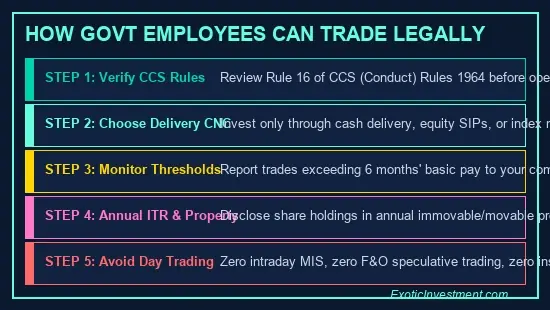
Illustration: How Government Employees Can Trade Legally: Step-by-Step Compliance Flowchart
CCS Conduct Rules: Prior Sanction vs Post Intimation
Understanding prior sanction versus post intimation prevents service record issues:
- Prior Sanction: Required when trades involve government suppliers or entities under your direct supervision.
- Post Intimation: Required when equity delivery or mutual fund trades exceed specified basic pay limits annually.
- Automated SIP Exemptions: Monthly SIPs in diversified index mutual funds rarely trigger conflict warnings because investment decisions are managed by licensed AMCs.
How to Invest Legally as a Government Employee
Here is the exact step-by-step roadmap used by thousands of government officers to build wealth safely:
Step 1: Open a Regular Individual Demat Account
Open an individual Demat account with brokers like Zerodha or Groww. Use your personal PAN card and bank account. Do not open joint accounts with subordinate staff.
Step 2: Stick Strictly to Cash Delivery (CNC) & Mutual Funds
Select CNC product codes when buying shares. Better still, invest in Nifty 50 index mutual funds via monthly SIPs. Mutual funds offer regulatory safety. Professional fund managers make all buying decisions.
Step 3: Keep Meticulous Transaction Records
Save all digital contract notes, P&L statements, and annual Demat holding statements provided by CDSL or NSDL. Having clean records makes filing annual property returns effortless.
Estimate your annual equity tax obligations with our free Stock Market Tax Calculator, and evaluate fundamental earnings multiples using our PE Ratio Calculator.
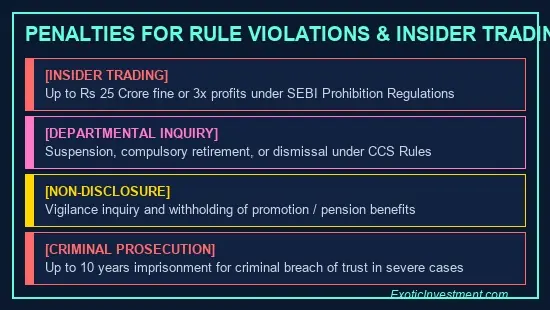
Illustration: Penalties for Rule Violations, Speculative Trading and Insider Trading
What Happens If You Break the Conduct Rules?
Ignoring service rules or attempting covert day trading carries severe administrative and legal consequences:
1. Departmental Disciplinary Action: Violating Rule 16 leads to departmental vigilance inquiries. Serious cases result in suspension or compulsory retirement.
2. SEBI Insider Trading Prosecution: Trading on price-sensitive government information attracts SEBI penalties up to ₹25 Crores. Criminal prosecution also applies.
3. Tax Audit and Black Money Scrutiny: Unreported Demat holdings or large cash transactions trigger Income Tax scrutiny notices under Section 143(2).
Calculate your capital allocation limits with our free Position Size Calculator, and check your transaction charges with our Zerodha Brokerage Calculator.
Summary Checklist: Safe Investing for Government Staff
Here is a quick checklist for government servants investing in Indian financial markets:
- Invest for Long Term: Buy shares with 100% upfront cash delivery and hold for years.
- Zero Intraday or F&O Trading: Completely avoid day trading, margin margin credit, and derivative contracts.
- File Timely Intimations: Report transactions exceeding 6 months’ basic pay to your competent administrative authority.
- Declare Holdings Annually: Include all Demat assets in your annual property return.
Recommended Trading Education & Stock Market Books
If you want to master technical chart reading, fundamental balance sheet analysis, and portfolio risk management, structured education is your best investment:
Learn price action and candlestick setups in our Technical Analysis Course in Kannada, or build foundational market skills with our Basics of Stock Market Course. If you trade options, explore our Options Buying Course in Kannada.
Kannada readers can also grab Ashok Kumar N Rao’s bestselling Kaliyiri Share Market Book, or explore the English edition on the Basics of Indian Stock Market Book page. For weekly research stock picks, subscribe to our Multibagger Stocks Annual Subscription. Also check out Emintage financial calculators for external financial modeling tools.
Summary Checklist: Departmental Compliance for Govt Staff
Here is a practical checklist used by civil service officers before opening trading accounts:
- Review Departmental Circulars: Check specific service rules for Class I, Class II, PSU, or defence roles.
- Select Cash Delivery Mode: Stick strictly to CNC orders, mutual fund SIPs, and primary market IPOs.
- Track Cumulative Trade Values: Intimate your office whenever annual transactions cross reporting thresholds.
- Maintain Paperless Records: Store contract notes and annual Demat statements for yearly property return filings.
Frequently Asked Questions — Can Government Employees Invest in Stock Market
FAQ 1: Can government employees invest in stock market legally?
Yes. Government employees can legally invest in stocks, IPOs, mutual funds, and bonds for long-term wealth building under CCS (Conduct) Rules 1964. Calculate your wealth growth with our free Lumpsum Investment Calculator.
FAQ 2: Can a government employee do intraday trading or options trading?
No. Rule 16 of the CCS Conduct Rules strictly prohibits speculative trading, intraday trading (MIS), short selling, and futures & options day trading. Read our guide on delivery shares and CNC orders.
FAQ 3: What is the transaction limit for government employees in stocks?
If your annual transactions in shares or mutual funds exceed 6 months’ basic pay (or prescribed departmental limits), you must submit a formal intimation to your competent authority. Model long-term returns with our SIP Return Calculator.
FAQ 4: Can government employees buy mutual funds and SIPs without permission?
Yes. Investing in mutual funds through monthly SIPs is completely legal and does not require prior permission, provided total annual investments remain within reporting limits. Calculate risk limits using our Position Size Calculator.
FAQ 5: Do government employees have to report Demat holdings in property returns?
Yes. All equity shares, Demat account balances, mutual fund units, and gold bonds must be declared in annual movable property disclosures. Calculate your exact tax liability with our Stock Market Tax Calculator.
FAQ 6: Can government employees apply for IPOs?
Yes. Applying for Initial Public Offerings (IPOs) as a retail investor is 100% legal for government employees. Master technical chart setups in our Technical Analysis Course in Kannada.