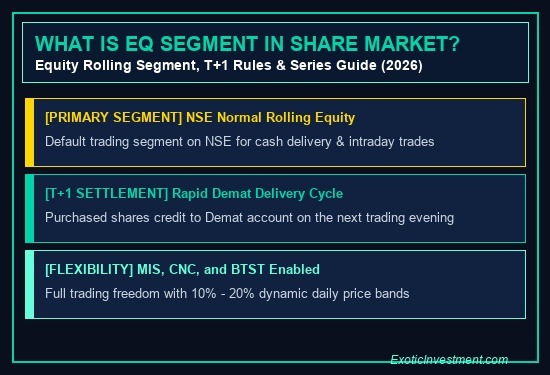
Listen, boss, when you search for a stock like Reliance, Infosys, or Tata Motors on Zerodha, Groww, or Angel One, you see the letters “-EQ” attached to the ticker symbol. Many beginners wonder: What does EQ actually mean? Does it mean equity? Or is it a special trading category? In truth, understanding the eq segment in share market is essential for placing trades correctly. On the National Stock Exchange (NSE), the EQ series represents the primary rolling settlement segment for equity shares. It gives you the flexibility to trade intraday or take multi-year delivery. Before checking live LTP, CMP, and ATP stock price terms, let’s keep it simple. Here is how the EQ segment works, how it differs from BE and BL series, and how T+1 settlement applies.
What is EQ Segment in Share Market? The Core Definition
On the National Stock Exchange (NSE), “EQ” stands for Equity. It is the default market series where ordinary shares of publicly listed companies trade under normal rolling settlement rules.
Whenever a company lists shares after an IPO, its shares trade under the EQ segment. In this series, buyers and sellers enjoy complete transaction flexibility.
You can buy shares as an intraday trader using intraday margin and exit before 3:15 PM. Alternatively, you can buy them as an investor using 100% cash to take delivery into your Demat account. If you trade delivery positions, read our guide on delivery shares and CNC order execution to see how share transfers operate.
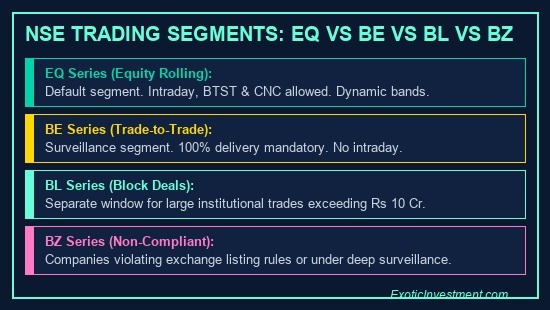
Illustration: NSE Market Trading Segments: EQ vs BE vs BL vs BZ Series Overview
NSE Market Segments: EQ vs BE vs BL vs BZ Series
To avoid placing orders in restricted segments, you must recognize the primary market series suffixes on NSE terminals:
1. EQ Series (Normal Equity Rolling): The standard trading segment. Allows intraday MIS orders, BTST trades, and delivery CNC orders with dynamic daily circuit limits (typically 10% to 20%).
2. BE Series (Trade-to-Trade Segment): A surveillance segment where every single trade requires 100% cash delivery. Intraday trading and BTST are strictly blocked. To understand these restrictions, read our complete guide on the NSE BE series and Trade-for-Trade rules.
3. BL Series (Block Deal Window): A specialized 15-minute trading window designed exclusively for large institutional transactions exceeding ₹10 Crores in value.
4. BZ Series (Non-Compliant Securities): Assigned to companies that have failed to comply with SEBI listing regulations or have defaulted on statutory financial reporting.
Also, when stocks hit extreme daily ceilings, read our guide on circuit limits and trading halts.
Order Execution in EQ Segment: MIS vs CNC Product Codes
When you place an order for an EQ series stock on your broker terminal, you must choose between two primary order types:
1. MIS (Margin Intraday Square-off):
In the EQ segment, brokers offer intraday margins (up to 5x buying power) under SEBI peak margin rules. You contribute 20% margin, and your broker provides the rest. However, your trade must be squared off before 3:15 PM on the same day. If you fail to close the position, the broker’s automated RMS closes it forcibly.
2. CNC (Cash and Carry):
If you want to hold shares overnight, you select CNC. You pay 100% upfront cash. The exchange settles the trade, and the shares credit to your Demat account on the next trading day. There is zero forced square-off, zero interest charge, and zero margin call.
Calculate your exact trading charges with our free Zerodha Brokerage Calculator, and estimate your annual tax liabilities with our Stock Market Tax Calculator.
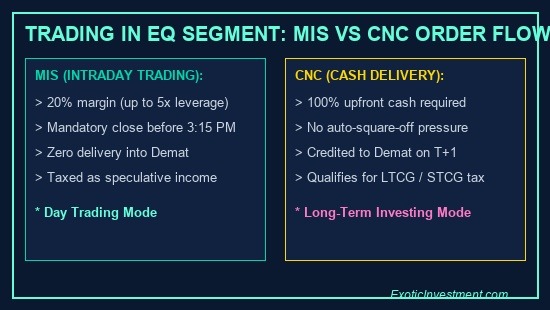
Illustration: Trading in EQ Segment: MIS Intraday vs CNC Cash Delivery Workflow
T+1 Settlement Timeline in the EQ Segment
India is a global pioneer in stock market settlement. Under SEBI regulations, all trades executed in the EQ segment follow a strict T+1 rolling settlement cycle:
1. Trade Day (T Day): You buy 100 shares of an EQ stock on Monday morning at 10:00 AM using CNC. Your broker debits your trading funds immediately.
2. Clearing House Processing (T Day Night): NSE Clearing Limited matches transactions between buying and selling brokers, calculating net fund and share delivery obligations.
3. Settlement Day (T+1 Evening): On Tuesday evening (T+1 working day), the shares are officially transferred by the depository (CDSL or NSDL) into your electronic Demat account.
Because the EQ segment uses net settlement, you can execute BTST trades. You can sell on Tuesday morning before Demat settlement. However, in the BE series, BTST is strictly illegal.
Calculate your portfolio position limits using our free Position Size Calculator, and evaluate fundamental ratios with our PE Ratio Calculator.
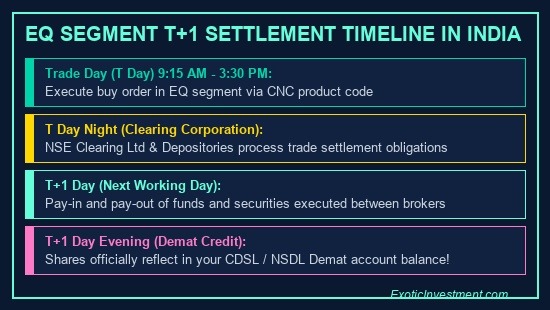
Illustration: EQ Segment T+1 Settlement Timeline: From Trade Execution to Demat Credit
Summary Checklist: How to Trade in the EQ Segment Safely
Here is a practical checklist for retail investors trading in the EQ segment:
- Verify the Suffix: Ensure the stock symbol shows “-EQ” to confirm you are trading in the normal rolling category.
- Select CNC for Long-Term Holdings: Always select CNC product code when buying shares for your investment portfolio.
- Respect 3:15 PM MIS Cut-Offs: If day trading under MIS, exit positions manually before the broker’s auto-square-off charges apply.
- Monitor Dynamic Price Bands: Most EQ stocks have 10% to 20% circuit limits, giving adequate room for price discovery.
Recommended Trading Education & Stock Market Books
If you want to master technical chart reading, order book analysis, and equity trading strategies, structured education is your best investment:
Learn price action and candlestick setups in our Technical Analysis Course in Kannada, or build foundational market skills with our Basics of Stock Market Course. If you trade derivatives, explore our Options Buying Course in Kannada.
Kannada readers can also grab Ashok Kumar N Rao’s bestselling Kaliyiri Share Market Book, or explore the English edition on the Basics of Indian Stock Market Book page. For weekly research stock picks, subscribe to our MultiBagger Plus Courses & Pro Tools Annual Subscription. Also check out Emintage financial calculators for external financial modeling tools.
Summary Checklist: How to Verify EQ Series Details on Broker Apps
Here is a practical checklist used by experienced traders when trading in the EQ series:
- Confirm Default Equity Suffix: Verify that the ticker shows “-EQ” on NSE or group “A” / “B” on BSE.
- Evaluate Margin Requirements: Confirm whether your broker requires 100% upfront cash (CNC) or offers 20% intraday margin (MIS).
- Track Post-Closing Settlement: Ensure your Demat account reflects share debits or credits by the evening of T+1 day.
- Audit Contract Note Levies: Check that exchange turnover fees and 18% GST match standard equity rates rather than derivatives pricing.
Frequently Asked Questions — What is EQ Segment in Share Market
FAQ 1: What is the meaning of EQ in the Indian stock market?
EQ stands for Equity on the National Stock Exchange (NSE). It is the default market series where ordinary equity shares trade under normal rolling settlement rules, allowing both intraday and delivery trades. Check trade costs using our free Zerodha Brokerage Calculator.
FAQ 2: What is the difference between EQ and BE series?
In the EQ series, intraday MIS trading and BTST trades are fully permitted. In contrast, the BE series mandates 100% cash delivery. It strictly prohibits intraday trading and BTST. Read our detailed guide on the NSE BE series and Trade-for-Trade rules.
FAQ 3: Can I do intraday trading in EQ segment stocks?
Yes. All stocks listed under the EQ series permit intraday MIS trading with up to 5x margin under SEBI peak margin guidelines. All open intraday positions must close before 3:15 PM. Model long-term returns with our Lumpsum Investment Calculator.
FAQ 4: How long does it take for EQ shares to reach my Demat account?
Under India’s T+1 settlement cycle, shares bought under CNC in the EQ segment are credited to your CDSL or NSDL Demat account on the next working evening following the trade day. Calculate your position sizes with our Position Size Calculator.
FAQ 5: Why do some stocks shift from EQ to BE series?
SEBI and stock exchanges move stocks into the BE series under surveillance frameworks like GSM and ASM to curb excessive speculative trading, abnormal volatility, and potential price manipulation. Learn chart setups in our Technical Analysis Course in Kannada.
FAQ 6: How are capital gains taxed when trading EQ segment shares?
Shares held for more than 12 months qualify as Long-Term Capital Gains (LTCG) taxed at 12.5% above ₹1.25 Lakh. Delivery trades held under 12 months attract STCG at 20%. Intraday trades are taxed as speculative business income at slab rates. Calculate your exact tax liability with our Stock Market Tax Calculator.