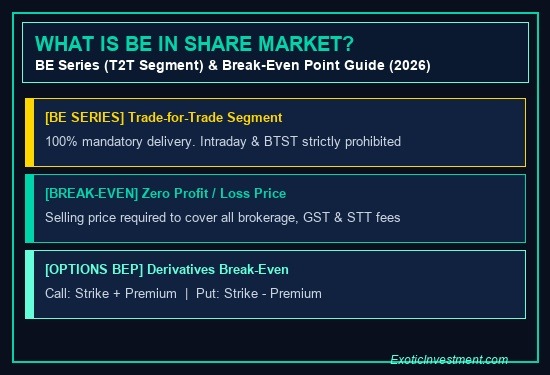
Understanding what is be in share market is essential for every Indian trader who has experienced an order rejection or wondered why a stock cannot be sold on the same day. In Dalal Street terminology, the acronym BE represents two fundamentally distinct market concepts. First, on the National Stock Exchange (NSE), the BE series denotes the strict Trade-for-Trade (T2T) settlement segment where all transactions require 100% compulsory delivery.
Second, in technical trading and corporate accounting, BE stands for Break-Even, representing the exact price threshold where gross gains balance out brokerage charges, taxes, and transaction fees. Mastering both concepts safeguards your capital against regulatory auction penalties while ensuring disciplined risk management across every trade. In this guide, we break down NSE surveillance rules, T2T settlement mechanics, options break-even formulas, and practical calculation steps.
What is BE in Share Market? The Two Essential Meanings
When searching for be in stock on Indian broker platforms like Zerodha, Upstox, Groww, or Angel One, participants encounter two distinct applications. Each definition plays a major role in how you execute trades and manage account balances:
First, the NSE BE series represents the official Trade-to-Trade segment designated by exchange surveillance teams. In this category, the exchange disables intraday squaring off, meaning every single purchase must be taken into Demat as 100% cash delivery. In addition, attempting to sell these shares before they settle under the T+1 cycle triggers severe exchange auction penalties.
Second, your trading Break-Even Point (BEP) represents the exact trade exit price where your net profit equals zero after paying all statutory levies. Many novice traders mistakenly assume that buying a share at ₹100 and selling at ₹100 produces zero loss. In reality, you lose money because brokerage, GST, and Securities Transaction Tax are deducted from your balance.
| Trading Feature | Standard EQ Series (Rolling Settlement) | BE Series (Trade-to-Trade Segment) |
|---|---|---|
| Permitted Order Types | CNC, MIS, CO, BO | CNC Only (Cash & Carry) |
| Intraday Squaring Off | Allowed (Buy and sell same day) | Strictly Prohibited |
| BTST Trading Allowed | Permitted on most broker platforms | Strictly Blocked (Auction Risk) |
| Margin Requirements | Up to 5x intraday margin credit | 100% Upfront Cash Margin |
| Daily Price Circuit Band | Dynamic bands up to 20% | Strict 5% Price Circuit Limit |
| Surveillance Classification | Normal Market Trading | ASM / GSM Stage Surveillance |
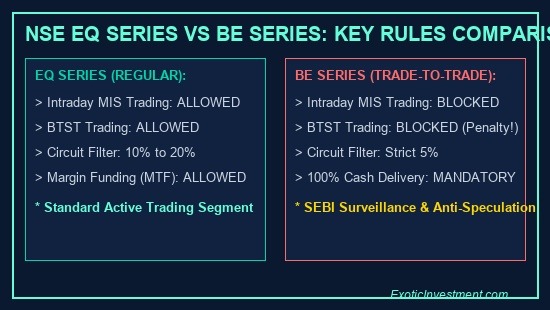
Illustration: EQ Series vs BE Series on NSE: Key Trading and Settlement Differences. In addition, verify delivery credits before placing sell orders.
Why Does NSE Shift Stocks into the BE Series?
The National Stock Exchange shifts equities from the standard EQ series into the BE series under SEBI investor protection mandates. When specific stocks exhibit abnormal price volatility, concentrated trading patterns, or high promoter share pledging, exchanges intervene proactively. By classifying a counter under the BE category, regulators curb excessive speculative volume.
Specifically, SEBI employs two primary surveillance frameworks: Additional Surveillance Measures (ASM) and Graded Surveillance Measures (GSM). When a small-cap counter triggers Stage 2 or higher of GSM, it is automatically transferred into the Trade-for-Trade BE segment. Consequently, retail participants can only purchase the stock if they possess 100% unencumbered cash in their accounts.
Therefore, understanding series suffixes prevents costly trading blunders. If you unknowingly buy a BE series stock intending to exit before 3:15 PM, your broker terminal will reject your intraday sell order. You can calculate your net capital commitments and verify round-trip trading fees using our free Indian stock brokerage calculator.
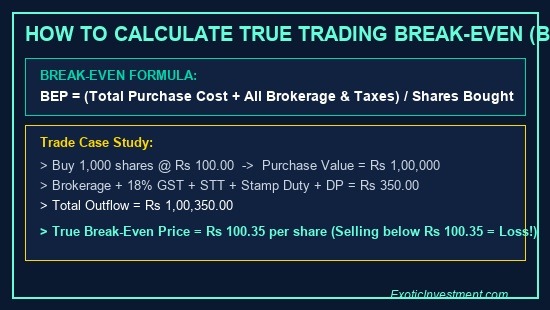
Illustration: Trading Break-Even Calculation: How Brokerage and Taxes Shift Your True Breakeven Point. In addition, review statutory charges before execution.
How to Calculate Your True Break-Even Price (BEP)
Beyond exchange series classifications, calculating your trading Break-Even Point is vital for every active market participant. In reality, every stock execution incurs a series of mandatory statutory costs, including brokerage, STT, exchange turnover charges, SEBI fees, and 18% GST. Consequently, your trade breakeven price is always higher than your original purchase price.
To compute your exact break-even point for an equity delivery trade, use this structured formula. In addition, always account for round-trip depository participant fees on delivery exits:
True Equity Break-Even Price Formulation:
For example, suppose you acquire 1,000 shares of a company at ₹100.00 each, representing an investment outlay of ₹1,00,000. Factoring in broker commissions, 0.1% delivery STT on both buy and sell sides, exchange fees, and a ₹15.93 DP debit fee, total transaction overhead reaches approximately ₹350. Therefore, your true break-even price is ₹100.35 per share, and selling at ₹100.00 would result in an immediate ₹350 net loss.
You can verify your exact breakeven points across discount brokers using our free Zerodha brokerage calculator and our Upstox brokerage calculator. In addition, you can simulate trade scenarios and profit targets using our stock profit calculator.
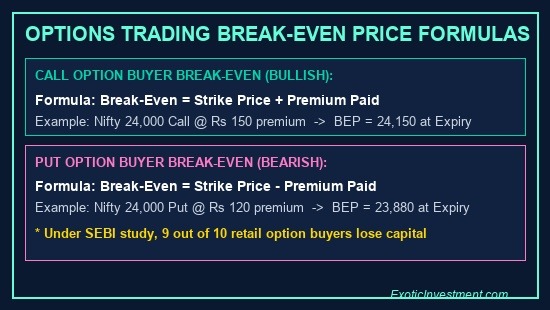
Illustration: Options Break-Even Matrix: Call vs Put Expiry Break-Even Formulas. In addition, check strike implied volatility.
Options Trading Break-Even Points: Call vs Put Formulas
In derivatives markets, understanding your break-even boundary before entering options contracts is essential for trading survival. For a Call option (CE) buyer, break-even at expiry equals the Strike Price plus the total Premium Paid. For instance, if you purchase a Nifty 24,000 Call option at a premium of ₹150, the index must settle strictly above 24,150 on expiry day for the contract to yield a net profit.
Conversely, for a Put option (PE) buyer, the expiry break-even equals the Strike Price minus the Premium Paid. For instance, if you buy a Nifty 24,000 Put option for ₹120, your position breaks even strictly at 23,880.
If Nifty closes at 23,950, your trade still suffers a loss despite the market moving downward. You can review current statutory taxes on derivatives in our what is STT in share market guide.
You can track your overall multi-asset investments and options performance using the eMintage portfolio tracker. In addition, modeling systematic compound wealth over time is simple with our free SIP wealth calculator.
To master options strategies and risk management thoroughly, explore our foundational Basics of Stock Market Course. In addition, study our bestselling Kaliyiri Share Market Book, and elevate your strategic trading edge with the MultiBagger Plus Pro Annual Subscription.
💡 Frequently Asked Questions on BE in Share Market
What does BE stand for on the National Stock Exchange?
On NSE, BE stands for Book Entry, which designates the Trade-for-Trade (T2T) settlement segment. In this category, all trades require 100% upfront delivery, and intraday squaring off is strictly prohibited.
Can I sell a BE series stock on the same day I buy it?
No, intraday trading is completely blocked for BE series stocks under SEBI surveillance rules. You must hold the shares until they are credited to your Demat account under the T+1 settlement cycle before placing a sell order.
Can I execute BTST (Buy Today, Sell Tomorrow) on BE series stocks?
No, BTST is completely disabled for BE series equities. Attempting to sell before Demat settlement leads to short delivery and severe exchange auction penalties that can reach up to 20% of trade value.
How do I calculate the break-even price for a stock purchase?
To calculate your true break-even price, divide your total purchase cost plus all round-trip brokerage, STT, 18% GST, exchange charges, and DP fees by your total purchased share quantity. Consequently, selling at your original cost price results in a loss equal to the total transaction overhead.