Listen, boss, whenever a company board announces a “300% dividend payout,” beginner investors rush to buy shares, expecting a giant windfall. But when the actual dividend credits to their bank account, it turns out to be just ₹30 per share! Why? Because they do not understand what is face value in stock market. Face value is the most misunderstood number on your trading screen. Beginners often confuse it with market price or book value. Before checking live LTP, CMP, and ATP stock price terms, let’s keep it simple. Here is everything you need to know about face value, dividend calculations, and stock splits.
What is Face Value in Stock Market? The Core Definition
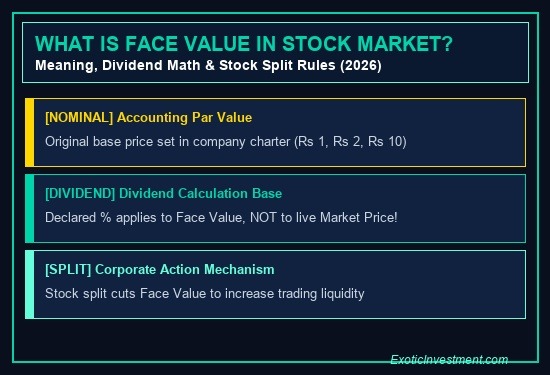
Let’s start with the basic definition. Face value (also called par value or nominal value) is the original cost of a single share of equity set by the company founders in its corporate charter.
Under the Indian Companies Act, every company must declare an authorized share capital. This capital is divided into shares of fixed nominal value. In India, most listed companies have a face value of ₹10, ₹5, ₹2, or ₹1 per share.
Face value remains fixed throughout the company’s operating life unless the board officially initiates a corporate action like a stock split. When placing long-term delivery shares and CNC orders, knowing face value helps you understand equity share capital.

Illustration: Face Value vs Book Value vs Market Value Comparison Table
Face Value vs Book Value vs Market Value: Key Differences
To avoid costly mistakes when analyzing financial reports, you must separate these three distinct valuation terms:
1. Face Value (Accounting Value): This is the arbitrary nominal base price recorded in company accounting books. It has zero direct connection to what investors pay on the open exchange.
2. Book Value (Net Worth Value): Book value represents the true accounting net worth of the company per share. It is calculated as (Total Assets minus Total Liabilities) divided by the total number of outstanding equity shares.
3. Market Value (Live Trading Price): This is the real-time price you see flashing on Zerodha, Groww, or Upstox. Market value reflects what buyers and sellers are willing to pay based on earnings growth, market sentiment, and forward prospects. Also, when stocks hit extreme daily ceilings, read our guide on circuit limits and trading halts.
How Dividends Are Calculated on Face Value (The 100% Myth)
Here is the single biggest trap that catches retail traders off guard. When a listed company announces a dividend percentage, that percentage applies strictly to the Face Value, NOT to the live Market Price!
Here is the official math formula:
Dividend Amount (in Rupees) = Declared Dividend Percentage × Face Value
Let’s look at a real-world example from our trading desk:
Suppose a stock trades at a market price of ₹3,000 per share with a face value of ₹10. The company announces a massive “200% dividend payout.”
A beginner might assume they will receive 200% of ₹3,000 = ₹6,000. That assumption is completely wrong!
The actual cash dividend paid is 200% of ₹10 = ₹20 per share. On a ₹3,000 stock, a ₹20 dividend represents an actual dividend yield of just 0.66%!
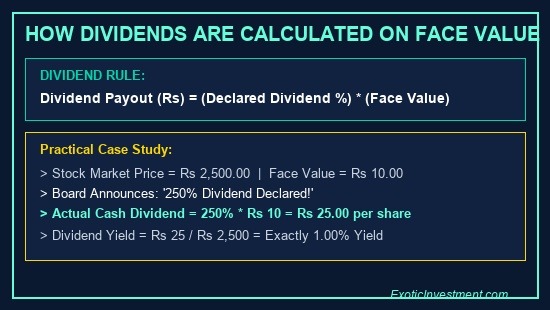
Illustration: How Dividends are Calculated on Face Value: Real Example Breakdown
How Stock Splits Change Face Value and Share Counts
Why do companies like Tata Motors, Reliance, or Titan split their shares? The answer lies directly in face value management:
When a share price rises to ₹3,000 or ₹5,000, retail investors hesitate to buy. To make shares affordable and boost liquidity, the board announces a Stock Split.
Here is how a 1:5 stock split works:
1. Face Value Divides: The original face value of ₹10 splits into ₹2 per share (₹10 / 5 = ₹2).
2. Share Count Multiplies: Every existing shareholder receives 5 shares for every 1 share previously held.
3. Market Price Adjusts: If the pre-split market price was ₹1,000, the post-split price opens at ₹200 (₹1,000 / 5 = ₹200).
Notice that your total investment value remains 100% unchanged! You hold 5 shares worth ₹200 each (Total = ₹1,000). Total paid-up equity share capital on the company balance sheet remains identical.
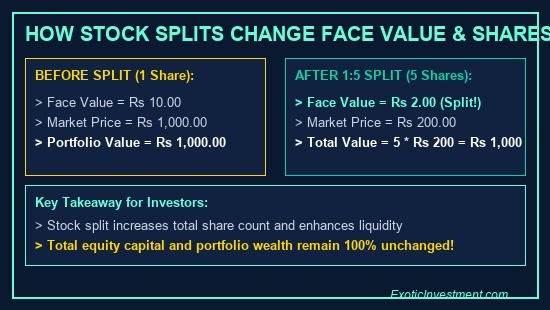
Illustration: Stock Split Mechanics: How Face Value Cuts Increase Market Liquidity
Bonus Shares vs Stock Splits: The Critical Face Value Difference
In our private WhatsApp trading community of 1,300+ traders, members frequently ask: What is the difference between a bonus issue and a stock split?
Here is the fundamental difference:
In a Stock Split, the company sub-divides its nominal Face Value. A ₹10 face value share becomes a ₹1 or ₹2 share. No accounting reserves are touched.
In a Bonus Issue, the Face Value remains completely unchanged! The company capitalizes its free reserves or retained earnings by converting cash reserves into fresh equity shares issued free to shareholders.
Check overall valuation multiples using our free PE Ratio Calculator, and calculate your exact risk allocation with our Position Size Calculator.
Taxation on Dividend Income and Share Buybacks in India
Under Indian tax rules, all dividend income is added to your total income. It is taxed according to your slab rate. In addition, companies deduct 10% TDS on annual dividends exceeding ₹5,000.
When selling shares after corporate actions, long-term capital gains are taxed at 12.5% above ₹1.25 Lakh. Short-term gains held under 12 months are taxed at 20%.
Calculate your net gains after statutory fees using our free Zerodha Brokerage Calculator, and estimate your annual tax impact with our Stock Market Tax Calculator.
Recommended Trading Education & Stock Market Books
If you want to master corporate balance sheets, fundamental financial ratios, and price action setups, structured education is your best investment:
Learn chart reading and moving averages in our Technical Analysis Course in Kannada, or master foundational concepts in our Basics of Stock Market Course. If you trade derivatives, explore our Options Buying Course in Kannada.
Kannada readers can also grab Ashok Kumar N Rao’s bestselling Kaliyiri Share Market Book, or explore the English edition on the Basics of Indian Stock Market Book page. For weekly research stock picks, subscribe to our MultiBagger Plus Courses & Pro Tools Annual Subscription. Also check out Emintage financial calculators for external financial modeling tools.
Summary Checklist for Evaluating Share Face Value
Here is a quick reference checklist whenever you review face value on company filings:
- Dividend Yield Reality: Always calculate dividend yield based on live market price, not declared percentage.
- Stock Split Impact: A split cuts face value and multiplies shares, but your total capital stays identical.
- Bonus Issue Independence: Bonus shares increase share count without touching nominal face value.
- Valuation Check: Never treat a low face value stock as cheap. Always evaluate P/E and price-to-book ratios.
Frequently Asked Questions — What is Face Value in Stock Market
FAQ 1: What is the meaning of face value in the Indian stock market?
Face value is the fixed nominal denomination of a single equity share set by company founders in its corporate charter. In India, face values commonly range between ₹1, ₹2, ₹5, and ₹10. Calculate risk-adjusted capital with our free Position Size Calculator.
FAQ 2: Why are dividends calculated on face value instead of market price?
Under the Indian Companies Act, dividends represent a return on the original capital contributed by shareholders. Because equity share capital is tracked on the balance sheet at face value, dividend percentages apply directly to that nominal base. Check transaction costs using our free Zerodha Brokerage Calculator.
FAQ 3: What happens to my shares when a company splits its face value?
When a stock splits (e.g. from ₹10 face value to ₹2), your share count multiplies by 5, while the market price per share reduces proportionally. Your total portfolio value remains exactly the same. Learn how delivery holdings settle in our guide on delivery shares and CNC orders.
FAQ 4: Can a company have a face value of ₹0 or zero?
No. Under the Indian Companies Act and SEBI regulations, all equity shares must carry a positive nominal value. While some US companies issue “no-par value” stock, Indian corporate law mandates a fixed face value of at least ₹1 per equity share. Check valuation multiples with our PE Ratio Calculator.
FAQ 5: Does a lower face value mean the stock is cheaper to buy?
Not at all! A stock with ₹1 face value can trade at ₹5,000, while a stock with ₹10 face value can trade at ₹50. Valuation depends on price-to-earnings, cash flows, and balance sheet strength, not nominal face value. Learn chart patterns in our Technical Analysis Course in Kannada.
FAQ 6: How are profits taxed when selling shares after a stock split?
When a stock splits, your acquisition date remains the original purchase date, but your cost price per share divides by the split ratio. Long-term gains held over 12 months are taxed at 12.5% above ₹1.25 Lakh, while short-term gains are taxed at 20%. Calculate your exact tax liability with our Stock Market Tax Calculator.