Listen, boss, whenever you call your broker’s dealing desk or listen to business news anchors, you constantly hear phrases like: “Which scrip are you tracking today?” or “Add this banking scrip to your watchlist.” If you are new to investing, you might wonder what on earth a scrip actually is. Is it a share? Is it a stock certificate? Or is it something entirely different? In truth, understanding scrip in stock market terminology is essential for navigating trading terminals. Before checking live LTP, CMP, and ATP stock price terms, let’s keep it simple. Here is everything you need to know about scrips, scrip dividends, and how exchange symbols work.
What is Scrip in Stock Market? The Core Definition
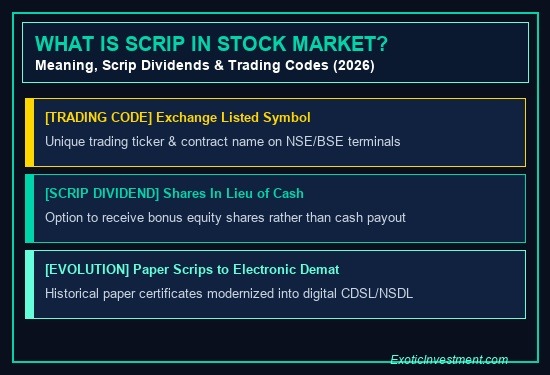
In financial markets, a scrip is any document, token, or certificate that acknowledges debt, rights, or ownership of equity shares.
Before electronic trading began in the late 1990s, investors received physical paper share certificates stamped with seal numbers and folio counts. Traders referred to those physical certificates as “scrips.”
Under SEBI and the Depositories Act, physical certificates transformed into electronic Demat holdings at CDSL and NSDL. However, the market jargon remains unchanged. On apps like Zerodha, Groww, and Angel One, brokers use “scrip” to refer to any listed company or tradable contract on NSE and BSE. If you trade physical or digital delivery, read our guide on delivery shares and CNC order execution.
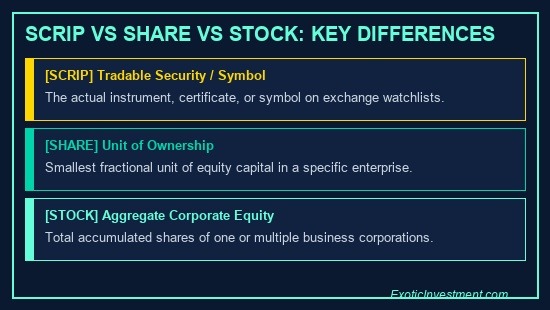
Illustration: Scrip vs Share vs Stock: Key Differences Explained
Scrip vs Share vs Stock: Understanding the Differences
Many retail investors use the words scrip, share, and stock as if they are identical. While closely related, each term has a distinct financial meaning:
1. Share (Unit of Ownership): A share is the indivisible single unit of ownership in a specific company. For example, if you own 10 units of Infosys, you hold 10 shares.
2. Stock (Aggregate Corporate Equity): Stock refers to the collective ownership certificates of one or more companies. When you say, “I invest in the stock market,” you refer to equities as an entire asset class.
3. Scrip (The Tradable Security / Symbol): A scrip is the functional instrument or electronic ticker traded on the exchange floor. When your broker tells you to add a new security to your market depth window, they call it a scrip. In addition, when a counter hits its upper daily limit, read our guide on circuit limits and trading halts.
What is a Scrip Dividend? (Bonus Shares in Lieu of Cash)
One of the most important corporate uses of this term is the “Scrip Dividend.” What happens when a profitable enterprise wants to reward shareholders but needs to conserve cash for expansion?
Instead of sending cash directly to shareholders’ bank accounts, the board offers a Scrip Dividend. Under a scrip dividend arrangement, investors receive additional newly issued equity shares (similar to a bonus issue) in proportion to their existing holding.
Let’s look at an example from our trading desk:
Suppose you hold 500 shares of an infrastructure firm. The company announces a 1:10 scrip dividend. You receive 50 fresh shares credited directly to your Demat account, raising your total holding to 550 shares without paying a single rupee.
The company retains its liquid cash reserves to fund factories or repay debt, while you expand your equity ownership. Calculate your long-term compounding returns using our free Lumpsum Investment Calculator, and estimate your annual tax liabilities with our Stock Market Tax Calculator.
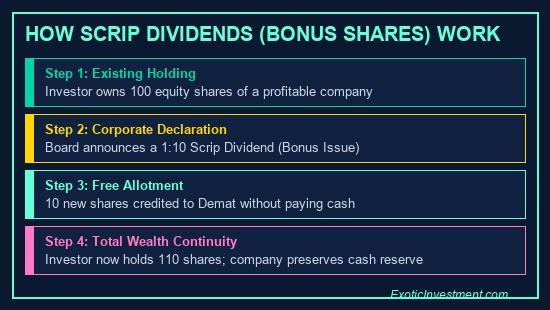
Illustration: How Scrip Dividends (Bonus Issues) Function Step by Step
How Scrips Are Identified on NSE and BSE Terminals
Every listed company has multiple identifiers across Indian exchanges. If you want to place accurate orders, you must know how these identifiers work:
1. NSE Trading Symbol (Ticker): On the National Stock Exchange, scrips are identified by intuitive alphanumeric symbols. For example, Reliance Industries trades under the symbol RELIANCE, Tata Consultancy Services trades as TCS, and State Bank of India trades as SBIN.
2. BSE Numeric Scrip Code: On the Bombay Stock Exchange, every company is assigned a unique 6-digit numeric scrip code. For example, Reliance is 500325, TCS is 532540, and Infosys is 500209.
3. ISIN Code (International Securities Identification Number): Under SEBI regulations, every equity scrip carries a globally unique 12-character alphanumeric code managed by NSDL. For instance, Reliance’s ISIN is INE002A01018. Even if a company renames its ticker, the ISIN remains permanent.
Before entering live positions, calculate your exact trade costs with our free Zerodha Brokerage Calculator, and calculate risk-adjusted capital limits using our Position Size Calculator.
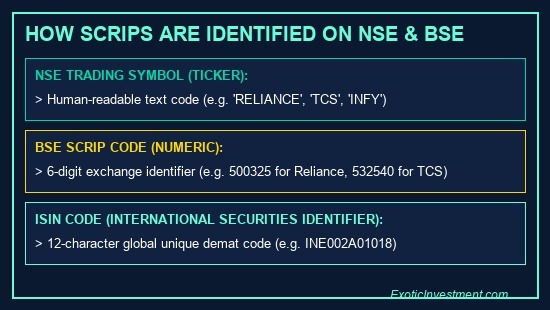
Illustration: Scrip Identification Codes: NSE Tickers vs BSE Numeric Codes vs ISIN
Scrip Liquidity and Spreads: What Every Trader Must Watch
In our private WhatsApp trading community of 1,300+ traders, we repeatedly remind members that not all scrips are created equal:
1. High-Liquidity Scrips (Nifty 50): Large-cap scrips trade millions of shares daily with razor-thin bid-ask spreads (often just 5 paise). You can enter and exit multi-crore positions without moving the price.
2. Illiquid SME and Micro-Cap Scrips: Low-volume scrips trade only a few hundred shares per day. Spreads can reach 2% to 5%, creating massive execution slippage. Always check order book depth before trading illiquid counters.
Evaluate enterprise valuation multiples using our free PE Ratio Calculator, and review margin requirements before taking multi-day positions.
Recommended Trading Education & Stock Market Books
If you want to master technical chart reading, order book analysis, and scrip selection, structured education is your best asset:
Learn price action and candlestick setups in our Technical Analysis Course in Kannada, or build foundational market skills with our Basics of Stock Market Course. If you trade options, explore our Options Buying Course in Kannada.
Kannada readers can also grab Ashok Kumar N Rao’s bestselling Kaliyiri Share Market Book, or explore the English edition on the Basics of Indian Stock Market Book page. For weekly research stock picks, subscribe to our MultiBagger Plus Courses & Pro Tools Annual Subscription. Also check out Emintage financial calculators for external financial modeling tools.
Summary Checklist: How to Track and Verify Scrips on Trading Apps
Here is a practical checklist used by experienced traders to select and verify scrips on trading apps:
- Match ISIN with Corporate Announcements: Always verify that the company’s 12-digit ISIN code matches official exchange press releases.
- Distinguish Between Equity and Derivatives: Never confuse cash equity scrips with monthly futures or options contracts carrying identical ticker names.
- Check BSE vs NSE Price Differences: Occasionally, small price differences exist between BSE and NSE scrips due to regional order books.
- Verify Daily Circuit Limits: Check whether the scrip operates under a 2%, 5%, 10%, or 20% daily price band before placing orders.
Frequently Asked Questions — Scrip in Stock Market
FAQ 1: What is the meaning of scrip in the Indian share market?
A scrip is any financial instrument, listed security, or contract traded on an exchange. While it historically referred to physical paper certificates, brokers today use the word scrip to mean any company or index symbol listed on NSE or BSE. Check trade costs using our free Zerodha Brokerage Calculator.
FAQ 2: What is the difference between a scrip and a share?
A share represents an individual fractional unit of company ownership. A scrip is the overarching security or market ticker traded on the exchange floor. In everyday conversations, traders often use them synonymously. Read our guide on delivery shares and CNC orders to see how holdings settle.
FAQ 3: How does a scrip dividend work?
A scrip dividend is a corporate action where a company gives shareholders new equity shares instead of paying a cash dividend. This allows the business to retain its cash for growth while shareholders receive more equity. Run long-term compounding projections with our Lumpsum Investment Calculator.
FAQ 4: How can I find the BSE scrip code for any company?
You can find the BSE scrip code on the official BSE India website or on your broker’s order placement window. It is a 6-digit numeric code (e.g. 500325 for Reliance). Calculate your position sizes with our Position Size Calculator.
FAQ 5: What is an ISIN code for a stock scrip?
An ISIN (International Securities Identification Number) is a unique 12-digit international alphanumeric code assigned to every Demat security in India by NSDL. It never changes, even if the trading symbol changes. Learn chart setups in our Technical Analysis Course in Kannada.
FAQ 6: How are bonus scrips taxed in India?
When bonus shares (scrip dividends) are credited to your Demat, their initial acquisition cost is treated as zero under Indian tax rules. When you eventually sell them, the entire sale proceeds are taxed as capital gains (12.5% LTCG if held over 12 months, or 20% STCG). Calculate your exact tax liability with our Stock Market Tax Calculator.