
Placing orders on stock exchanges requires more than just choosing a stock price. You must also instruct the exchange how long your order should stay active. In Indian stock trading, the standard default duration is a gfd order in share market terminals. Short for Good For Day, this validity setting governs when an unfulfilled order expires.
Every active trader should understand order types before committing live capital. You must master essential stock market terms so order mechanics work in your favor. In this detailed guide, we examine what GFD means, how it compares to IOC and GTC instructions, and how to execute orders with confidence.
👨🏫 Real Market Experience & SEBI Disclosure: Written by Dr.Ashok Kumar N Rao and the Exotic Investment research desk based on 12+ years of active market trading. All insights follow SEBI investor education guidelines. Exotic Investment does not provide unsolicited tips or PMS services. Always practice strict position sizing before taking live trades.
What Does GFD Order in Share Market Mean?
In simple terms, a GFD (Good For Day) order is a trade instruction that remains active until the official close of the current trading session. On Indian stock exchanges like the NSE and BSE, that means your order stays live until 3:30 PM. Therefore, if your target price does not get hit during regular trading hours, the exchange automatically cancels the order.
Consequently, this automated cancellation prevents unexpected fills on following trading days. In the past, forgotten pending orders could get filled days later during erratic market gaps. A GFD instruction ensures your trading slate wipes clean at the end of every trading day.
In fact, whether you buy cash delivery share trades or trade intraday derivatives, GFD serves as the default validity setting across all Indian brokerage platforms.
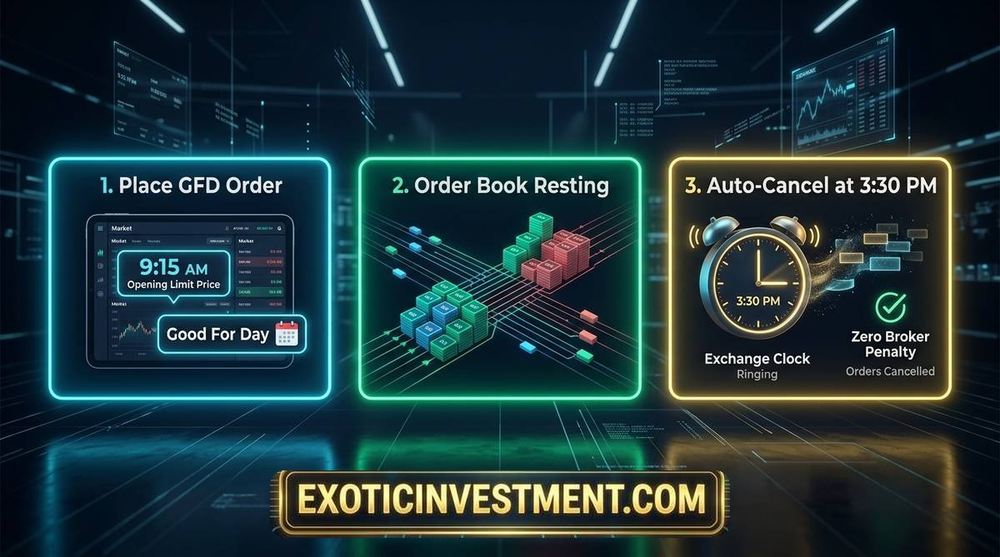
Order lifecycle: how gfd orders work in share market sessions from morning placement to 3:30 PM auto-expiry.
How a GFD Order Works Step by Step
Understanding the exact mechanics of a GFD order helps you manage your daily execution strategy. Here is how an order moves through exchange matching engines:
- Order Placement: At 9:30 AM, you place a limit buy order for 100 shares of Infosys at Rs 1,800. The current market price sits at Rs 1,815. You select ‘Day’ or ‘GFD’ validity on modern stock broker apps in India.
- Resting in Order Queue: Your order travels to the exchange matching engine. It rests in the limit order book, waiting patiently for sellers willing to accept your Rs 1,800 price.
- Partial Execution Possibility: At 1:30 PM, the stock dips to Rs 1,800, but only 40 shares are available at that price. The exchange matches 40 shares immediately. The remaining 60 shares stay active in the queue.
- End of Day Auto-Expiry: At 3:30 PM, regular trading concludes. The stock did not trade further at Rs 1,800. The exchange cancels the remaining 60 shares automatically. Your broker charges zero cancellation penalty for unexecuted legs.
This automated protection shields traders from overnight shocks. For example, without GFD cancellation, an overnight gap could execute your order at unfavorable levels, leaving you trapped like a lame duck in stock market short squeezes.
GFD vs IOC vs GTC: The Core Order Validity Comparison
To choose the right order instruction, you must compare GFD against alternative validity types available on modern trading terminals:
- GFD (Good For Day): Active throughout the entire trading session until 3:30 PM. Great for patient limit buyers who want to wait for favorable intraday dips.
- IOC (Immediate or Cancel): Executes immediately in microseconds upon reaching the exchange matching engine. Any unfulfilled quantity cancels instantly. High-speed floor participants practicing jobbing in stock market order books often use IOC to test order book depth.
- GTC (Good Till Cancelled / GTT): Remains active across multiple trading days until filled or manually cancelled by the user. In India, brokers provide Good Till Triggered (GTT) features valid up to 365 days.
By contrasting these instructions, you pick the exact tool that matches your patience level and trade setup.
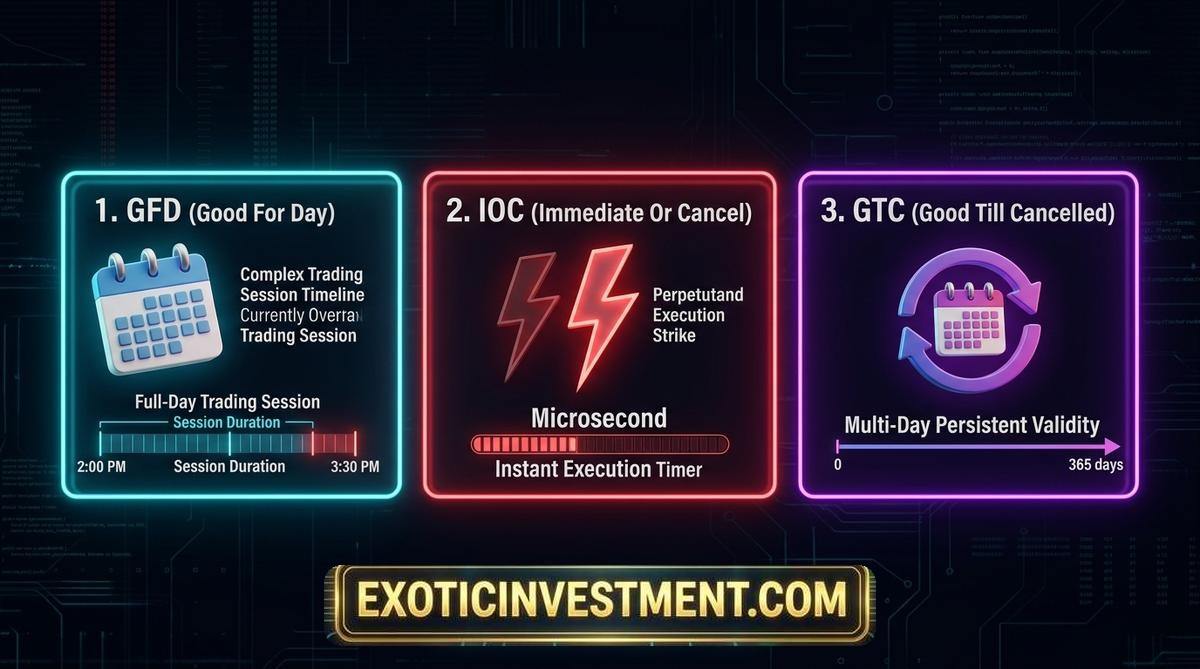
Validity comparison: gfd vs ioc vs gtc order comparison in share market platforms and execution timelines.
Order Timing, Sessions, and Exchange Matching Rules
Indian equity bourses operate on precise trading sessions. Knowing these timelines helps you place GFD orders effectively:
First, the pre-open session runs from 9:00 AM to 9:15 AM. Orders entered during this window discover the opening print. If you participate in initial public offerings like an IPO stag in stock market listings, this pre-open window determines your exit price.
Second, continuous normal market trading runs from 9:15 AM to 3:30 PM. Any GFD limit order entered during this period remains active until 3:30 PM. However, if you trade with MIS intraday product codes, note that brokers run automated Risk Management Systems (RMS) that square off intraday trades around 3:15 PM, before the exchange closes.
Third, the post-closing session operates from 3:40 PM to 4:00 PM. Here, participants can place orders only at the day’s official closing volume-weighted average price (VWAP).
Transaction Costs and Brokerage on GFD Orders
A common question among beginner traders is whether cancelled GFD orders incur broker fees or exchange taxes. The answer is reassuring: Indian exchanges charge fees only on executed trades.
First, review the breakdown of brokerage charges in India. If your GFD order expires unexecuted at 3:30 PM, your broker charges zero commission. You pay brokerage only on the quantity that successfully matches.
Second, Securities Transaction Tax and GST apply exclusively to executed trades. You can calculate statutory dues easily with our free STT calculator. Then, determine your net realized profit after all exchange turnover levies using our stock profit calculator.
Third, if you trade digital assets alongside equity markets, analyze your post-tax yields with the crypto profit calculator on eMintage to measure comparative profitability.
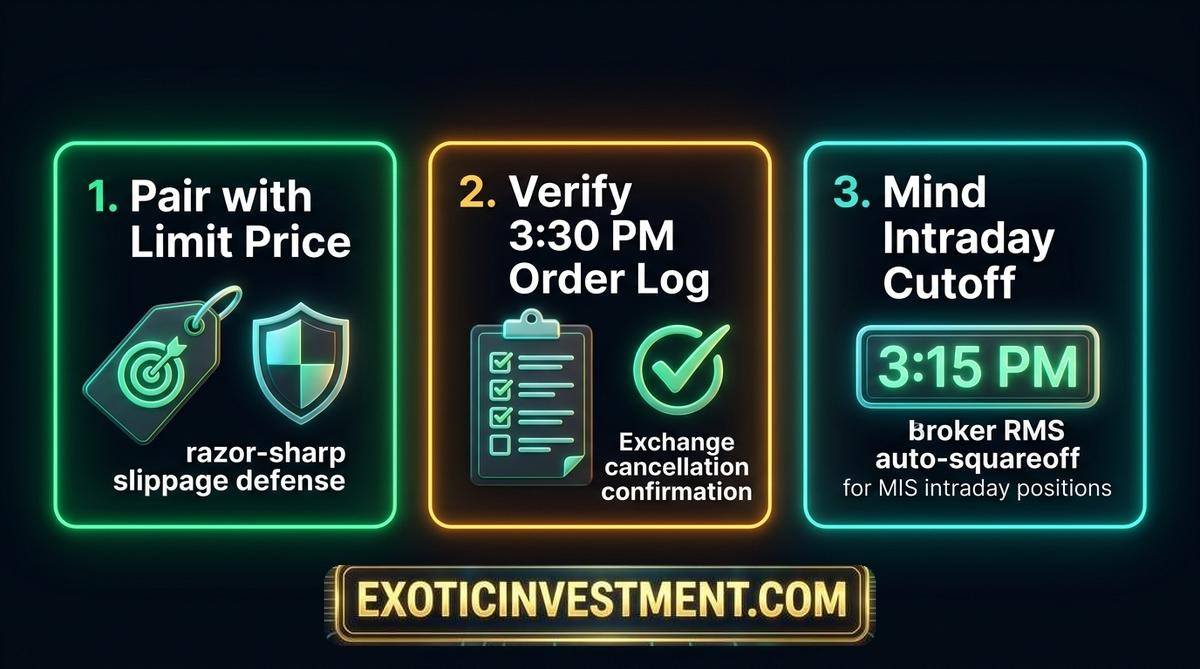
Best practices: best practices for placing gfd orders in share market accounts to prevent execution errors.
Best Practices for Placing GFD Orders in Share Market
To maximize execution efficiency and protect your capital, adhere to these proven execution habits:
1. Always Pair GFD with Limit Orders
First, never attach GFD validity to a market order. Market orders execute immediately at the best available ask price, making validity duration irrelevant. Use GFD strictly with limit orders to buy at support levels or sell at resistance peaks.
2. Verify Post-Close Order Status
Second, develop the habit of checking your broker’s order log at 3:35 PM. Verify that all unexecuted GFD legs show as ‘Cancelled’. If a partial fill occurred, note your net open position so you can plan the following day’s strategy.
3. Distinguish Between CNC Delivery and MIS Intraday
Third, remember that GFD validity does not override intraday margin cutoffs. If you place a GFD limit order under MIS margin, your broker’s RMS system will cancel open orders and close positions around 3:15 PM. If you want multi-day holding flexibility, review our step-by-step guide to swing trading in India.
Building Long-Term Wealth Beyond Order Execution Mechanics
Mastering order types ensures you never make rookie execution mistakes. But true financial freedom comes from structured long-term investing across compounding assets.
For instance, build a solid foundation with systematic equity mutual funds. You can model your multi-year compounding targets using our SIP calculator. You can also track your portfolio growth rates using our CAGR calculator.
Later in life, you can turn your accumulated portfolio into predictable monthly passive income. Study our guide on SWP mutual fund rules, and calculate exact monthly withdrawal schedules using our SWP calculator.
Also, explore geographic diversification outside Indian equities. Read our beginner guide on how to invest in Japan stocks from India to broaden your investment horizon.
Additionally, learn about equity issuance by studying who distributes shares during primary offerings. Also, examine balance sheet rules for discount on issue of shares to evaluate corporate fundamentals like an experienced auditor.
Recommended Trading Courses & Premium Subscriptions:
- Options Buying Course in Kannada: Options Buying Course in Kannada.
- Technical Analysis in Kannada Course: Technical Analysis in Kannada Course.
- Kaliyiri Share Market Book: Kaliyiri Share Market Book.
- Basics of Stock Market Course: Basics of Stock Market Course.
- Multibagger Stocks Pro Subscription: MultiBagger Plus Courses & Pro Tools Annual Subscription.
💡 Frequently Asked Questions (FAQ)
What does GFD mean in Indian share market trading?
GFD stands for Good For Day. It means your order remains active in the exchange order book until the market closes at 3:30 PM on that trading day.
What happens to a GFD order if it does not get filled?
If your GFD order does not match by 3:30 PM, the exchange cancels it automatically. You do not pay any cancellation charges or penalties to your broker.
Can a GFD order get partially executed?
Yes, if only a portion of your requested shares find a matching price, that part executes immediately. The remaining unfilled quantity stays active until 3:30 PM.
What is the key difference between GFD and IOC orders?
A GFD order waits in the queue until 3:30 PM for a price match. In contrast, an IOC (Immediate Or Cancel) order cancels instantly if it cannot find an immediate match in microseconds.
Can I modify or cancel a GFD order during the trading day?
Yes, you can modify the price, quantity, or cancel the pending order anytime during regular market hours, provided the order has not executed yet.