
What is grey market premium in ipo?
👨🏫 Real Market Experience & SEBI Disclosure: Written by Dr.Ashok Kumar N Rao and the Exotic Investment research desk based on 12+ years of active market trading. All insights follow SEBI investor education guidelines. Exotic Investment does not provide unsolicited tips or PMS services. Always test trading setups with disciplined position sizing before risking live capital.
Listen, boss. Let’s keep it simple here. The grey market premium in IPO means extra money traders pay over the official issue price of an IPO before it lists on the stock exchange. You see it happening in India every time a popular company announces its public listing.
Now, here’s the thing. This grey market is not an official or regulated market. SEBI has not given it any recognition. Yet, it exists everywhere in India. Thousands of traders participate daily through unofficial channels.
When an IPO gets a positive grey market premium, it signals that retail investors expect the stock to list at a higher price than the issue price. Let me give you a practical example. Suppose Company XYZ announces an IPO priced at Rs 100 per share. If the grey market premium stands at Rs 25, it means traders are willing to pay Rs 125 for shares they will get only after the official listing date arrives.
The premium can also be negative. That happens when demand drops. Investors start doubting the valuation or feel the overall market sentiment is weak. In such cases, the grey market premium turns negative. It might sit at minus Rs 10, which means traders expect the stock to list even below the issue price of Rs 100.
I have been watching Indian IPOs closely since many years now. What I tell you here comes from real observation on NSE and BSE platforms. The grey market premium often moves sharply in the three days before the IPO allocation date. That is when smart money starts positioning itself for the listing gains.
So, in plain words, the grey market premium in IPO shows what common Indian investors actually believe about how the listed price will perform. It acts as a barometer of public sentiment before the official outcome arrives. No confusion here.
Why grey market premium in ipo Matters for Indian Stock Traders
First, understand this. Grey market premium directly affects your expected listing gains or losses. If the premium stays strong right up to the allotment date, your chances of making quick profit on listing day look much better. That means real money in your trading account.
Second, it helps you decide whether to apply at all. Many novice investors blindly apply to every IPO they see. But if the grey market premium shows a negative trend two days before the closing date, you should rethink your decision. Applying then only increases your risk unnecessarily.
Third, brokers on platforms like Zerodha, Groww, and Upstox show IPO applications in real time. You can track how the premium is moving alongside your application status. Combining that data with your own research gives you a clear edge over casual retail investors.
Honestly speaking, the grey market premium also reveals institutional interest. When big players show confidence by pushing the premium higher, small investors usually follow. But do not copy blindly. Always cross-check the fundamentals first.
Here’s the real deal. IPOs with consistent grey market premiums tend to list above the issue price more often. However, this rule breaks during market crashes or sector-specific downturns. So always consider the broader economic picture too.
If you want to manage your risk properly, use a stop loss calculator before you place any listing day trade. That single step can save your capital from sudden afternoon declines on NSE or BSE.
Key Concepts Related to grey market premium in ipo
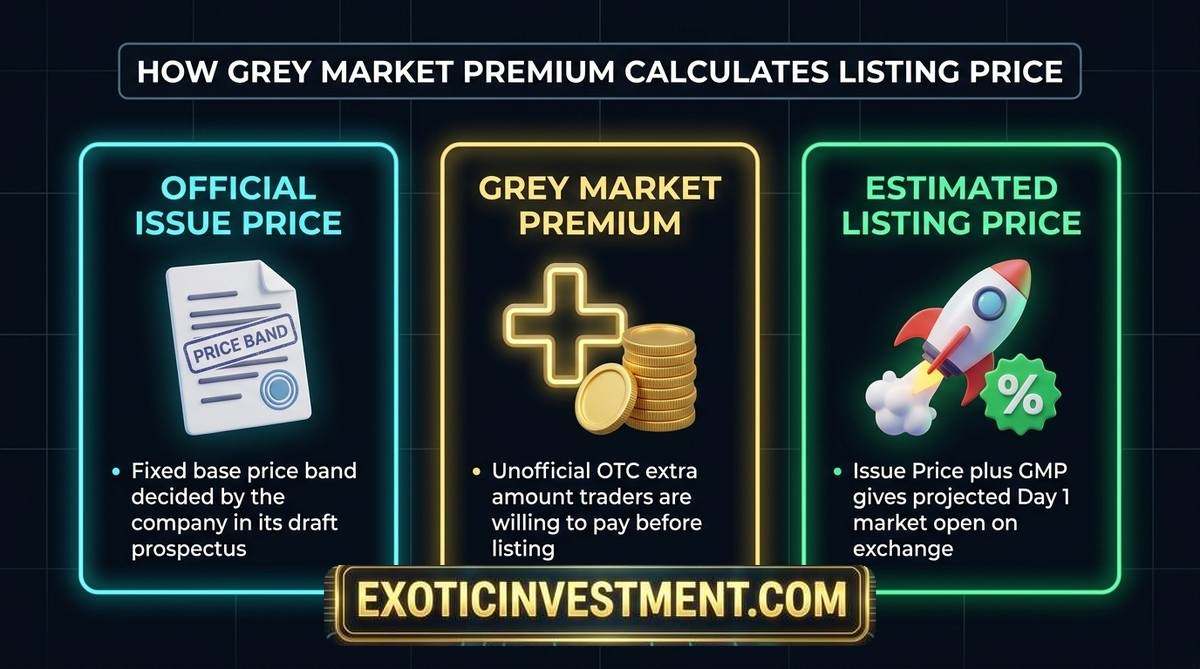
Illustration: How Grey Market Premium Calculates Listing Price
There are a few core terms you must know cold. First is the issue price, which the company fixes when it files its DRHP with SEBI. Second is the cut-off price band, usually given as a range like Rs 90 to Rs 95 per share. Third is the subscription number, which tells you how many times the IPO has been oversubscribed.
Fourth comes the listing gain estimate, calculated by adding the grey market premium to your application price. For instance, if you applied at Rs 95 and the premium is Rs 20, your estimated listing price becomes Rs 115. Simple math, but very powerful when used correctly.
Fifth is the subscription ratio. When an IPO gets oversubscribed by three times or more, the grey market premium usually stays positive. That is because limited supply meets heavy demand, which pushes expectations higher.
Sixth concept is the anchor investor allocation. Anchor investors commit large amounts before the general public even gets a chance to apply. Their participation often stabilizes the grey market premium and reduces wild swings during the final trading hours.
Seventh, remember the allotment date. The grey market premium becomes irrelevant after shares get allocated and credited to your demat account. From that point forward, only the live market price matters on NSE or BSE.
Also, keep an eye on the Zerodha brokerage calculator and the Upstox brokerage calculator. Trading IPO listing gains involves STT, exchange charges, and GST. These costs eat into your actual profit if you ignore them.
Finally, the Grey Market Premium is purely driven by supply and demand. No official data source publishes it. You rely on trusted grey market operatives and community updates shared through Telegram groups and trading forums.
How to Apply This Knowledge Step by Step
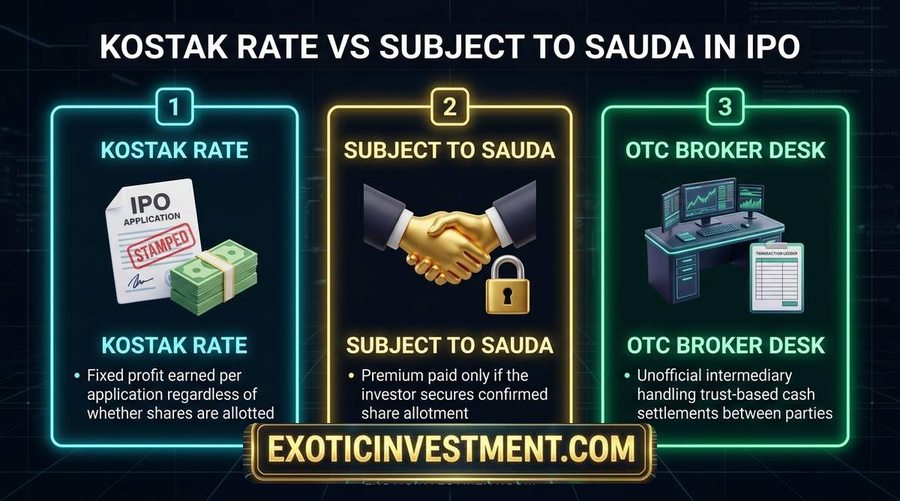
Illustration: Kostak Rate vs Subject to Sauda in IPO
Step one: pick the IPO you want to track. Go to the Groww SIP calculator page if you plan to invest through mutual fund routing as well, though IPO applications usually go through your broker’s IPO window directly.
Step two: check the grey market premium on at least two reliable sources. Do not trust just one WhatsApp forward or one Telegram channel. Compare the numbers. If both sources show a similar premium trend, you can treat it as genuine signal.
Step three: study the fundamentals before applying. Look at the company revenue growth, debt levels, promoter holding, and sector outlook. A strong premium behind weak fundamentals is often a trap for unwary retail investors.
Step four: decide your application quantity based on your risk appetite. Never apply more than you can afford to lose. Even with a healthy premium, listing day outcomes can surprise you badly.
Step five: submit your application through your preferred broker platform. Whether you use Zerodha Kite, Groww app, or Upstox Pro, make sure your bank mandate is active and linked correctly. Failed mandates waste time and miss the deadline.
Step six: monitor the premium daily until the allotment result declares. Prices can shift fast in the last forty-eight hours before the draw of lots. Stay alert but do not panic-trade based on rumors.
Step seven: once your shares get allotted, use the Indian Rupee profit calculator to figure out your actual net returns after deducting all charges and taxes. Real profit is what stays in your pocket, not the gross listing gain number you see on paper.
Recommended Trading Courses & Premium Subscriptions:
- Options Buying Course in Kannada: Options Buying Course in Kannada.
- Technical Analysis in Kannada Course: Technical Analysis in Kannada Course.
- Kaliyiri Share Market Book: Kaliyiri Share Market Book.
- Basics of Stock Market Course: Basics of Stock Market Course.
- Multibagger Stocks Pro Subscription: MultiBagger Plus Courses & Pro Tools Annual Subscription (Checkout link: MultiBagger Plus Courses & Pro Tools Annual Subscription).
Common Mistakes and How to Avoid Them
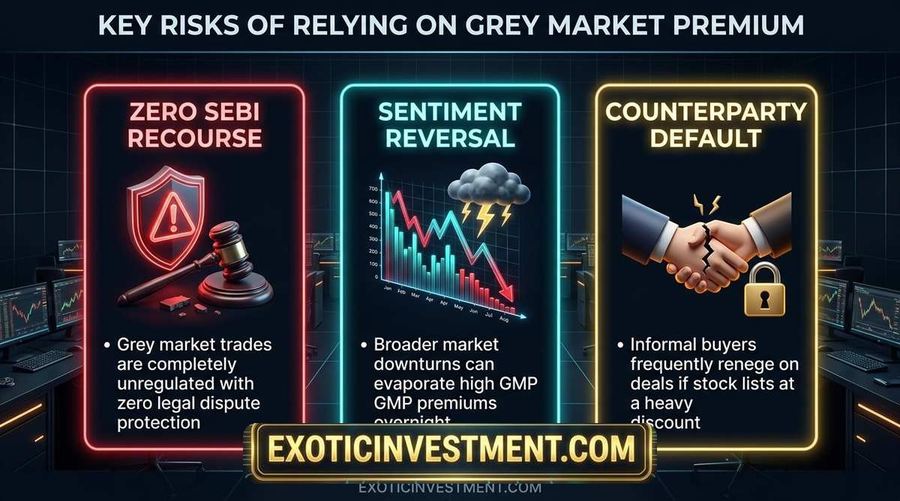
Illustration: Key Risks of Relying on Grey Market Premium
Mistake number one: trusting a single source for the grey market premium. Different agents quote different rates. That causes confusion among retail traders. Always verify from two independent channels before taking any action.
Mistake number two: applying without reading the prospectus. Just because the premium looks high does not mean the company is fundamentally strong. Blind applications lead to blocked funds and disappointment on allotment day.
Mistake number three: holding listing day shares without a plan. Some traders wait hoping the price keeps climbing. But IPOs frequently open high and close lower on the same day. Have a clear exit strategy ready before the bell rings.
Mistake number four: ignoring brokerage and tax costs. Your gross listing gain looks impressive, but after STT, transaction charges, GST, and brokerage, the net figure drops significantly. Use the stop loss tool mindset even here. Know your exact cost before you enter.
Mistake number five: chasing negative premiums recklessly. Some traders think buying at a discount in the grey market is a free profit opportunity. But a falling premium often warns of deeper trouble ahead. Do not catch a falling knife.
Mistake number six: forgetting your overall portfolio balance. Putting too much capital into a single IPO because the premium looks attractive can hurt you badly if that stock underperforms. Diversification remains the oldest surviving rule in Indian markets.
Advanced Trading Tips to Master This Topic
Tip number one: track the subscription numbers alongside the premium. When an IPO crosses twelve times subscription and the grey market premium also rises simultaneously, the listing probability strengthens considerably. Watch both indicators together.
Tip number two: compare the IPO’s price band with peer company valuations. If the issue price seems expensive compared to listed peers on NSE, the premium may fade quickly once listing happens. Relative valuation matters a lot in Indian markets.
Tip number three: use pivot point analysis for post-listing trades. After your shares hit the exchange, refer to the pivot point calculator to identify key support and resistance zones. Those levels help you decide when to book profits or hold for a bigger move.
Tip number four: read the RHP carefully for risk factors. Sometimes companies hide warning signs inside lengthy legal documents. Look for sections mentioning litigations, related-party transactions, or unusual revenue recognition patterns.
Tip number five: build a personal tracking sheet. Maintain a simple spreadsheet showing each IPO’s issue price, premium trend, subscription status, and final listing price. Over time, you will notice patterns that no generic article can teach you.
Tip number six: combine grey market data with technical chart patterns from listed peers. If similar companies in the same sector are trading near their all-time highs, that positive momentum often carries over to the new IPO listing as well.
Tip number seven: practice with a demo account before risking real money. Most broker apps provide paper trading features. Test your grey market premium strategy there first. Only switch to live trading once your win rate improves consistently over twenty to thirty simulated trades.
Final Summary
The grey market premium in IPO remains one of the most useful informal indicators for Indian retail investors. It reflects real market sentiment long before official results arrive. But remember, it is unofficial and unregulated. SEBI has not endorsed it. So use it as a guide, not as a guarantee.
Always pair the premium data with fundamental research, subscription numbers, and proper risk management. Never invest money you cannot afford to lock away for several weeks until allotment completes. Trading is a marathon, not a sprint.
Keep learning, stay disciplined, and protect your capital first. Profits will follow naturally when you combine knowledge with patience. That is the real secret behind successful Indian stock market investing.