Groww SIP Calculator & Wealth Suite
Estimate mutual fund future value, model dynamic 10% annual step-up increments, audit real inflation-adjusted purchasing power, and plan retirement SWP longevity.
How to Plan Your Wealth Journey in 4 Steps
Select Mode
Choose Standard Step-Up SIP, Real Inflation Purchasing Power, or SWP Retirement Pension.
Set Contribution
Adjust monthly deposit from ₹500 to ₹2 Lakh or click quick presets (₹5K, ₹10K, ₹25K, ₹50K).
Model Growth
Define expected annual CAGR (12% to 15%) and target investment horizon from 1 to 40 years.
Audit Real Wealth
Evaluate your compound wealth multiplier and compare nominal maturity against inflation haircut.
The Mathematics of Mutual Fund SIP Compounding Explained
Groww and leading Indian investment platforms popularized Systematic Investment Plans (SIPs) by making disciplined investing accessible to millions of retail investors. However, a basic SIP calculator only tells half the story. To build multi-generational wealth, investors must account for three structural variables: annual contribution step-ups, inflation-adjusted purchasing power, and tax-efficient retirement withdrawal mechanisms (SWP).
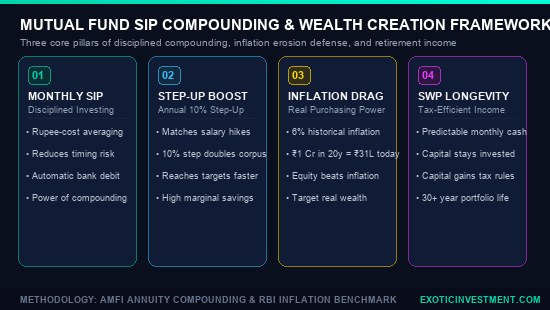
Figure 1: Complete Mutual Fund Wealth Creation Architecture — From SIP Accumulation to SWP Retirement Distribution
Fixed SIP vs Step-Up SIP: The Compounding Multiplier Benchmark
As your career progresses, your income and savings capacity naturally expand. Retaining a flat ₹10,000 monthly SIP for 20 years represents an artificial ceiling on your financial growth. The table below illustrates the exponential impact of adding an annual 10% Step-Up increment at a conservative 12% CAGR:
| Horizon (Years) | Fixed SIP Capital | Fixed SIP Maturity (12%) | 10% Step-Up Capital | 10% Step-Up Maturity (12%) | Wealth Multiple |
|---|---|---|---|---|---|
| 5 Years | ₹6,00,000 | ₹8,24,864 | ₹7,32,610 | ₹9,68,412 | 1.32x |
| 10 Years | ₹12,00,000 | ₹23,23,391 | ₹19,12,491 | ₹33,35,920 | 1.74x |
| 15 Years | ₹18,00,000 | ₹50,45,760 | ₹38,12,689 | ₹89,24,190 | 2.34x |
| 20 Years | ₹24,00,000 | ₹99,91,479 | ₹68,73,000 | ₹2,12,49,200 | 3.09x |
Crucial Wealth Engineering Principles
1. The Rupee Cost Averaging Advantage
When markets experience sharp corrections, your fixed monthly SIP purchases more units at discounted Net Asset Values (NAVs). When markets rally, those accumulated units compound into massive wealth gains. Attempting to time market bottoms leads to cash drag, whereas automated SIP execution ensures 100% participation in Dalal Street bull runs.
2. Inflation: The Hidden Wealth Destroyer
Targeting an arbitrary nominal figure like ₹1 Crore without factoring in inflation is a critical financial planning error. At India’s 6% average inflation, ₹1 Crore in 20 years will possess the exact purchasing power that ₹31.18 Lakh possesses today. To maintain your living standard in retirement, calculate your target corpus in real, inflation-adjusted terms using our dedicated mode.
3. Post-Retirement SWP Tax Efficiency
Upon retirement, transferring your accumulated mutual fund corpus to a bank Fixed Deposit (FD) is disastrous because FD interest is taxed at your full slab rate (up to 39%). With a Systematic Withdrawal Plan (SWP), every monthly payout consists partly of your original principal (tax-free) and partly of long-term capital gains, taxed at the concessional 12.5% rate under Section 112A.
📋 Regulatory References & Data Sources
- AMFI (Association of Mutual Funds in India) — SIP return methodology
- SEBI (Mutual Funds) Regulations 1996, as amended
- Historical Nifty 50 CAGR data: NSE India, FY 1994-2026 (12% avg)
Disclaimer: This calculator is for educational and planning purposes only. It does not constitute financial advice. Consult a SEBI-registered investment advisor for personalised guidance. Tax rules are updated as per the latest Finance Act — verify with a qualified CA before filing.
🛠️ More Helpful Mutual Fund & Wealth Engines
💡 Frequently Asked Questions (FAQ)
1. What is a Systematic Investment Plan (SIP) and how does it compound wealth?
A Systematic Investment Plan (SIP) is an investment vehicle provided by Indian mutual fund asset management companies (AMCs). It enables investors to allocate a fixed sum of money at regular intervals (usually monthly) into an equity scheme. SIPs eliminate market timing risk through Rupee Cost Averaging and harness exponential compound growth. To model dynamic annual contribution increments, check our Step Up SIP Return Calculator.
2. What is the mathematical formula used by Groww to calculate SIP maturity?
The standard SIP future value formula is: M = P × ({[1 + i]^n – 1} / i) × (1 + i), where M is maturity corpus, P is monthly installment, i is monthly interest rate (annual return ÷ 12 ÷ 100), and n is total number of monthly payments. For one-time lump-sum deposits, use our dedicated Lumpsum Investment Calculator.
3. What expected rate of return should I assume for equity mutual funds in India?
Historically, the benchmark Nifty 50 Index has delivered approximately 12% to 13% CAGR over 15+ year periods, while actively managed Flexi Cap and Large & Midcap funds have delivered 14% to 16% CAGR. Consistent performers like Parag Parikh Flexi Cap Fund have recorded an 18.5% historical CAGR. For conservative planning, 12% p.a. is the institutional gold standard.
4. How does an annual 10% Step-Up SIP impact my final wealth?
Stepping up your monthly SIP by just 10% each year (matching salary increments) typically doubles your final retirement corpus compared to a fixed flat contribution. For instance, a flat ₹10,000 monthly SIP at 12% over 20 years accumulates ₹99.9 Lakh, whereas a 10% annual step-up accumulates ₹2.12 Crore from the same initial budget!
5. How does inflation reduce the real purchasing power of my SIP maturity?
While your mutual fund statement reflects nominal wealth, consumer price inflation (averaging 6% annually in India) continuously erodes purchasing power. A nominal corpus of ₹1 Crore accumulated 20 years from today will only buy what ₹31.18 Lakh buys today. Our Real Inflation mode discounts your maturity corpus so you target authentic real-world financial independence.
6. What is a Systematic Withdrawal Plan (SWP) and how is it used in retirement?
A Systematic Withdrawal Plan (SWP) allows you to withdraw a fixed monthly amount from your accumulated mutual fund corpus while the remaining balance stays invested and continues compounding. SWP is vastly superior to traditional bank fixed deposits because withdrawals are taxed only on the capital gains portion. Calculate your retirement cash flow on our SWP Calculator India.
7. How are equity mutual fund SIP returns taxed under Budget 2024–2026?
Under Section 112A of the Income Tax Act, equity mutual fund units held for more than 12 months qualify as Long-Term Capital Gains (LTCG) and are taxed at 12.5% on profits exceeding ₹1.25 Lakh per financial year. Units redeemed within 12 months incur Short-Term Capital Gains (STCG) at 20%. Plan your redemptions with our STCG vs LTCG Calculator.
8. Can I stop, pause, or modify my SIP amount on Groww without penalties?
Yes. Mutual fund SIPs are completely flexible. You can pause your SIP for 1 to 6 months, cancel future installments, or modify installment dates directly from the Groww, Zerodha Coin, or AMC portal without paying any penalty or surrender fees. Accumulated units continue to compound undisturbed.
9. How does SIP differ from active stock trading on Dalal Street?
Active stock trading involves frequent buy and sell transactions seeking short-term price momentum, which triggers brokerage fees, STT, and exchange taxes. In contrast, mutual fund SIPs provide passive institutional asset management with diversified portfolios managed by professional fund managers. Compare trading friction fees on our Upstox Brokerage Calculator.
10. How can I determine the exact CAGR my portfolio needs to reach ₹5 Crore?
If you have a fixed target corpus (e.g. ₹1 Crore, ₹2.5 Crore, or ₹5 Crore) and a set timeline, standard forward calculators require manual trial and error. Instead, use our institutional Reverse CAGR Calculator to solve the exact annualized growth rate and required monthly savings ticket needed to hit your financial milestone.