SWP Calculator India — Systematic Withdrawal Plan & Longevity Engine

SWP Calculator India — Systematic Withdrawal Plan & Longevity Engine

Calculate predictable monthly income, factor in inflation step-up, compare post-Budget 2024 LTCG tax savings, and determine your portfolio’s survival runway with institutional accuracy.


PRO SWP ENGINE 2026 🔒 PRO LOCKED
⚡ Post-Budget 2024 LTCG: 12.5% • Exempt Limit: ₹1.25 Lakh • Safe Withdrawal Benchmark: 4% Trinity / 6% India
Capital & Withdrawal Settings Active Mode
Total Investment Corpus (₹)
Monthly Withdrawal Amount (₹)
Returns, Horizon & Escalation
Expected Annual Return (%)
Withdrawal Duration (Years)
Annual Inflation Step-Up (% p.a.)
Post-Budget 2024 Tax Mode
Final Remaining Corpus
₹1,48,22,504
After 20 years of continuous monthly payouts
Total Withdrawn
₹1,38,87,314
Total Growth Earned
₹2,37,09,818
Est. Tax Drag (LTCG)
₹8,45,210
Effective SWR Rate
8.40% p.a.
Capital Sustained: Corpus flourishes indefinitely!
First Month Payout: ₹35,000
Final Year Payout: ₹88,432
Net In-Hand (Post-Tax): ₹1,30,42,104
Year-by-Year Corpus & Withdrawal Trajectory
Remaining Corpus Annual Payouts
Yearly Cashflow & Tax Amortization Schedule
Year Opening Corpus Growth Earned Total Withdrawn Est. LTCG Tax Closing Corpus
×
👑

Unlock MultiBagger Pro SWP Engine

Get complete access to advanced Monte Carlo Sequence of Returns stress-testing, custom multi-asset tax harvesting, unbranded institutional PDF client audits, and high-alpha retirement strategies.

✓ Post-Budget 2024 Clause 112A Tax Drag Diagnostics
✓ Bear Market Drawdown Stress Simulator (-15% shocks)
✓ Infinite Client PDF Exports with Zero Branding
Upgrade to Pro (₹2,739/yr)

How It Works in 4 Steps

1

Set Capital & Monthly Payout

Enter your accumulated retirement corpus and target monthly cashflow. Use instant preset chips from ₹10 Lakh to ₹5 Crore.

2

Calibrate Return & Horizon

Select expected annual compounding rates (7.5% debt to 14% midcap equity) and your desired withdrawal runway up to 40 years.

3

Incorporate Inflation Step-Up

Prevent lifestyle erosion by applying an annual step-up (0% to 15%) so your monthly income rises annually alongside Indian CPI inflation.

4

Audit SWR & Tax Drag

Evaluate your Safe Withdrawal Rate against the 4% Trinity rule and review Post-Budget 2024 Clause 112A LTCG tax savings over bank FDs.

Understanding the Mechanics of an SWP Calculator

A Systematic Withdrawal Plan (SWP) is a disciplined mutual fund withdrawal facility that allows investors to redeem a fixed sum of money at predetermined intervals (typically monthly, quarterly, or annually). While a Systematic Investment Plan (SIP) helps accumulate wealth during the accumulation phase of life, an SWP acts as its exact mathematical mirror image during the distribution or retirement phase.

Unlike traditional fixed deposits or annuities where capital remains static or locked away forever, an SWP allows the unwithdrawn portion of your investment corpus to remain actively invested in market-linked instruments. This dual-action engine—where money is steadily withdrawn while the remaining balance continues to compound—creates a resilient shield against longevity risk and purchasing power erosion.
swp calculator with inflation

Why Inflation Adjustment is Crucial: The Step-Up SWP Advantage

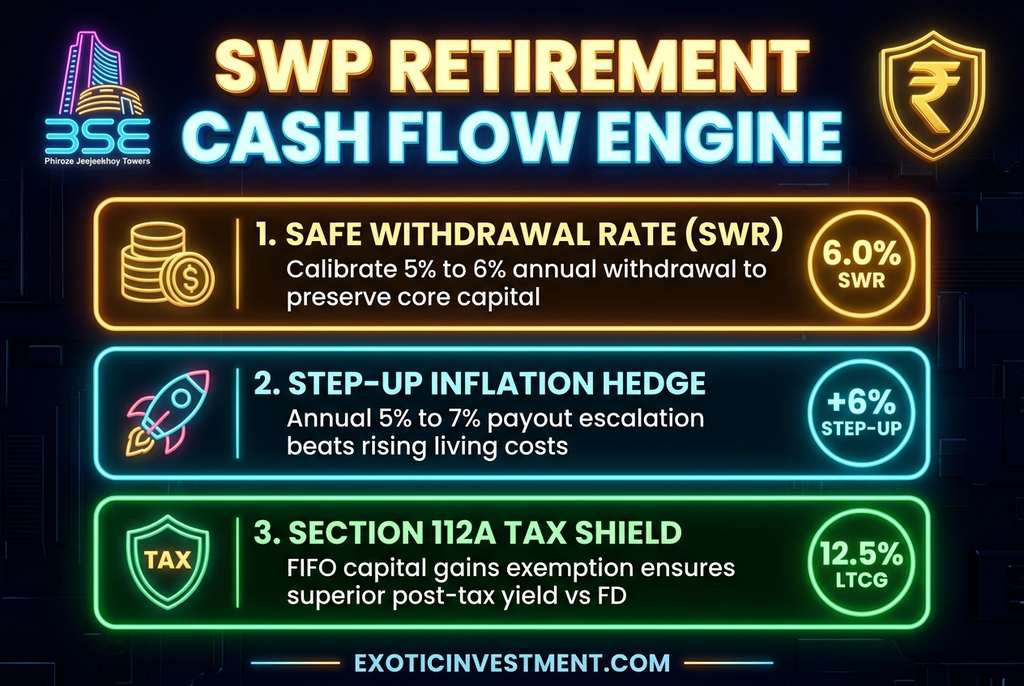
The single greatest flaw in conventional retirement planning is relying on a flat, non-increasing monthly payout. In an economy like India where headline retail inflation averages between 5% and 7% per annum, a fixed monthly payout of ₹50,000 today will lose more than 50% of its real purchasing power in just 12 years. By Year 20, that same ₹50,000 will buy what ₹15,500 buys today.

Our step-up SWP calculator solves this dilemma by introducing an annual percentage escalation. By configuring an annual escalation rate (for example, 5% or 6%), your withdrawal automatically increases at the end of every 12 months. This guarantees that your household standard of living remains constant regardless of escalating healthcare, grocery, or utility expenses.

The Safe Withdrawal Rate (SWR) Trinity Rule in India

In global financial planning, William Bengen’s famous 1994 “Trinity Study” established the 4% Safe Withdrawal Rate (SWR) rule: withdrawing 4% of your initial portfolio in Year 1 and adjusting for inflation each subsequent year gives your portfolio a 95%+ probability of surviving 30 years. In India, because long-term equity returns (12% to 14%) and domestic nominal GDP growth outpace Western markets, financial planners frequently utilize a 5% to 6% initial withdrawal rate when investing in diversified hybrid or flexicap equity mutual funds.
step up swp calculator

SWP vs Bank Fixed Deposit (FD) vs Senior Citizen Savings Scheme (SCSS)

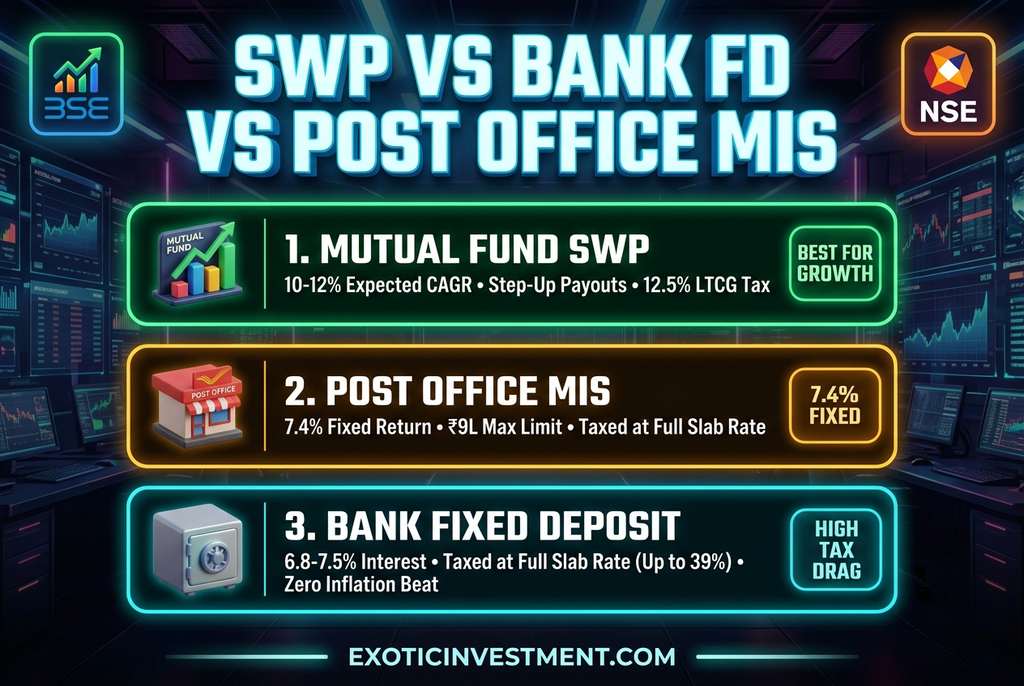
Indian retirees historically parked their lifetime savings in Bank Fixed Deposits, Post Office Monthly Income Schemes (POMIS), or SCSS. However, examining the post-tax cashflow reality reveals why SWP has emerged as the premier institutional cashflow vehicle:

Feature Mutual Fund SWP (Equity/Hybrid) Bank Fixed Deposit (Monthly Payout) Post Office MIS / SCSS
Capital Appreciation High (Residual corpus grows with market upside) Zero (Principal remains flat, eroded by inflation) Zero (Fixed principal returned at maturity)
Tax Drag on Monthly Payout Extremely Low (Only gains taxed, not capital) Heavy (100% of interest taxed at income slab) Heavy (100% of payout taxed at slab rate)
Tax Rate (Post-Budget 2024) 12.5% LTCG (> ₹1.25L annual exemption) Up to 30% + surcharge (Highest slab rate) Up to 30% + surcharge
Liquidity & Flexibility Instant (T+2 redemption, alter payout anytime) Penalties on premature liquidation Lock-in periods & premature closure fines

Post-Budget 2024 Mutual Fund Taxation on SWP Withdrawals

Following the Finance Act 2024 amendments effective July 23, 2024, mutual fund taxation operates under specific frameworks that make SWP uniquely advantageous:

  • First-In, First-Out (FIFO) Rule: When an SWP triggers a monthly redemption, fund houses redeem the oldest units first. Because each redeemed unit consists of both original principal and capital appreciation, only the profit portion attracts taxation—your principal return is 100% tax-free.
  • Equity-Oriented Funds: Long-term capital gains (holding period > 12 months) are taxed at 12.5% on aggregate gains exceeding ₹1.25 Lakh per financial year. In the initial years of an SWP, capital gains typically fall below this ₹1.25L annual threshold, rendering your monthly income virtually zero-tax.
  • Specified Debt Mutual Funds: Funds investing less than 35% in domestic equity purchased after April 1, 2023, are taxed at applicable income slab rates without indexation benefit.


📋 Regulatory References & Data Sources
  • AMFI (Association of Mutual Funds in India) — SIP return methodology
  • SEBI (Mutual Funds) Regulations 1996, as amended
  • Historical Nifty 50 CAGR data: NSE India, FY 1994-2026 (12% avg)

Disclaimer: This calculator is for educational and planning purposes only. It does not constitute financial advice. Consult a SEBI-registered investment advisor for personalised guidance. Tax rules are updated as per the latest Finance Act — verify with a qualified CA before filing.

Frequently Asked Questions — SWP Calculator

1. What is an SWP calculator and how is it used in retirement planning?
An SWP calculator is an analytical tool designed to forecast the monthly cashflow, remaining corpus, and longevity runway of a Systematic Withdrawal Plan. It models how much you can withdraw monthly from mutual funds while the remaining capital compounds. You can cross-verify your accumulation targets with our Retirement Corpus Calculator or simulate decentralized staking income via Emintage’s Crypto Staking Calculator.

2. How does an SWP calculator with inflation adjustment work?
An SWP calculator with inflation applies an annual compounding step-up percentage to your base monthly payout. If you withdraw ₹30,000 per month with a 6% annual step-up, Year 2 monthly payouts automatically increase to ₹31,800, Year 3 to ₹33,708, and so on. This maintains your standard of living against inflation, similar to how our Step-Up SIP Return Calculator compounds wealth dynamically.

3. Is SWP better than bank FD monthly interest payout for retirees?
Yes, SWP is substantially superior in two core dimensions: tax efficiency and inflation preservation. In a bank FD, 100% of interest earned is taxed annually at your marginal tax slab (up to 39%), and the principal never grows. In an SWP, only the capital gain portion of redeemed units is taxed at the concessional 12.5% LTCG rate after the ₹1.25L exemption, while the underlying corpus grows. Analyze your post-tax yields using our Income Tax Calculator.

4. How are SWP mutual fund withdrawals taxed after Budget 2024?
Under Finance Act 2024, withdrawals from equity mutual funds held for more than 12 months are subject to 12.5% Long-Term Capital Gains (LTCG) tax on net gains exceeding ₹1.25 Lakh per financial year. Each monthly SWP is treated as a partial redemption under Section 112A. For digital asset taxation rules, refer to our comprehensive guide or audit cross-border portfolios with Emintage’s Crypto Tax Calculator.

5. What is the recommended Safe Withdrawal Rate (SWR) in India?
While the classical American Trinity study recommends a 4% initial withdrawal rate, Indian equity returns of 11% to 13% allow a safe withdrawal rate between 5% and 6% per annum for a well-diversified portfolio. For instance, on a ₹1 Crore corpus, an initial withdrawal of ₹40,000 to ₹50,000 per month (4.8% to 6.0% annually) ensures high longevity without capital ruin. You can monitor portfolio drawdowns using our Value at Risk (VaR) Calculator.

6. Can my investment corpus last forever with an SWP?
Yes. If your annual withdrawal rate is lower than the net real rate of return generated by your mutual fund portfolio, your principal remains untouched while payouts are funded entirely from growth. In this scenario, known as a perpetual endowment, the corpus actually grows over time. Track multi-asset compounding curves with our Reverse CAGR Calculator or explore high-yield compounding models on Emintage Compounding Engine.

7. What is Sequence of Returns Risk (SRR) and how does it affect SWP?
Sequence of Returns Risk occurs when a market crash strikes in the initial 2 to 3 years of starting an SWP. Withdrawing fixed rupee amounts from a depressed corpus forces the fund manager to sell more units at rock-bottom prices, permanently impairing portfolio recovery. To mitigate SRR, smart retirees maintain a 2-year cash or liquid fund buffer and periodically rebalance using our Portfolio Rebalancing Calculator.

8. Which mutual fund category is best suited for an SWP?
Conservative Hybrid Funds, Balanced Advantage Funds (BAFs), and Multi-Asset Allocation Funds are universally considered ideal for SWPs because dynamic asset allocation between equity, debt, and arbitrage shields capital during volatility. Pure large-cap or flexicap funds are suitable for long horizons (>15 years) where higher drawdown tolerance exists. Compare historical risk-adjusted metrics using our Beta Calculation Tool.

9. How do I track and rebalance multi-asset portfolios during retirement?
Retirees should perform an annual audit of asset allocation, trimming overweight equities following bull runs and refilling the 2-year debt liquid buffer. If you hold digital tokens alongside domestic equities, manage your global exposure holistically using Emintage’s Institutional Portfolio Tracker alongside Exotic Investment’s automated equity desk tools.

10. Can I modify, pause, or cancel my SWP at any time?
Yes. Unlike life insurance pension annuities or bank fixed deposits that enforce severe surrender penalties, an SWP offers 100% liquidity. You can increase or decrease your withdrawal amount, pause payouts during market corrections, or redeem the entire remaining balance online with zero penalty through your AMC or demat broker. To audit brokerage or transaction costs on listed transactions, check our Indian Stock Brokerage Calculator.


AR
Written & Verified By

Dr.Ashok Kumar N Rao

Stock Market Educator & Author | 3,500+ Students Trained

Alternative Investments advisor and author of 'Basics of Stock Market for Beginners' and 'ಕಲಿಯಿರಿ ಶೇರ್ ಮಾರ್ಕೆಟ್'. All financial tools and content on this site are reviewed personally before publication.