Optimize multi-asset allocations (Large Cap, Mid Cap, Debt, Gold) with exact buy/sell trade quantities and Indian capital gains tax impact modeling.
Asset Allocation & Trade Generator
Unlock Tax-Aware Rebalancing Pro
Access threshold drift triggers, automated loss-harvesting trade matches, multi-year glide path models, and printable trade order sheets.
How It Works in 4 Steps
Select Asset Model
Choose an institutional preset (Aggressive 70/20/10, Balanced 50/30/20, Conservative) or create a custom model.
Enter Current Holdings
Input your current investment value across domestic equity, debt, international equity, and sovereign gold.
Choose Rebalancing Strategy
Select Sell & Buy to rebalance instantly, or Cash Flow Only to route fresh SIP capital without incurring taxable sales.
Analyze Tax & Execute
Review exact net adjustments, estimated LTCG/STCG tax friction, and generate an actionable trade execution plan.
Institutional Portfolio Rebalancing: Preserving Risk-Adjusted Alpha
Portfolio Rebalancing is the systematic discipline of realigning asset class weightings that have drifted due to unequal market returns. Without periodic rebalancing, an initial 60% equity / 40% debt portfolio can effortlessly balloon into an 85% equity portfolio during sustained bull markets, exposing investors to catastrophic drawdowns right before retirement.
1. Calendar vs Band-Based (Threshold) Rebalancing
While calendar rebalancing triggers trades at fixed annual or semi-annual intervals, institutional desks favor tolerance band rebalancing (e.g. ±5% deviation). This prevents unnecessary churning during low-volatility regimes and captures tactical buy/sell opportunities during sharp market dislocations.
2. Minimizing Indian Capital Gains Tax Friction
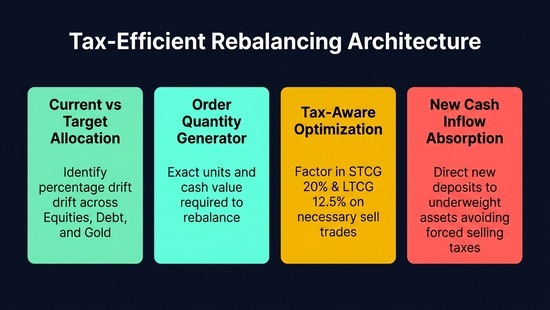
Selling appreciated equity units triggers Long-Term Capital Gains (LTCG at 12.5% beyond the ₹1.25 Lakh exemption) or Short-Term Capital Gains (STCG at 20%). Smart investors utilize Cash Flow Rebalancing: directing fresh monthly SIP surpluses exclusively into lagging asset classes, restoring target weights without selling a single rupee of winners.
3. Modern Portfolio Theory (MPT) in Practice
Rebalancing forces you to systematically sell high (trim outperforming assets) and buy low (accumulate underperforming assets with mean-reversion potential), mathematically boosting risk-adjusted Sharpe ratios over 10-year horizons.
📋 Regulatory References & Data Sources
- SEBI risk management framework guidelines
- Reserve Bank of India (RBI) financial market benchmark data
- Income Tax Department of India rules & circulars
Disclaimer: This calculator is for educational and planning purposes only. It does not constitute financial advice. Consult a SEBI-registered investment advisor for personalised guidance. Tax rules are updated as per the latest Finance Act — verify with a qualified CA before filing.
Explore Related Risk & Allocation Engines
Markowitz Efficient Frontier
Compute optimal portfolio asset weights along the institutional risk-return frontier.
Monte Carlo Simulator
Simulate 1,000+ geometric Brownian motion paths to stress-test your portfolio lifespan.
Value at Risk (VaR) & CVaR
Quantify maximum drawdown risk and tail-loss vulnerability across Parametric and Historical VaR.