Income Tax Calculator Old and New Regime

Income Tax Calculator Old and New Regime (FY 2026-27 & FY 2025-26)

Compare tax liabilities under Section 115BAC New Tax Regime vs Old Tax Regime with updated ₹75,000 standard deduction, Section 87A rebate thresholds up to ₹12.75 Lakhs, slab-by-slab breakdown, and investment breakeven analysis.

TAX ENGINE FY 2026-27 & 2025-26
Budget 2025 Revised Slabs • Sec 115BAC Real-Time Slab Breakeven Engine ↓

Annual Earnings & Deductions

Select a preset profile below or enter custom salary details
₹10 Lakhs ₹12 Lakhs ₹12.75L (Zero Tax) ₹13 Lakhs ₹15 Lakhs ₹25 Lakhs ₹50 Lakhs
1. Tax Year & Age Category
2. Gross Earnings
3. Deductions & Exemptions (Chapter VI-A)
RECOMMENDED REGIME

NEW TAX REGIME

₹1,87,200
Annual Savings Over Old Regime
Old Regime Tax
₹1,87,200
New Regime Tax
₹0
Standard Deduction: ₹50,000 (Old) vs ₹75,000 (New)
Effective Tax Rate: 14.68% vs 0.00%
Breakeven Deductions (Pro): 🔒 UNLOCK PRO
Monthly Take-Home Salary (Pro): 🔒 UNLOCK PRO
👉 You pay ₹0 tax under the New Tax Regime thanks to the enhanced ₹75,000 standard deduction and ₹60,000 Section 87A rebate for income up to ₹12.75 Lakhs!
Share Analysis to WhatsApp 📲

⚡ How the Old vs New Tax Regime Calculator Works

1

Enter Gross Earnings

First, input your annual salary and other taxable incomes. As a result, the engine establishes your baseline gross earnings before deductions.

2

Declare Eligible Deductions

Next, enter Section 80C, 80D health insurance, home loan interest, and NPS. Consequently, the tool calculates total deductions applicable to the Old Regime.

3

Apply Standard Deductions & Slabs

After that, the algorithm applies ₹75,000 standard deduction for the New Regime and ₹50,000 for the Old Regime across revised tax brackets (0–4L nil, 4–8L 5%, 8–12L 10%, up to 30%).

4

Compare Net Tax & Breakeven

Finally, review net tax liability under both regimes, verify Section 87A rebate eligibility (up to ₹60,000), and identify the exact breakeven deduction tipping point.

🎓 Master Stock Market Basics & Trade Planning!

Want to master technical analysis, spot breakouts, and manage portfolio taxes? Enroll in our top-rated stock market basics course today!

🎓 ENROLL IN BASICS OF STOCK MARKET COURSE NOW 🚀

Old vs New Tax Regime: Key Differences for FY 2026-27 & FY 2025-26

Choosing between the Old Tax Regime and the revised New Tax Regime under Section 115BAC is one of the most critical financial planning decisions for Indian taxpayers. With the revised slabs under Finance Act 2025 (retained for FY 2026-27), the Central Government has sweetened the New Tax Regime with an enhanced ₹75,000 Standard Deduction, widened brackets (0–4L nil, 4–8L 5%, 8–12L 10%, 12–16L 15%, 16–20L 20%, 20–24L 25%, >24L 30%), and a massive Section 87A rebate making income up to ₹12 Lakhs (₹12.75 Lakhs for salaried individuals) completely tax-free.
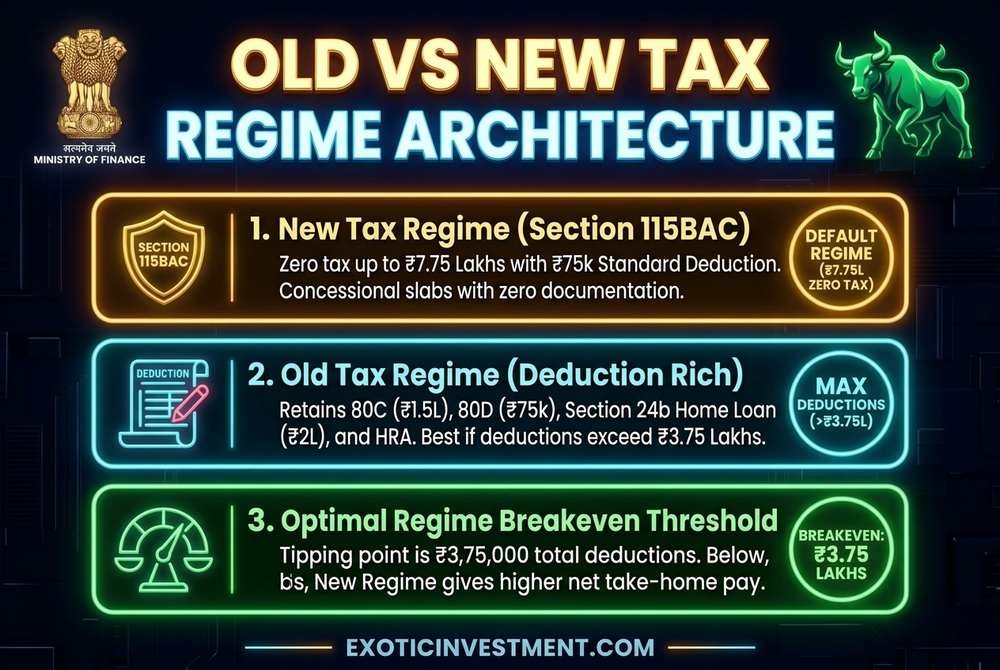
old vs new tax regime comparison

3-Card Breakdown: Income Slabs, Standard Deductions & Breakeven Tipping Points under Budget 2024

1. The Zero-Tax Threshold: ₹12.75 Lakhs for Salaried Employees

Under the New Tax Regime, Section 87A provides a full tax rebate of up to ₹60,000 for taxable income up to ₹12,00,000. When combined with the enhanced standard deduction of ₹75,000 under Section 16(ia), a salaried employee with a gross total income of up to ₹12,75,000 pays absolutely zero income tax. In contrast, under the Old Regime, the zero-tax threshold remains capped at ₹5,50,000 (₹5,00,000 taxable income after ₹50,000 standard deduction).

2. Breakeven Deduction Tipping Points

Whether you should opt for the Old Regime depends entirely on your total Chapter VI-A deductions (Section 80C, 80D, Section 24(b) home loan interest, NPS under 80CCD(1B), and HRA exemption):

  • Gross Income up to ₹12.75 Lakhs: The New Tax Regime is automatically superior because your tax liability is ₹0 with zero locked-in investments.
  • Gross Income at ₹15 Lakhs: The breakeven point is ₹5,43,750 of deductions (excluding standard deduction). If your combined eligible deductions exceed ₹5.44 Lakhs, the Old Regime delivers lower tax liability; otherwise, the New Regime wins hands down.
  • Gross Income at ₹25 Lakhs and above: The breakeven point climbs to ₹8,00,000 of deductions. Unless you have massive home loan interest, HRA, and medical expenses, the New Regime saves over ₹1.24 Lakhs annually.

3. High Net-Worth Individuals (HNIs) & Surcharge Cap

For affluent taxpayers earning over ₹2 Crore, the New Tax Regime caps the maximum surcharge rate at 25%, bringing the peak effective tax rate down to 39% (compared to 42.74% under the Old Regime with its 37% surcharge on incomes exceeding ₹5 Crore). Model your portfolio rebalancing and surcharge drag with our Portfolio Rebalancing Calculator.

Old Regime vs New Regime: Comprehensive Feature Comparison

👉 Swipe horizontally for Strategic Advantages →
Feature / Parameter Old Tax Regime New Tax Regime (Sec 115BAC) Strategic Advantage
Standard Deduction ₹50,000 ₹75,000 (Enhanced Standard Deduction) New Regime provides an additional ₹25,000 tax-free buffer.
Zero-Tax Threshold ₹5,50,000 Gross ₹12,75,000 Gross Salaried earners up to ₹12.75L pay zero income tax under New Regime.
Tax Slabs 0-2.5L Nil
2.5-5L 5%
5-10L 20%
>10L 30%
0-4L Nil
4-8L 5%
8-12L 10%
12-16L 15%
16-20L 20%
20-24L 25%
>24L 30%
New Regime features progressive 5% increments across 7 brackets.
Sec 87A Rebate Up to ₹12,500 (Income ≤ ₹5L) Up to ₹60,000 (Income ≤ ₹12L) Full tax immunity for taxable income up to ₹12 Lakhs under New Regime.
Section 80C & 80D Allowed (Up to ₹2.5 Lakhs) Not Allowed Old Regime rewards high insurance, EPF, and PPF allocations.
Home Loan Interest 24(b) Deduction up to ₹2,00,000 Not Allowed (Self-Occupied) Homeowners with heavy EMIs often save significantly under Old Regime.
Peak Surcharge Rate 37% (> ₹5 Crore) Capped at 25% High-income earners enjoy a 3.74% lower peak effective tax bracket.
Default Tax System Optional (Must opt in) Default Regime New Regime applies automatically unless explicitly opted out in ITR.

📋 Regulatory References & Data Sources
  • Income Tax Act 1961, Proviso to Section 2(1)(a) — Statutory Marginal Relief on Surcharge
  • Finance Act 2024 — Surcharge slabs for FY 2024-25 / AY 2025-26 under Section 115BAC
  • Central Board of Direct Taxes (CBDT) Circular No. 04/2024 on TDS and surcharge thresholds
  • Income Tax Department of India Notification on Section 87A rebate and surcharge parity
  • Proviso to Section 115BAC(1A) — marginal relief under the new tax regime

Disclaimer: This calculator is for educational and planning purposes only. It does not constitute financial advice. Consult a SEBI-registered investment advisor for personalised guidance. Tax rules are updated as per the latest Finance Act — verify with a qualified CA before filing.

💡 Frequently Asked Questions (FAQs)

What is the standard deduction for salaried individuals in FY 2025-26 and FY 2026-27?

Under the New Tax Regime (Section 115BAC), the Standard Deduction is ₹75,000 for salaried employees and pensioners. Under the Old Tax Regime, the Standard Deduction remains ₹50,000. Under the Old Tax Regime, the Standard Deduction remains unchanged at ₹50,000. Check equity profit taxation on our Capital Gains Tax India Calculator.

How does the Section 87A rebate work under the New Tax Regime?

Under Section 87A of the Income Tax Act, resident individuals with total taxable income up to ₹12,00,000 receive a tax rebate of up to ₹60,000 under the New Tax Regime, reducing tax payable to zero. After factoring in the ₹75,000 standard deduction, salaried professionals earning up to ₹12,75,000 pay zero income tax. Plan your compounding returns on our SIP Wealth Calculator.

What is marginal relief under Section 87A for income slightly above ₹12 Lakhs?

Marginal relief prevents unfair tax jumps where earning a few extra thousand rupees triggers massive tax bills. Under Section 115BAC(1A), if your taxable income marginally exceeds ₹12,00,000 (up to ₹12,70,588 taxable, or ₹13,45,588 gross for salaried), the tax payable is legally capped so that it cannot exceed the amount by which your income exceeds ₹12,00,000. Audit trade profitability on our Indian Stock Brokerage Calculator.

What are the revised tax slabs under the New Tax Regime for FY 2025-26 & FY 2026-27?

Under the revised New Tax Regime, the income tax slabs are: ₹0 to ₹4,00,000 (Nil), ₹4,00,001 to ₹8,00,000 (5%), ₹8,00,001 to ₹12,00,000 (10%), ₹12,00,001 to ₹16,00,000 (15%), ₹16,00,001 to ₹20,00,000 (20%), ₹20,00,01 to ₹24,00,000 (25%), and Above ₹24,00,000 (30%). Evaluate portfolio growth targets using our Reverse CAGR Calculator.

What is the exact breakeven deduction needed to make the Old Regime better?

Under the current slabs, for an annual gross salary of ₹15 Lakhs, the breakeven deduction threshold is ₹5,43,750 (excluding standard deduction). For ₹25 Lakhs gross income, the breakeven threshold rises to ₹8,00,000 of deductions. If your combined eligible deductions exceed these thresholds, the Old Regime saves tax; otherwise, the New Regime is significantly superior. For trading turnover audits, use our F&O Turnover Calculator.

Can salaried individuals switch between Old and New Regimes every year?

Yes. Salaried employees with income only from salary, house property, capital gains, and other sources (no business or professional income) have the flexibility to switch between the Old Regime and New Regime every financial year when filing their Income Tax Return (ITR-1 or ITR-2) under Section 139(1). Track realized portfolio returns using our Stock Portfolio XIRR Calculator.

Can business owners and derivative traders switch regimes every year?

No. Individuals with business or professional income (including F&O trading income reported under PGBP) can only opt out of the New Regime once in a lifetime by filing Form 10-IEA. Once they opt back into the New Regime in any future year, they cannot return to the Old Regime unless their business income ceases completely. Check derivative capital limits on our NSE F&O Margin Calculator.

How does the New Tax Regime impact high-net-worth individuals earning over ₹2 Crore?

Under the Old Tax Regime, incomes exceeding ₹5 Crore attract a punitive surcharge of 37%, pushing the peak effective tax rate to 42.74%. Under the New Tax Regime, the maximum surcharge is capped at 25%, lowering the peak tax rate to 39.00%. This provides significant annual tax relief for high-bracket investors. Measure downside equity tail risks with our Value at Risk (VaR) Calculator.

Are cryptocurrency profits and staking rewards eligible for regime deductions?

No. Under Section 115BBH of the Income Tax Act, Virtual Digital Assets (VDAs) including cryptocurrencies and NFTs are taxed at a flat 30% plus 4% cess. No deductions (other than cost of acquisition) or basic exemption set-offs are permitted under either regime. To calculate international crypto tax liabilities, explore Emintage’s Crypto Tax Calculator.

Can I claim HRA exemption under the New Tax Regime?

No. House Rent Allowance (HRA) exemption under Section 10(13A) is not available under the New Tax Regime. If you pay significant house rent in metro cities (50% of basic) and claim HRA alongside Section 80C and 80D, the Old Regime frequently delivers lower tax liability than the New Regime. Review asset allocation strategies with our Markowitz Efficient Frontier Calculator.
AR
Written & Verified By

Dr.Ashok Kumar N Rao

Stock Market Educator & Author | 3,500+ Students Trained

Alternative Investments advisor and author of 'Basics of Stock Market for Beginners' and 'ಕಲಿಯಿರಿ ಶೇರ್ ಮಾರ್ಕೆಟ್'. All financial tools and content on this site are reviewed personally before publication.