
Stepping onto Dalal Street without understanding stock market terms in india is like driving on the Bengaluru-Mysuru expressway without knowing highway traffic signs. Every trading session, crores of rupees change hands through flashing order books, blinking tickers, and cryptic three-letter acronyms. In fact, if you cannot distinguish your LTP from your CMP, or your CNC delivery trades from your MIS intraday bets, you risk making catastrophic execution errors.
Listen, boss, the stock market has its own specialized language developed over decades of electronic trading. When brokers announce margin calls, circuit breakers, or corporate dividends, you must know instantly how your capital is impacted. Therefore, mastering foundational share market terminology gives you the confidence to read broker screens like a seasoned market professional.
In this complete mentor handbook, our research desk breaks down essential share market terms with crystal clarity, explaining order types, price quotes, and settlement mechanics. Before taking live market positions, learning how to pick momentum setups in our guide to how to choose stocks for swing trading gives you an immediate analytical edge. In addition, knowing your statutory costs ensures you keep more of your realized gains.
Core Price Discovery Terms: CMP, LTP, Bid, and Ask
When you look at a stock quote on Zerodha Kite or Groww at 9:15 AM, multiple price fields update simultaneously. Specifically, the Last Traded Price (LTP) represents the exact price at which the most recent transaction was completed between a buyer and a seller. In contrast, the Current Market Price (CMP) is the broader quote summarizing prevailing market levels.
In addition, order execution depends entirely on the Bid and Ask spread in the market depth window. For instance, the Bid represents the highest price buyers are currently willing to pay, while the Ask (or Offer) represents the lowest price sellers are willing to accept. Consequently, when you execute a market order, you immediately buy at the Ask price and sell at the Bid price.
A classic Kannada proverb wisely reminds us: “ಅಕ್ಷರ ಕಲಿತವನು ಜಗತ್ತನ್ನೇ ಗೆಲ್ಲುತ್ತಾನೆ” (Akshara kalithavanu jagathhanne gelluthane — one who masters the alphabet conquers the entire world). Similarly, the trader who masters market vocabulary conquers the complexities of Dalal Street without fear. Therefore, spending time to study core financial definitions is the smartest investment a beginner can make.
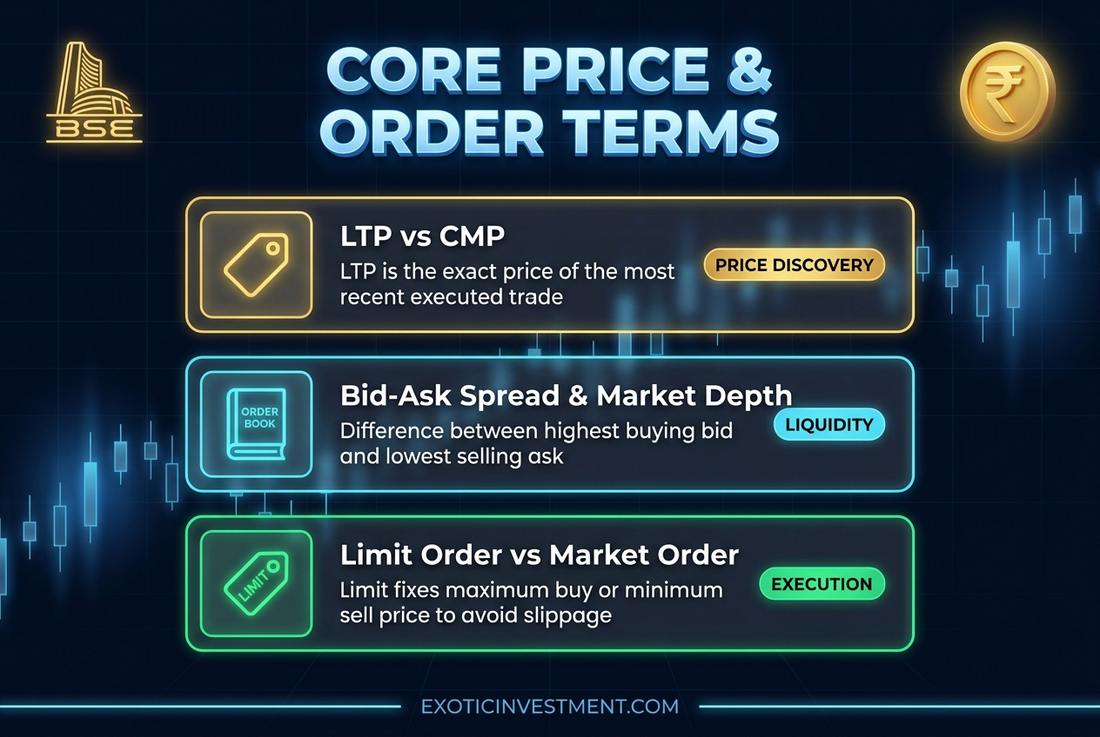
Illustration: Core Price Discovery and Order Execution Terms in the Indian Stock Market
Order Types Explained: Market, Limit, SL, and SL-M
Entering trades requires selecting the correct order type to avoid unexpected execution slippage. First, a Market Order instructs the exchange to execute your purchase immediately at the prevailing market price, which can cause severe price slippage during high volatility. Second, a Limit Order allows you to specify the maximum price you are willing to pay, ensuring you never buy above your planned level.
Third, a Stop-Loss (SL) Order acts as your automatic capital shield by remaining dormant until a pre-determined trigger price is breached. Once triggered, it converts into a limit order to exit your trade at your designated safety price. In addition, you can calculate exact position sizing and risk parameters using our free position size calculator.
In addition, traders executing breakouts can study chart setups in our guide to price action trading strategies. In addition, you can verify net realized profits after all exchange fees using our stock profit calculator. Therefore, selecting the appropriate order type ensures you enter and exit trades with institutional precision.
| Stock Market Term | Full Form / Category | Practical Market Definition | Trader Takeaway |
|---|---|---|---|
| CNC | Cash and Carry | Delivery equity purchase held in your Demat account | Zero auto square-off |
| MIS | Margin Intraday Square-off | Intraday order requiring closure before 3:15 PM | Auto square-off applies |
| LTP | Last Traded Price | The exact price of the most recent exchange match | Live price marker |
| T+1 | Trade Plus 1 Day | Indian settlement cycle for delivery share transfers | Next-day demat credit |
| STT | Securities Transaction Tax | Statutory direct tax levied on all exchange trades | Non-deductible on delivery |
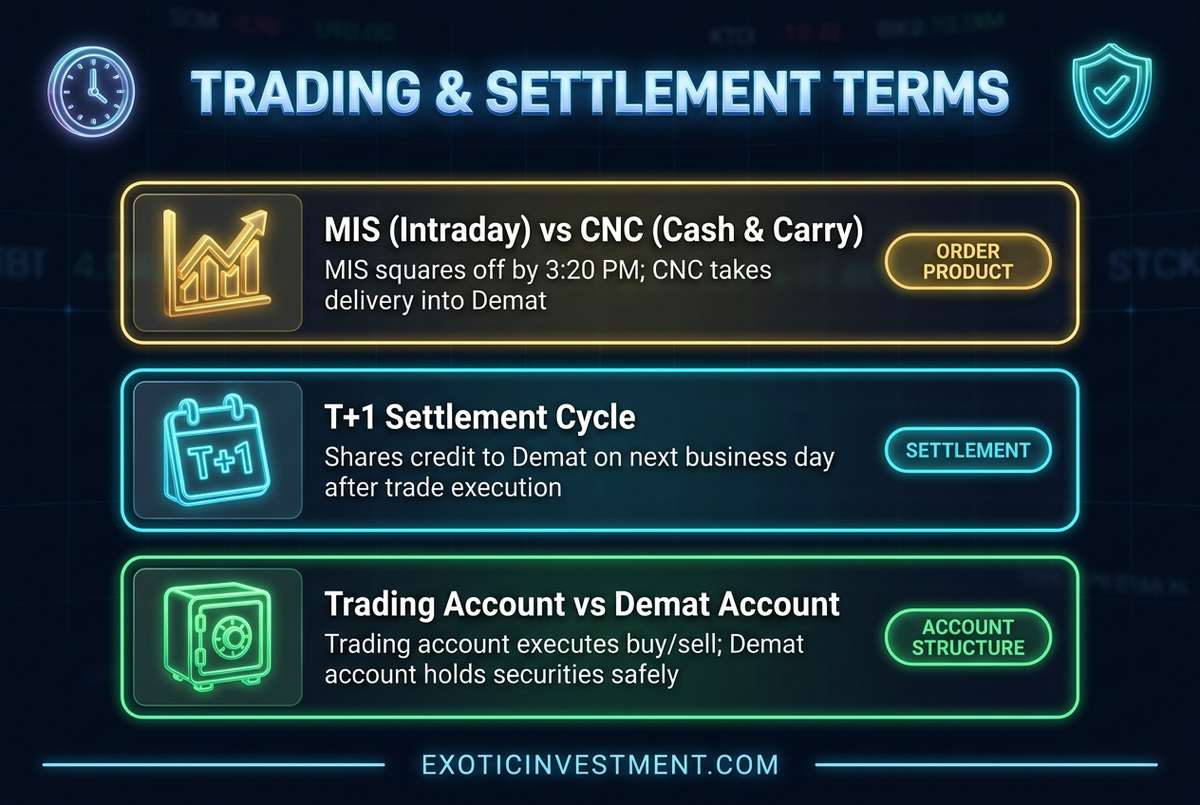
Illustration: Broker Product Codes: CNC vs MIS vs NRML Trade Mechanics
Product Codes Demystified: CNC vs MIS vs NRML
When placing an order on Indian discount brokers, you must select a product code. Specifically, selecting CNC (Cash and Carry) tells your broker to buy delivery shares that will be credited to your Demat account on a T+1 basis. In contrast, selecting MIS (Margin Intraday Square-off) flags the order for intraday trading, which will be forcefully closed by your broker around 3:15 PM if you do not exit manually.
For derivatives trading, the NRML (Normal) code is used for overnight Futures and Options positions. In addition, you must maintain 100% upfront margin compliance as mandated by market regulators. Review full peak margin guidelines in our breakdown of sebi margin rules in india.
To evaluate trading costs across different product codes, compare broker fees using our zerodha brokerage calculator and upstox brokerage calculator. Similarly, commodity traders can check margin limits with our mcx margin calculator. Consequently, picking the proper product code ensures your trades are never squared off unexpectedly.
🚀 Master Stock Market Foundations & Technical Analysis
Stop feeling confused by complicated stock market jargon. Learn how to read order depth, analyze financial statements, and execute high-probability setups with complete clarity. Join over 1,300+ successful traders who learn directly from Dr. Ashok Kumar N Rao.
- Master wealth compounding and share market foundations with our bestselling book Kaliyiri Share Market Book and our English handbook Basics of Indian Stock Market Book.
- Accelerate your portfolio returns with institutional stock screeners and quantitative analytics through the MultiBagger Plus Courses & Pro Tools Annual Subscription.
- Master chart analysis and breakout triggers by studying our structured Technical Analysis Course in Kannada or options mechanics in our Options Buying Course in Kannada.
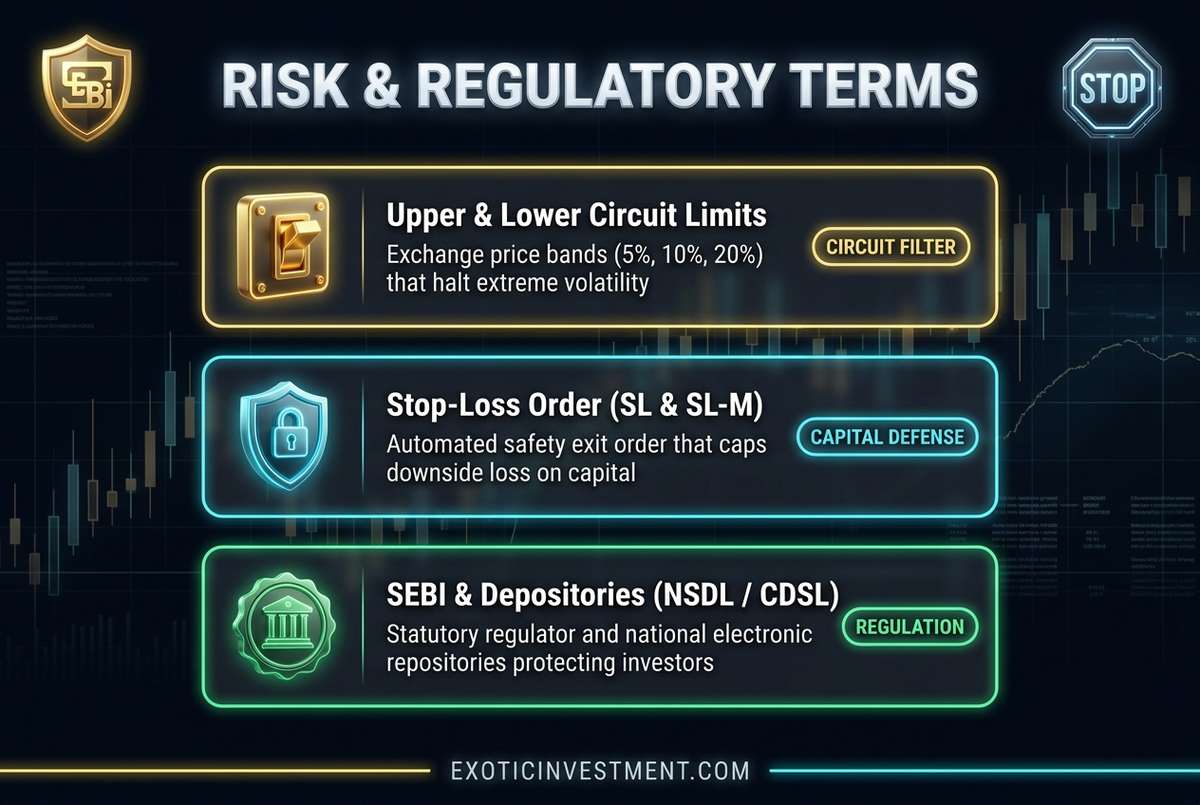
Illustration: Exchange Settlement Timeline, Circuit Filters, and Corporate Actions
Settlement Cycles, Circuit Filters, and Corporate Actions
India is a global pioneer in exchange infrastructure, operating on a lightning-fast T+1 rolling settlement cycle. Specifically, when you buy delivery shares on Monday, the shares are delivered directly into your Demat account by Tuesday evening. In addition, when you sell shares, 80% of sales proceeds are credited immediately, with the remaining 20% released on the next settlement day.
In addition, exchanges enforce circuit breaker limits to prevent runaway panic selling or artificial manipulation. For instance, individual stocks have daily price bands of 5%, 10%, or 20%, while index circuit breakers halt entire market trading when breached. In addition, learn how circuit limits protect investors in our breakdown of upper and lower circuit limits.
When tracking your portfolio performance over multi-year horizons, measure returns using geometric metrics rather than simple averages. For instance, explore the mathematics of compounding in our guide to how to calculate cagr in stocks or review high-yielding stalwarts in our guide on dividend yield stocks in india. Therefore, mastering settlement mechanics and compounding metrics establishes true financial independence.
💡 Frequently Asked Questions
1. What is the difference between Demat and Trading accounts in India?
A Trading account is used to buy and sell securities on the exchange, acting as the transactional vehicle. In contrast, a Demat account is an electronic vault (managed by NSDL or CDSL) where your actual share certificates and mutual fund units are safely held. Master risk allocation with our risk to reward ratio guide.
2. What happens if an MIS intraday trade is not closed before 3:15 PM?
If you do not close an open MIS intraday order, your broker’s risk management software will automatically trigger an auto square-off at market price. In addition, brokers charge an automated square-off penalty fee of ₹50 plus GST per executed order. Review automated execution rules in our guide to algorithmic trading in india.
3. How does the T+1 settlement cycle benefit Indian retail investors?
The T+1 cycle ensures that shares and funds are settled within 24 hours of trade execution. Consequently, this rapid turnaround slashes counterparty risk and allows investors to redeploy capital faster than older T+2 or T+3 systems. Explore long-term wealth compounding with our step up sip guide.
4. What is the difference between Dividend Yield and Dividend Payout?
Dividend Yield measures the annual dividend payout divided by the stock’s current market price, expressed as a percentage. In contrast, Dividend Payout ratio represents the percentage of net corporate earnings distributed to shareholders as dividends. Learn more about high-yielding stalwarts in our guide on dividend yield stocks in india.
5. How are capital gains taxed when holding delivery CNC shares?
Delivery shares sold within 365 days are taxed at 20% STCG, while shares held for more than 12 months qualify for 12.5% LTCG with an annual ₹1.25 Lakh tax-free exemption. Review complete filing requirements in our guide to stock market profit taxation in india.