
Listen closely, retail participants on Dalal Street frequently search for the amul share price hoping to spot an early multibagger consumer stock. In reality, you cannot purchase equity shares in Amul on either the National Stock Exchange (NSE) or the Bombay Stock Exchange (BSE). Therefore, understanding why this dairy giant remains unlisted will protect you from widespread gray market misinformation.
Desk Note from Dr. Ashok Kumar N Rao:
Our trading desk regularly monitors retail queries regarding unlisted consumer monopolies. Because cooperative bylaws prohibit external equity capital, Amul does not have public shares, ticker symbols, or daily market quotations. Always verify exchange registrations on official exchange portals before committing capital to rumored pre-IPO allotments.
Every single day, thousands of beginner investors look up trading terminals expecting to find Amul trading alongside FMCG giants like Hindustan Unilever and Nestlé India. However, Amul represents an apex cooperative model rather than a joint-stock corporation owned by external shareholders. Because of this structure, all operational profits flow back directly to milk farmers rather than equity investors through quarterly dividends.
Core Business Divisions and the GCMMF Structure
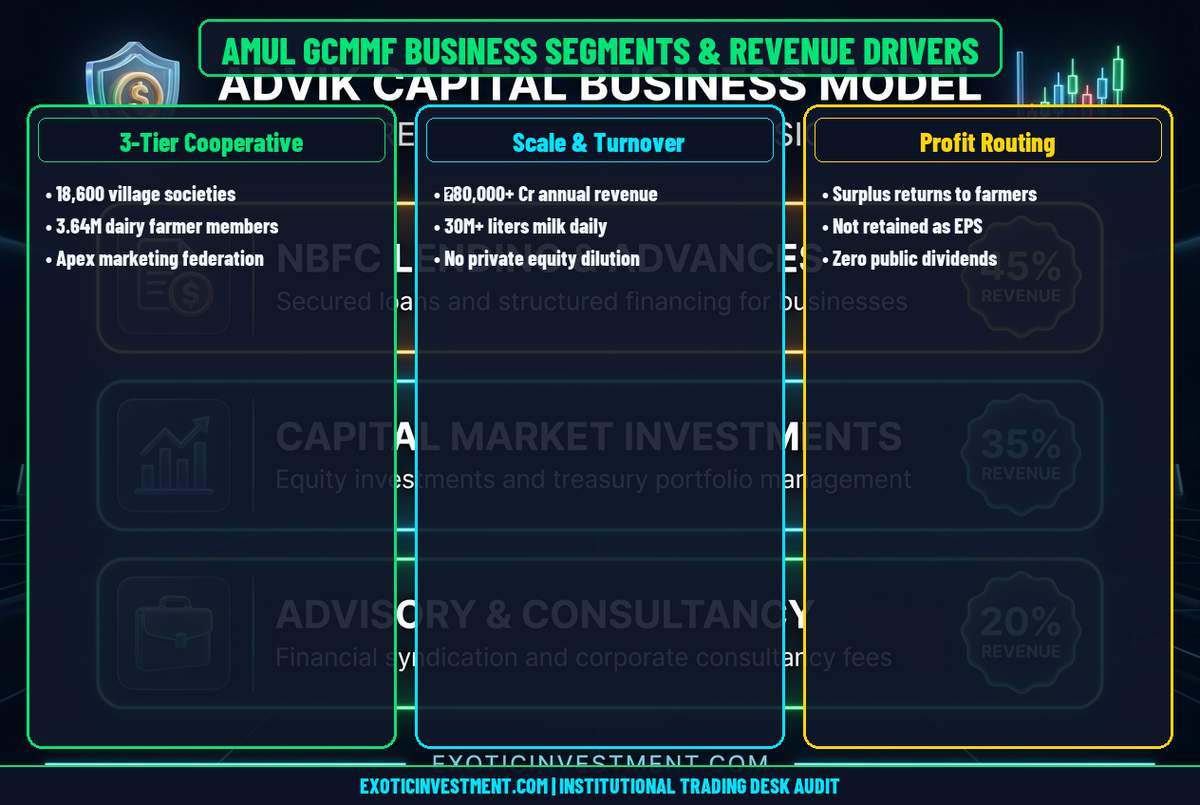
To understand why no stock price exists, one must examine the Gujarat Cooperative Milk Marketing Federation (GCMMF). Specifically, GCMMF operates as a three-tier cooperative structure spanning 18,600 village milk societies and more than 3.6 million farmer members across Gujarat. In addition, this network procures over thirty million liters of fresh milk daily to manufacture butter, cheese, ice cream, and liquid milk.
During the latest fiscal year, GCMMF recorded a staggering group turnover exceeding eighty thousand crore rupees across domestic and export markets. Nevertheless, this massive commercial scale does not translate into publicly tradable earnings per share on Dalal Street. Consequently, institutional funds seeking exposure to Indian dairy consumption must look toward alternative listed competitors.
Before allocating funds to any consumer brand, serious investors track risk metrics using an Indian stock brokerage calculator to evaluate real net transaction expenses. Similarly, disciplined position sizing requires calculating realistic risk-reward ratios rather than following social media IPO rumors.
Listing Status and Debunking Pre-IPO Share Scams
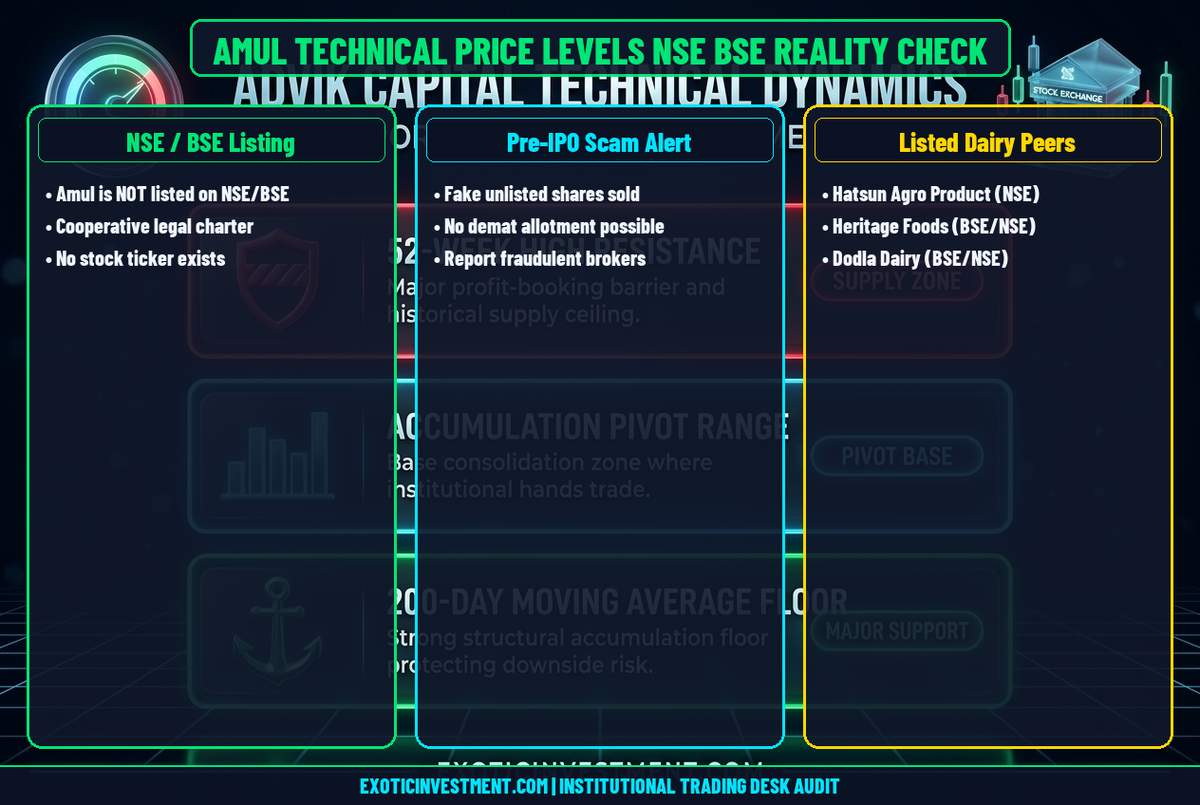
Unscrupulous gray-market brokers frequently circulate fraudulent claims offering pre-IPO allocations or unlisted shares in Amul. Clearly, these offerings are absolute scams because cooperative societies registered under the Gujarat Cooperative Societies Act cannot legally issue tradable equity shares. In reality, SEBI regulations strictly prohibit unapproved share offerings from non-corporate entities.
If anyone contacts you offering private equity placements or demat transfers for Amul, immediately reject and report those solicitations. In addition, you can verify corporate registration filings directly on the Ministry of Corporate Affairs portal. Genuine wealth creation on Dalal Street comes from analyzing transparent listed companies with audited quarterly financial disclosures.
Traders eager to master proper valuation methods should enroll in our structured Basics of Stock Market Course to distinguish between legal joint-stock companies and cooperative enterprises. In addition, reading our authoritative Kaliyiri Share Market Book provides essential frameworks for identifying legitimate Dalal Street growth compounders.
| Enterprise / Brand | Exchange Listing | Corporate Structure | Investor Exposure Route |
|---|---|---|---|
| GCMMF (Amul) | Unlisted (No Ticker) | Cooperative Federation | Zero public equity access |
| Hatsun Agro Product | NSE / BSE Listed (HATSUN) | Public Limited Company | Direct secondary market shares |
| Heritage Foods | NSE / BSE Listed (HERITAGEFOOD) | Public Limited Company | Direct secondary market shares |
| Dodla Dairy | NSE / BSE Listed (DODLA) | Public Limited Company | Direct secondary market shares |
Dairy Sector Investment and Risk Management Rules
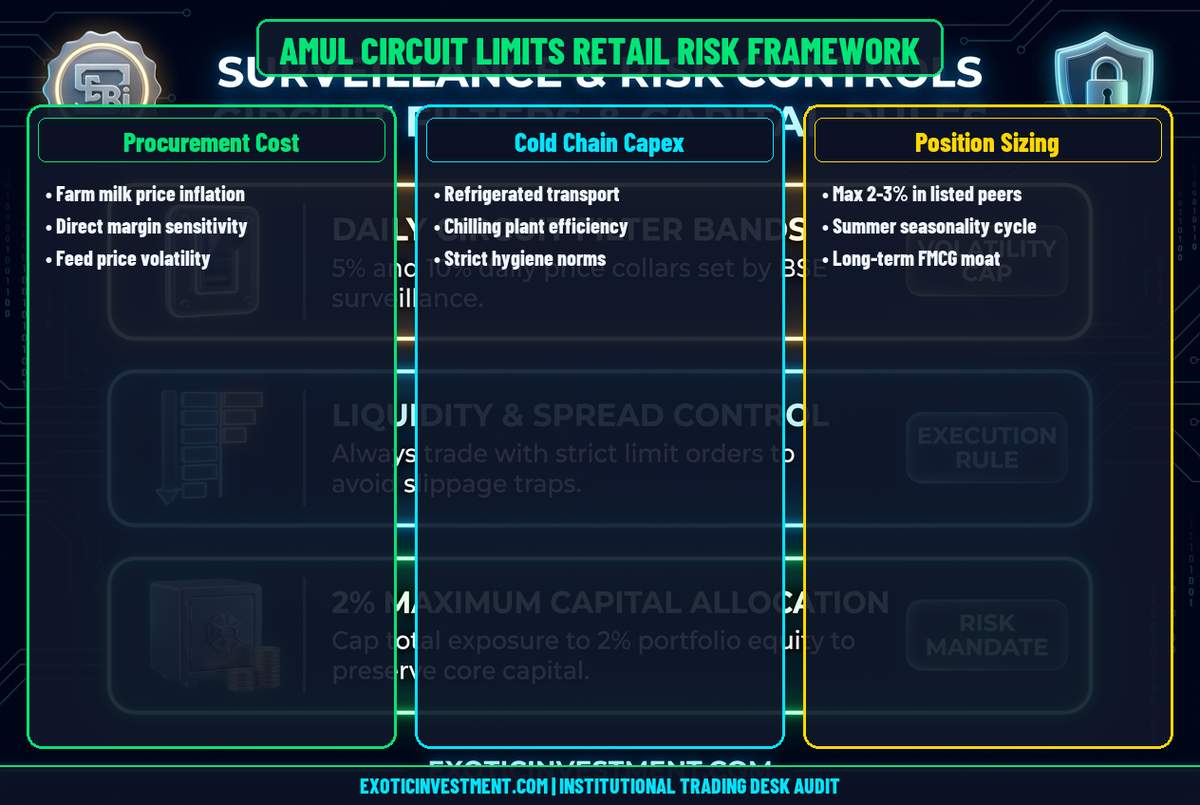
If you want to capitalize on rising per-capita dairy demand across urban and rural India, you must study genuine listed dairy producers. For instance, companies like Hatsun Agro Product, Heritage Foods, and Dodla Dairy provide liquid equity exposure on national exchanges. In addition, these enterprises publish regular balance sheets showing raw milk procurement costs, cold-chain logistics expenses, and value-added product margins.
However, dairy stocks face distinct business risks including seasonal milk flush cycles, cattle feed inflation, and regional procurement pricing competition. Because raw milk remains highly perishable, processing efficiency and cold-chain infrastructure directly determine operating margins. Therefore, seasoned traders monitor quarterly operating margins closely using our interactive stock profit calculator before executing delivery trades.
When constructing a long-term FMCG portfolio, never allocate more than three to four percent of total capital to single dairy counters. Instead, diversify across broader consumer staples and monitor your overall asset weighting inside the eMintage portfolio tracker. Consequently, your wealth remains protected against unexpected commodity swings or regional supply disruptions.
Actionable Investor Takeaways
First, recognize that Amul is not listed on NSE or BSE, and it has no tradable equity shares or daily stock price. Second, immediately reject any broker claiming to sell unlisted pre-IPO Amul shares because cooperative laws prohibit public stock distribution. Third, allocate capital exclusively to established, publicly listed dairy peers with transparent financial filings.
💡 Frequently Asked Questions (FAQ)
Can retail investors buy Amul shares on NSE or BSE?
No, retail participants cannot buy Amul shares on any exchange. Because Amul operates as an apex cooperative under GCMMF, it does not issue public equity capital or maintain stock tickers.
Will Amul ever launch an Initial Public Offering (IPO)?
An Amul IPO remains legally impossible under its existing cooperative charter. In addition, GCMMF leadership has consistently stated that profit maximization for corporate shareholders contradicts their foundational cooperative mission.
Which listed dairy stocks can Indian investors trade instead?
Indian market participants can trade established listed dairy enterprises including Hatsun Agro Product, Heritage Foods, and Dodla Dairy. Specifically, these joint-stock companies trade daily on NSE and BSE under standard SEBI regulatory oversight.
What are the primary operational risks in the Indian dairy sector?
Dairy processors face raw milk procurement inflation, summer supply contraction, cold-chain logistics costs, and strict hygiene regulations. Therefore, wise investors track quarterly gross margins and limit sector exposure to a disciplined portfolio allocation.