
Listen closely, retail participants frequently track excel realty n infra ltd share price fluctuations without evaluating the complex real estate project execution cycles that actually dictate valuations on Dalal Street. In real trading desks, we never look at a low-priced infrastructure counter in isolation. Instead, we dissect property land parcels, civil construction joint ventures, and technical order book delivery volumes before risking hard-earned trading capital.
Here is the real deal about small-cap realty and infrastructure stocks in India. Small property developers frequently experience lengthy cash conversion cycles. Because property monetization depends on municipal approvals and construction progress milestones, headline project announcements can take multiple quarters before showing up as realized revenue on the balance sheet.
Traders eager to master proper valuation methods should enroll in our structured Basics of Stock Market Course to distinguish between genuine corporate turnarounds and speculative penny rallies. In addition, reading our authoritative guide Kaliyiri Share Market Book provides essential rules for trading volatile small-cap momentum stocks with discipline.
Excel Realty N Infra Business Model and Core Operating Verticals
Let us keep it simple when breaking down how Excel Realty N Infra generates operational income. The company maintains three distinct business streams across property development, civil infrastructure contracting, and commercial trade services. Each division carries unique working capital requirements and margin profiles.

First, infrastructure development forms approximately 45% of historical operational turnover. The firm engages in joint civil construction projects, road earthworks, and sub-contracted public infrastructure works. While these projects provide baseline operational activity, cash inflows depend heavily on timely bill clearances by primary contractors.
Second, real estate housing and commercial land development contribute roughly 35% of total revenue. By acquiring suburban land parcels and structuring residential layouts, the company aims to capture capital gains as urban expansion accelerates. However, real estate sales velocity can stall during phases of elevated home loan interest rates.
Third, general merchandise trading accounts for the remaining 20% of turnover. Supplying construction materials, steel products, and auxiliary building supplies provides steady short-term liquidity while long-term real estate projects remain under development.
Before buying into micro-cap real estate counters, smart traders compute net take-home returns using our free Stock Profit Calculator to budget transaction taxes and exit fees. Serious investors also monitor global risk sentiment on eMintage crypto tracking to evaluate cross-asset capital flows across emerging markets.
Dalal Street Delivery Volume Analysis Versus Day Trading Speculation
Understanding price action in micro-cap infrastructure stocks requires separating genuine institutional delivery from superficial day trading volume. Low-priced counters frequently experience massive volume spikes driven by retail momentum screeners and social media chatter. However, seasoned desk traders look specifically at end-of-day delivery percentages on the BSE and NSE.
When an infrastructure counter demonstrates daily delivery volume exceeding 60% of total traded shares, it indicates that serious buyers are transferring shares into electronic demat custody accounts. This steady absorption reduces the floating supply available in the market. As floating supply shrinks, future demand can ignite strong upward price continuation.
Conversely, when daily volume surges into tens of millions of shares but the delivery percentage drops below 25%, it signals aggressive retail day trading churn. Speculative intraday traders quickly dump positions before the 3:30 PM closing bell, leaving the stock vulnerable to sharp morning gap downs. Tracking delivery trends prevents traders from entering speculative bull traps.
Excel Realty N Infra Share Price Technical Levels and Volume Trends
When analyzing price charts on the Bombay Stock Exchange, technical structures reveal the ongoing battle between retail hope and institutional distribution. Reading order depth and moving averages prevents getting stuck in illiquid holdings.
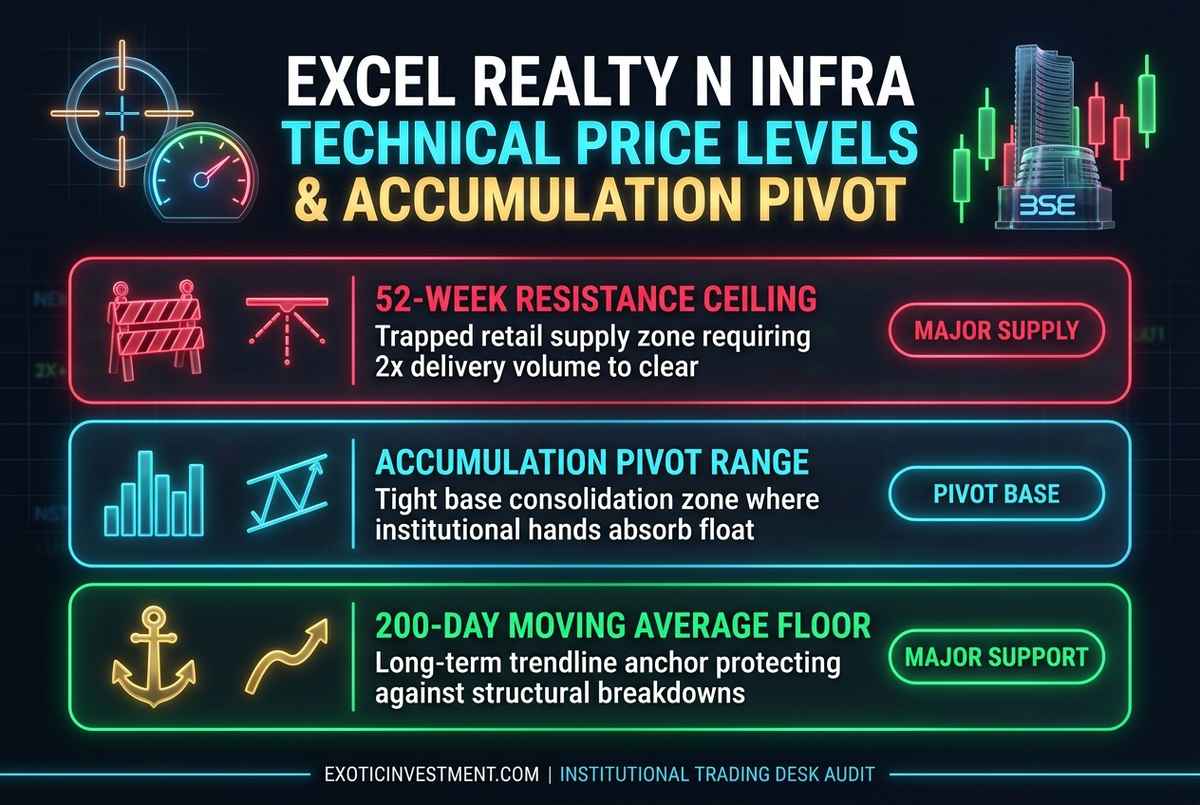
No confusion exists about the 52-week resistance ceiling. In micro-cap penny stocks, previous high zones represent clusters of trapped retail buyers who bought during earlier speculative surges. As price re-tests these levels, trapped participants rush to exit at breakeven. Therefore, clearing major resistance requires multi-day expanding volume supported by fresh fundamental catalysts.
Between overhead resistance and structural support lies the accumulation pivot range. In this base-building zone, daily price volatility tightens and volume contracts significantly. Experienced chartists treat this quiet consolidation as evidence that speculative sellers are finally exhausted.
Finally, the 200-day moving average represents the long-term trendline anchor. When weekly candles trade and hold above this line, the technical framework remains constructive. A breakdown below the 200-DMA signals prolonged fundamental stagnation and warns against fresh capital commitments.
Traders calculating execution expenses can use our Indian Stock Brokerage Calculator to budget total charges accurately. Keeping friction costs low protects portfolio capital across choppy consolidation phases.
Real Estate Debt Cycles and Working Capital Realities
Evaluating an infrastructure company requires deep attention to balance sheet liquidity and debt servicing capability. Small construction firms frequently take on short-term borrowings to purchase raw materials and pay site labor ahead of project milestone disbursements. If project completion deadlines stretch, interest costs rapidly eat away thin operating margins.
In addition, municipal regulatory clearances can delay project delivery schedules. Approvals for environmental clearances, floor space index expansions, and fire safety certifications often take months. Prudent market participants check quarterly filings to confirm whether operating cash flows are positive or if the firm relies on fresh debt issuances to fund ongoing operations.
When examining quarterly results, our desk checks whether receivables are aging beyond 180 days. A sharp rise in unpaid trade receivables indicates that clients or government agencies are delaying project disbursements. Companies that maintain low receivables and conservative debt levels enjoy superior resilience during real estate down-cycles.
Excel Realty N Infra Key Metrics and Comparative Desk Table
Institutional trading desks always compare core financial indicators against industry benchmarks before committing capital. Below is our Dalal Street desk matrix outlining operational parameters for Excel Realty N Infra.
Honestly speaking, an infrastructure firm’s true strength lies in its cash collection efficiency and disciplined debt profile. When an enterprise consistently turns project milestones into positive free cash flow, shareholder returns steadily improve.
Penny Stock Circuit Limits and Retail Risk Protection Rules
Trading low-priced infrastructure shares requires strict adherence to risk management guidelines. Because penny stocks carry lower market capitalization, retail investors face real liquidity exit risks during broader market downturns.
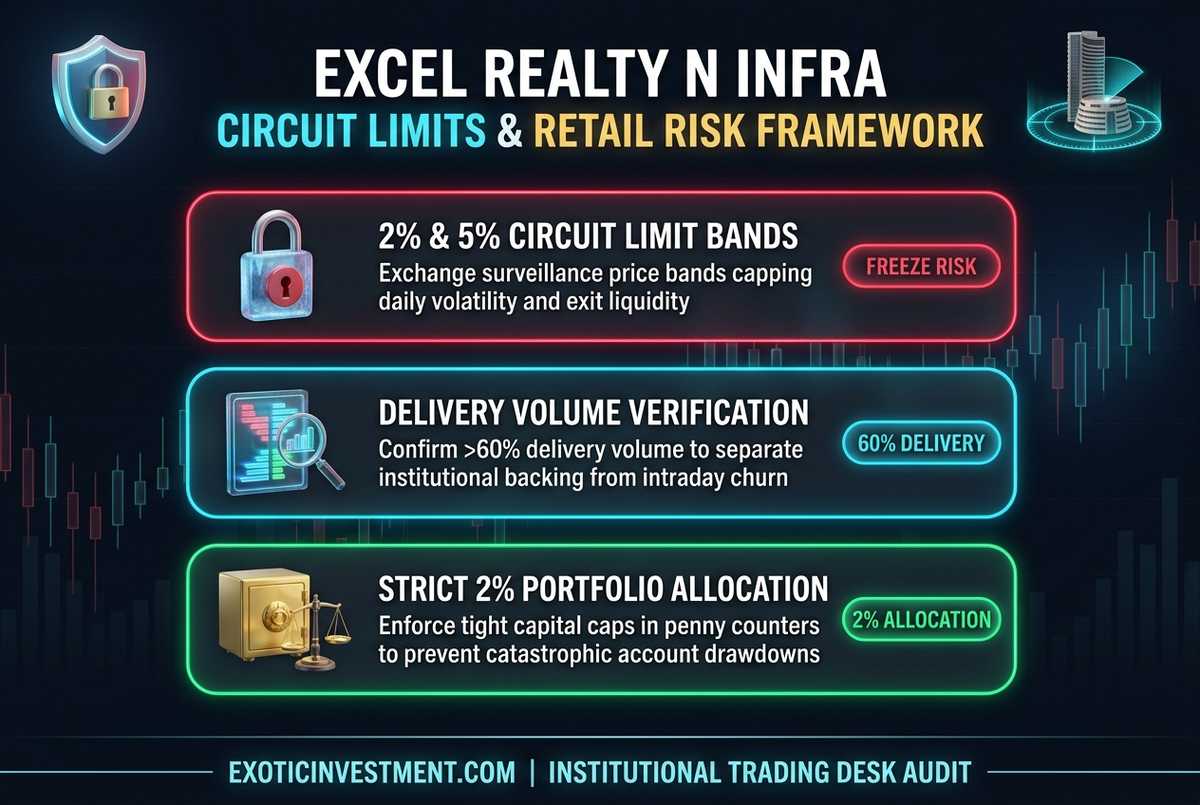
First, be conscious of circuit freeze liquidity locks. In micro-cap stocks governed by 2% or 5% daily price bands, heavy selling pressure can lock the counter at lower circuit limits. When this occurs, buy orders disappear from the exchange order book, preventing participants from selling until fresh liquidity emerges.
Second, check promoter shareholding disclosures on official BSE filings. Confirm that promoter shares remain free from pledge burdens. Avoiding heavily pledged companies protects investor capital from forced institutional margin liquidations during market corrections.
Third, enforce strict capital allocation caps. Never invest more than 2% of total portfolio capital into a single micro-cap penny counter. In addition, avoid using borrowed margin debt. Always practice taking partial profits when a stock reaches major technical resistance levels rather than chasing unrealistic multi-bagger targets.
Step-by-Step Desk Blueprint for Trading Excel Realty N Infra
To safely trade low-priced infrastructure counters, our Dalal Street desk follows this disciplined four-step execution routine.
- Verify Corporate Disclosures: Check the latest quarterly earnings reports, board meeting outcomes, and project order filings on the official BSE and NSE websites.
- Analyze Delivery Volume Trends: Ensure that volume expansions are supported by daily delivery percentages above 60% rather than churning intraday speculation.
- Strictly Limit Position Sizing: Keep total capital allocation capped at 2% of your portfolio so daily circuit moves never impact your overall wealth.
- Set Pre-Determined Stop-Loss Triggers: Place stop-losses beneath swing consolidation support. If price breaks key moving averages, exit immediately without emotional hesitation.
Following this structured desk protocol protects capital across volatile market cycles. Dalal Street rewards patient risk managers while penalizing emotional speculators.
Frequently Asked Questions About Excel Realty N Infra Ltd Share Price
What is Excel Realty N Infra’s core business activity?
Excel Realty N Infra Ltd operates across infrastructure civil construction contracting, residential and commercial real estate development, and general merchandise trading. The company executes property projects and supplies construction materials across Indian regional markets.
Where does Excel Realty N Infra stock trade?
Excel Realty N Infra shares trade on both the Bombay Stock Exchange (BSE scrip code 533090) and National Stock Exchange (NSE symbol EXCEL). Investors can purchase shares through any registered Indian stock broker via electronic demat accounts.
What daily circuit filter applies to Excel Realty N Infra?
The stock is subject to exchange surveillance circuit filter bands, typically set at 2% or 5% daily limits. These bands restrict excessive intraday volatility and help protect market participants against speculative manipulation.
How should retail traders manage downside risk in penny real estate stocks?
Traders should limit position sizing strictly to 1% or 2% of total capital, avoid borrowed margin debt, and monitor daily delivery percentages. Placing stop-losses below swing support protects capital against unexpected project execution delays.
Why is delivery volume important when analyzing Excel Realty N Infra?
High delivery volume indicates that long-term participants are absorbing shares for custody holding rather than day-trading. A delivery percentage above 60% provides stronger confirmation of genuine structural accumulation.